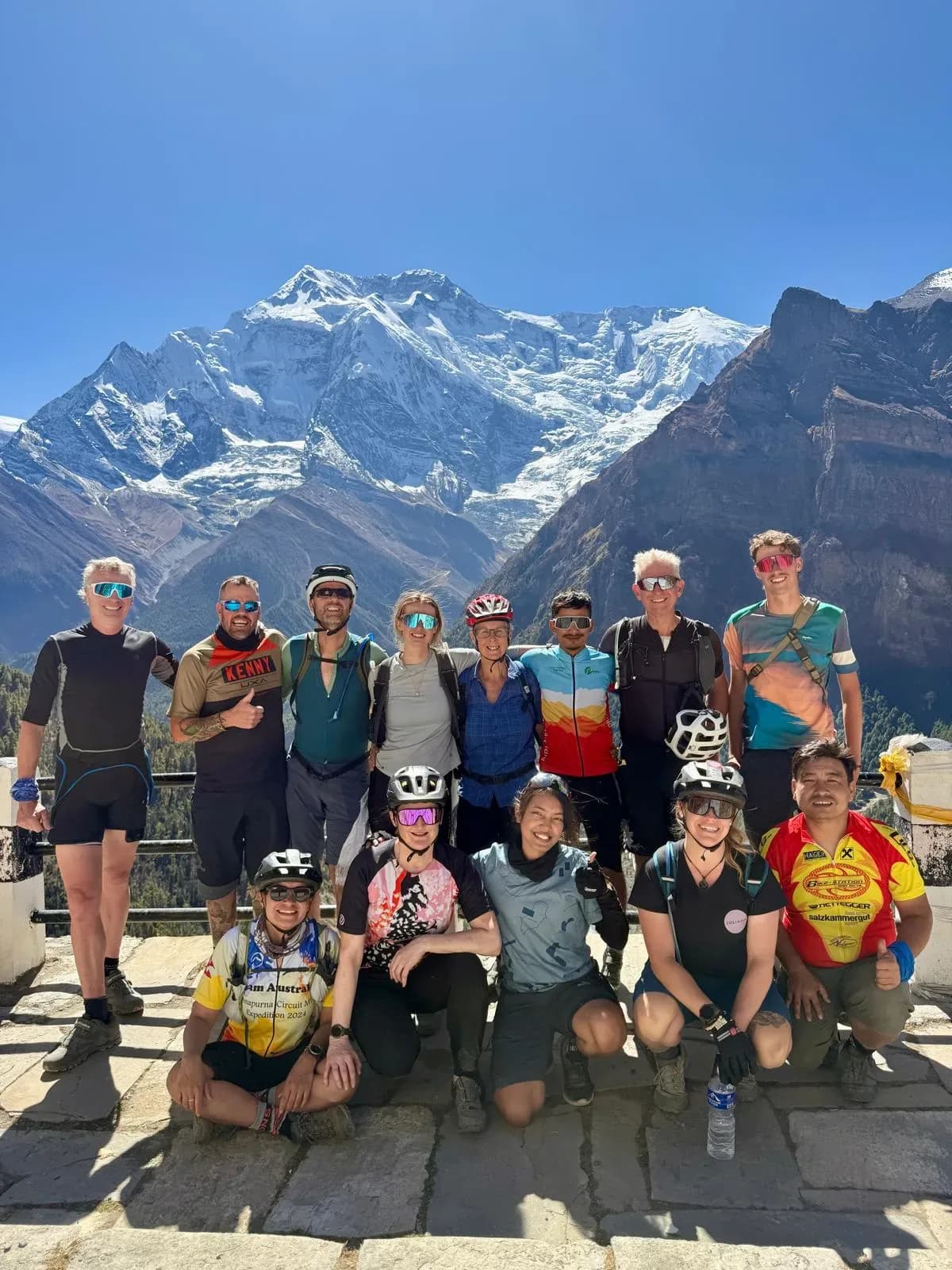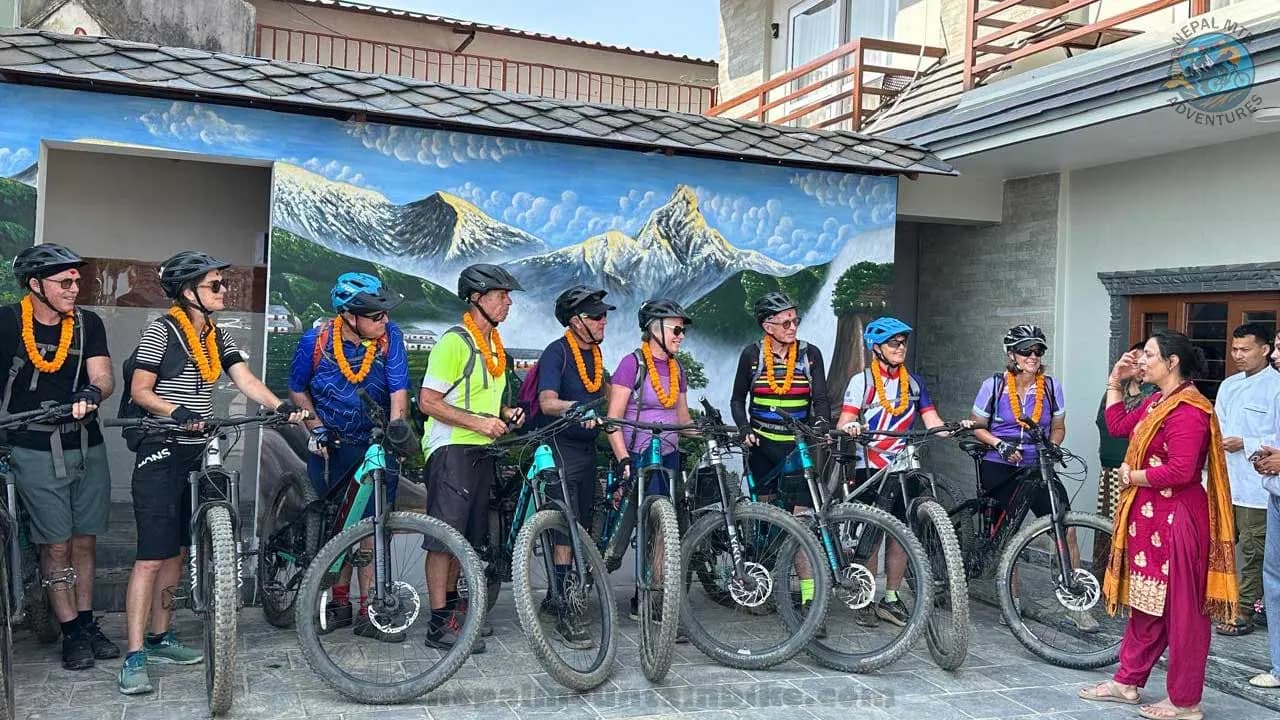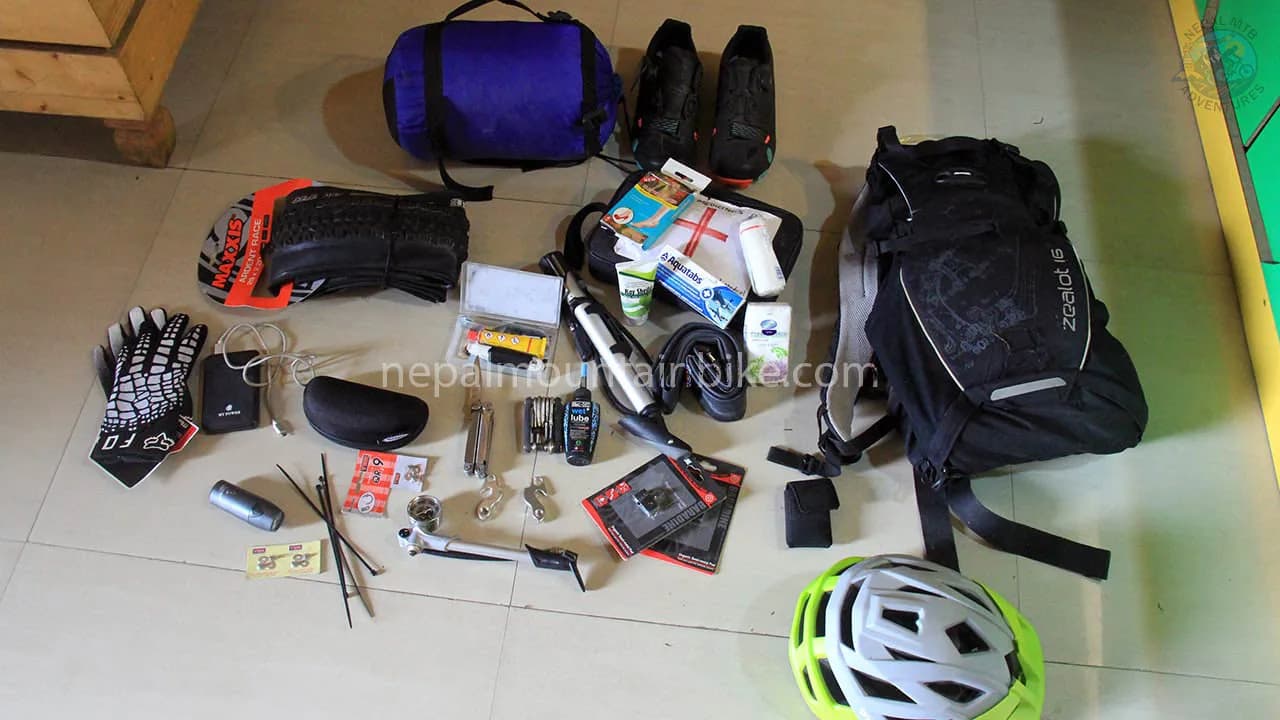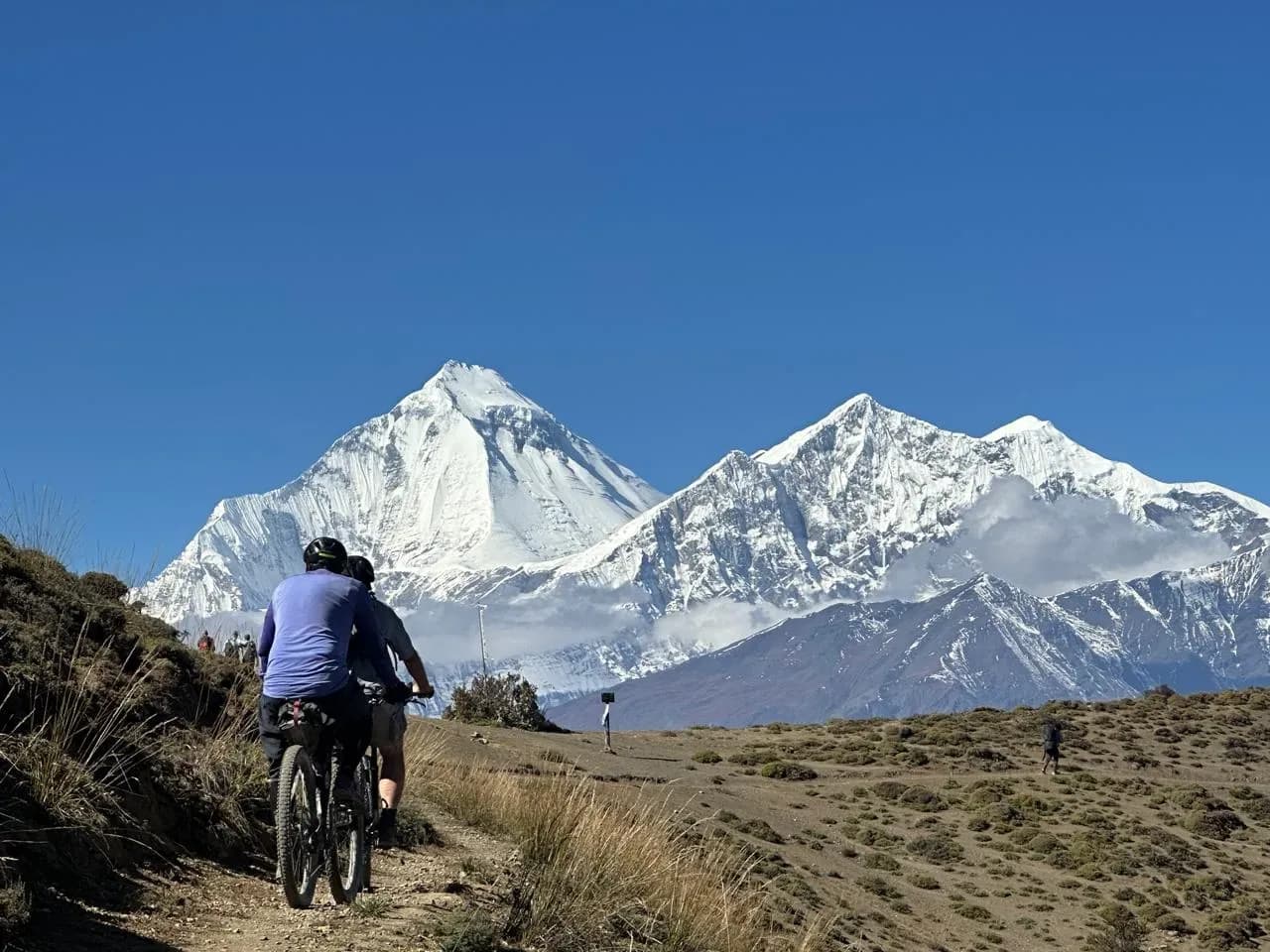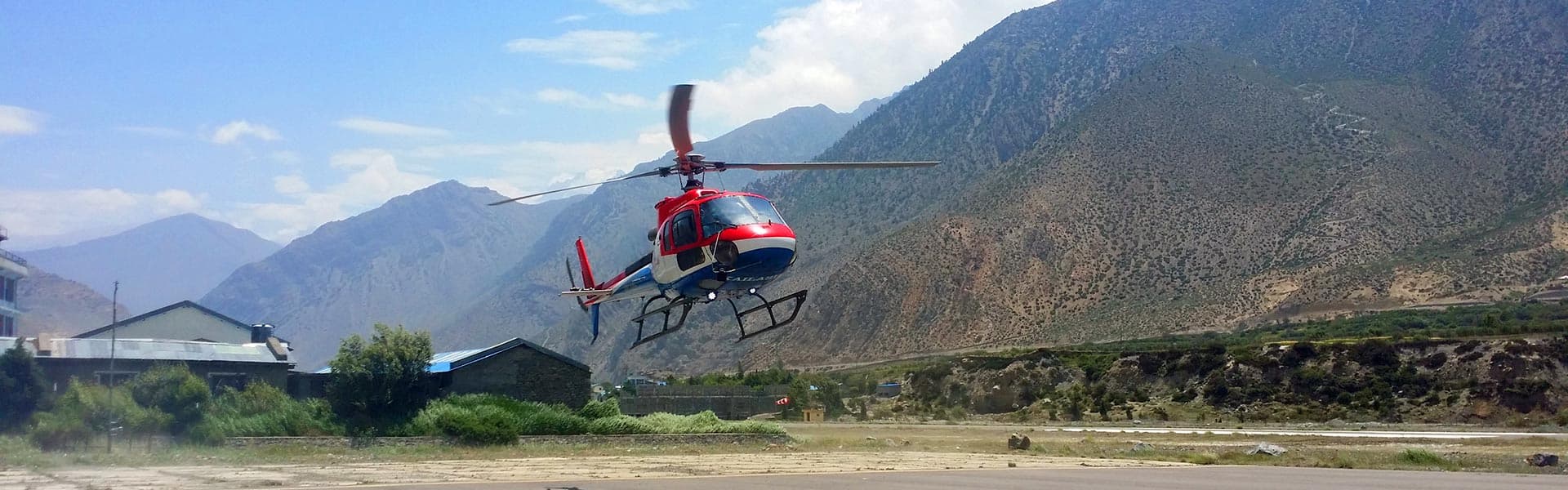



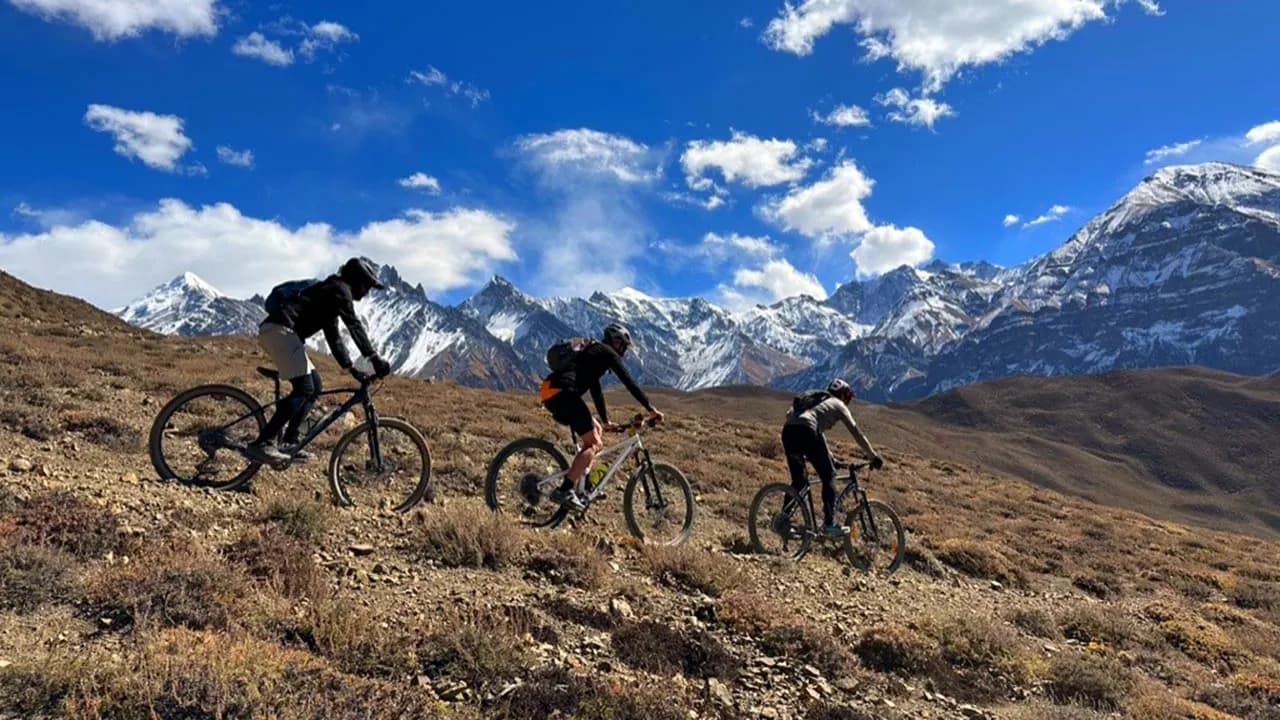
The best mountain biking trail in Nepal depends on what you want from it. For the big high-altitude ride, it's the Annapurna Circuit. For technical descending in a dry desert, it's the Lupra Valley in Lower Mustang. For shuttle laps, it's the Ratnange forest in Solukhumbu. For a first taste, it's the valley around Pokhara, where you can be on dirt fifteen minutes after breakfast.
Almost none of these trails were built for bikes. They are trade routes, pilgrim paths and village links, some of them a thousand years old, worn into the hillside by feet and hooves. That gives you what no purpose-built bike park can: a trail that actually goes somewhere. It also means a trail's name tells you very little about the riding, so this guide gives you the grade, the surface, and the hard part of each one.
Ready to ride? See all our guided Himalayan MTB tours.
The Best Trail for Each Kind of Rider
If you want | Ride |
The benchmark ride of high altitude mountain biking | Annapurna Circuit |
The best high singletrack in the country | Ghyaru to Ngawal, on the Annapurna Circuit |
A remote ride through living Tibetan culture | Upper Mustang |
Long technical descents in a dry desert | Lupra valley, Lower Mustang |
Shuttle laps on real singletrack | Ratnange, Solukhumbu, or the Pokhara gravity trails |
Everest on the horizon, with no restricted permit | Pikey Peak |
A ride and hike to a high Himalayan lake | Tilicho Lake |
Dry trails during the monsoon | Upper or Lower Mustang |
A multi-day journey with no altitude to manage | Kathmandu to Pokhara |
Mountains to jungle in one trip | Pokhara to Chitwan |
One night out, close to town | Royal Trek |
One spare day in Kathmandu | Kakani or Nagarkot |
Your first time off-road | Pame Valley, Pokhara |
The 10 Trails at a Glance
No. | Trail | Region | Grade | High point | Days | Best season |
1 | Annapurna Circuit | Annapurna | Challenging (Black) | 5,416 m / 17,769 ft | 14 to 17 | Mar–May, Oct–Nov |
2 | Upper Mustang | Mustang | Hard to challenging (Red to Black) | 4,210 m / 13,812 ft | 15 to 16 | Mar–Nov |
3 | Lower Mustang | Mustang | Hard (Red) | 3,800 m / 12,467 ft | 11 | All year |
4 | Pikey Peak and Ratnange | Solukhumbu | Hard (Red) | 4,065 m / 13,337 ft | 7 | Mar–May, Sep–Nov |
5 | Tilicho Lake | Annapurna | Challenging (Black) | 4,919 m / 16,138 ft, on foot | 11 | Mar–May, Sep–Nov |
6 | Royal Trek | Pokhara | Moderate (Blue) | 1,500 m / 4,921 ft | 2 | All year |
7 | Kathmandu Valley Rim | Kathmandu | Moderate (Blue) | 2,732 m / 8,963 ft | 1 to 7 | All year |
8 | Kathmandu to Pokhara | Central Nepal | Hard (Red) | About 2,000 m / 6,562 ft | 10 | Oct–Apr |
9 | Pokhara Valley | Pokhara | Easy to moderate (Green to Blue) | 1,592 m / 5,223 ft | 1 to 3 | All year |
10 | Pokhara to Chitwan | Central Nepal and Terai | Hard (Red) | Low, no altitude to manage | 10 | Jan–May, Sep–Dec |
Our grades measure the whole ride, not just the hardest section. The mountain bike trail grading guide converts them into UK, IMBA, Australian, New Zealand and S-scale grades. For the month-by-month detail, read the best time to mountain bike in Nepal.
1. Annapurna Circuit
The Annapurna Circuit is the benchmark ride of high altitude mountain biking, and the one riders come to Nepal for. You start at around 800 m (2,625 ft) in subtropical Lamjung and climb for a week from Hindu hill villages through Gurung country into Tibetan Buddhist settlements. Then you cross Thorong La, about 600 m higher than the top of Mont Blanc, and drop more than 1,600 m (5,250 ft) to Muktinath. From there, the Kali Gandaki, often called the deepest gorge in the world, carries you down between Dhaulagiri at 8,167 m (26,795 ft) and Annapurna I at 8,091 m (26,545 ft).
• The riding: the full circuit runs about 279 to 300 km (173 to 186 mi) with roughly 5,000 m (16,404 ft) of climbing. Around 35 to 40% is rugged jeep track, and 35% is alpine singletrack. The rest is fast dirt trail and short stretches of paved road. The day everyone remembers is the Ghyaru to Ngawal high trail, bench-cut into the slope above the valley road.
• The hard part: the last 5 km (3 mi) to the pass is too steep, too high, and too often snow-covered to ride, so you push. The air up there holds roughly half the oxygen it does at sea level. You also need a proper acclimatisation week, with a rest day at Manang at 3,540 m (11,614 ft).
• Suits: experienced riders with strong aerobic fitness who want to earn the biggest day of their riding life.
Ride it with us:
• Annapurna Circuit MTB Tour (15 days): the classic fully supported guided ride over Thorong La.
• 14-Day Annapurna Circuit Expedition: a faster, harder version of the same circuit.
• Hike and Bike Annapurna Circuit (17 days): cross the pass on foot, then bike the descent from Muktinath.
• 22-Day Annapurna + Upper Mustang Combo: the full circuit, extended into the old kingdom of Lo.
2. Upper Mustang
Upper Mustang, the Last Forbidden Kingdom, is the ride for people who care as much about where they are as what's under the tyres. North of the main Himalayan wall, the rain stops, and the land turns to eroded red and ochre badlands, cut into fins and cliffs. Then you come over a high pass and find a walled medieval city in the middle of it. Lo Manthang is mud-brick, four storeys high, and still lived in. It was the capital of a kingdom that stayed closed to outsiders until 1992, which is why the culture survived intact.
• The riding: about 295 to 335 km (183 to 208 mi) of gravel, rocky jeep track, old caravan trail and singletrack, with about 7,850 m (25,755 ft) of climbing over 13 riding days. Your highest point on the bike is Paha Pass, and you sleep as high as 3,840 m (12,598 ft) at Lo Manthang.
• The hard part: steep approaches to the passes mean short sections of pushing or carrying, and the remote Yara and Tangge loop is rougher still. An afternoon headwind up the valley means we build the riding day around mornings.
• Suits: intermediate to advanced riders who can handle a long stretch of days at altitude.
Our Upper Mustang riding guide covers altitude, weather, and equipment, and the trail-by-trail guide covers the route itself.
Ride it with us:
• Upper Mustang MTB Tour (16 days): the full guided expedition, with the Yara and Tangge loop.
• 15-Day Upper Mustang Package: a shorter, more streamlined version.
• E-MTB Upper Mustang Tour (15 days): the same country with battery-assisted climbs.
3. Lower Mustang
Lower Mustang gives you most of the Mustang landscape without the restricted-area permit or the two-week commitment. It has the best big descents in Nepal for the time you put in. You climb to Muktinath, sacred to Hindus and Buddhists alike, with 108 water spouts along a stone wall and a flame burning on natural gas behind the temple. Then you give all that height back through Kagbeni, the apple orchards of Marpha and the wide grey bed of the Kali Gandaki.
• The riding: the Lupra valley (also spelled Lubra) is the one to come for: 900 to 1,000 m (2,953 to 3,281 ft) of natural switchback singletrack through blue and grey eroded rock, past one of the oldest Bon villages in Nepal. Below it, expect loose rock, jeep track, gravel and village roads.
• The hard part: days run up to 40 to 50 km (25 to 31 mi) on loose surfaces, and the valley wind builds from late morning.
• Suits: confident riders who want the most varied riding in Nepal, and anyone who can only travel in June, July or August. It sits in the rain shadow behind Annapurna and Dhaulagiri and stays dry while the rest of the country is under monsoon.
Our Lower Mustang mountain biking guide covers the trails in detail.
Ride it with us:
• Lower Mustang MTB Tour (11 days): the classic guided ride through Kagbeni, Muktinath and the Kali Gandaki.
• Lower Mustang E-Bike Tour (11 days): the same high desert with pedal assist on the climbs.
• Lower Mustang Enduro (11 days): shuttle-assisted, gravity-focused riding on Mustang's best singletrack.
• Heli Mountain Biking Trip (10 days): skip the climbs with helicopter drops into downhill terrain.
Guide's tip: be rolling early. In the Kali Gandaki, a morning start is the difference between a tailwind-free descent and pedalling downhill into a gale.
4. Pikey Peak and Ratnange
Most lists give the lower Everest region a line or two. It deserves more, because it may have the best dirt in the country. The route runs through lower Solukhumbu, south of Sagarmatha National Park, which is closed to bikes. You start from Dhap, cross high rhododendron ridges and Sherpa villages, and carry your bike to the prayer flags on Pikey Peak before sunrise. From the top, you can see the Himalaya from Dhaulagiri to Kanchenjunga, Everest included.
Then comes Ratnange, the closest thing Nepal has to a trail centre. The Phaplu Mountain Bike Club has built 17 trails stretching 70 km (43 mi) in the community-managed Ratnange forest, for beginners through to experts, on existing foot trails. French pro Rémy Absalon told Nepali Times they are "some of the best in the world; the mixture of loam and dust is just awesome to ride on."
• The riding: jeep road and high grassy ridge at first, then singletrack off the summit towards Jasmane Bhanjyang and steeper trail down to Loding. The last riding day is jeep shuttle laps from Phaplu up to Ratnange.
• The hard part: sections before Pikey Base Camp need pushing or carrying, and the summit is a carry. The drives are long too: the way back to Kathmandu takes 8 to 10 hours.
• Suits: riders who want gravity and big views, and who would rather be somewhere few people ride.
Ride it with us: Mountain Biking Tour in Pikey Peak's Wilderness (7 days).
5. Tilicho Lake
Tilicho takes the east side of the Annapurna Circuit and turns off it. From Manang, you ride west past Khangsar to Shree Kharka, leave the bikes at the lodge, and walk on to Tilicho Base Camp at about 4,200 m (13,780 ft). Early the next morning, you hike to a turquoise lake below Tilicho Peak. It gives you the big-mountain feel of the circuit without having to cross Thorong La.
• The riding: we take a jeep up the lower Marsyangdi to Chame, so the riding starts high. Then it's trail to Pisang and Manang, out to Shree Kharka and back, and a long descent down the valley to Besisahar at 760 m (2,493 ft).
• The hard part: the top of this trip is on foot, so come ready to hike as well as ride. There's also a short push before Shree Kharka, and sleeping at base camp after only a few days up here is the real test.
• Suits: strong riders who want a very high day out and can't spare two weeks.
Ride it with us: Tilicho Lake Mountain Biking Tour (11 days).
6. Royal Trek
The Royal Trek near Pokhara is perfect for a short trip, and it's the ride we suggest as a warm-up before something higher. The route takes its name from the trek King Charles, then Prince of Wales, and his party walked in the early 1980s. It runs the low ridges east of Pokhara between Begnas and Rupa lakes.
• The riding: a full day of ridge riding on farm track and trail through Gurung villages, terraced hillside and sal and rhododendron forest, with the Annapurna range and Machhapuchhre on the northern horizon for most of it.
• The hard part: there isn't much of one. Nothing goes high enough for altitude to matter, and it stays comfortable in every month, including winter.
• Suits: riders on shorter holidays. You sleep in a village guesthouse, which is the part most riders remember, then ride back down through forest to the lakes the next day.
Ride it with us: Royal Trek MTB Tour (2 days).
7. Kathmandu Valley Rim
The Kathmandu Valley is where mountain biking in Nepal began, and the ring of hills around the capital holds far more trail than anyone expects. Shivapuri Nagarjun National Park climbs on old woodcutter tracks under oak and rhododendron, with Kakani on its western side. Nagarkot, at about 2,175 m (7,136 ft), holds the eastern rim with the Himalayan skyline behind it at dawn. Godavari and Phulchowki fill in the south.
• The riding: the northern rim mixes dirt road with technical forest singletrack. Nagarkot and Hattiban are the valley's gravity trails, steep enough that you want full suspension and pads. The Scar Road, ridden from Kakani through Shivapuri, is a very big day out.
• The hard part: the climbs. The rim rises well above the valley floor, and the ride up from Tinpiple to Kakani gains close to 1,000 m (3,281 ft).
• Suits: anyone with a day between flights, and riders who want to get used to Nepali trails before going high.
For every ride around the rim, read our guide to mountain biking trails near Kathmandu.
Ride it with us:
• Kathmandu MTB Day Tour (Thamel to Budhanilkantha): a 35 km (22 mi) loop through valley villages to the Budhanilkantha temple.
• Kakani Sky Trail: a full day with Himalayan viewpoints and forest singletrack above the valley.
• Kathmandu E-Bike Day Tour: Shivapuri to Changu Narayan with pedal assist.
• Kathmandu Valley Rim E-MTB Tour (7 days): about 211 km (131 mi) of singletrack, ridges and village trails around the whole valley.
8. Kathmandu to Pokhara
This route links Nepal's two best-known cities over the top of everything in between. Most people make the trip in a twenty-five-minute flight or a seven-hour bus. We take ten days, on dirt roads, farm tracks, and village paths that link one ridge to the next instead of following the highway along the valley floor. There is no single famous landmark on it, and that's exactly the point.
• The riding: 291 km (181 mi) of mid-hills riding, over rivers on suspension bridges and through terracing stacked hundreds of metres from river to ridge, with the Himalayan skyline to the north for most of the week.
• The hard part: most days run about 40 to 55 km (25 to 34 mi), with plenty of climbing. It's a test of legs, not lungs.
• Suits: genuinely fit riders who don't want a high pass, a restricted permit or an altitude schedule.
Ride it with us:
• Pokhara to Kathmandu MTB Tour (10 days): the cross-country route through backroad villages, Gorkha and Gurung country.
• 13-Day E-MTB Version: the same corridor with pedal assist and a gentler effort level.
9. Pokhara Valley
Pokhara is where our workshop is, and it's the easiest place in the country to get onto dirt. Our complete Pokhara guide and top trails around Pokhara go deeper, but the short version is this. Sarangkot ridge gives you sunrise over Machhapuchhre, 6,993 m (22,943 ft) and only about 25 km (16 mi) away, with Phewa Lake about 800 m (2,625 ft) below. Then it hands you a descent straight back into town for breakfast.
• The riding: the Sarangkot and Peace Pagoda ridges are the classics. The Peace Pagoda line through Queen's Forest is steep singletrack with staircases, switchbacks, roots and rocks. MTB Project lists the Pokhara Downhill at 4 km (2.5 mi) of singletrack, with 352 m (1,155 ft) of descent, and rates it difficult. Behind those sit Kristi Village, Australian Camp, and the Panchase ridge, which climb higher and harder.
• The hard part: picking the right ride. Most day rides here are moderate; Australian Camp is graded hard and includes a carry, and the gravity trails need good bike control.
• Suits: everyone. A complete beginner can ride the flat Pame valley in an afternoon while an expert spends three days on shuttle-assisted gravity trails.
Grab a bike or pick a ride:
• MTB Rentals: hire Trek and Scott hardtails, full-suspension trail bikes or e-MTBs by the day.
• Sarangkot: climb the famous sunrise ridge by bike, then descend through the forest.
• Around Fewa Lake: climb to the World Peace Pagoda, then drop through the technical Queen's Forest singletrack.
• Pame Valley: a flat, easy half-day ride, ideal for beginners and families.
• Begnas Lake E-Bike Day Tour: an easy full day of ridge and village riding out to the quieter lakes.
• Kristi Village: climb through orange orchards to a ridge with sweeping Annapurna views.
• Australian Camp: a 2-day overnight ride through Gurung villages with big Annapurna and Dhaulagiri views.
• Enduro & Downhill Day: around 1,000 m (3,281 ft) of shuttle-assisted descending in a day.
• 3-Day Pokhara Enduro: jeep and cable car shuttles, and more than 60 km (37 mi) of downhill-focused trail.
10. Pokhara to Chitwan
This is the biggest single change of scenery you can ride in Nepal. You start in the cool hills with the Annapurnas behind you and finish in subtropical jungle at roughly 150 m (492 ft). On the way, the temperature climbs about fifteen degrees Celsius, and the vegetation shifts from pine and terraced farmland to sal forest and elephant grass.
• The riding: about 203 km (126 mi), mostly rolling dirt road and farm track rather than technical singletrack, with a run along the Kali Gandaki towards Devghat near the end.
• The hard part: the first days are physically hard, and from late spring the Terai turns uncomfortably hot. The monsoon makes the lowland tracks impassable.
• Suits: riders chasing distance, warmth and variety more than steep descents. The trip finishes with a chance to see greater one-horned rhino, gharial and more than five hundred bird species, by jeep safari or canoe on the Rapti, and it passes through both hill and Tharu communities.
Ride it with us: Pokhara to Chitwan MTB Tour (10 days), or the Kathmandu, Chitwan and Mustang e-MTB tour.
Why Manaslu and Langtang Aren't in Our Ten
Both are great treks, and riders do ask about them. We leave them out because they aren't among our listed tours, and because we judge a trail by how much of it you actually ride. If either is the ride you have your heart set on, tell us and we'll talk you through what it takes right now.
• Manaslu Circuit: the route loops Manaslu at 8,163 m (26,781 ft), the eighth-highest mountain on earth, and crosses the Larkya La at 5,106 m (16,752 ft). It's magnificent, but the approach to the pass is a full carry, and long sections of the lower Budhi Gandaki gorge are stone staircases and suspension bridges. It's a restricted area, with a permit through a registered agency and a licensed guide.
• Langtang Valley: this is the closest glacier country to Kathmandu, with forest singletrack along the Langtang Khola, wide alpine track above Ghodatabela, and Langtang Lirung at 7,234 m (23,733 ft) over Kyanjin Gompa at about 3,870 m (12,697 ft). The August 2026 Bhote Koshi flood damaged the road to Syabrubesi, the usual way in, so ask us how you would get there before you plan around it.
Singletrack or Jeep Road? What You Actually Ride
Almost every trail in Nepal is a mix, and the only honest way to choose is to know the mix before you book. Roads have been pushing up the big valleys since about 1980, so the skill in guiding here is knowing where the old walking trail still runs beside the jeep road.
Mostly singletrack | A mix of singletrack and jeep track | Mostly dirt road and farm track |
Ratnange | Annapurna Circuit | Kathmandu to Pokhara |
Pokhara gravity trails | Upper Mustang | Pokhara to Chitwan |
Nagarkot and Hattiban | Lower Mustang | Royal Trek |
| Pikey Peak |
|
| Tilicho Lake |
|
| Kathmandu rim |
|
Don't read "jeep track" as a gravel road at home. Here it usually means loose rock, water bars, ruts and braided lines, and you share it with mule trains and buses. The descents on it can be just as much work as a technical trail.
Guide's tip: if singletrack matters most to you, tell us when you book. On most routes there's a harder line beside the easier one, and we can plan your days around it.
If You Already Know the World's Best Mountain Bike Trails
The same few names fill every list of the best mountain biking trails. If you've ridden them, here's the nearest thing to each one in Nepal. This isn't a ranking. It's a way to translate what you already love.
If you love | Try | What's different here |
The Whole Enchilada, Moab: a 26-mile shuttle run dropping 7,000 vertical feet, alpine to desert | Muktinath and the Lupra valley | You start about 400 m higher than Burro Pass at 11,200 ft (3,414 m), and you earn the height |
Downieville Downhill, California: 17 miles and 5,000 feet of drop | Thorong La to Muktinath | A similar drop, starting at 5,416 m, and mostly natural mountain trail rather than flowing singletrack |
Monarch Crest, Colorado: over 30 miles, much of it above 11,000 feet | Ghyaru to Ngawal | Higher, more exposed, and with 7,000 m peaks straight across the valley |
Whistler Mountain Bike Park, the top pick on Singletracks' member-ranked list | Ratnange and the Pokhara gravity trails | No chairlifts. You get jeep shuttles, a cable car in Pokhara, and mostly natural dirt rather than machine-built berms |
Kingdom Trails, Vermont, or a red route at a UK trail centre such as Glentress | Pokhara and Kathmandu day rides | A network you can ride from town, but natural and unsignposted, so you want a guide who knows the lines |
The Old Ghost Road, New Zealand: a multi-day backcountry trail | Kathmandu to Pokhara | Similar days in the saddle, with villages and hot food every night instead of huts |
Permits and Guides, Trail by Trail
Most of these trails need a permit, a guide or both, and we arrange every one for you on our tours. The main rule is that since 2023, the Nepal Tourism Board has required foreign visitors on its listed routes in protected areas to travel with a licensed guide and carry a TIMS card from a registered agency. The rule covers cyclists as well as trekkers.
Trail | What it needs |
Annapurna Circuit, Tilicho Lake, Lower Mustang, Australian Camp | ACAP conservation permit (NPR 3,000). We ride these with a licensed guide and a TIMS card (NPR 2,000) |
Upper Mustang | Restricted-area permit at USD 50 per person per day inside the area, through a registered agency, plus ACAP. Licensed guide and TIMS card required. Solo riders have been able to get the permit since March 2026, but the guide rule stays |
Pikey Peak and Ratnange | Not on the Nepal Tourism Board's guide and TIMS list. We stay outside Sagarmatha National Park and sort out any local fees |
Kathmandu Valley | Shivapuri Nagarjun National Park charges foreigners NPR 1,000 per day plus NPR 150 per bike, and asks for a nature guide. Trails outside the park carry no park fee |
Pokhara Valley day rides, Royal Trek, Kathmandu to Pokhara | No trekking permit |
Pokhara to Chitwan | No trekking permit for the ride. Park entry for the safari |
Thinking of riding without us? Our guide to guided or self-guided mountain biking in Nepal shows where you can and can't. Check the altitude limit in your insurance too, because many policies stop at 3,000 or 4,000 m (9,843 or 13,123 ft). Our mountain bike travel insurance guide explains what to look for.
From the Expert: Why I Call These Trails Must-Rides
"Must-ride" gets used loosely, and after two decades of guiding here, I have watched a lot of trails get called that when they are really just famous. So when we put this list together, we used three tests, and every one of the ten had to pass all three.
My three tests:
• Does the trail change under you? The best Himalayan riding is not one landscape held for a week; it is four. On the Annapurna Circuit you leave rice paddy and stand in Trans-Himalayan desert eight days later. That change is the thing riders talk about afterwards, more than any single descent.
• How much of it do you genuinely ride? This is the test most lists skip, and it decides whether you come home happy. I will tell you straight: on Pikey Peak you carry your bike to the summit. On the Annapurna Circuit, you are on the bike for almost all of it. Both are worth doing. They are not the same trip, and you should know which one you booked.
• Would people still walk it if no tourists came? Every trail here is a working route, used for trade, pilgrimage and getting a load of rice to the next village. You will pull over for mule trains. That is why these rides feel different from a bike park, where the trail exists only for you.
The mistake I see most is riders booking the famous name instead of the right fit. The Annapurna Circuit is on this list because it earns it, not because everybody has heard of it. Three of the ten get almost no international attention and are, for the right rider on the right dates, the better trip.
Tell us what you actually want out of the week, and we will tell you which of the ten it is, even when the answer is not the one you came in asking for.
Start Your Himalayan Ride
Whether it's the legendary Annapurna Circuit, the forbidden kingdom of Upper Mustang or the back roads from Kathmandu to Pokhara, these trails will change the way you see riding. If you are choosing scenery rather than riding, our 10 most beautiful MTB trails in Nepal cover the same country by what you see instead.
Don't just dream about it. Join our Himalayan MTB tour.
Frequently Asked Questions
Can you bike the Annapurna Circuit?
Yes. We plan for about 90 to 95% of it to be rideable in good conditions, depending on snow, the trail, and the rider. The rest is the push to the pass. Riding it on your own isn't an option, though, because the route is on the licensed guide list.
Is Thorong La the highest mountain bike trail in the world?
No, and we won't claim it is. Umling La in Ladakh reaches 5,799 m (19,024 ft) by road. What Thorong La offers is a real mountain crossing on an old trade route, with the ride down on trail. The Yak Attack organisers call their race, which crosses it, the highest on earth.
What is the hardest mountain bike trail in Nepal?
On our list, the hardest ride is the 22-day Annapurna and Upper Mustang combination, simply because of how long you stay high. The hardest single day is the Thorong La crossing. For pure technical riding, look at the 13-day Himalayan Enduro Expedition.
Is there a mountain bike trail map for Nepal?
There is no official one. Trailforks lists more than 180 trails in Nepal, with the most around Kathmandu, Pokhara, Kagbeni and Phaplu. Komoot and Wikiloc hold routes uploaded by riders. Use them for ideas rather than navigation, because roads and landslides change the trails every season, and some of the reports are years old.
Are there bike parks in Nepal?
There are no lift-served bike parks. Ratnange is the nearest thing to a trail centre, and the club built a pump track in Phaplu where local kids learn to ride. In Pokhara we use a cable car and jeep shuttles for gravity days.
Are there mountain bike races on these trails?
Yes. The Yak Attack stage race runs through the Annapurna region, Enduro Ratnange runs in the Solukhumbu forest, and the Pokhara Enduro runs in December. Dates change from year to year, so check with each organiser.
Which trail is best for beginners?
Start in Pokhara. The Pame Valley ride suits someone who has never ridden off road, and the Begnas Lake e-bike day tour is graded easy too. The next step up is the Royal Trek and the Kathmandu day rides, with short days and a comfortable bed every night.
How fit should I be for these rides?
For day rides in Kathmandu and Pokhara and for the Royal Trek, ordinary active fitness is plenty. For the mid-hills crossings, you need to handle consecutive long days. For the Black-graded rides, you need to ride hard days back to back for a week and a half. Three months of consistent riding usually closes the gap, and the thing to train is sustained climbing rather than descending skill.
Can I rent a good bike in Nepal?
Yes. We rent MTBs and e-MTBs with full support, including Trek and Scott hardtails and full-suspension bikes in a full size range, so most riders travel with pedals and nothing else. A good hardtail handles most of these trails, and on the high routes a lighter bike helps because you carry it over the pass. Full suspension earns its place in the Lupra Valley, at Ratnange and on the Pokhara and Kathmandu gravity trails.
Do guided tours include support?
Yes. Our tours include expert guides, a mechanic, jeep support, and accommodation. On the high routes, that also means porters or pack animals for luggage, every permit arranged in advance, and daily oxygen saturation checks with a pulse oximeter.