

 Tripadvisor
 Google
 Facebook
 Trustpilot
 hard
hardE-MTB Upper Mustang: Unique Biking Experience
Upper Mustang15 days
$ 4650
Price may vary according to your plan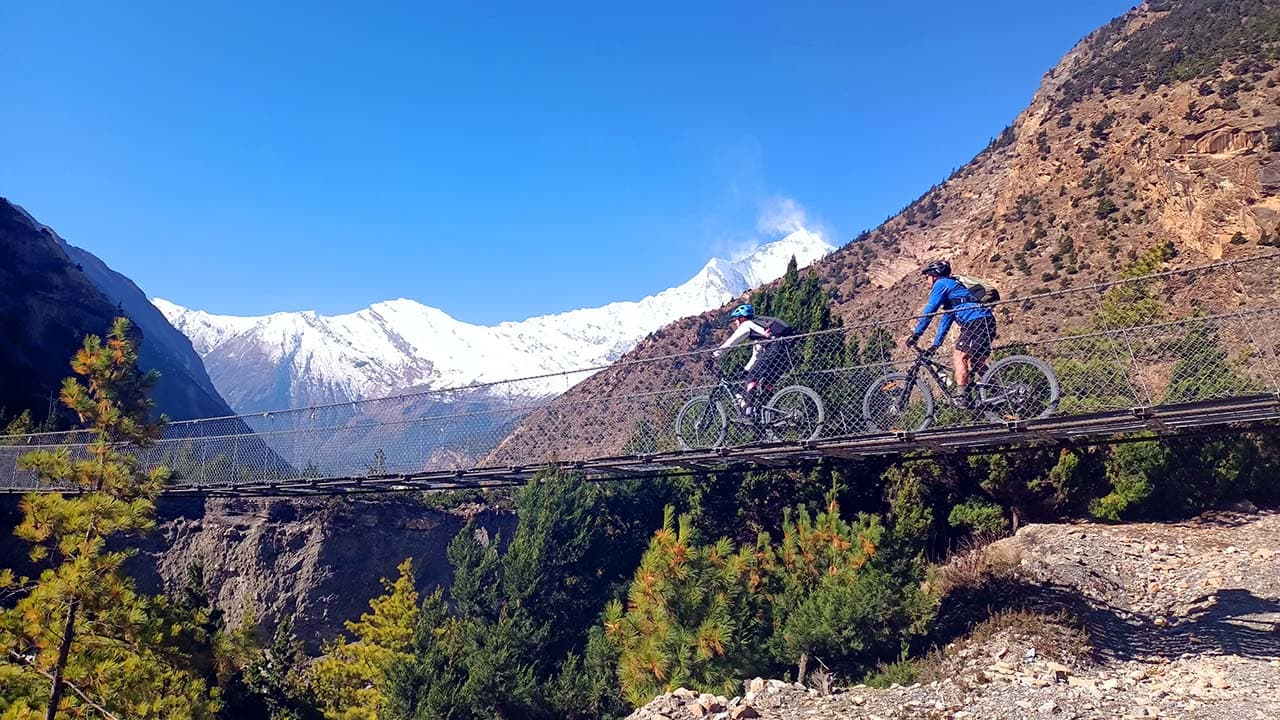
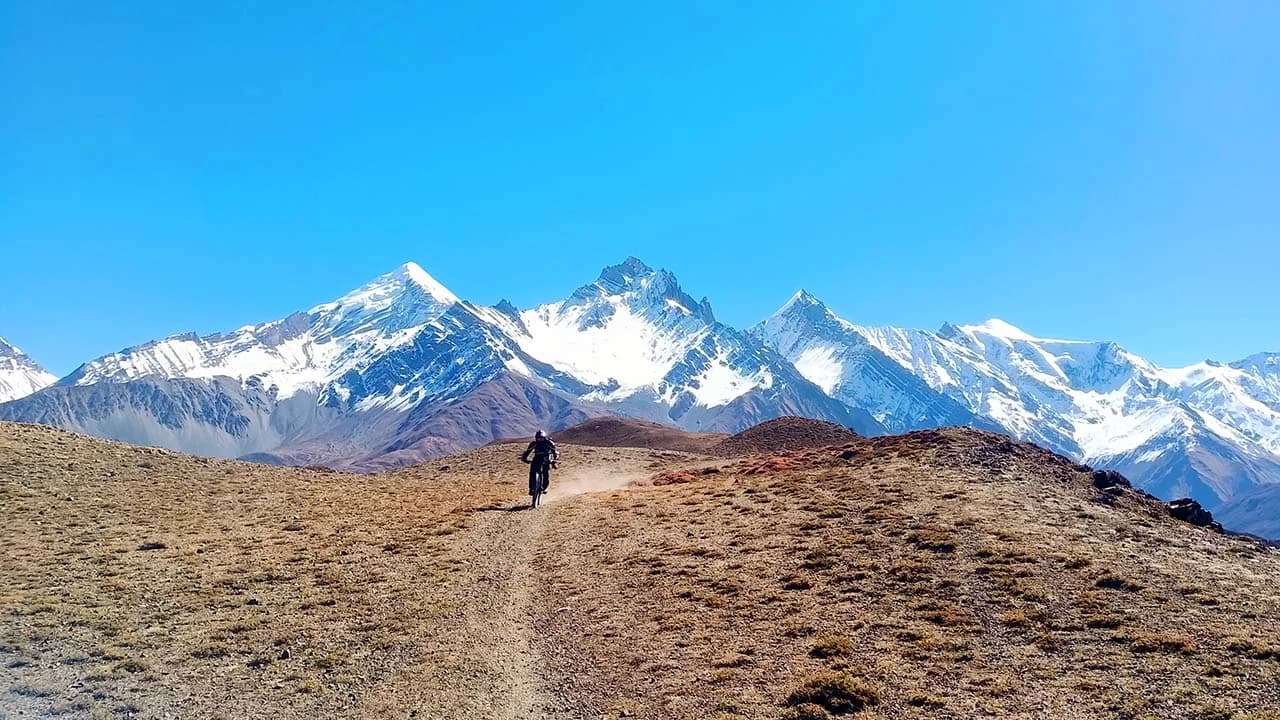
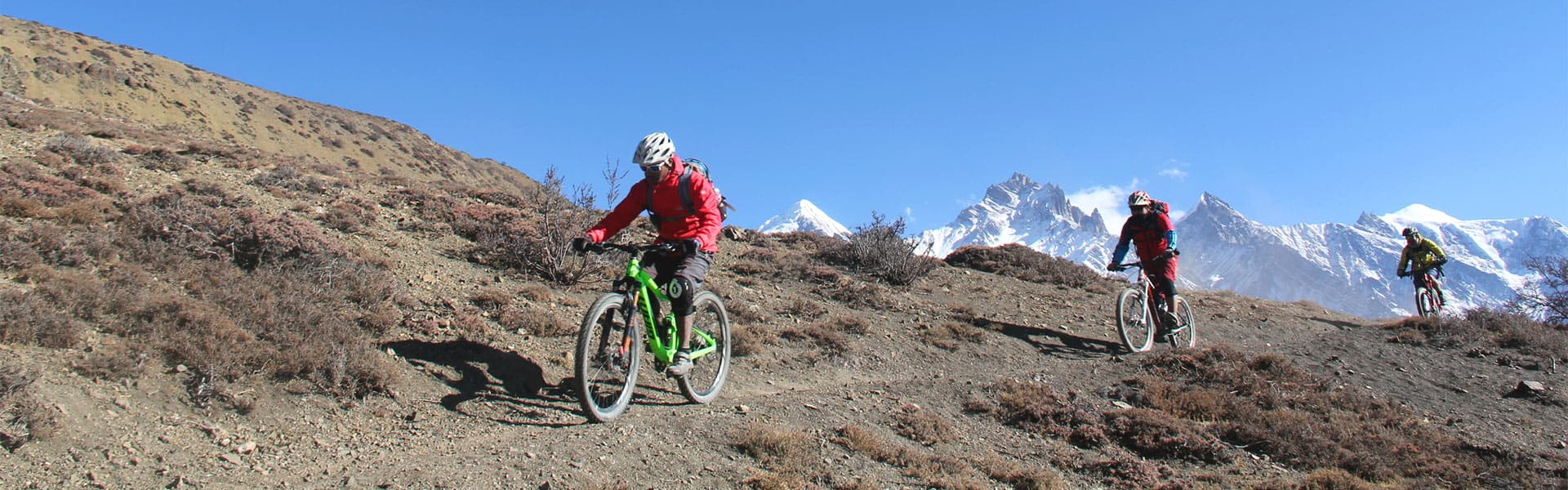
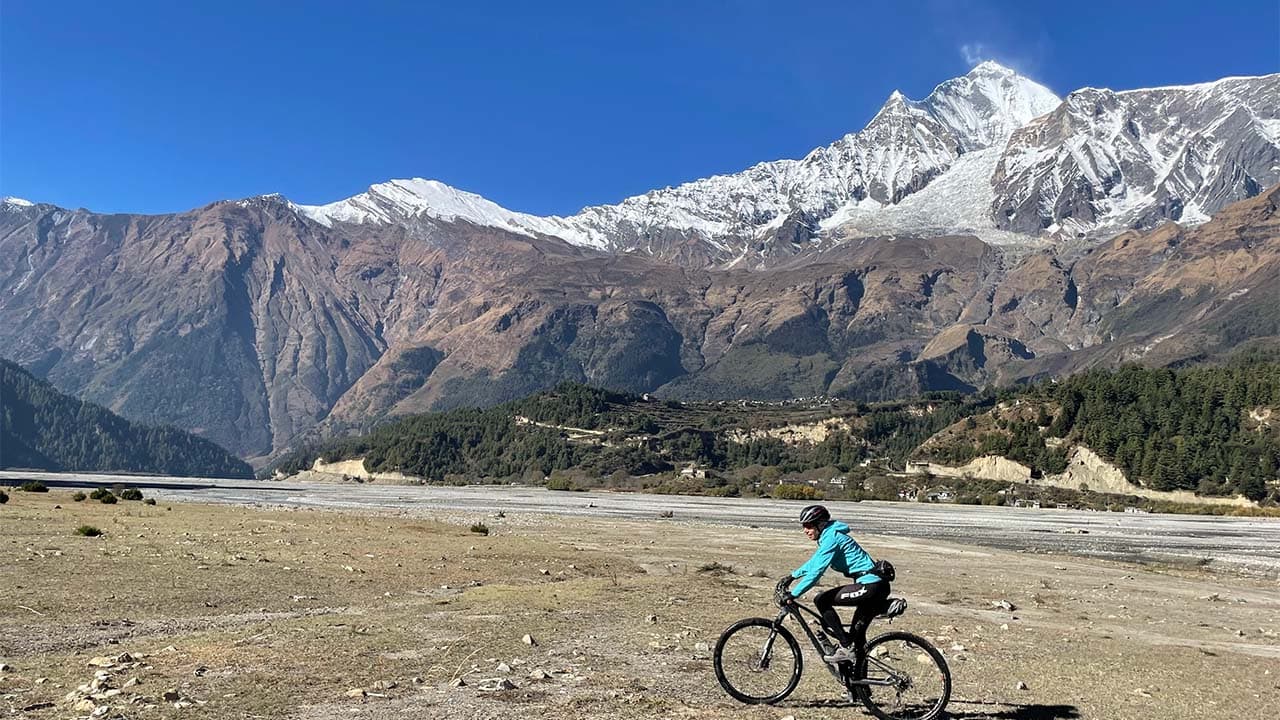
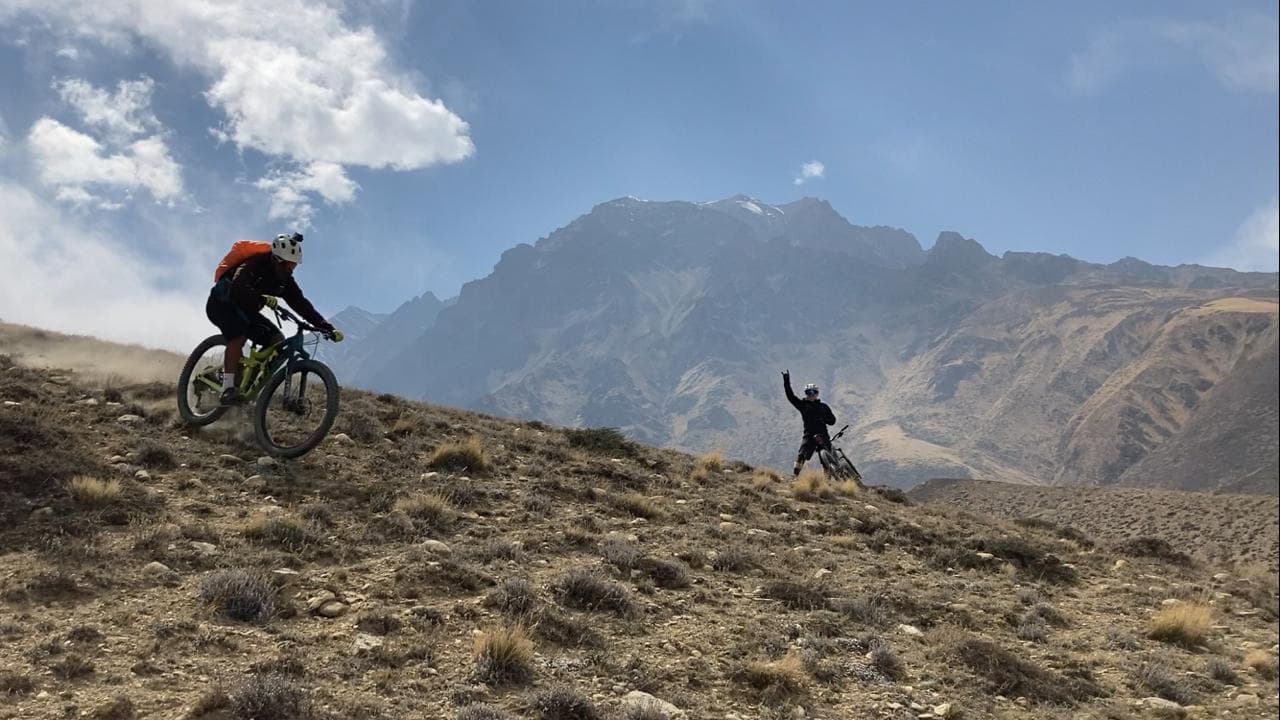
The 11-Day Lower Mustang E-MTB Expedition takes you from the green hills of Pokhara into the dry, high valleys of Mustang, on the far side of the Himalaya. You travel up the Kali Gandaki valley between Dhaulagiri (8,167 m) and Annapurna I (8,091 m), then ride from Jomsom to Kagbeni, climb to Muktinath, and reach the high point of the trip at Gyu La Pass, 4,070 m.
The ride home is mostly downhill. You drop through the Lupra valley, follow the river past Marpha and the lakes near Kalopani, and ride down the gorge towards Beni before returning to Pokhara via Sarangkot.
You ride a full-suspension e-MTB with a Bosch motor, which helps most where the air is thin and the climbs are long. A senior guide, assistant guide, mechanic, and 4WD support team travel with the group, and hotels, lodges, meals, permits, and flights are included.
Detail | What to expect |
Duration | 11 days, 10 nights, Kathmandu to Kathmandu |
Route | Kathmandu, Pokhara, Jomsom, Kagbeni, Muktinath, Gyu La, Lupra, Marpha, Kalopani, Beni, Sarangkot, Pokhara, Kathmandu |
Riding days | 8 (Days 3 to 10) |
Riding distance | About 215 km, not counting vehicle transfers |
Climbing on the bike | About 3,600 m in total |
Descending on the bike | About 6,300 m in total. Much of the height is gained by jeep, so the riding is mostly downhill |
Highest point | Gyu La pass, 4,070 m (ridden as a day trip from Muktinath) |
Highest overnight | Ranipauwa, the lodge village at Muktinath, about 3,710 m (2 nights) |
Terrain | About 35% technical singletrack, 50% high-desert jeep track, 15% cobbled trail and asphalt |
Difficulty | Challenging |
Rider level | Intermediate to advanced. Comfortable on exposed trail, loose shale and technical descents |
Bike | Full-suspension Trek Rail 5 or Bergamont E-Trailster with a Bosch Performance Line CX motor |
Permits | ACAP and TIMS, both included. No restricted area permit needed |
Guiding | 1 guide for every 4 riders, plus a mechanic and 4WD support crew |
Flights | Kathmandu to Pokhara and back, included |
Best season | March to May and September to November |
Lower Mustang is some of the best high-mountain riding in Nepal, and it is also some of the hardest on the lungs. Most of the challenge is not the trail. It is climbing above 3,000 m, where every breath carries less oxygen. That is where an e-MTB changes the trip.
The motor does not tire at altitude. An electric motor does not need oxygen, so the Bosch motor gives the same help at 4,000 m as it does in Pokhara, while your own body works harder with every metre. The climbs to Muktinath and Gyu La become steady rather than exhausting.
More energy for the descents. Lower Mustang pays you back in downhill. Arriving at the top with energy left means you ride the Lupra descent and the Kali Gandaki singletrack with better focus.
It suits mixed groups. A strong rider and a less fit partner can ride the same trails at a similar pace, because each rider sets their own level of assist.
You still ride the real trail. The motor only helps when you pedal. You still steer, brake, and pick your lines on loose shale and rocky singletrack.
This expedition also explains one thing you might notice in the itinerary: it drives to Jomsom instead of flying. E-bike batteries cannot travel on passenger flights, so the bikes and batteries go by 4WD, and so do you.
Day | Route | Riding | Climb / Descent (bike) | Overnight |
1 | Arrive in Kathmandu | 0 km | None | Kathmandu, about 1,400 m |
2 | Fly to Pokhara, bike fitting | 0 km | None | Pokhara, about 820 m |
3 | Pokhara shakedown ride | About 30 km | +650 m / -650 m | Pokhara, about 820 m |
4 | Jeep to Jomsom, ride to Kagbeni | About 14 km | +180 m / -90 m | Kagbeni, about 2,810 m |
5 | Kagbeni to Muktinath via Jhong | About 22 km | +1,050 m / -120 m | Ranipauwa (Muktinath), about 3,710 m |
6 | Gyu La pass and back | About 20 km | +620 m / -620 m | Ranipauwa (Muktinath), about 3,710 m |
7 | Muktinath to Marpha via Lupra | About 32 km | +380 m / -1,420 m | Marpha, about 2,670 m |
8 | Marpha to Kalopani via the lakes | About 34 km | +420 m / -560 m | Kalopani, about 2,530 m |
9 | Kalopani to Beni, drive to Sarangkot | About 48 km | +250 m / -1,950 m | Sarangkot, about 1,600 m |
10 | Sarangkot to Pokhara | About 16 km | +80 m / -860 m | Pokhara, about 820 m |
11 | Fly to Kathmandu, depart | 0 km | None | None |
Lower Mustang has a bit of everything, from wide desert tracks to narrow, rocky singletrack. Roughly, the riding breaks down like this:
Surface | Share of the riding | Where you ride it |
High-desert jeep track | About 50% | Jomsom to Kagbeni, the Muktinath valley and the Kali Gandaki valley roads |
Technical singletrack | About 35% | Gyu La, the Lupra valley, the side trails near Marpha and Kalopani, and parts of the gorge descent |
Cobbled trail and asphalt | About 15% | Village lanes in Kagbeni, Jhong, and Marpha, the lower valley near Beni, and Pokhara |
Loose shale is common. Many descents above Muktinath run on loose, sharp rock. Full suspension and steady braking help a lot.
Some trail is exposed. Parts of the high singletrack run along steep slopes. You should be comfortable riding narrow trail with a drop to one side.
Jeep tracks can be rough and busy. You share them with jeeps, buses, and mule trains, and dust is common.
Wind is part of the day. A strong wind blows up the Kali Gandaki valley every afternoon, so the group rides early where it can.
You can always walk a section. Your guide will show you the safest line and wait while you walk anything you are not happy to ride.
This expedition goes higher, faster, than a typical trek, because the e-MTB takes away most of the physical strain of climbing. Your body still needs time to adjust, so the altitude plan matters.
The biggest jump is Day 5. Riders sleep at Kagbeni (about 2,810 m) and then at Ranipauwa (about 3,710 m), a gain of about 900 m in one night. Medical guidance advises no more than about 500 m of extra sleeping height per night above 3,000 m, so this is a step to take seriously.
Day 6 helps. Riding up to Gyu La at 4,070 m and sleeping again at Ranipauwa follows the "climb high, sleep low" principle.
After Day 6, you only go down. From Muktinath onwards, every night is lower than the last.
Your guides watch for symptoms. Senior guides are trained in wilderness first aid and check daily for headache, nausea, poor sleep, and unusual tiredness. They will change the pace or the plan if needed.
Your part. Tell us about any past altitude sickness when you book. Drink plenty of water, avoid alcohol on Days 4 to 6, and tell your guide straight away if you feel unwell.
Emergency backup. The group carries a medical kit and an emergency oxygen cylinder. Your travel insurance must cover high-altitude mountain biking and helicopter evacuation.
International air rules do not allow passengers to carry lithium batteries over 160 Wh, and e-MTB batteries are several times larger. That is why this trip uses our own [e-MTB fleet in Nepal](https://www.nepalmountainbike.com/blog/e-mtb-rentals-in-nepal-2026-prices-best-bikes-tours-booking-guide), and why the bikes and batteries travel to Jomsom by 4WD rather than on the Jomsom flight.
Every night on a power supply. The lodges used on this route, at Kagbeni, Muktinath, Marpha and Kalopani, are on the electricity grid or have solar storage.
Chargers travel with the support vehicle and are set up in the lodge each evening.
Standard package: charging uses the lodge's normal power supply.
Premium package: power is pre-arranged with the lodges, so your battery is guaranteed a full overnight charge.
Cold nights. Lithium batteries lose range in freezing weather and should not be charged below 0°C, so batteries are brought indoors overnight.
Your guide will show you when to use each assist mode. Eco and Tour on the long jeep-track climbs save battery for the steep singletrack, where eMTB or Turbo mode helps most.
You ride a full-suspension electric mountain bike from our own fleet: the Trek Rail 5 Gen 3 or the Bergamont E-Trailster. Both use Bosch mid-drive motors with 85 Nm of torque, removable batteries, and hydraulic disc brakes.
Fitted to you. Frame size, suspension sag, cockpit, and brakes are set up on Day 2.
Checked every day. Your mechanic tunes and checks the bikes daily, with tools and selected spare parts carried in the support vehicle.
Helmet included. Every rider gets a MIPS helmet.
Bringing your own bike? You can save USD 300 on either package. Please talk to us before you book, because e-bike batteries cannot be carried on flights. If you bring a bike, a tubeless setup with reinforced tyre casings is strongly recommended for the sharp shale and rocky descents.
Every departure is led by an experienced Nepali mountain bike guide from our own team, with an assistant guide and a mechanic.
Laxman grew up in the hills around Pokhara and has been guiding in Upper and Lower Mustang since 2010, including several Tiji Festival trips. He knows the Lupra Valley singletrack and the lake trails near Kalopani well, and has ridden widely in Mustang, the Annapurna region, Dolpo, and on the Pokhara to Kathmandu route. He holds a Wilderness First Responder (WFR) qualification, has a bachelor's degree, and speaks fluent English.
Suman is one of the strongest riders on our team and loves enduro and all-mountain riding. He grew up in Gandaki Province and has ridden many trips in Upper and Lower Mustang, so he knows the trails and the culture of the region closely. He holds Wilderness First Responder and Red Cross first aid qualifications.
Anil is a local mountain bike race champion who loves cross-country and all-mountain riding, and he finished third in a local enduro championship in Pokhara. He grew up in this province and has ridden many times in the Annapurna, Everest, and Manaslu regions. He holds a Wilderness First Responder qualification and speaks fluent English.
Santaram travels with every departure. He runs daily suspension and battery checks and handles repairs on the trail from the support vehicle. He has worked with Nepal MTB Adventures as a senior guide and mechanic for more than 20 years.
Lower Mustang is not a restricted area, so you do not need the expensive restricted area permit that Upper Mustang requires. You need two standard permits, and both are included in your package.
ACAP (Annapurna Conservation Area Permit): NPR 3,000 for foreign nationals
TIMS card: arranged through our office
Kagbeni is the last village before the Upper Mustang restricted area begins, so the group does not ride north of it on this trip. Nepal's rules also require a licensed guide in protected areas, which this expedition already includes.
Season | Months | What to expect |
Spring (best) | March to May | Warm days, dry trails and good mountain views. Wind picks up in the afternoons |
Autumn (best) | September to November | Clear skies, stable weather, and the sharpest views of Dhaulagiri and Annapurna |
Winter | December to February | Cold but often clear. Freezing nights at Muktinath and shorter battery range in the cold |
Monsoon (green season) | June to August | Mustang sits in a rain shadow, so the high valleys stay fairly dry, but the road from Beni can be hit by rain and landslides |
Lower Mustang can be ridden in every season, and each one brings a different trip.
Spring. The valleys warm up, the apple trees around Marpha blossom, and long days give plenty of riding time.
Autumn. The most popular season, with crisp air, blue skies, and the big peaks at their clearest.
Winter. Quiet trails and lodges, and often clear skies, but nights at Muktinath drop well below freezing. Pack warm layers and expect shorter battery range on cold mornings.
Monsoon. Mustang lies behind the main Himalaya, so the upper valleys get far less rain than Pokhara. The lower gorge and the road can still be wet and slippery, and landslides can delay the drive.
For the lower gorge and the road, the drier months are safest. Across the country, the best time to mountain bike in Nepal depends on the region, and Mustang's rain shadow makes it one of the few areas where riding carries on through the summer.
Intermediate and advanced riders who are comfortable on loose, rocky, and exposed trail
Riders who want high-altitude Himalayan riding without spending every ounce of energy on the climbs
Couples and groups where riders have different fitness levels
Riders who want a fully supported trip, with transport, lodges, meals, and permits handled
Travellers interested in Mustang's culture, from Muktinath and Kagbeni to the Bon village of Lupra
Riders who prefer long descents to long climbs
The expedition is graded Challenging. The motor makes the climbing manageable, but the trip still asks a lot:
Riding on 8 of the 11 days, up to about 48 km in a day
Technical singletrack with loose shale, rock and some exposure
Riding at up to 4,070 m, with two nights at about 3,710 m
Wind, dust and long days in the saddle
If you are unsure whether the trip suits your riding, send us a short description of your experience, and we will give you an honest answer.
Mustang's trails pass through villages, farmland, and sacred sites that people have used for centuries. A few simple habits help keep them welcoming.
Give way to mule trains and livestock. Stop, move to the uphill side of the trail, and let them pass.
Slow down in villages. Children, animals, and older people share the lanes.
Stay on the trail. Cutting corners on loose shale causes erosion that lasts for years.
Brake smoothly. Skidding tears up the trail surface, especially on steep descents.
Pass mani walls and chortens on the left, walking or riding clockwise around them.
In Lupra, the custom is reversed. Lupra is a Bon village, and Bon practitioners walk counter-clockwise around their sacred sites. Follow your guide's lead.
At Muktinath, dress modestly, follow the signs about shoes and photography, and let pilgrims go first.
Do not collect or buy shaligram fossils. These ammonite fossils from the Kali Gandaki are sacred, and collecting or exporting them is prohibited under Nepali law.
Carry out all your rubbish. Waste management in the high valleys is limited.
Use a refillable bottle. Safe drinking water is provided, so there is no need for plastic bottles.
Respect the Upper Mustang boundary. The restricted area begins north of Kagbeni, and entering it needs a special permit.
Ask before taking photos of people, and support local lodges, cafes, and shops along the way.
Leave No Trace is part of how we run every tour, as set out in our community and sustainability pledge.
This is a supported trip, so your main bag travels by vehicle in the expedition duffle bag we provide. Pack for hot valleys and freezing nights. The full mountain biking checklist for Nepal covers multi-day trips like this one in detail.
Padded cycling shorts and moisture-wicking jerseys
Long-sleeve riding tops for sun and dust
Full-finger gloves
MTB shoes or flat-pedal shoes with good grip
Knee pads, recommended for the technical descents
A windproof jacket for the afternoon wind
A light waterproof jacket
A warm down or synthetic jacket for evenings at Muktinath
Thermal base layers, a warm hat and warm gloves
Sunglasses and high-SPF sunscreen
A buff or neck gaiter for dust
A hydration pack of at least 2 litres
Personal medication, including anything your doctor advises for altitude
A headlamp and a small power bank
Copies of your passport and insurance documents
Prefer to ride without a motor? The Lower Mustang Mountain Bike Tour is an 11-day pedal-powered expedition through the same valleys.
Want to go further north? The Upper Mustang e-MTB tour rides beyond Kagbeni into the restricted area and on to Lo Manthang.
Want Chitwan and Mustang in one trip? The Ultimate E-MTB Tour in Nepal links the jungle lowlands with the Kali Gandaki.
Want steeper, more technical descents? The Lower Mustang enduro tour focuses on gravity riding in the same region.
Want to reach Muktinath over Thorong La? The Annapurna Circuit guided mountain bike tour crosses the 5,416 m pass and descends into the same valley.
Planning your own Lower Mustang trip? Our Lower Mustang mountain biking guide covers the trails, permits, and costs, and the Lower Mustang destination page lists every tour we run in the region.
Nepal MTB Adventures is a 100 percent locally owned company that has run mountain bike trips from Pokhara since 2004. Lower Mustang is one of the regions our riders write about most.
We fix problems on the spot. Past riders describe a cancelled Jomsom flight replaced by a jeep the same morning, a brake part sent up to Jomsom mid-trip, and a crashed bike rebuilt overnight. That comes from having our own fleet, workshop, and team on the ground.
Trips shaped around you. Riders have done shorter and longer versions of Lower Mustang with us, built around their dates and the trails they like.
Guides riders remember. Laxman, Anil, Suman and Santaram, who lead this expedition, are named again and again in our Mustang reviews.
Your money stays local. Our guides, mechanic, and drivers are Nepali, and your spending supports the lodges and villages along the route.
Read what riders say in their own words on TripAdvisor and Trustpilot.
Choose your dates, tell us how many riders are coming, and pick Standard or Premium. We will confirm your booking, arrange your permits and flights, and have your e-MTB fitted and ready in Pokhara.
This package is fully customizable. You can add or remove days, change the pace, swap in different trails, upgrade your accommodation, or plan the trip around your own dates. Tell us what you have in mind, and we will shape the expedition to suit you.
Have a question first? Contact our team. We are happy to help you plan the trip.
Arrive in Kathmandu
Drive: about 7 km from the airport | Riding: none | Overnight: Kathmandu, about 1,400 m
We meet you at Tribhuvan International Airport and take you to your hotel. In the evening, you sit down with your senior guide for a full briefing: how the expedition works, what to expect at altitude, and a check of your permit details. The rest of the evening is free to explore Thamel.
Fly to Pokhara and Meet Your E-MTB
Flight: Kathmandu to Pokhara, about 25 minutes | Riding: none | Overnight: Pokhara, about 820 m
The short morning flight to Pokhara gives you your first big mountain views. Sit on the right-hand side of the plane for Ganesh Himal, Manaslu and the Annapurna range. After checking in at your Lakeside hotel, you head to the Nepal MTB Adventures workshop to meet your bike, a full-suspension Trek Rail 5 or Bergamont E-Trailster. Your guide and mechanic fit it to your size, set the suspension sag and cockpit, and run a full battery check.
Pokhara Shakedown Ride
Riding: about 30 km | Climb: +650 m | Descent: -650 m | Overnight: Pokhara, about 820 m
Today you learn how your bike rides on real dirt. A loop through the foothills, riverside trails, and forest singletrack around Phewa or Begnas Lake lets you practise the assist modes, feel the motor on steep climbs, and test the brakes on loose descents. Any small changes to your setup can happen today, while you are still next to the workshop.
Drive to Jomsom and Ride to Kagbeni
Drive: Pokhara to Jomsom, about 160 km, 7 to 9 hours | Riding: about 14 km | Climb: +180 m | Descent: -90 m | Overnight: Kagbeni, about 2,810 m
An early start takes you by 4WD up the Kali Gandaki road to Jomsom, a long and dramatic drive with Dhaulagiri and Annapurna on either side. At Jomsom, you unload the bikes and ride the wide riverbed track north to Kagbeni, a walled medieval village that marks the entrance to Upper Mustang. Expect wind on this stretch, and some roadworks between Jomsom and Kagbeni.
Kagbeni to Muktinath via the Jhong Valley
Riding: about 22 km | Climb: +1,050 m | Descent: -120 m | Overnight: Ranipauwa (Muktinath), about 3,710 m
This is the first real test of altitude. You climb out of Kagbeni into the Jhong Khola valley in Eco or Tour mode, saving battery and letting the motor carry most of the effort while your body adjusts. You pass the old villages of Jhong, with its ruined hilltop fort, and Purang, with Thorong Peak and Nilgiri North in view. The day ends at Ranipauwa, the lodge village just below the Muktinath temple.
Take it slowly today. This is a big gain in sleeping height, so drink plenty of water, avoid alcohol, and tell your guide about any headache or nausea.
Ride to Gyu La Pass (4,070 m) and Back
Riding: about 20 km | Climb: +620 m | Descent: -620 m | Overnight: Ranipauwa (Muktinath), about 3,710 m
The high point of the trip. You climb alpine singletrack to Gyu La, 4,070 m, where the bare, folded landscape of Upper Mustang opens out to the north. Then you descend the same technical trail back to Ranipauwa. Riding high and sleeping lower is also good for acclimatisation. If time and energy allow, walk up to the Muktinath temple, with its 108 water spouts and the natural gas flame at the Jwala Mai shrine.
Muktinath to Marpha via the Lupra Valley
Riding: about 32 km | Climb: +380 m | Descent: -1,420 m | Overnight: Marpha, about 2,670 m
A climb above Muktinath leads to the Lupra pass and one of the best descents of the trip: a fast, technical drop through the Lupra gorge, across dry riverbeds and down to Lupra village, the oldest surviving Bon community in Nepal. From Jomsom, the afternoon is an easier valley ride south to Marpha. The Kali Gandaki wind blows up the valley in the afternoon, so expect to ride into it on this last stretch. Marpha is a Thakali village of whitewashed houses, apple orchards, and locally made apple brandy.
Marpha to Kalopani via Sekong and Titi Lakes
Riding: about 34 km | Climb: +420 m | Descent: -560 m | Overnight: Kalopani, about 2,530 m
Pine-scented singletrack follows the Kali Gandaki downstream, past Tukuche and Kobang, the old salt-trading villages of Thak Khola. Side climbs take you to Sekong Lake near Kobang and Titi Lake above Kokhethanti, two small lakes that reflect Dhaulagiri and the Annapurnas on a still morning. The ride ends at Kalopani, below the Dhaulagiri Icefall.
Kalopani to Beni, then Drive to Sarangkot
Riding: about 48 km | Climb: +250 m | Descent: -1,950 m | Drive: Beni to Sarangkot, about 85 km, about 3.5 hours | Overnight: Sarangkot, about 1,600 m
The biggest descent of the trip. You follow the Kali Gandaki gorge down past suspension bridges and the tall Rupse waterfall, losing height all the way to Beni. If your legs need it, stop for a soak in the natural hot springs at Tatopani. At Beni, the bikes go back on the 4WD vehicles for the drive to Sarangkot, the hill above Pokhara. This is a long day, so start early.
Sarangkot Ride to Pokhara
Riding: about 16 km | Climb: +80 m | Descent: -860 m | Overnight: Pokhara, about 820 m
Wake up early for sunrise over the Annapurna range from Sarangkot, then ride the ridge trail down into Pokhara. In the afternoon, the bikes are cleaned and checked, and in the evening you share a farewell dinner with the guides and mechanic who kept you rolling.
Return to Kathmandu and Depart
Flight: Pokhara to Kathmandu | Riding: none
A morning flight takes you back to Kathmandu, and we transfer you to the international airport for your flight home. Book your international flight for later in the day, in case the domestic flight is delayed. If you would like to stay longer in Nepal, we can help plan extra days.
No reviews yet — be the first to share your ride.
It is 11 days and 10 nights, starting and ending in Kathmandu. You ride on 8 of those days and cover about 215 km on the bike. The other days are for arrival, the flight to Pokhara, and departure.
hard moderate
 moderatemoderate
 challenging
 moderate
 hard
hardGet trail updates, riding tips, and exclusive tour offers straight to your inbox