

Mountain Biking in Annapurna: The World's Greatest High-Altitude Ride
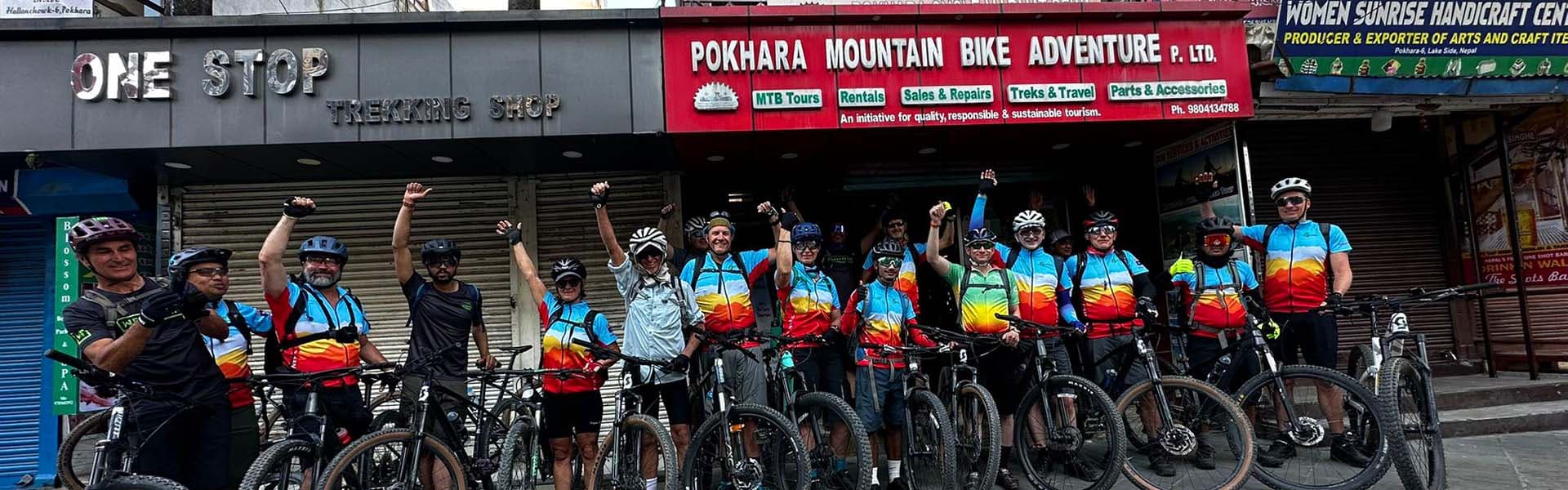
The Annapurna Circuit is a dream destination for mountain bikers and MTB enthusiasts worldwide, and we have spent 20 years riding and guiding it. Nepal MTB Adventures is a Nepali company. We are based here in Pokhara, and the guides who take you around this circuit are our own people, not a crew hired in for somebody else's departure. We provide everything you need for this Annapurna Circuit Tour: guided mountain bike tours, e-MTB by arrangement, and bike rental from our own fleet for riders who want to ride the circuit on their own.
This route is the best high-altitude mountain biking in South Asia, and one of the best anywhere on earth. Being the local company changes what we want from that. Our aim is not simply to sell trips on a famous route; it is to get every rider who wants this route all the way around it, on the terms that suit them. That is why there is more than one way to do it with us. Rent a bike and ride it independently, ride it with our guides, or tell us what you need and we will build the itinerary around you. Every trip runs as a standard, premium, or all-inclusive package. It is also why we were the first to bring an e-MTB onto this route, so that every rider who wants it can finish it, intermediate riders and riders in their fifties and sixties included, and not only the very fittest.
Annapurna is not a good ride. It is one of the world's great ones.
It is the only place on earth where you can ride a complete circle around an 8,000 metre mountain. Not to a viewpoint. Not to a base camp. All the way around, from rice terraces at 800 metres to a desert gorge on the far side of the Himalaya.
That is the sort of thing a tour company says about its own trip. So here is the rest in other people's words.
Lonely Planet put this route in the top 10 travel experiences on the planet. Not the top 10 in Nepal. In the world.
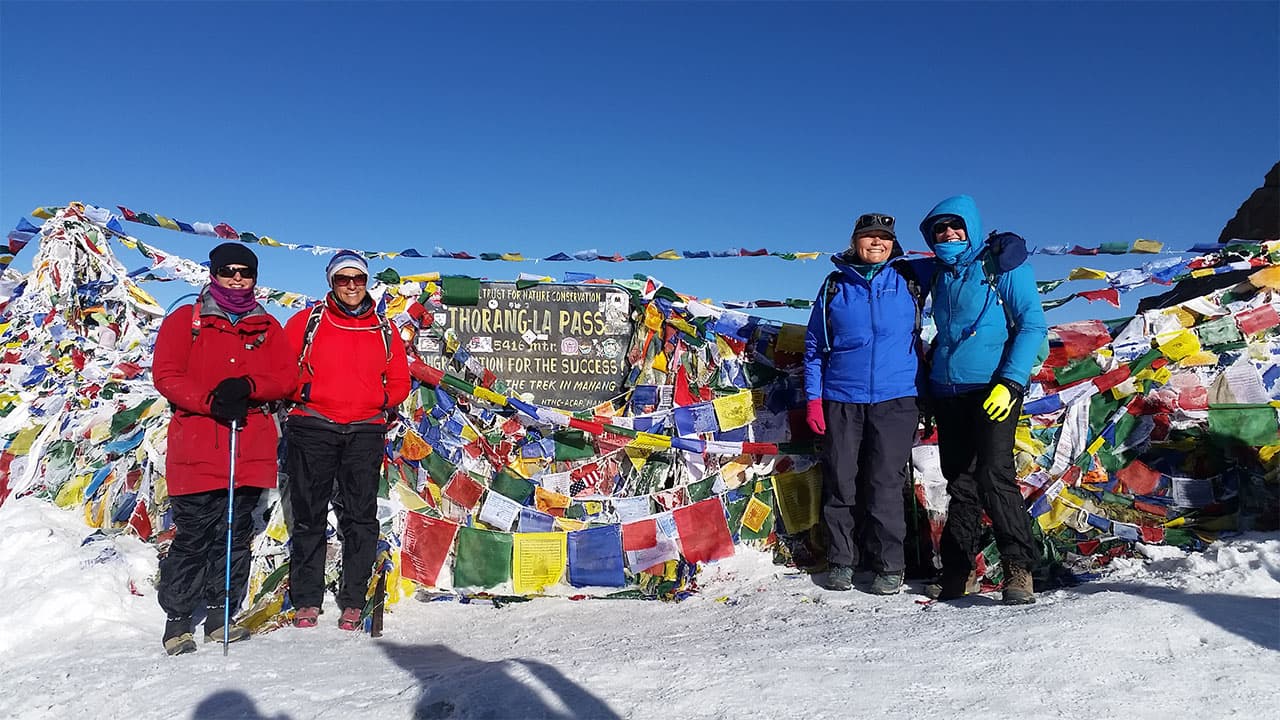
The world's highest mountain bike race runs on it. The Yak Attack crosses Thorong La at 5,416 metres, over six stages and more than 9,000 metres of climbing. It is not our race, but it happens on this ground.
A world champion keeps coming back. Cory Wallace, Kona rider and 24-hour solo world champion, won the Yak Attack five years running, then raced the circuit alone against the clock and took it to 21 hours 26 minutes. Pinkbike covered it. A professional can pick any mountain on earth. He picked this one, repeatedly.
The descent off the pass is called one of the greatest anywhere. 1,616 vertical metres from Thorong La down to Muktinath, in roughly nine kilometres.
Why the Annapurna Circuit is the ultimate mountain bike destination
Nobody built these trails for mountain bikes
Everywhere else you travel to ride, the trail was built for riding. Trail centres, bike parks, machine-cut flow lines. Somebody designed the corner you are railing.
Nothing here was designed for you. These paths exist because people needed to move.
Tibetan salt and wool came south, Nepali grain went north, on yak, horse and mule, for centuries
The Thakali ran the Kali Gandaki stretch of that trade and built the inns you now sleep in
The Manangi traders won royal trade privileges in 1784, held tax-free status with Kathmandu by 1825, and ran caravans as far as Calcutta
Every switchback exists because a loaded mule needed it. Every village sits a day's walk from the last one. You cannot manufacture six hundred years of use.
Bikes are legal here. In much of the world's best terrain, they are not.
The 1964 US Wilderness Act bans "mechanical transport", and since the Forest Service tightened its reading in 1984 that has meant bicycles. Some of the finest mountain country in America is permanently closed to you and your bike.
Nepal does it too. Bikes are banned inside the core of Sagarmatha National Park, which is why nobody rides to Everest Base Camp.
The Annapurna Conservation Area is not like that. Get the permit, follow the rules, ride.
You sleep in a bed and eat hot food every night, at altitude
Remote high-altitude riding anywhere else means carrying camping gear, or a full camp crew moving behind you.
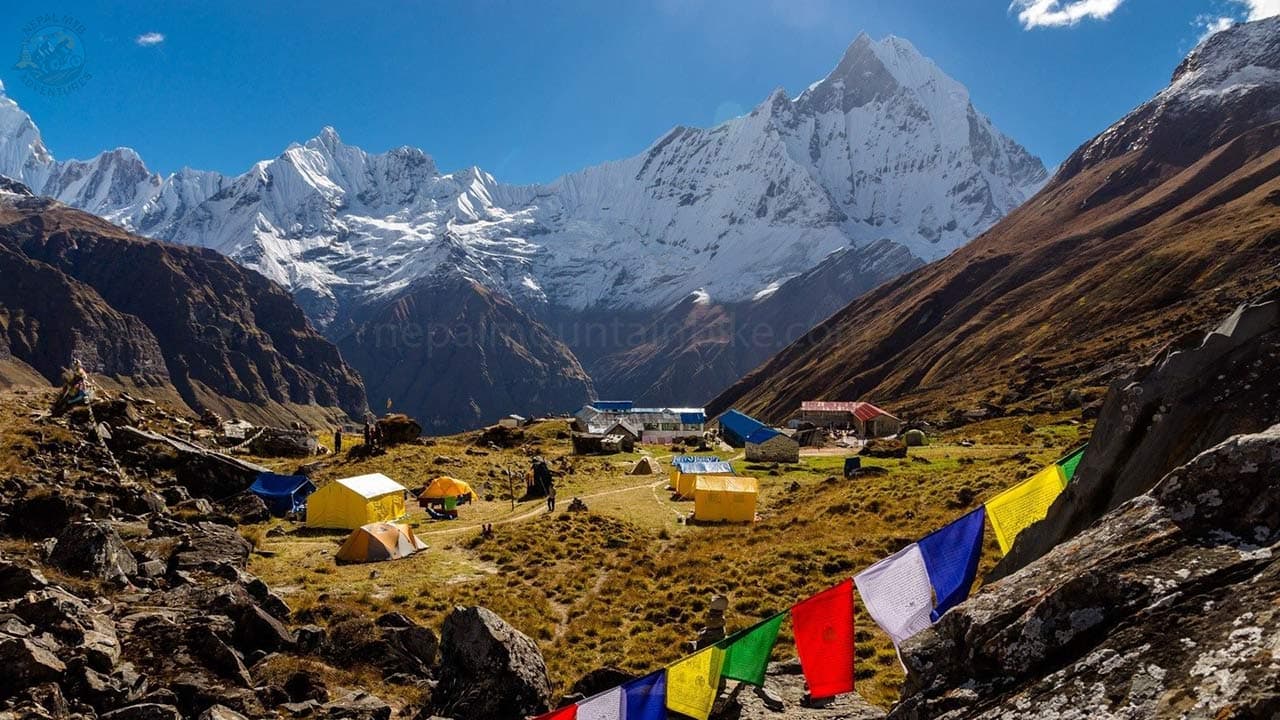
Not here. There is a lodge at the end of every stage, up to 4,450 metres, with a bed, a hot meal and a stove. That is the salt trade again. The Thakali built inns for the caravans, and the inns simply carried on. For a rider that means the whole circuit on a day-pack. No tent, no stove, no four days of food on the frame. On a route with this much climbing, riding light instead of loaded is the whole difference.
High altitude, and what it actually does to you
You start at about 800 metres and top out at 5,416. That is 4,616 metres of net gain, ridden, not flown or driven.
What that means in practice:
At the pass there is roughly half the oxygen there is at sea level
You sleep above 4,000 metres for several nights running, and the highest lodge sits at about 4,450
A rider gains sleeping altitude far faster than a walker does, which is the part nobody in this industry says out loud
You cross five climate zones on the way: subtropical valley, terraced farmland, alpine forest, Tibetan plateau above the treeline, and rain shadow desert on the far side
If you want to know what that feels like, take it from somebody who was riding it fully acclimatised at professional level. Cory Wallace, chasing a record here, described the stretch from 4,000 to 5,416 metres as "painfully slow, almost half of race pace."
Three cultures, in two weeks
Days | The people | Who they are |
3 to 6 | Gurung | Lower Marsyangdi. Buddhism alongside older shamanic traditions, and generations in the Gurkha regiments |
6 to 8 | Nyeshang | The six villages of upper Manang. Tibetan origin, trans-Himalayan caravan traders |
12 to 13 | Thakali | The Kali Gandaki. Ran the salt trade, and cook the best food on the route |
Three languages, three histories, and you cross all of it on a bike.
The trail runs straight through sacred ground
Muktinath is holy to two religions at once. Hindus count it among the 108 Divya Desams, named in Tamil hymns from the sixth century. Buddhists call it Chumig Gyatsa and hold that Padmasambhava meditated here. Behind the temple, 108 bull's-head spouts run with meltwater. Nearby at Jwala Mai, natural gas burns as an eternal flame beside spring water.
Below it, the gorge holds the only natural source of shaligram on earth. Ammonite fossils, revered as a manifestation of Vishnu and venerated by Hindus, Buddhists and Bon for more than two thousand years. Sea creatures, in a riverbed now at 2,500 metres under two 8,000 metre peaks.
And then there is the riding
This is what you actually get to ride, and how each one measures against anything else on the planet.
The Ghyaru wall and the Ngawal traverse
The best singletrack in Nepal, and the hardest hour on the circuit that has nothing to do with altitude.
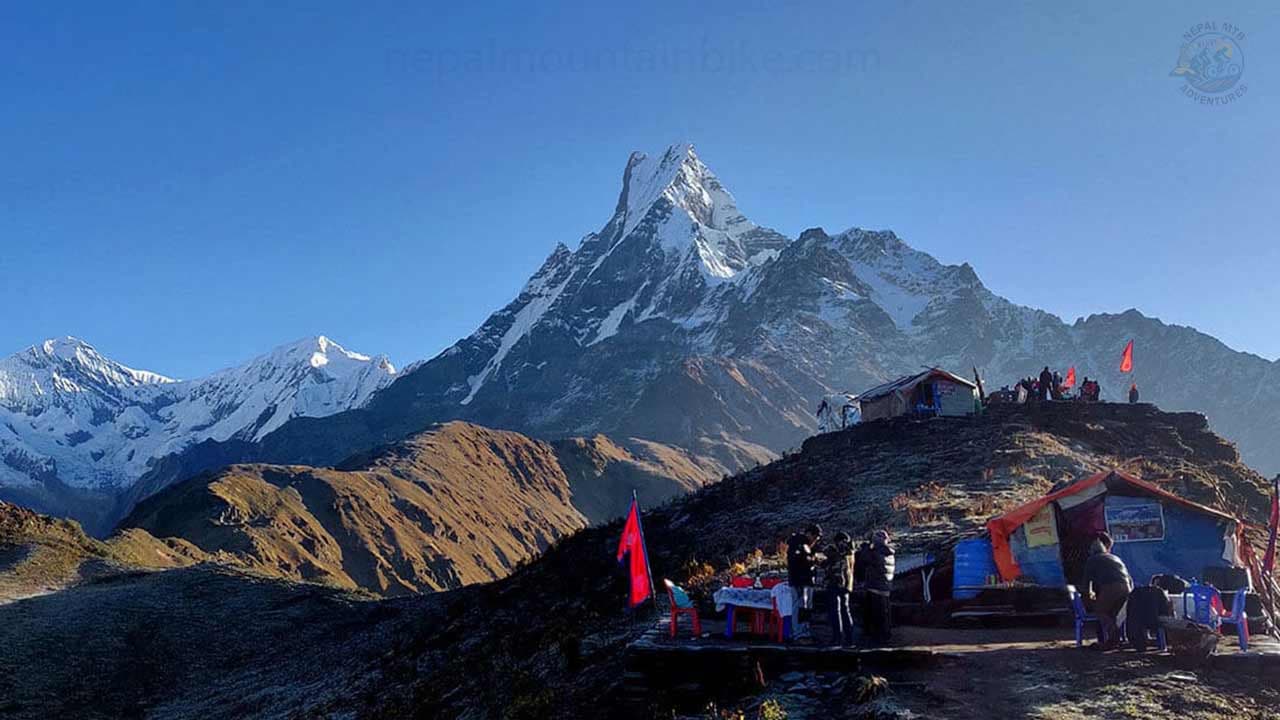
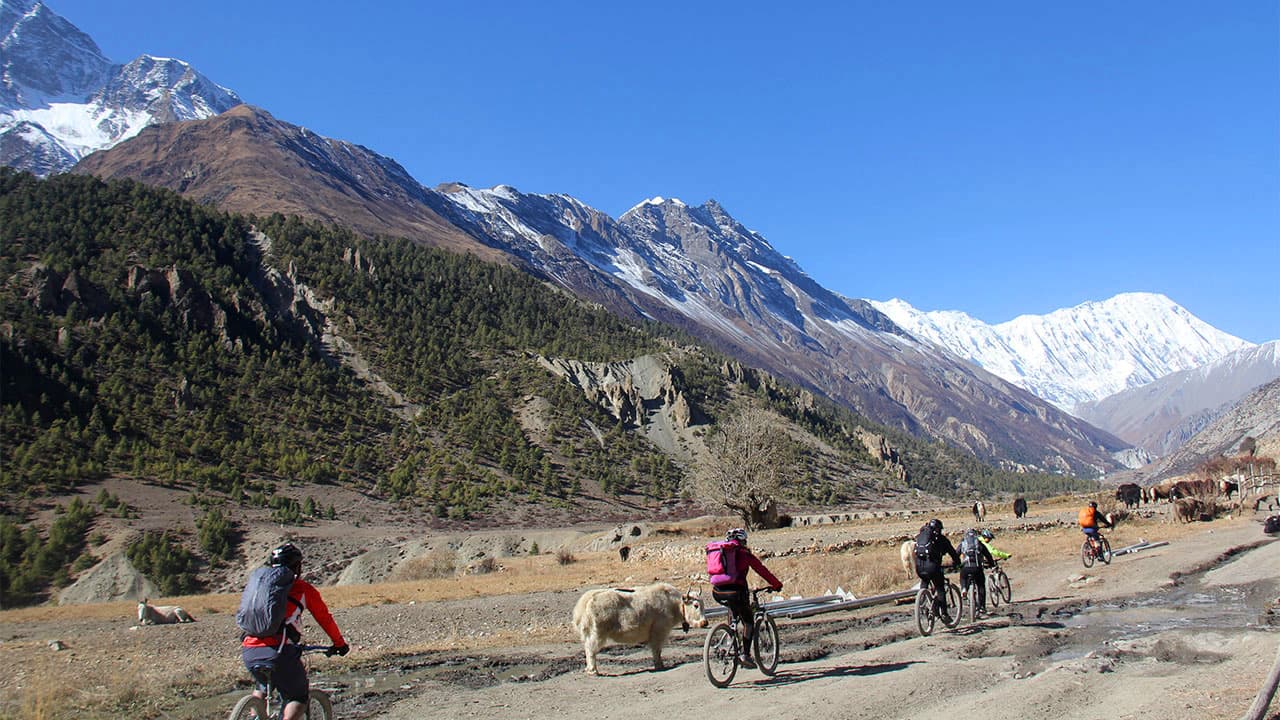
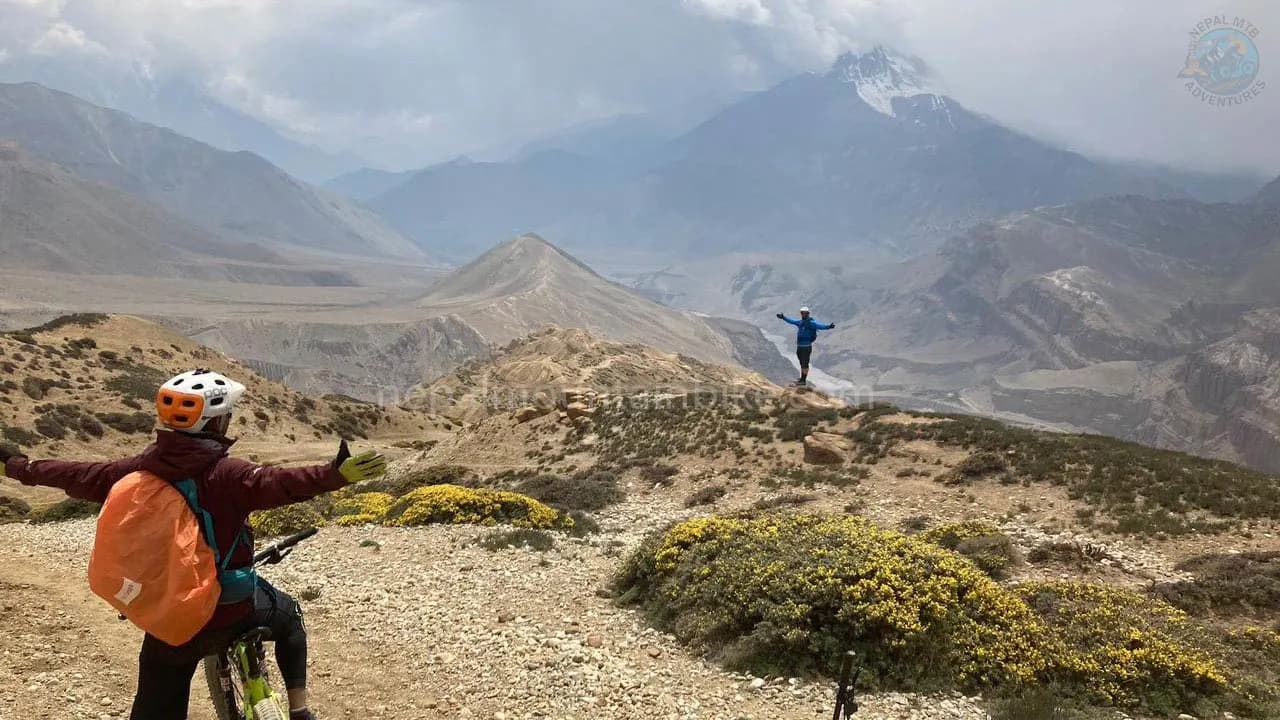
From Upper Pisang, the trail turns off the valley floor and goes straight up the wall to Ghyaru. It is a stack of tight switchbacks on loose ground with a drop on one side, and most riders push some of it. Nobody minds. What you get at the top is a bench-cut singletrack traverse running for kilometres across the face of the valley to Ngawal, level with Annapurna II, III and IV, close enough that you stop looking at the trail.
It is exposed. It is narrow. The surface is dry, loose and fast, and the switchbacks dropping into Ngawal are the most technical riding of the trip. This is where you find out whether you brought the right bike.
For scale: Ghyaru sits at 3,730 metres, and Annapurna II across the valley is 7,937. There are very few places on earth where a rider gets to hold a singletrack traverse that high with a mountain that big at eye level.
Thorong La to Muktinath
1,616 vertical metres in about nine kilometres, and the reason this route has a reputation.
Getting up there is the price. From Thorong Phedi at roughly 4,450 metres, the trail is frozen switchbacks, and above High Camp it is not rideable in any honest sense. Our porters carry the frames over the worst of it, which is the only reason riders reach the top with anything left in them.
Then you are standing on the pass with prayer flags snapping in wind that has not stopped since dawn and your legs completely finished, and you clip in.
For scale: a big lift-served bike park hands you somewhere between 300 and 800 metres of descent per lap. This is 1,616 metres in one, and the top of it stands higher than the summit of Mont Blanc. No lift on earth reaches it. You get it because you spent nine days climbing to it, and that is exactly why riders remember it.
The Lupra valley
Ask our guides for their favourite descent in Nepal and most of them say this one.
Lupra drops off the main Kali Gandaki line into a side valley of eroded cliffs and dry riverbed, and it is proper singletrack the whole way. No jeeps. No trucks. Just a narrow trail through a canyon that looks like nowhere else in Nepal, coming out near Jomsom. Riders who have done both often rate this above the pass descent for pure riding quality.
You will not find it on your own. That is not marketing; it is geography.
The Kali Gandaki gorge run
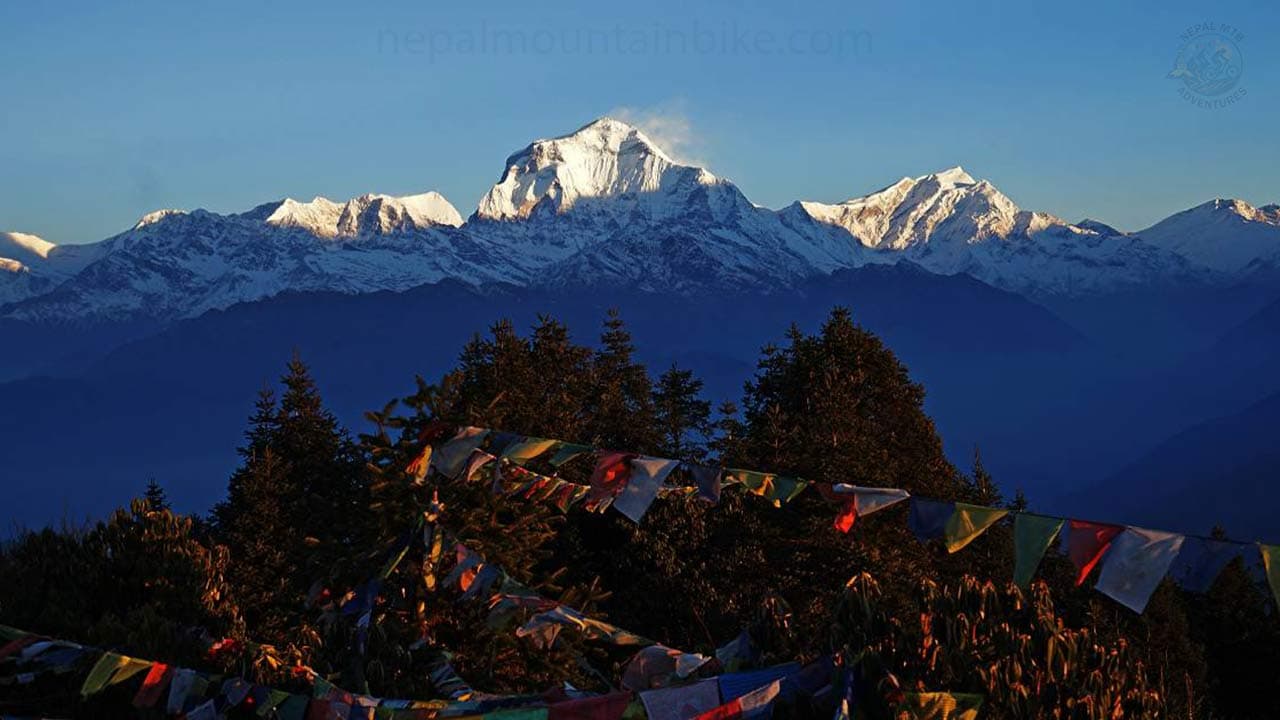
Two days of descending through the deepest gorge in the world, with Dhaulagiri on one side and Annapurna I on the other. You drop from Marpha's apple orchards through the whitewashed Thakali villages of Tukuche and Larjung, past Ghasa, and back into subtropical air at Tatopani, where there are hot springs and the day is done.
For scale: this is the deepest gorge on the planet. Dhaulagiri stands at 8,167 metres on one side, Annapurna I at 8,091 on the other, and the river runs between them at around 2,500. That is roughly three times the depth of the Grand Canyon, and you descend through the middle of it for two days.
The Timang drop
Early in the trip, above Chame, a stretch of old trail through pine forest that reminds people what they came for after two days of climbing. Fast, wooded, and the first real descent of the route.
Tilicho and Shree Kharka
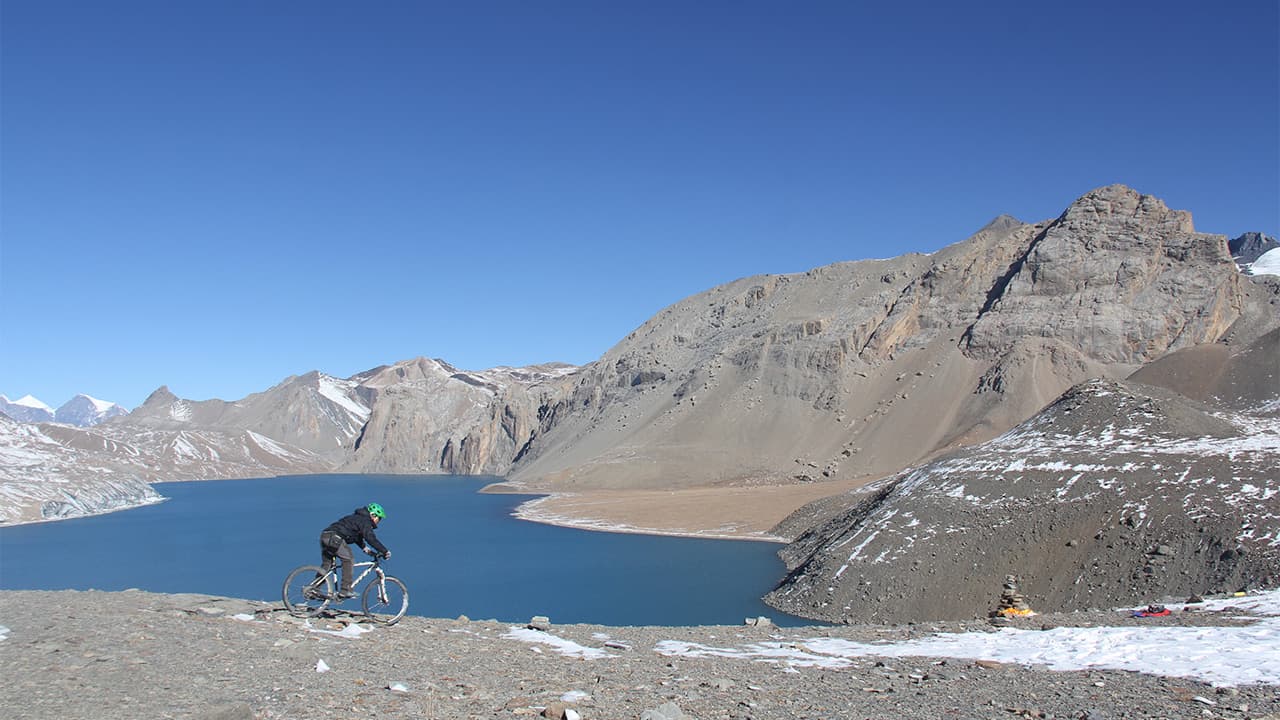
Off the main circuit, a spur towards Tilicho Lake, which sits at around 4,919 metres and is one of the highest lakes anywhere on earth. Be clear about this one: you cannot ride to the lake. You ride to Shree Kharka and walk in from there. Some operators are vague about that. We would rather you knew before you booked.
Those are the major attractions of the Annapurna Circuit, and between them they are the reason the route has the reputation it does.
Why riders come here from all over the world
From twenty years of taking riders around this circuit, these are the reasons that come up again and again.
It is an expedition, not a holiday. Riders who come here have usually done the bike parks already and want an objective. Over a hundred reviews talk about how hard it was. "We all had a real sense of accomplishment crossing over the Thorong La pass at 5,416 m."
The ground changes every day. Rice terraces, pine forest, alpine meadow, high desert, then the deepest gorge on earth. "The landscapes changed every day, from green valleys to high alpine regions."
The trail is the attraction. Centuries-old trade paths, not lines cut for bikes. One rider: "highly varied topography, major rivers, suspension bridges, and unpredictable weather, at some of the highest elevations for bikes in the world."
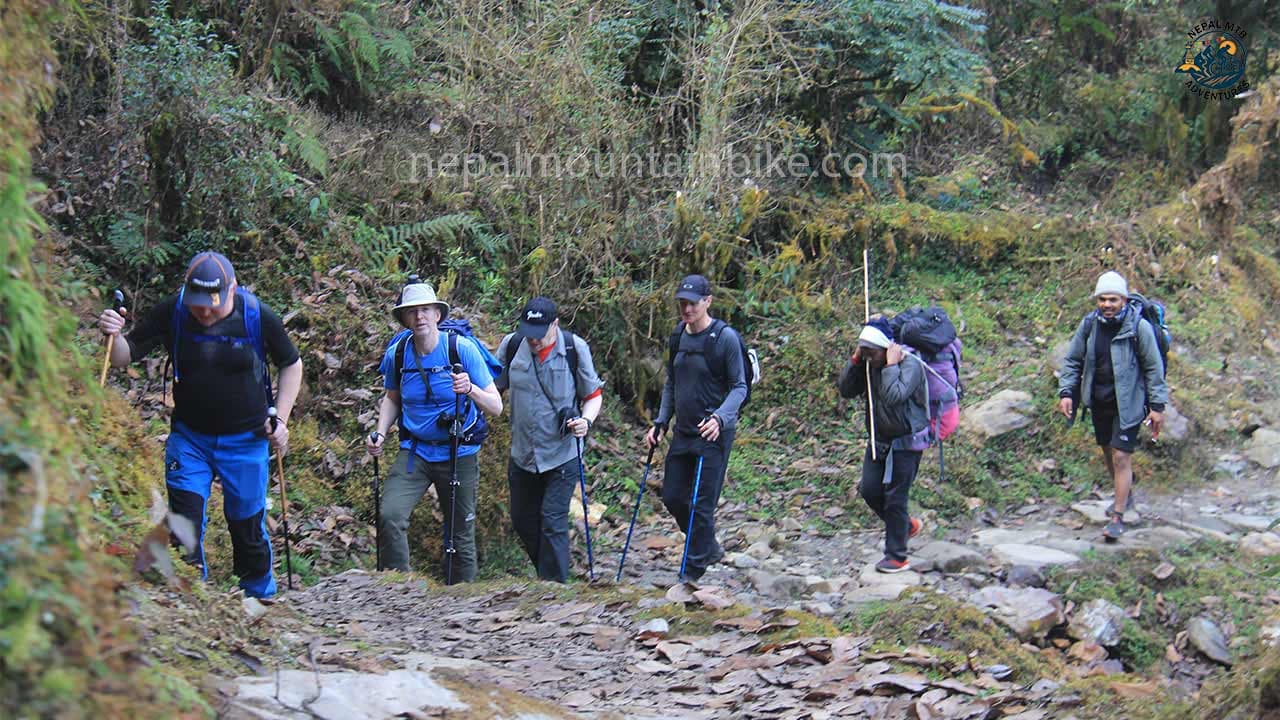
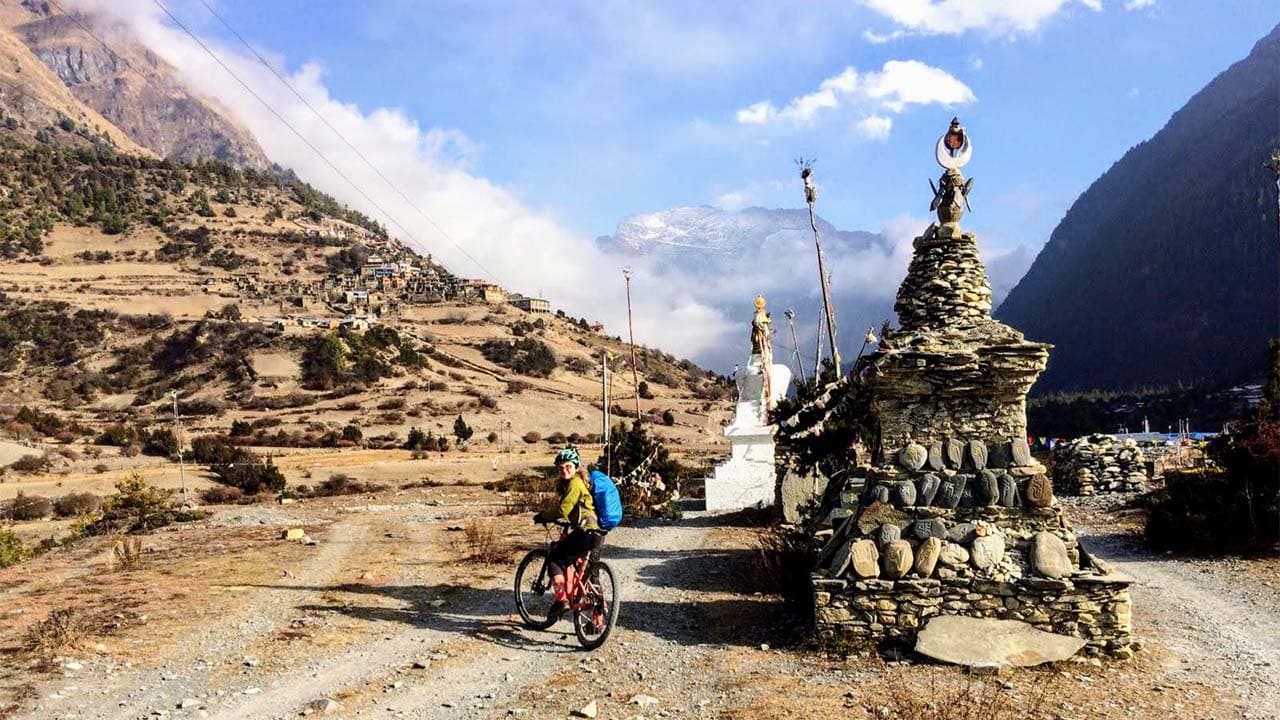
You live alongside people rather than looking at them. You sleep in family lodges, eat what the family eats, and ride through villages having an ordinary morning.
Monasteries and prayer walls, every day. Chortens, spinning wheels, painted gompas, mani walls. Not scheduled stops. Just what sits beside the trail.
Muktinath. Holy to Hindus and Buddhists both, 108 spouts and an eternal flame, at the bottom of the biggest descent on the route. You arrive with your brakes still hot.
Forest and wildlife that change with the altitude. Rhododendron, blue pine, juniper and sea buckthorn. Blue sheep and Himalayan tahr on the high slopes, griffons overhead, snow leopard country above Manang.
The welcome. A hundred reviews mention hospitality, kindness, or being treated like family. "Genuine Nepali hospitality." "The porters were unbelievably strong, kind, and always ready to help with anything." No trail network anywhere can build that.
Choose Your Ride
Trip | Days | Choose this if |
15 | You want the complete circuit ridden properly, on the high trails rather than the jeep road, with full support. This is the flagship. | |
11 | You have two weeks of holiday and the full circuit will not fit. High Annapurna riding, Manang, and the Tilicho spur. | |
17 | Your group is mixed. Some walk the high half, everyone rides the descent from Muktinath down. Also the answer if you want the pass without carrying a bike over it. | |
22 | The maximum trip. The full circuit, then north into the restricted kingdom of Upper Mustang and the walled city of Lo Manthang. | |
14 | You are booking for a club, a private group or a company, and you want the circuit run for your riders on your dates. |
Why choose us for your dream destination
Twenty years on this one route. We have run riders around this circuit since 2004, and the crew is assembled for your departure. Laxman Sunar has fifteen years guiding this exact route. Dhan Magar has twenty years in high-altitude logistics. Santaram has twenty years as our lead mechanic. Jagan founded the company and still answers the emails.
Altitude is managed, not hoped for. An acclimatisation day at Manang with a climb-high-sleep-low hike. Deliberately short stages above 4,000 metres. Blood oxygen and heart rate checked morning and evening. Medical oxygen in the support vehicle. And guides with the authority to turn any rider around without asking anyone.
A mechanic on the trail, not a phone number. We ride the full route with tools and spares. Daily bike checks, tyre pressures set for the day's surface, brake pads swapped before the big descents rather than after. At the end, he strips and boxes your bike for the flight home. There is no bike shop past Besisahar.
A private 4x4 behind you. It runs to Manang and meets you again at Muktinath, carrying luggage, spares, the mechanic's kit and the medical oxygen. It is also the fast way down if somebody needs to come off the hill.
Buffer days, because the pass does what it likes. The itineraries carry room to wait out weather instead of pushing a group into it, and a plan that still delivers the big descent if Thorong La stays shut.
Emergency plans that already exist. Established descent and helicopter evacuation procedures, satellite communication on the route, and a Pokhara office set up to run a rescue rather than work one out.
We will tell you what your insurance actually has to say. Most policies that mention trekking do not cover you here. You need a stated altitude limit above 5,500 metres, wording that names mountain biking rather than trekking, and helicopter evacuation included. We check that before you fly, not at 4,500 metres.
The bikes are ours. Trek, Scott and Bergamont, built and serviced in our own workshop. Hardtail as standard, full-suspension as an upgrade, e-MTB by arrangement. Bring your own and our mechanic builds and checks it before you leave Pokhara.
Dates and groups that bend to you. Scheduled departures if you want company, or a private trip on your own dates at whatever group size you have. Standard, premium, and all-inclusive packages on every trip.