A high-altitude guided MTB expedition combining technical riding, remote mountain trails, Tibetan Buddhist heritage, dramatic desert landscapes, and carefully managed logistics. The route is designed and operated by Nepal MTB Adventures, a local mountain-bike specialist with more than 20 years of experience guiding riders in the Himalayas.
Built by riders for riders, our expedition goes beyond standard trekking agency add-on itineraries. We avoid busy road tours where possible to deliver an authentic trans-Himalayan singletrack adventure. Designed for mountain bikers, adventurous travelers, MTB club/ tour operators, and corporate teams, this journey explores ancient salt-trading paths, technical high-desert trails, and rapid alpine descents through the last forbidden kingdom of Lo Manthang, all backed by a 4x4 support vehicle, certified guide, and expert mechanic.
By creating a peer-to-peer network, we connect local experts with the global adventure cycling community to advance sustainable adventure tourism. Global riders gain access to an unmatched, culture-rich mountain biking frontier, while local communities benefit directly through economic opportunities, trail preservation, and cultural exchange. Together, we are building a lasting, mutually beneficial bridge between international cyclists and the Himalayan region.
Trip at a Glance:
Why ride Upper Mustang by mountain bike?
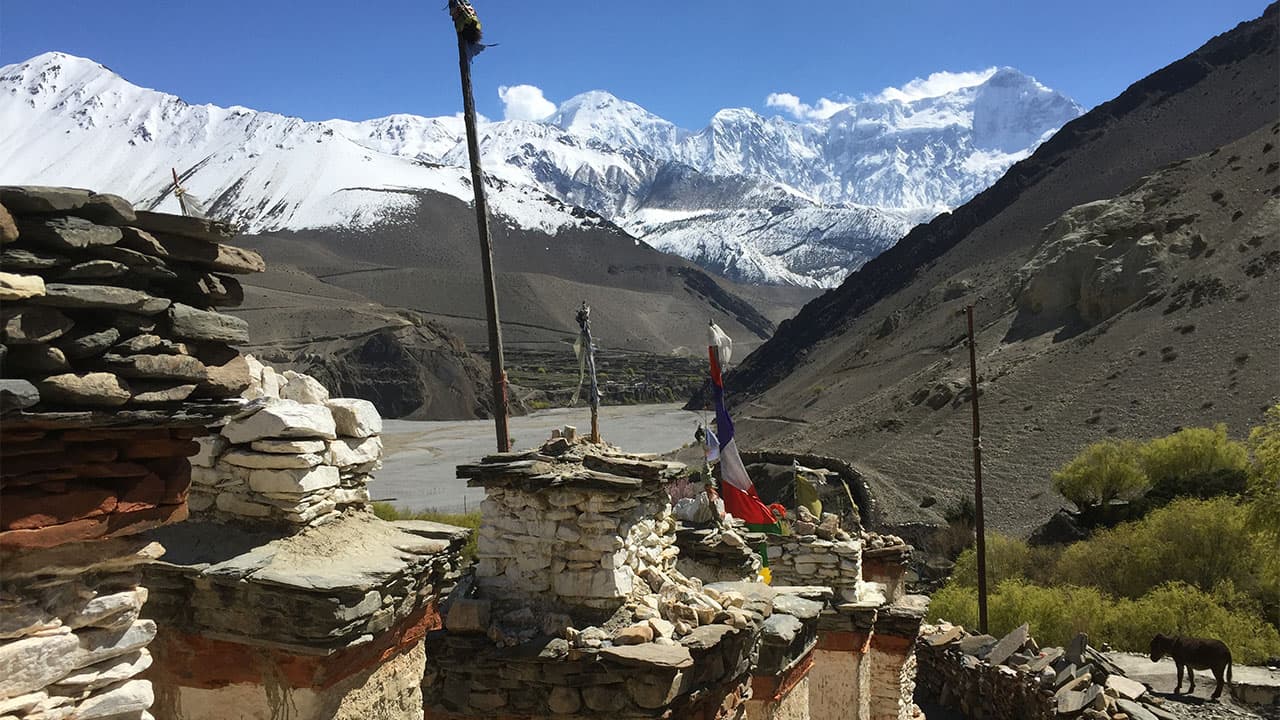
Upper Mustang is one of Nepal’s most distinctive high-altitude riding regions. The landscape changes from the deep Kali Gandaki Valley to dry plateaus, sandstone cliffs, remote villages, ancient monasteries and high passes. The region lies in the Himalayan rain shadow, making it considerably drier than much of Nepal during the summer monsoon, although wind, weather and trail conditions can still change quickly.
What sets it apart from the rest of Nepal
The rain shadow. Upper Mustang sits behind the Annapurna and Dhaulagiri ranges and gets a fraction of the rain the rest of the country does. It stays rideable in June, July and August while most Nepali trails are washed out.
The surface. Dry, firm and grippy for most of the year. No mud, no leeches, no slick roots. Loose rock and sand are the challenge here instead.
The emptiness. Permit control keeps visitor numbers low. On the eastern loop through Yara and Tangge, you can ride most of a day and see nobody.
The descents. Long ones. Lubra Valley gives you 1,350 m of natural switchback singletrack, and the final day drops about 1,850 m from Marpha to the hot springs at Tatopani.
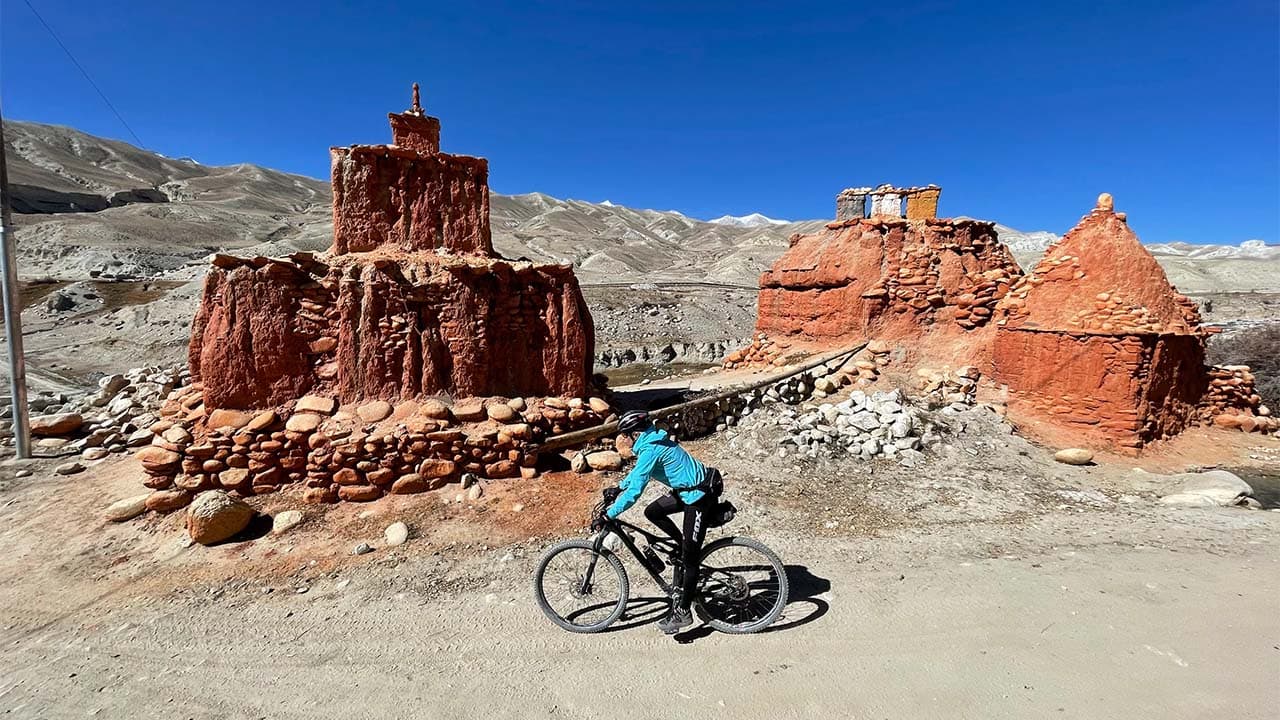
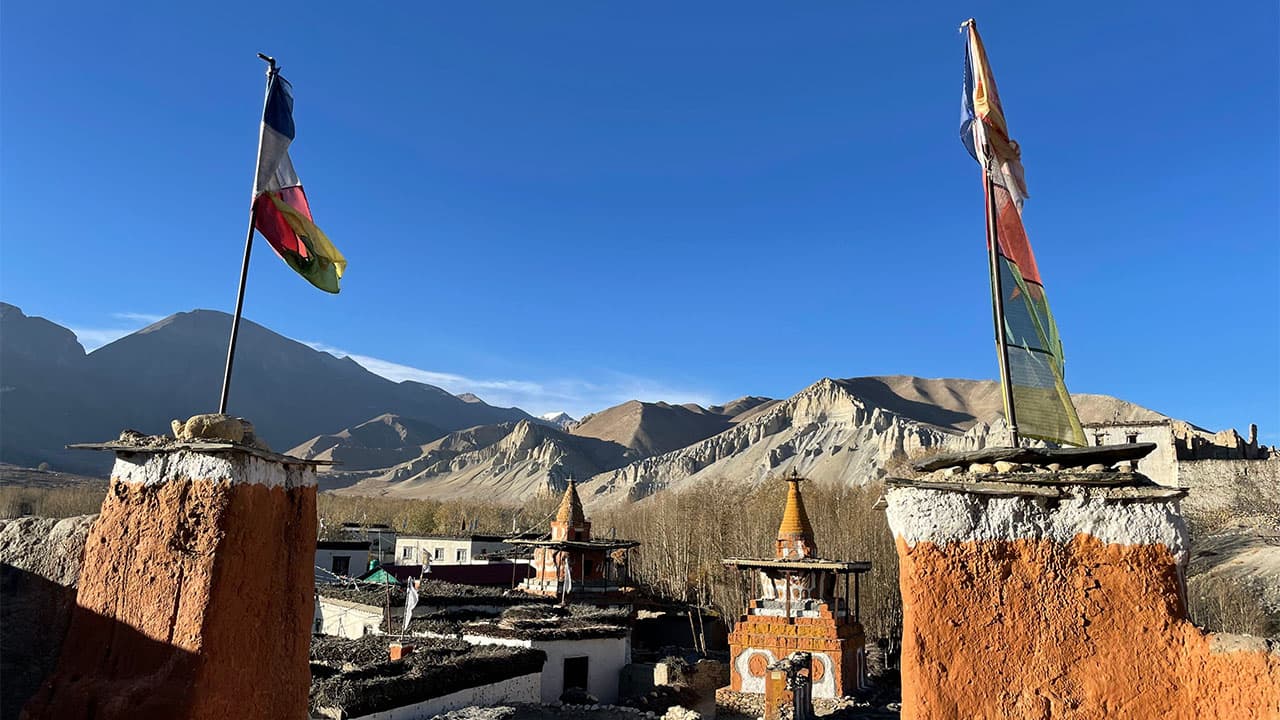
The culture. Tibetan Buddhist monasteries, cave dwellings, and a walled medieval capital, all of it still in daily use rather than staged for visitors.
The route and riding character
The expedition is a broad loop, not an out-and-back on the same road. From Kathmandu and Pokhara, you enter the Kali Gandaki valley and head north through Kagbeni, Chele, Samar, Syangboche, Ghami, Tsarang and Lo Manthang. From Lo Manthang, the route turns east into the quiet side of Mustang, through Dhi, Yara, Luri Gompa and Tangge, then crosses Paha Pass and comes back south through Chhusang, Gyu La, Muktinath, the Lubra valley, Marpha and Tatopani.
Daily distances and terrain percentages are operating estimates. They can change because of weather, road construction, local access, livestock movement, trail damage, rider condition, and other field conditions. The guide team may adjust the route to protect safety and the expedition's quality.
What riders should expect
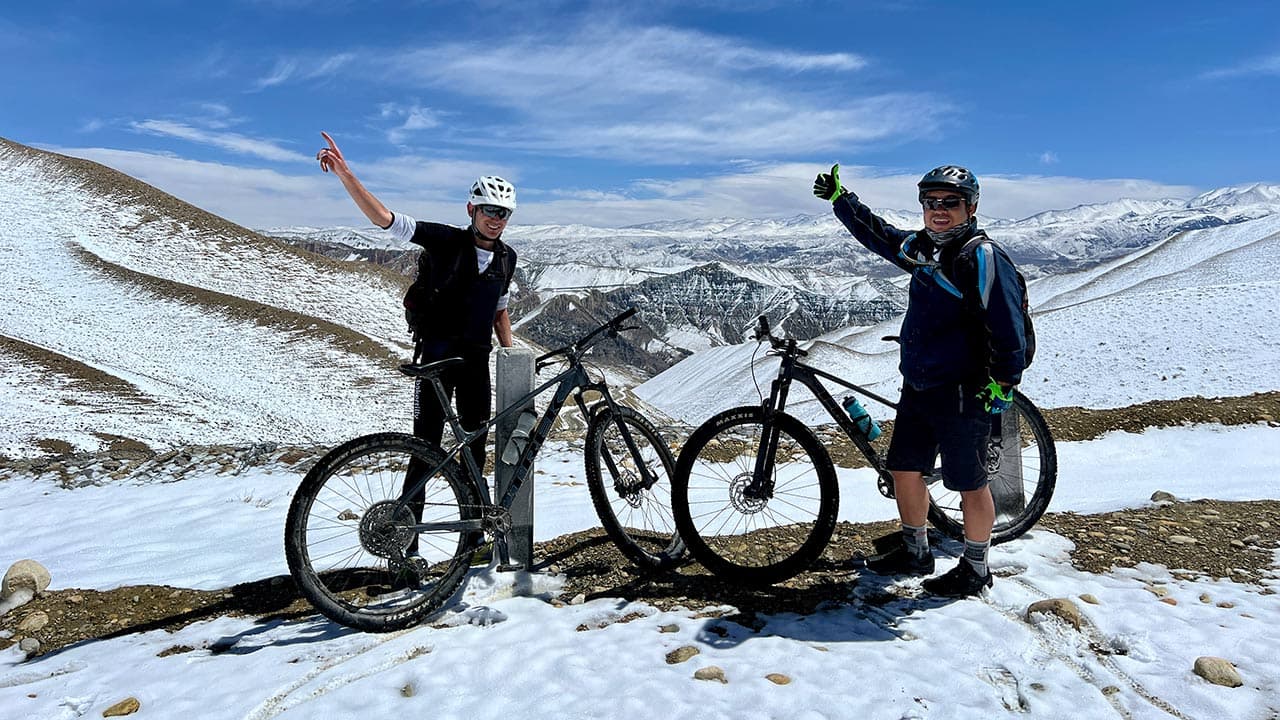
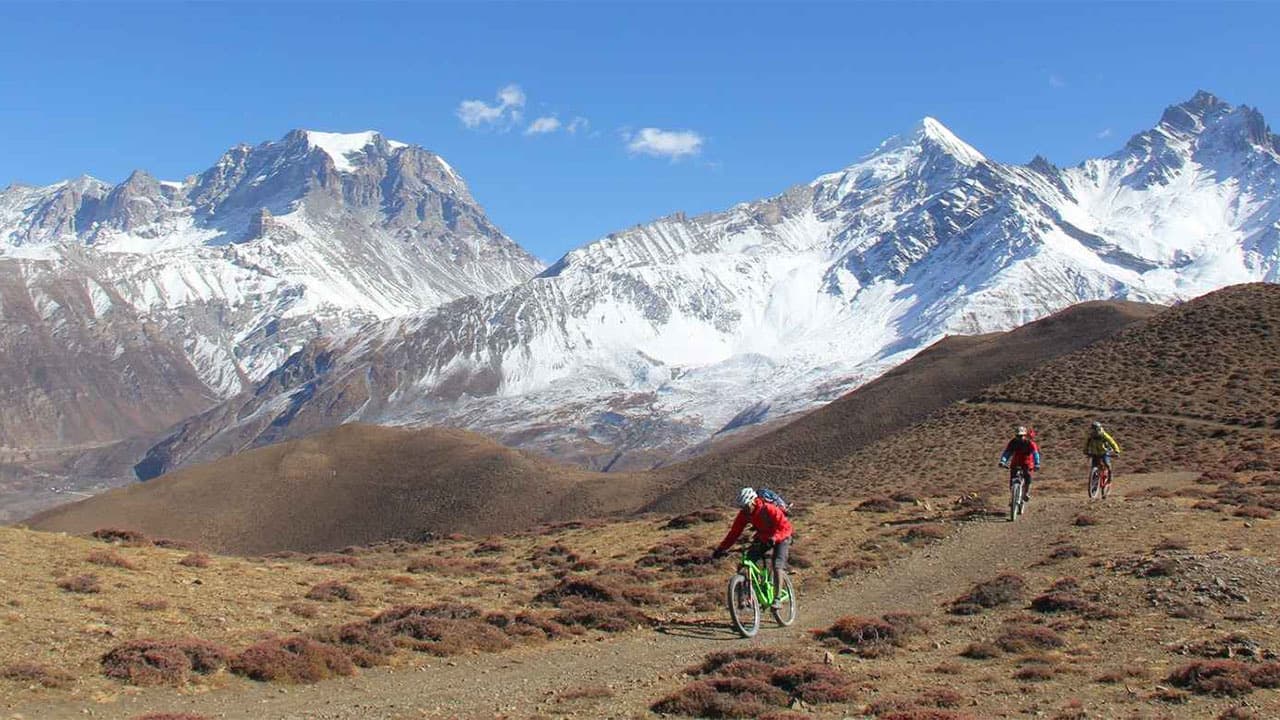
From Kagbeni, easy village paths and jeep tracks give way quickly to exposed wind-blown climbs and loose shale descents over the high passes. Around Lo Manthang, the country opens into a wide desert plateau. Heading east toward Yara and Tangge, it gets far more remote, with rough singletrack and steep hike-a-bike.
Expect varied surfaces. Gravel, rocky jeep track, singletrack, village trails, and short paved sections.
Expect hike-a-bike. Short sections of pushing or carrying are a normal part of this route, especially on steep approaches to the high passes.
Expect exposure. Several high sections are wide open to wind, sun, and fast weather changes.
Expect technical descents. Loose rock and uneven ground call for controlled braking and good line choice.
Expect the demand to change day to day. Some days are about climbing and altitude. Others give long descents or more technical singletrack.
Expect route changes when they are needed. Weather, trail damage, road conditions, local access, and rider condition can all force the guide team to modify the line.
Do not judge a day by its distance. A short stage at 4,000 m can be much harder than a long one lower down.
Terrain by Stage & Rider Difficulty
This table gives a practical read on riding character. It is not a fixed measurement of every trail surface. Percentages and difficulty ratings are operating estimates and can change with weather, road construction, trail damage, and route adjustments.
Altitude, safety and acclimatization
The itinerary moves progressively from the lower Kali Gandaki valley into Upper Mustang and includes several nights above 3,500 m. The profile is built to give your body time.
What riders should do:
Hold a conservative pace, especially on the first two days above 3,500 m. Riding at your normal home effort at altitude is the fastest way to get into trouble.
Eat and drink regularly. The air is dry, the wind is constant, and you dehydrate without noticing.
Protect yourself from sun and wind. UV at 4,000 m is brutal, and the wind strips heat fast.
Report symptoms to the guide early. Unusual headache, dizziness, nausea, marked fatigue, shortness of breath at rest, or loss of coordination all need to be said out loud, not pushed through.
Some sections need short periods of hike-a-bike. You should be comfortable pushing or carrying your bike on steep, loose, or narrow ground.
One thing worth being clear about: altitude is not decided by fitness. A very fit rider can still get altitude sickness, and sometimes fitness makes it worse because it lets you climb faster than your body can adapt. Gradual acclimatization, conservative pacing and honest reporting are what keep you safe.
The group carries a medical kit and an emergency oxygen cylinder. Lead guides carry Wilderness First Responder certification and Government of Nepal mountain bike guide licences.
Bike setup and equipment standards
A modern trail or enduro full-suspension mountain bike with about 140 to 160 mm of travel is the preferred tool for this route. A capable, aggressive hardtail also works for experienced riders who are comfortable on rough ground, and the Standard package bike is a quality hardtail for exactly that reason.
What to bring
The mechanic carries tools, spares and a workshop. The support vehicle carries your duffle. This list is your personal kit.
Riding kit
Helmet. Full-face optional for the technical descents, and the crew can advise
Gloves, two pairs, one lighter and one warmer
Riding shorts and jersey, plus a spare set
Knee pads. Recommended for Days 11, 12 and 14
Riding shoes, and flat pedal riders should bring grippy soles
Layers, because the temperature swing is large
Thermal base layer, top and bottom
Insulated jacket, down or synthetic
Windproof and waterproof shell
Buff or neck gaiter. The wind and dust in Mustang make this essential
Warm hat and light gloves for early mornings
Warm socks
Protection and health
Sunglasses with good UV protection, plus a spare pair
High-factor sun cream and lip balm with SPF
Personal first aid kit and any personal medication
Water purification tablets or filter as backup
Hydration pack, 2 to 3 litres
Everything else
Energy snacks and electrolyte tablets for the long days
Power bank, and note that lodge charging at altitude is limited and often costs extra
Head torch
Camera
Small daypack for the ride
Sleeping bag liner, and a bag rated to about minus 5 for the higher nights if you feel the cold
Lodges provide bedding. Charging, hot showers and wifi become limited, unreliable and paid the further north you go.
Accommodation and food
Where you sleep
Kathmandu and Pokhara: premium boutique hotels on Standard, five-star on Premium. Hot water, reliable power, comfortable rooms.
Kagbeni, Marpha and Muktinath: well-established lodges with private rooms, hot water most of the time and a heated dining room.
Syangboche, Yara and Tangge: simpler. Basic rooms, often shared bathrooms, limited or bucket hot water, a stove in the dining room and rationed solar power.
Facilities thin out the further north and east you go. That is what exists in villages at 3,600 m that sit days from a road. The lodges are family-run, and staying in them is how this trip's money reaches the communities you ride through.
What you eat
Nepali and Tibetan, and mostly excellent. Dal bhat is the staple and the right call on a hard riding day because refills are free. Expect thukpa, momos, tsampa, fried rice and noodles, and apples in everything around Marpha.
Vegetarian: easy everywhere on the route.
Vegan, gluten-free and other requirements: workable with notice. Tell us at booking, not on Day 4.
Permits and documentation
Upper Mustang north of Kagbeni is a restricted area. You can travel solo. The two-person minimum ended on 22 March 2026. A licensed guide and a registered agency are still required, so solo means riding with a guide, not riding alone.
Restricted Area Permit. Issued by the Department of Immigration and required for every foreign national entering Upper Mustang. It must be arranged through a licensed Nepali operator before you travel, and it requires a minimum of two travellers on a single permit application.
Annapurna Conservation Area Permit. Upper Mustang sits inside the Annapurna Conservation Area, so this is required as well.
TIMS. The Nepal Tourism Board places Upper Mustang inside the applicable TIMS framework. TIMS is now issued to registered guided groups rather than to independent travellers.
Nepal MTB Adventures handles all permit processing for booked expeditions. Your permits are processed while you are in Pokhara on Day 3, which is one reason that day is built into the itinerary.
Government permit fees and documentation rules change, sometimes with little notice. Our logistics team confirms the exact current tariff for your departure before the expedition.
Bring your passport with at least six months' validity, and passport photos. We will tell you how many when we start your application.
Insurance
Buy comprehensive travel and medical insurance before you travel. This is not optional on a trip like this.
Your policy needs to explicitly cover:
Mountain biking as an activity, not just trekking. Many standard policies exclude it.
The maximum altitude on this itinerary, about 4,210 m. Check the altitude limit in your policy wording, because many cap at 3,000 or 4,000 m.
Emergency medical treatment and hospital costs in Nepal.
Helicopter evacuation, where available.
Trip delay and cancellation, which matters because of the Jomsom flight.
Confirm the exclusions and altitude limits directly with your insurer in writing, not with a call centre summary. Send us a copy of your policy details before departure so the guide team has the emergency contact and policy number on the route.
Best time to ride
Spring, March to May. The most reliable window. Days warm up steadily, the trails are dry, and the light on the sandstone is at its best. Nights are still cold above 3,500 m. The Tiji festival in Lo Manthang usually falls in May and is worth timing a trip around if you can.
Autumn, September to November. The other prime window. Air is clear after the monsoon, mountain views are at their sharpest, and the trails have firmed up. October is the most popular month in Nepal generally, though Upper Mustang never gets crowded by Annapurna standards.
Monsoon, June to August. This is Upper Mustang's real advantage. It sits in the rain shadow of the Annapurna and Dhaulagiri ranges and gets a fraction of the rain the rest of the country does, so it stays rideable while most Nepali trails are washed out.
Winter, December to February. Very cold nights, frozen ground and possible snow on the high passes. Many families in Upper Mustang move south for the winter and a number of lodges close.
Whatever the season, conditions change fast around the exposed passes, and the wind picks up in the Kali Gandaki almost every afternoon. That is why the riding days start early. The final line on any given day may be adjusted for weather, trail condition, road access and rider safety.
Who this expedition is for
Book this trip if you are:
An experienced mountain biker comfortable with sustained off-road riding and technical descending.
An adventure cyclist who wants demanding riding combined with genuine Tibetan Buddhist cultural depth.
An endurance rider preparing for or enjoying multi-day alpine riding.
A solo rider, private group, couple, group of friends or cycling club looking for a private departure.
A photographer, filmmaker or travel professional who needs a supported Himalayan riding expedition with reliable logistics.
An international tour operator looking for a local Nepal MTB operating partner or DMC.
If your high-altitude experience is limited but your riding is strong, talk to us before booking rather than after. There are real options: the Plan B support route on Days 11 and 12, an extra acclimatization night, or in some cases a different trip that suits you better. We would rather have that conversation in advance.
Wildlife and landscape
Upper Mustang is a high-altitude desert, and everything living here is adapted for it.
What you can see
Blue sheep, or bharal. Common on the high slopes around Yara, Tangge and Chhoser, and often visible from the trail.
Lammergeier and Himalayan griffon. Overhead on almost every riding day, riding the thermals on wingspans close to three metres.
Kiang, the Tibetan wild ass. Occasional on the northern plateau near the border.
Himalayan snowcock and chough. Regular. In spring, migrating birds move north up the Kali Gandaki, one of the great migration corridors in Asia.
Snow leopard and Himalayan wolf. Both live here. Sightings are rare enough that finding tracks counts as a good day.
The Kali Gandaki riverbed also holds shaligram, black ammonite fossils from a sea that closed 100 million years ago when India collided with Asia and pushed up the Himalaya.
Vegetation is sparse. Barley, buckwheat and mustard grow in the irrigated village fields, which makes every village a shock of green. Above the fields it is rock, sand and wind.
Culture and sacred places
Upper Mustang was the Kingdom of Lo, founded in 1380 and independent until 1795. Nepal's monarchy formally ended the royal title in 2008, but the culture did not go anywhere. The region was closed to outsiders entirely until 1992, which is a large part of why so much has survived here that has been lost elsewhere in the Tibetan cultural world.
The Loba people speak a Tibetan dialect, practise Tibetan Buddhism and, in Lubra, the older Bon tradition. The monasteries you visit on this route are working religious sites, not museums.
Riding responsibly here matters. A few things that cost you nothing:
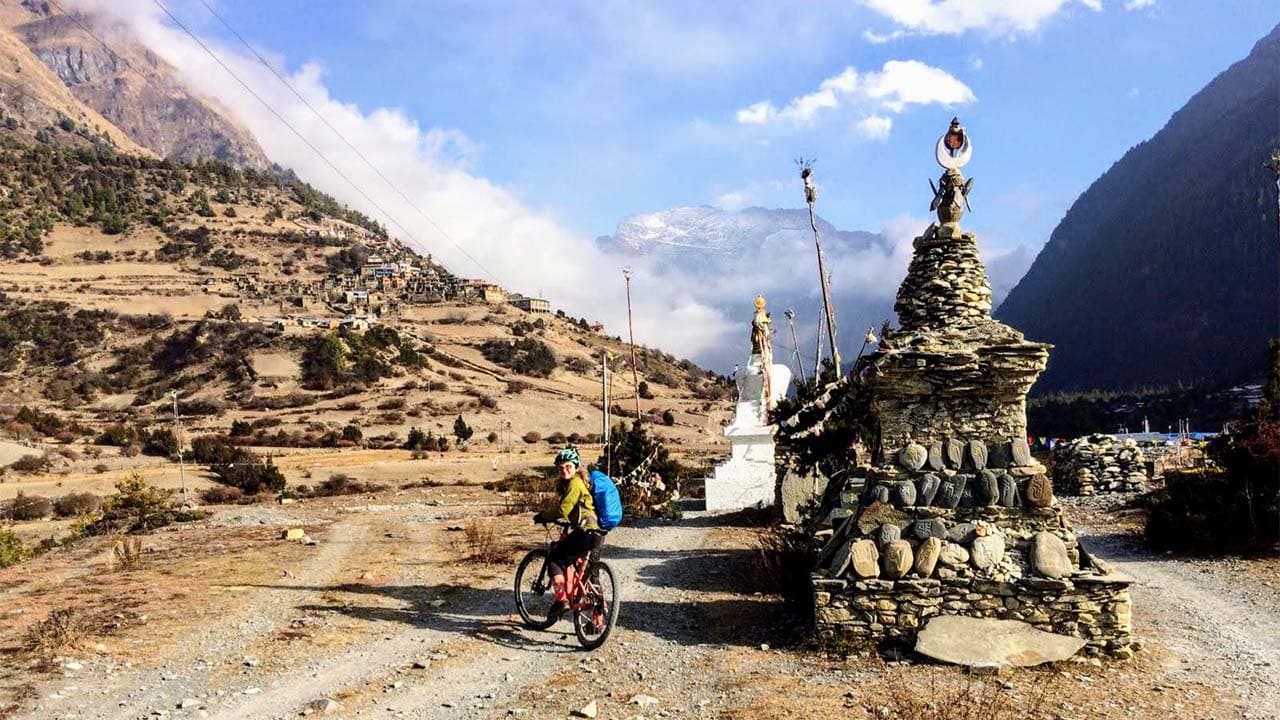
Walk your bike through village centres, monastery grounds and past chortens. Speed and dust in a village square are how tourism gets a bad reputation.
Pass chortens and mani walls with them on your right, which is the local practice.
Ask before photographing people or interiors. Some monastery chambers do not allow photography at all, and the answer is no for good reasons.
Give way to livestock, mule trains and horses. Stop, step off the trail on the uphill side, and let them pass.
Take your rubbish out with you. Waste disposal in Upper Mustang is basically non-existent, so what you bring in has to come back out.
Buy locally made items, and tipping is optional.
Why ride with Nepal MTB Adventures
We have guided riders across the Himalayas since 2004, more than 20 years on these trails, first as Pokhara Mountain Bike and now as Nepal MTB Adventures. We run the tours, own the bikes, and ride the trails ourselves.
Route knowledge from riding it, not from a GPS file. Our guides are active riders who check trail conditions, test route alternatives, and hold relationships with the communities along this route.
Built for mountain biking from scratch. This is not a trekking itinerary with bikes bolted on. The stage lengths, the acclimatization profile and the pass crossings are set around what works on a bike.
A real fleet. In-house Trek, Scott and Giant mountain bikes, with full-suspension and e-MTB options, maintained by our own workshop.
A mechanic who travels with you. Daily tuning, a full tool kit and spare parts on the route. A mechanic at 4,000 m in Tangge is not a place you want to be improvising.
Local employment as the default. Guides, mechanics, drivers, lodges and support crew are local and directly employed. We prioritise long-term employment, fair conditions and professional development across the team.
Support where the road allows it. 4WD backup, alternative routing and documented Plan B options on the hardest stages.
Book direct. Several international operators sell this exact route using Nepali ground services. You are booking the ground operator.
Route expertise and field review
This itinerary was designed by Nepal MTB Adventures specifically for mountain biking. It is reviewed by our senior guiding team rather than left to age on the website.
Reviewed by:
Laxman Sunar, Senior MTB Guide. Upper Mustang field experience: 15 years.
Sophiya Biswakarma, MTB Guide. Trail, field and mountain biking experience: 7 years.
Review focus: route suitability, riding difficulty, terrain, altitude exposure, bike setup, logistics, support access and alternative routing.
For each departure, the guide team reassesses route conditions before and during the expedition rather than relying on a fixed itinerary or an old GPS track. Himalayan weather, trail damage, and roadwork all change the ground. If we need to adapt or shorten a section to keep you safe, we will, and we will keep the character of the expedition intact while doing it.
Flight and weather contingency
Nepal's mountain flights, and the Pokhara-to-Jomsom leg in particular, operate in mountainous terrain and are affected by wind and visibility. Jomsom flights usually go early in the morning, before the valley wind builds, and cancellations do happen.
If the scheduled Jomsom flight is cancelled, we activate the agreed ground-support contingency using private vehicles and available road options, subject to weather and road conditions. The road to Jomsom exists and is drivable in normal conditions, so a cancelled flight usually costs time rather than the trip.
A documented alternative route may also be used when a high-pass crossing or a technical section is unsuitable due to weather, trail conditions, or rider conditions. Any additional hotel nights or transport that fall outside the booked package, and that are caused by circumstances outside our control, are payable by the traveller unless agreed otherwise in writing. This is standard across Himalayan operators, and it is worth having travel insurance that covers trip delay.
Package Options & Pricing
This is a private trip. It runs for your group only, on any start date that suits you. Choose Standard or Premium.
Bike options, upgrades and supplements
Bring your own bike (BYOB): USD 200 off the Standard package, USD 300 off the Premium package.
Full-suspension upgrade on Standard: USD 550 for the whole expedition.
E-MTB upgrade, either package: USD 750 for the whole expedition.
Single room supplement: USD 550 for private single-room accommodation, subject to availability. Single rooms are easy in Kathmandu and Pokhara and harder in the remote high villages, so request early.
Upper Mustang Tour Ride Map
The Upper Mustang mountain biking route takes you through the beautiful Kali Gandaki Valley to the ancient walled city of Lo Manthang. You will ride past small villages, apple orchards, and colourful canyons with views of the Himalayas along the way.
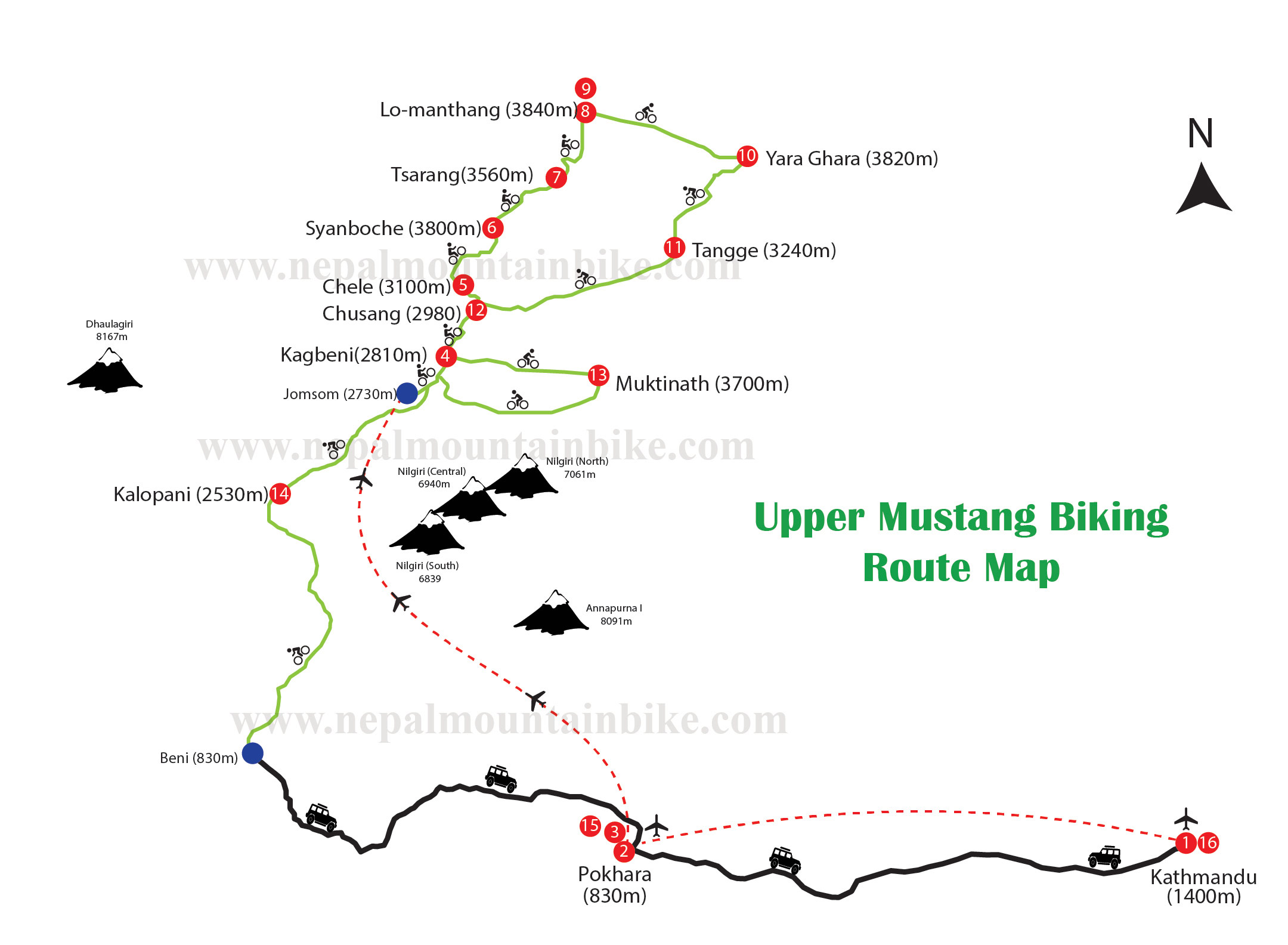
This map shows the main riding sections, overnight stops, and key highlights of your tour. If you need more details about the daily routes or want a GPX file for your device, let us know, and we will be happy to share it with you.
Book Your Tour Now!