

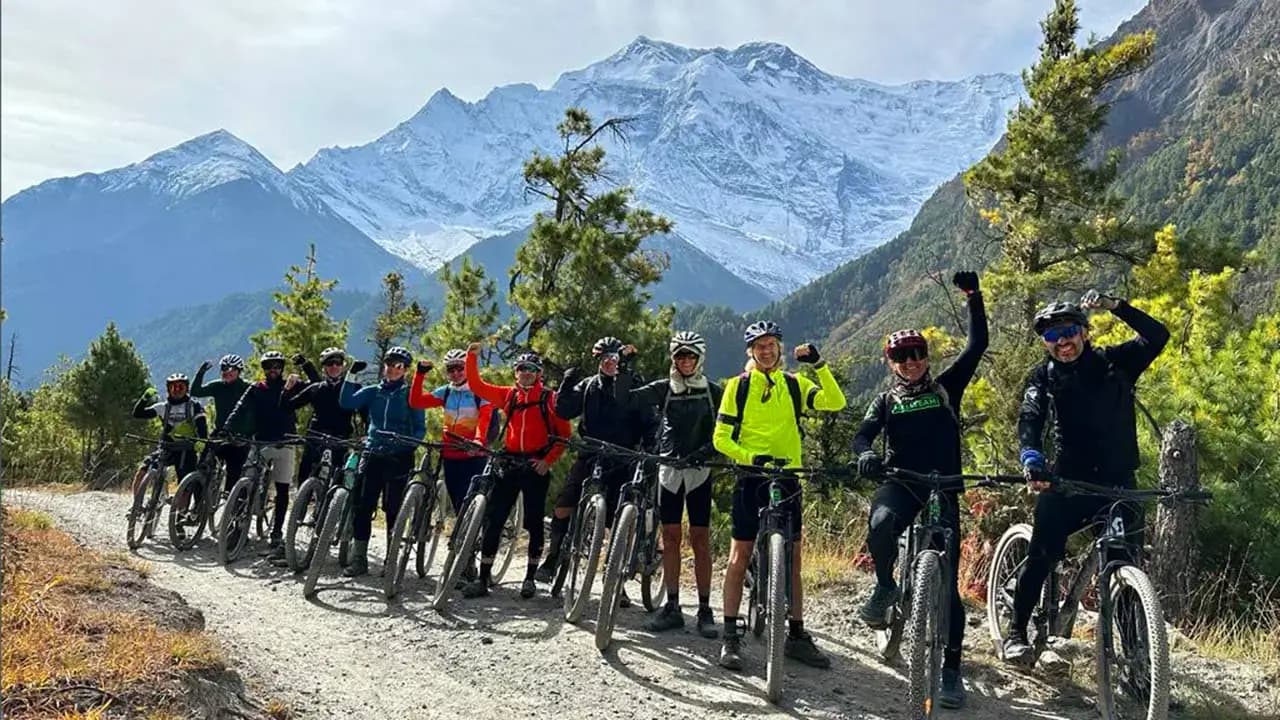
Nepal is a dream place to mountain bike, with Himalayan views, old trading trails, and descents that go on for hours. Once you decide to come, one question comes up fast. Should you book a guided trip, or rent a bike and ride on your own? Lots of riders ask this, and there is no single right answer. Some want the freedom to set their own pace and pick their own trails. Others want a guide who knows the routes and sorts out the hard parts.
Both can be the right choice. It comes down to where you want to ride, how much experience you have, and how much you want to plan yourself. The rules in Nepal matter too, because in a few areas a guide is required by law, while most day rides need nobody at all. We will guide you through the rules, the permits, the costs, and the regions you can ride alone, so you can decide with a clear head.
We do both, bike rentals and guided trips, so we are not here to push you one way. We just want you on the ride that suits you.
Guided vs self-guided at a glance
Before we get into the regions, here is the honest head-to-head. The right one depends on you.
What matters | Guided or supported | Self-guided |
Freedom and pace | Flexible with a good operator, but the plan is shared | Full control of your route, pace, and stops |
Navigation | The guide knows the current trails and the new roads | You rely on GPS files, offline maps, and route notes |
Permits and paperwork | Handled for you, and the only legal way into restricted areas | You arrange your own, and restricted areas are off limits |
Mechanical help | The guide carries spares and can fix problems | You carry the spares and fix them yourself |
Safety at altitude | Someone watches for altitude sickness and can call for help | You watch your own body, and help can be far away |
Bags and transfers | Often a support vehicle for luggage and dull road sections | You carry everything or arrange local jeeps yourself |
Cost | Higher, but more is included | Lower in open areas, about the same in restricted areas |
Best for | First-timers, high or remote routes, and restricted areas | Experienced, self-reliant riders in open regions |
This table shows what self-guided and guided riding look like. If you want our answer on which to choose, we have explained everything you need across this guide, so the final decision is yours to make.
Do you need a guide to mountain bike in Nepal? It depends on where you ride. Here is the quick version for the regions covered in this guide. For a wider look at the trails and routes behind each one, see our full guide to mountain biking tours in Nepal
Kathmandu Valley: no guide needed. Ride the valley rim on your own.
Pokhara: no guide needed. The classic day loops are open to everyone.
Lower Mustang (Jomsom, Kagbeni, Muktinath): open area, ridden independently every day.
Annapurna region (Circuit, Tilicho): a guide is required on paper since 2023.
Upper Mustang: a licensed guide is genuinely mandatory. There is no legal self-guided option here.
Everest region via Pikey Peak: rideable on your own, because it sits outside the national park.
Is a guide required to mountain bike in Nepal?
Here is the rule that changed everything, and that most riders have half-heard about. On 1 April 2023, the Nepal Tourism Board banned solo trekking on the routes covered by the trekking permit system. That sounds strict, and in some places it truly is. But the honest picture has three layers, and you need all three to make a smart decision.
First, some places genuinely require a guide, and the rule is enforced. These are the restricted areas, like Upper Mustang. You cannot even buy the permit as an individual. It only comes through a registered agency, with a licensed guide, and checkpoints do check.
Second, plenty of great riding needs no guide at all. The day loops around the Kathmandu Valley, and Pokhara sits outside the permit routes. You just pay a small park entry fee where one applies and ride. This is where most self-guided riders start.
For the exact restricted-area rules and the current permit fees, the official sources are the Nepal Tourism Board trekking permit page and the Department of Immigration. We cite these again in the region table below, because permit rules in Nepal have changed twice in the last year, and it is worth checking them close to your trip date.
A few rows need a plain word of explanation of the destinations.
Lower Mustang: Jomsom, Kagbeni, and Muktinath are open to ride without a guide-only permit. The restricted area begins north of Kagbeni.
Upper Mustang: The only restricted route on this list. A licensed guide and agency permit are required, and the two-person minimum was removed in 2026. Check the latest rules on the Nepal Tourism Board and Department of Immigration websites
Everest via Pikey Peak sits outside Sagarmatha National Park, where bikes are banned, so the Pikey ridge is open to ride. You will need a local municipality permit plus, on most routes, a conservation-area permit.
Kathmandu and Pokhara: No guide is needed for day rides, though guided rides are available. The Annapurna Circuit officially requires a guide, but checks for riders are generally relaxed.
What a guided route looks like, and what self-riding looks like
The choice is not only about rules and money. A guided day and a self-guided day simply feel different. Here is what each one looks like on the ground, so you can picture yourself in it.
A guided or supported route
A guided trip lets you focus on the riding while the operator handles the planning, logistics, and support. You still enjoy the adventure, but with local knowledge and help whenever you need it.
Airport pickup or local meet-up: Your operator meets you on arrival or connects with you if you're already in Nepal.
Trip planned for you: Daily distances, climbing, terrain, and accommodation are arranged before you start riding.
Ride with a licensed guide: Your guide chooses the best line and knows which trails are currently rideable.
Support vehicle (on many trips): Bags, tools, spare parts, and sometimes a spare bike travel with the vehicle, so you ride light.
Accommodation and meals sorted: Teahouses and lodges are booked in advance, with warm meals along the route.
Permits handled: Your guide or operator takes care of permits, paperwork, and checkpoints.
More riding, less climbing: Many enduro and downhill trips include jeep uplifts to maximize descents.
Safety and flexibility: Your guide monitors altitude, adapts to weather changes, and knows where to get medical help if needed.
You focus on the ride: You make the riding decisions while your guide manages the logistics.
A self-guided route
A self-guided trip gives you complete freedom to ride Nepal your own way. You choose the route, set your pace, and manage every part of the journey yourself.
Plan your own route: Load GPS tracks, download offline maps, and check for new roads before each ride.
Ride on your schedule: Travel solo or with friends, stop whenever you want, and choose your own pace.
Carry your own gear: Bring repair tools, spare parts, a pump, and a small first-aid kit, as bike shops are rare outside the cities. Our mountain biking checklist for Nepal covers what to pack.
Manage your own supplies: Carry enough cash, arrange your own water, and stay in teahouses along the route.
Navigate carefully: One wrong turn can add hours, so you'll rely on your maps and route planning.
Look after your own safety: Monitor altitude, weather, road conditions, and trail hazards throughout the trip.
Handle your own logistics: Accommodation, daily planning, and problem-solving are all part of the experience.
Most riders fall somewhere between these two approaches, which is why the supported middle ground further down exists.
To be clear, we are not trying to talk you out of self-guided riding. It is a great way to experience Nepal, and many riders rent a bike from us and do exactly that. This guide is simply an honest comparison of both options.
What a good guide actually does for you
Beyond the company, a guide knows their place in real, practical ways, especially the higher and more remote you ride.
Finding the right trail. New jeep roads often replace old trails. A local guide knows which routes are still rideable.
Rescue and repairs. In remote areas, there are no bike shops. A guide carries spares, fixes problems, and knows how to get you out.
Altitude safety. High passes like Thorong La (5,416 m) require careful pacing. A guide watches for altitude sickness and knows where to get help.
Permits and checkpoints. Guides handle permits and paperwork, and they are required for restricted areas.
Road support. Many guided trips include luggage transport, spare bikes, and lifts past long or unsafe road sections.
Help in an emergency. If you crash where there is no phone signal, a guide can get help quickly.
None of this means you must have a guide. It means you should be honest with yourself about which of these you can cover on your own.
What riding self-guided really takes
Self-guided riding in Nepal is very easy, and it is a brilliant way to travel if you are ready for it. But it asks more of you than a trip at home. Here is the honest checklist.
Navigation you can trust. You will lean the google maps and the locals for the location, direction, and everything.
Your own spares. Tubes, tyres, chains, and pads are easy to find in Kathmandu and Pokhara, and we keep them in our bike shop.
Altitude sense. Climb slowly, watch for altitude sickness, and be prepared to turn back if needed.
Cash and simple logistics. There are no reliable ATMs on most trails, so carry enough cash for the whole loop. Teahouses give you a bed and hot food, and English works on the popular routes, but food prices climb steeply the higher you go.
A plan for no signal. Long stretches near high passes have little or no phone coverage. Carry a local SIM, and tell someone your route and your dates.
If you are flying in, decide whether to bring your own bike as luggage or rent a good one here, sort a visa on arrival, and take out travel insurance that covers mountain biking and helicopter evacuation up to the altitude you plan to reach. That last point is not optional. A rescue flight can cost thousands of dollars.
Bring your own bike, or rent one in Nepal?
If you already own a mountain bike you love, you will wonder whether to fly with it or rent one when you land. Both work, and here is the honest trade-off.
Bringing your own bike gives you your exact fit, your setup, and a machine you trust.
Renting in Nepal skips almost all of that. You fly in light, with no bike fee and no worry about your own frame getting crushed in transit.
Our fleet runs from hardtails like the Trek Marlin 7 to full-suspension bikes like the Scott Genius 950 and e-MTBs like the Trek Rail 5, and you can check current rates in our bike rental price guide.
Here is the simple rule most riders follow. For a short trip, or any ride in the Kathmandu Valley, Pokhara, or the open Mustang regions, rent here and travel light. For a long expedition where your exact bike and setup really matter, and you are ready to carry your own spares, bringing your own can be worth the hassle. If you are not sure, tell us your plan, and we will give you a straight answer.
The middle path: rent from us and ride your own way
Here is the option we have for you. You do not have to choose between a full guided tour and going completely alone. You can rent a strong, well-kept bike and get just the support you want around it, then ride at your own pace.
This is exactly what our bike rental side is set up for. Here is what we offer independent riders. Tell us where you want to ride and how much support you want, and we build the rental around that.
So, which one is right for you?
In the end, it comes down to where you want to ride and how much you can handle on your own. Use this as a quick guide.
Go self-guided if:
You are an experienced rider who is comfortable navigating from a map and a GPS.
You can handle basic trailside repairs and carry your own spares.
You are riding the open regions, meaning the Kathmandu Valley, Pokhara, Lower Mustang, or the Pikey Peak side of the Everest region.
You want full control over your pace and your route, and you are happy sorting your own permits and logistics.
Book a guide, or take the supported middle path, if:
This is your first time riding in Nepal or at high altitude.
You are heading into Upper Mustang or any restricted area, where a guide is required by law.
You want technical trails you cannot easily find on a map, or you are unsure how hard a route is; our trail grading guide explains the levels.
You would rather not deal with permits, spares, and route-finding, and would rather just ride.
Rent a bike and ride your own line, join a guided trip, or take the middle path with support. Have a look at our destinations and rentals, or just message us with where you want to ride, and we will point you to the honest best option, even if that option is doing it yourself.
Is Nepal a good place to ride alone or self-guided?
Yes, and it may be the friendliest country you ever ride in. We say this with real pride. In Nepal, strangers greet you with a warm namaste, point you the right way when you look lost, and treat a guest almost like family. There is an old idea here that the guest is a form of god, and you feel it in small ways all day, from the tea a shopkeeper insists you take to the villager who walks you to the start of a trail.
We will still be honest with you. What makes Nepal hard is never the people. It is the terrain, the altitude, and the long gaps between towns on the high routes, which we cover in the sections above. So travelling here alone is easy on the heart and the social side. The care you need is on the practical side: the maps, the spares, the permits, and the altitude. Get those right, and Nepal is one of the best places in the world to ride on your own.
Frequently asked questions
Do I need a guide to mountain bike in Nepal?
It depends on where you ride. Day rides around the Kathmandu Valley and Pokhara need no guide, and open areas like Lower Mustang are ridden independently. Restricted areas such as Upper Mustang genuinely require a licensed guide, and that is enforced.
Can I mountain bike in Nepal without a guide?
Yes, across a lot of the country. The valley rides near Kathmandu and Pokhara, and open regions like Lower Mustang and the Pikey Peak side of the Everest area, are all ridden without a guide. You will still need permits in some places, which you can arrange yourself. The only hard no is the restricted areas, where a guide and a registered agency are required by law.
Is it safe to mountain bike alone in Nepal?
Yes, Nepal has low violent crime and friendly locals, so the danger is rarely other people. The real risks are rough terrain, altitude, and being far from help if you crash or break down. Ride within your ability, carry a repair kit and spares, take insurance that covers evacuation, and tell someone your route and dates.
Is Nepal safe for solo women riders?
Many solo women ride and travel in Nepal and have a great experience, and the country is generally welcoming. The same terrain and altitude cautions apply as for any solo rider, so plan your route, keep someone informed, and avoid isolated trails alone if you are unsure. Some riders prefer the peace of mind of a guide or a supported rental for the more remote sections. That is a personal call, and both are fine choices.
Do I need a guide for Upper Mustang?
Yes. Upper Mustang is a restricted area, so a licensed guide and a registered agency are mandatory, and the permit costs about USD 50 per person per day on top of the conservation permit. You cannot buy the permit as an individual, and checkpoints enforce this. The old rule that you needed at least two people was dropped in 2026, so a single rider can now go, but still only with a guide through an agency.
Is Lower Mustang a restricted area?
No. Lower Mustang, meaning Jomsom, Kagbeni, and Muktinath, is an open area. You need the standard conservation permit and a TIMS card, but there is no guide-only rule and no daily restricted fee. The restricted zone begins north of Kagbeni. This makes Lower Mustang the honest way to ride high Mustang scenery without the guide-mandatory permit.
Can I mountain bike near Everest?
Yes, in the right spot. Bikes are banned inside Sagarmatha National Park, the core Everest zone, but the Pikey Peak area sits outside that park in lower Solukhumbu. It runs on a ridge and jeep-track network under a local permit, plus a conservation-area permit on most routes, and biking is allowed there. So you can ride big Himalayan views near Everest without hitting the park ban.
Can an agency arrange my permits without a full guide?
For open areas, you can often sort the standard permits yourself, or an agency can help. For restricted areas, the permit legally comes only through a registered agency with a licensed guide, so there is no permit-only, guide-free version there. A good middle path is a supported rental, where we help with your permits and logistics for the open regions while you still ride at your own pace. Ask us what your specific route needs.
Will I get lost riding without a guide?
It is a real risk on Nepal's unmarked trail networks, where jeep tracks and footpaths cross constantly, and new roads keep appearing. Apps like Trailforks and Komoot help a lot, especially with offline maps downloaded before you ride, but a GPS line from last year can still send you the wrong way. Carry a backup map, ask bike shops for current route notes, and give yourself daylight buffer. If route-finding worries you, a guide or a supported rental with ready-made route files removes the problem.
What happens if my bike breaks in a remote area?
This is where riding with a good operator pays off. Out in remote valleys there are no bike shops, and modern spares run out fast once you leave Kathmandu or Pokhara. We plan for that: we run our own workshop and keep a large stock of parts, from tubes, tyres, and pads to hangers, chains, and drivetrain spares, so every bike we rent or ride goes out well set up. On a guided or supported trip, your guide carries spares and doubles as a mechanic; our support vehicle can bring more, and we can get a part or even a replacement bike out to you. If you ride fully self-guided, we still send you off with the key spares and show you how to fit them, so a mechanical does not have to end your trip.
When is the best time to mountain bike in Nepal?
The two prime seasons are spring, roughly March to May, and autumn, roughly September to November. Both bring stable weather and clear mountain views. Avoid the monsoon from June into September, when trails turn to mud and leeches and views vanish behind cloud. Winter riding is possible at lower elevations but cold and sometimes snowy up high.
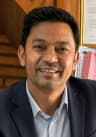
A word from our director, Jagan Bishwokarma
The rest of this guide gave you the facts. This last part is from Jagan Bishwokarma, who runs Nepal MTB Adventures and has ridden and guided these trails for years.
The choice is yours, guided or self-guided, and we welcome you for both. Some riders want a guide beside them the whole way, and some want to rent a good bike and ride off into the hills on their own. Both are welcome here, and we are glad to set up either one for you.
I have noticed that many riders lean toward self-guided because of something that happened to them somewhere else. In a lot of countries, a guide can mean strict rules, a fixed pace, and being told what you can and cannot do. If that is what a guide has meant for you before, I understand completely why you would rather go it alone.
But it is different in Nepal, and it is different with us. Here is what riding with our team actually feels like.
Friendly staff who treat you like a riding partner, not a customer to be managed.
No rigid rulebook. We match the route and the pace to you; we do not force you into ours.
Guides who are local riders themselves, so they know the trails, the quiet shortcuts, and the best places to stop. You can meet the team before you book.
Real flexibility. If you want a bigger day, a rest day, or a change of plan on the morning, we make it happen.
Problem-solvers. When a flight gets cancelled, or a bike acts up, we sort it out fast so your trip is not wrecked.
Honest advice. If self-guided is truly the better fit for you, we will say so, and we will still set you up with a great bike.
So please do not let one bad experience from another country decide this for you. Come and ride with people who love these mountains as much as you do, and do it on your own terms.
You do not have to take my word for it. Read what our riders say on Google reviews and on TripAdvisor, then come and see for yourself.