

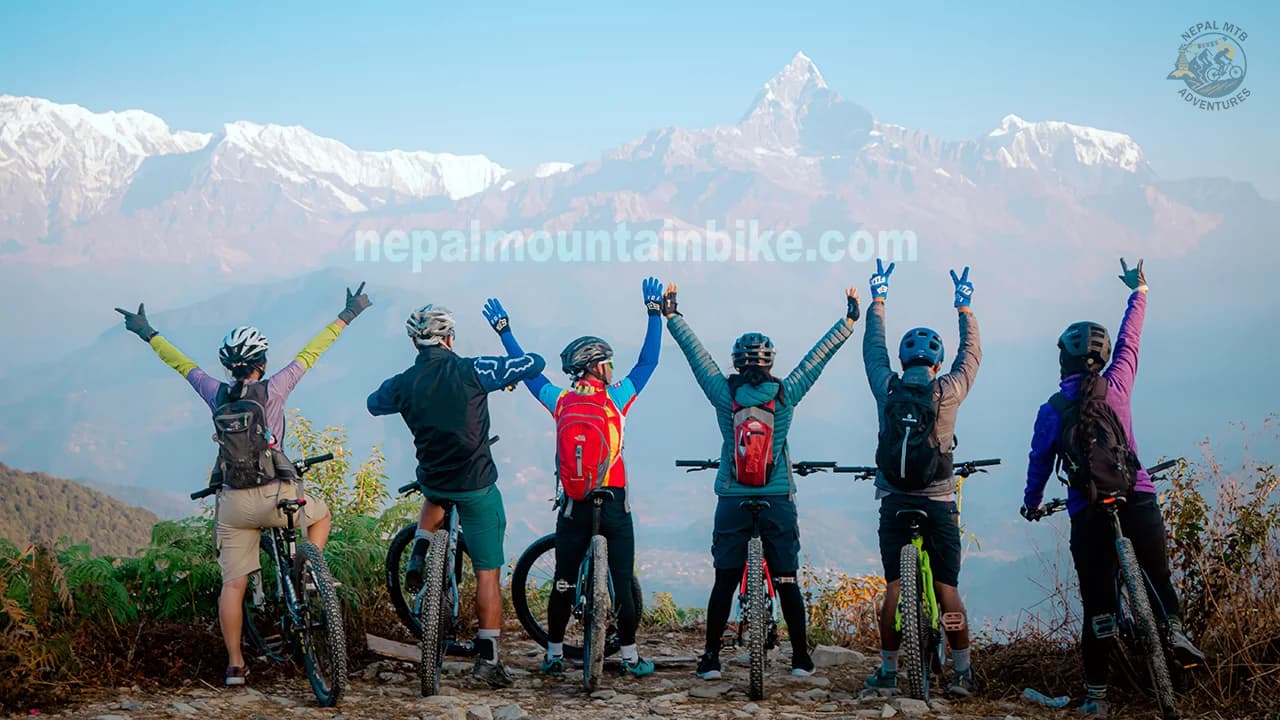
Everything we tell riders before a bike tour in Nepal, from the Pokhara guiding team that has run them since 2004.
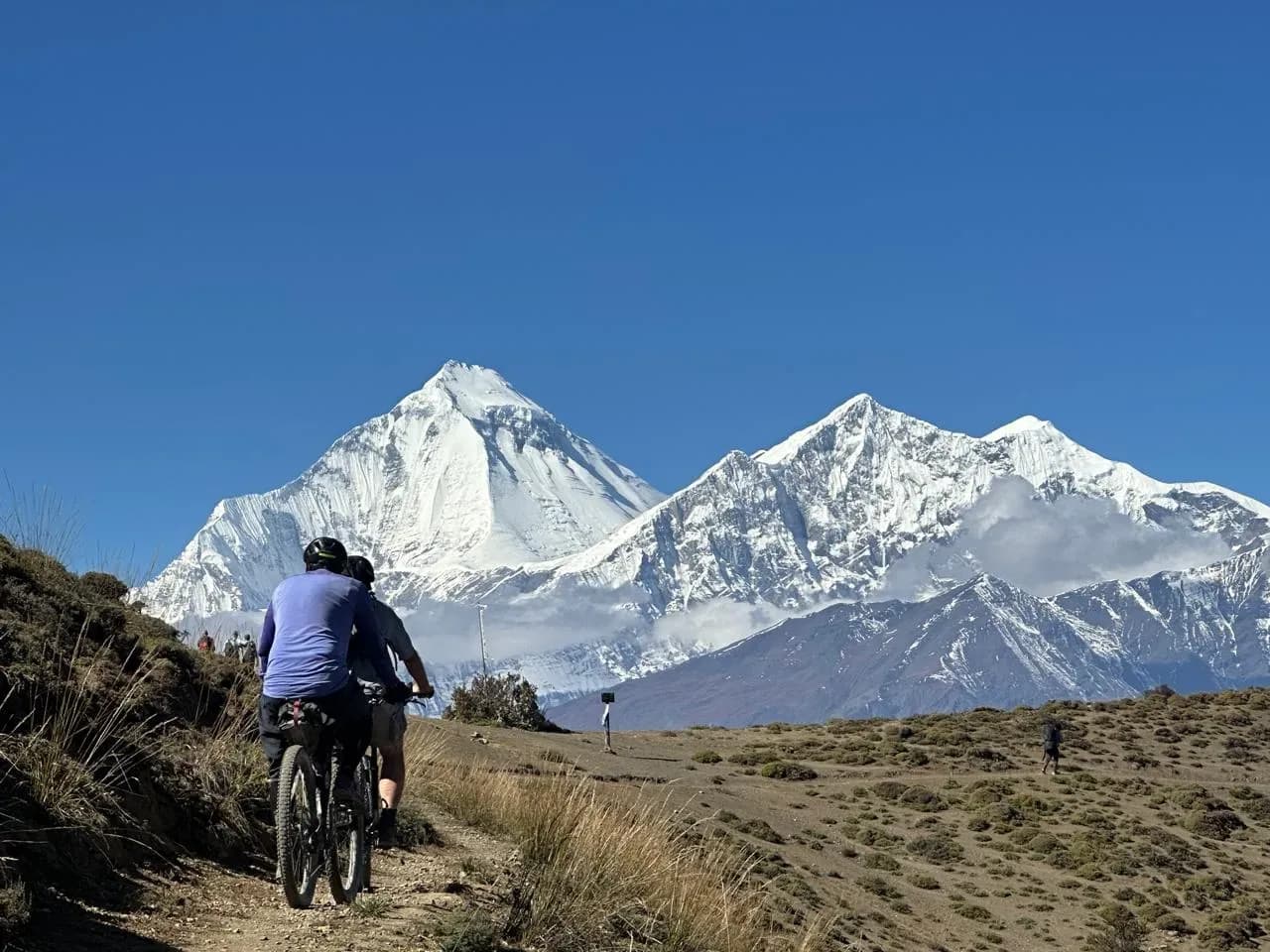
Picture yourself at 5,416 metres (17,769 ft) on Thorong La, the high pass of the Annapurna Circuit, with your bike beside you. Ahead is a 1,616-metre (5,302 ft) descent to the temple town of Muktinath. A week earlier you were riding past rice terraces and banana trees. That's mountain biking in Nepal: warm valleys to high desert, ridden on trails that people have walked for centuries.
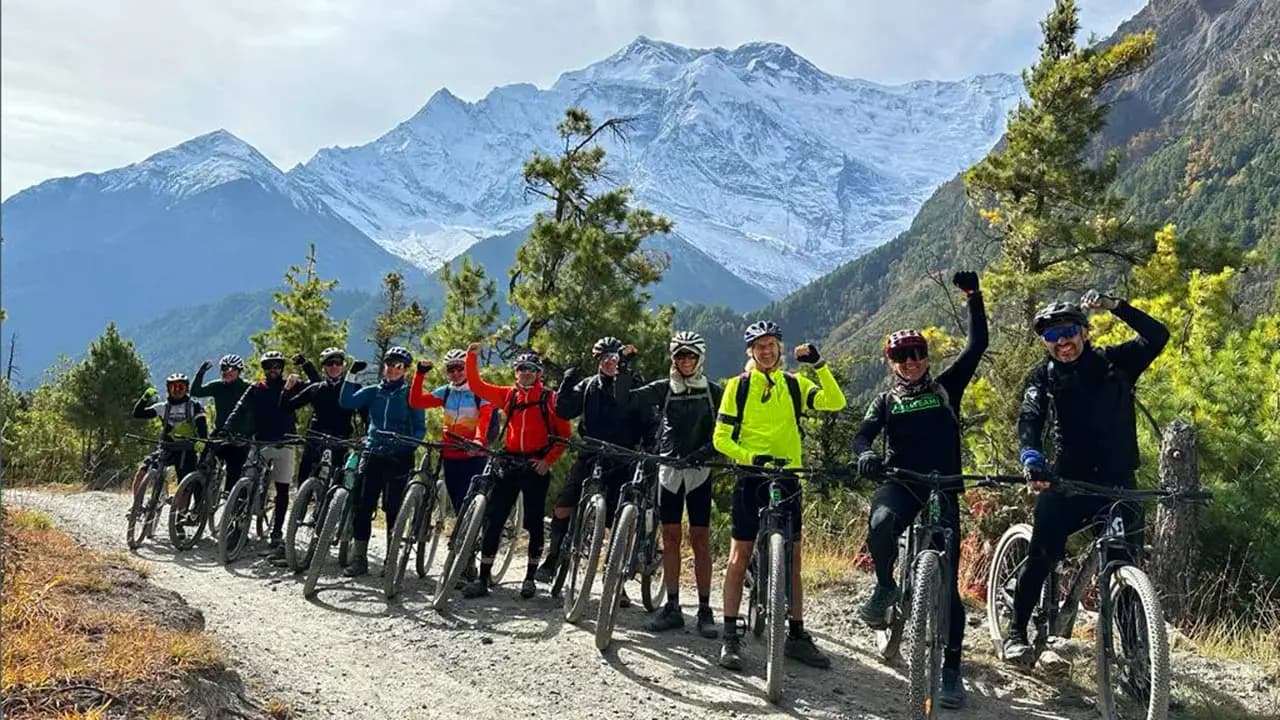
Most riders see it on a guided mountain bike tour. We've been running them from Pokhara since 2004, and this guide is the briefing we give every rider who asks us where to start. It explains how a tour works, the types of tours, how to choose one, how to prepare, what life on the trail is like, and how booking works. Read it in order, or jump to the part you need.
Nepal mountain bike tours in brief
Length: from a half-day ride to a 17-day expedition
Best seasons: October to November and March to May. Mustang also rides well in the June to August monsoon.
Riding: old footpaths, village trails, singletrack and jeep track. Expect some walking with the bike.
What we arrange: your licensed guide, permits, bike, mechanic, support vehicle, transport, hotels, lodges and meals on riding days
What you bring: fitness, insurance that covers mountain biking at altitude, and your riding kit
Altitude: from 800 m (2,600 ft) around Pokhara to 5,416 m (17,769 ft) on Thorong La
Why Nepal for mountain biking
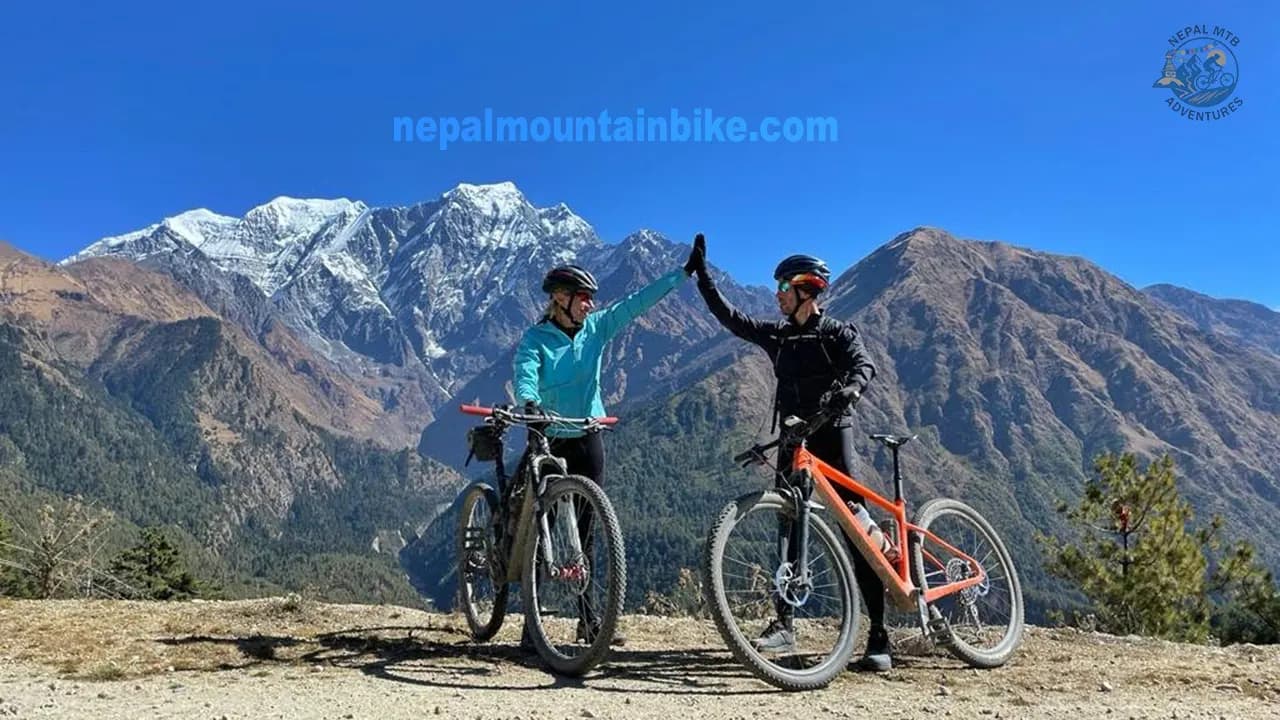
In Nepal, you can ride from warm, green valleys to high mountain desert on one trip. You ride old village trails with huge descents, and you sleep in a lodge every night, even high in the Himalaya.
What Nepal gives a rider | What it means on the bike |
|---|---|
A huge range of heights | Rice terraces, pine forest and high desert on the same trip |
Long descents | Drops of 1,000 m (3,300 ft) or more in one go |
Trails people built, not machines | Natural, varied riding that changes every day |
Lodges along the main routes | Riding high with a day pack instead of camping gear |
Villages, monasteries and mountain culture | Riding through places people live, not just landscapes |
Riding somewhere in every season | Valleys in winter, the rain shadow in the monsoon |
The land rises from jungle to the highest mountains on earth
From south to north, Nepal is on average less than 200 km (125 miles) wide. In that short distance, it climbs from about 60 metres (200 ft) on the southern plains to 8,849 metres (29,032 ft) at the top of Everest. Eight of the world's fourteen 8,000-metre peaks stand on or inside its borders.
For a rider, that means a single tour can pass through several climate zones. You might start among rice fields and banana trees, climb through oak, pine and rhododendron forest, and finish in bare, wind-cut desert in Mustang. The landscape changes so fast that most days feel like a new country.
The descents are long
When you ride down from the high country, the descents keep going. Thorong La to Muktinath on the Annapurna Circuit drops 1,616 metres (5,302 ft). Descents of 1,000 metres (3,300 ft) and more are normal on our mountain routes, and on the Pokhara ridges you can drop from the viewpoints almost to the lake. This is why good brakes, strong tyres and a well-set-up bike matter so much here.
The trails are old footpaths, not built trail centres
Almost everything you ride in Nepal is a path that has linked villages for centuries. Farmers, traders, pilgrims and mule trains still use them. Nobody shaped the corners or graded the climbs, so the riding is natural and never repeats: stone steps, roots, loose rock, flowing ridgelines and smooth village singletrack, sometimes all in one morning. Some sections can't be ridden, and that's part of it. You'll push and carry the bike now and then.
You can ride high without carrying a camp
Along the main routes there's a lodge, called a teahouse, every few hours. Families run them, and they serve hot meals, have simple rooms, and a warm stove in the dining room. That means you can ride at 4,000 metres (13,100 ft) with a normal trail bike and a day pack. You don't need a tent, a stove or a loaded bike. On our tours, the support vehicle carries your main bag wherever there's a road.
You ride through living culture
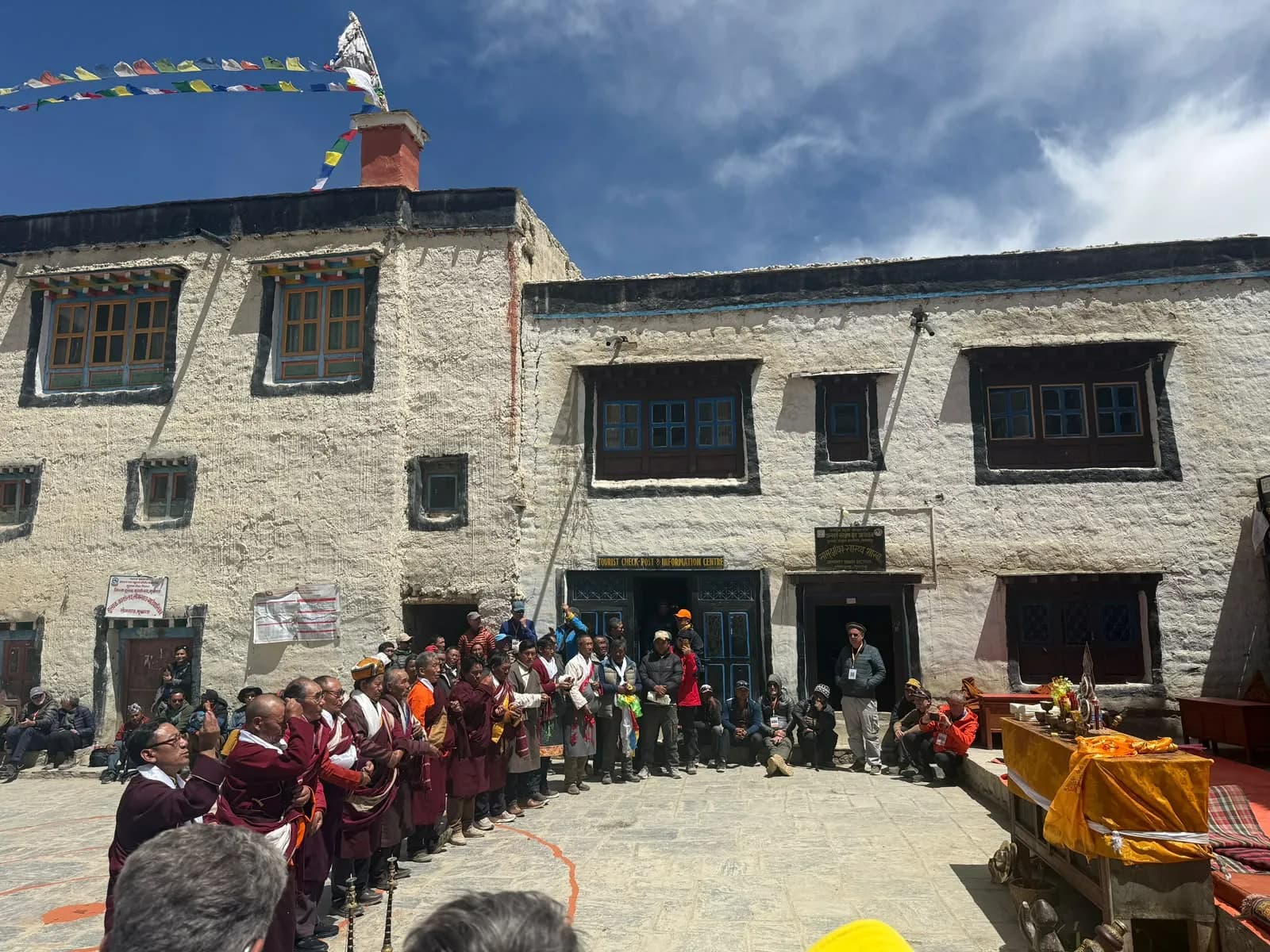
Nepal is home to more than 120 ethnic groups. On one tour, you can ride past Hindu temples in the Kathmandu Valley, Gurung and Magar hill villages above Pokhara, and Tibetan Buddhist monasteries, prayer walls and prayer flags in Manang and Mustang. You stop for tea in villages, share the trail with school children and mule trains, and stay in family homes. The culture isn't a side trip. It's along the trail all day.
There's riding in every season
Nepal has two main riding seasons, October to November and March to May. In the June to August monsoon, Upper and Lower Mustang sit in the rain shadow behind the Himalaya and stay mostly dry. In winter, from December to February, the high passes close, but the valleys around Pokhara and Kathmandu are clear, quiet, and very good to ride. Whenever you come, there's a route that works.
Pokhara is a riding town
Pokhara sits beside Phewa Lake at about 820 metres (2,700 ft), with the Annapurna range filling the skyline to the north. You can ride trails from town in the morning and be back at the lake for lunch. It's also where most of our multi-day tours start, and where our bike fleet, workshop, and team are based. If you only have a few days in Nepal, Pokhara alone is worth the trip. Read more about mountain biking in Pokhara.
The landscape is full of wildlife
Nepal's height range gives it a huge variety of plants and animals. Riding toward Chitwan, you may see one-horned rhinos, deer, and crocodiles. In the middle hills there are langur monkeys and hundreds of bird species, and in spring the rhododendron forests turn red and pink. In Mustang, blue sheep graze on slopes that look too dry to hold anything. Much of the riding passes through conservation areas and national parks set up to protect all of this.
How our mountain bike tours work

What we arrange for you
Short answer: everything except your flight to Nepal, your insurance and your riding kit.
Nepal is easy to ride in and hard to organize from home. The best trails are unsigned footpaths, permits are issued in Kathmandu and Pokhara, and some areas only let foreign visitors in with a licensed guide. On a multi-day tour, we take care of:
What | How we handle it |
|---|---|
Guide | A licensed, English-speaking mountain bike guide. Leaders on multi-day trips are Wilderness First Responder (WFR) trained. |
Permits | We get every permit your route needs before you arrive and carry them through the checkpoints. |
Bike | If you rent, we set the bike up for you on day one: saddle height, brake levers, suspension. |
Mechanic | On supported routes, a mechanic rides with the group with spare parts. |
Support vehicle | Where there's a road, our vehicle carries your main bag, water and spares, and has room for anyone who needs a break. |
Transport | Airport pick-ups, transfers and flights inside Nepal. |
Where you sleep | Hotels in Kathmandu and Pokhara. Family-run mountain lodges, called teahouses, on the trail. |
Food | Breakfast, lunch and dinner on riding days. |
A day on tour
Short answer: 4 to 6 hours on the bike, a lunch stop in a village, and a lodge by mid-afternoon.
Time | What happens |
|---|---|
6:30 | Wake up. Bags packed and handed to the crew. |
7:00 | Breakfast. Your guide goes through the day: distance, climbing, and where the hard sections are. |
7:45 | The mechanic has checked your bike. You set off with a small day pack. |
Morning | Riding at your own pace. Your guide regroups everyone at junctions and before technical sections. |
12:00 | Lunch in a village teahouse, often dal bhat (rice and lentils). |
Afternoon | More riding. On mountain routes, the day often has 700 to 1,200 metres (2,300 to 3,900 ft) of climbing. |
15:00 to 16:00 | Arrive at the lodge. Your bag is already there. Shower, rest, explore the village. |
18:30 | Dinner around the stove in the lodge dining room. Briefing for tomorrow. |
> Guide's tip. Hike-a-bike, which means pushing or carrying your bike, is part of riding in Nepal. On some routes you'll carry your bike for an hour to reach a descent that lasts two. If a section is beyond you, walk it. Our guides do the same.
Our trail lines
Jeep roads now run up many Himalayan valleys. Where a road has replaced the old trail, our team has spent years mapping other lines along walking paths, the Natural Annapurna Trekking Trails (NATT) and connecting ridges. That way, more of your tour is on singletrack and less on dusty roads. Most multi-day trips still include some jeep track, and we tell you how much before you book.
Types of mountain bike tours

Tour type | Length | Who it suits |
|---|---|---|
Day tour | Half day to 1 day | First-timers, short stays, anyone testing the trails |
Overnight and short tour | 2 to 5 days | Riders who want a village night without two weeks off |
Multi-day expedition | 10 to 17 days | Fit riders who want the big Himalayan routes |
E-MTB tour | 1 to 16 days | Mixed-fitness groups, riders returning from injury |
Enduro and downhill | 3 to 7 days | Confident riders who mainly want descents |
Heli-biking | Part of a 10-day trip | Riders who want the most descending in the least time |
Hike and bike | 17 days | Riders happy to walk as well as ride |
Family tour | 1 to several days | Parents, children, and less keen riders |
Day tours.
We pick you up from your hotel in Pokhara or Kathmandu, ride a loop or a point-to-point route, and drop you back by evening. They run in most months. See our guided day tours in Pokhara, such as the Sarangkot day tour and the easier Pame Valley ride, and the Kakani Sky Trail in Kathmandu.
Overnight and short tours.
A night or two in a village lodge, with a big ride on each side. See overnight mountain bike trips from Pokhara and the two-day Royal Trek ride.
Multi-day expeditions.
The classic Nepal mountain bike tour: valleys, villages and often a high pass, with a guide, a mechanic and the support vehicle wherever there's a road. All of them are on our mountain bike tours page.
E-MTB tours.
An electric mountain bike helps on the climbs. It doesn't ride the descents for you. Many lodges run on solar, so on our e-MTB tours we carry spare batteries and chargers in the support vehicle. Airlines don't carry e-bike batteries, so you'll ride one of our e-MTBs. See e-MTB tours in Nepal and regular MTB or e-MTB.
Enduro and downhill.
We use jeep uplifts so you spend more of the day riding down: shuttle trails close to Pokhara, and long forest descents at Pikey Peak in the lower Everest region. See the enduro and downhill guide, the 3-day Pokhara enduro tour, and the Pikey Peak tour.
Heli-biking.
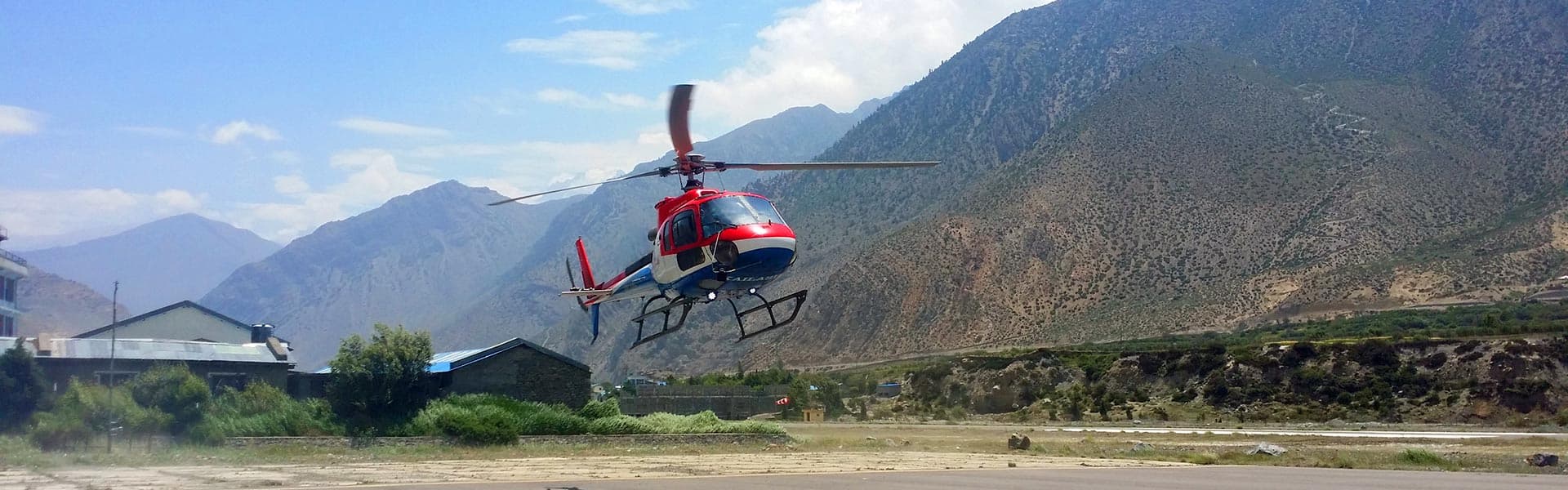
A helicopter lifts you and your bike to the top of a descent that would otherwise take days to reach. See heli enduro and all-mountain riding and the Mustang heli-MTB tour.
Hike and bike.
Some of the best places in Nepal are part ride, part walk, so we plan for both. See the Annapurna Circuit hike and bike with Tilicho Lake.
Family tours.
Low-altitude valley rides, shorter days, and a vehicle that picks up anyone who's had enough. See family mountain bike tours in Nepal.
Choosing your tour, step by step

Match the tour to your riding
Short answer: be honest about how you ride at home on loose, rocky trails, and about how you handle back-to-back long days.
Your riding | Start with | Wait before |
|---|---|---|
New to mountain biking or out of practice | Pokhara and Kathmandu day tours, family tours | Anything above 3,000 m (9,840 ft) |
Intermediate: happy on rocky, loose trails, fine with walking sections | Overnight Pokhara rides, Pokhara to Kathmandu, Pokhara to Chitwan, e-MTB tours | Pikey Peak, the Annapurna Circuit |
Strong intermediate to advanced: long days in a row, steep descents | Lower Mustang, Upper Mustang, the Pokhara enduro tour | |
Advanced and fit at altitude | The Annapurna Circuit, Tilicho Lake, Pikey Peak, heli-biking |
Altitude changes how a trail feels. A moderate trail at 4,500 m (14,760 ft) is a different ride from the same trail at 1,400 m (4,600 ft). Our trail grading guide explains the grades we use.
Match the tour to your time
Time you have in Nepal | Tours that fit |
|---|---|
1 to 2 days | A day tour from Pokhara or Kathmandu |
3 to 5 days | An overnight ride, or several-day tours from Pokhara |
7 days | Pikey Peak enduro, or a block of Pokhara and Kathmandu riding |
10 days | |
11 days | |
15 to 17 days |
Add a spare day at each end of your trip. The first is for jet lag and bike setup. The last covers delays: mountain flights, especially to Jomsom, often wait for the weather.
Choose what you want to see
Tour | Highest point | What it's about |
|---|---|---|
Pokhara Valley | about 2,050 m (6,725 ft) | Lakes, ridges and big views of the Annapurna range from close to town |
Kathmandu Valley rim | about 2,780 m (9,120 ft) | Forest singletrack, temples and Newar villages |
about 2,000 m (6,560 ft) | Middle-hill villages away from the tourist routes | |
about 2,030 m (6,660 ft) | From mountain views down to jungle and rhinos | |
about 3,800 m (12,470 ft) | The Kali Gandaki gorge, apple orchards, Thakali villages | |
4,065 m (13,337 ft) | Forest descents and Everest views | |
about 4,920 m (16,140 ft) | One of the world's highest lakes | |
5,416 m (17,769 ft) | The full circuit of the Annapurna range and the Thorong La pass | |
about 4,200 m (13,780 ft) | Tibetan culture, red cliffs and the walled town of Lo Manthang |
More detail on each area: mountain biking in Pokhara, around Kathmandu, Annapurna, and the day-by-day Circuit itinerary, the Lower Mustang guide, the Upper Mustang guide. To see the trails themselves, read the top Himalayan mountain biking trails in Nepal.
> Good to know. Mountain bikes aren't allowed in Sagarmatha National Park, the core Everest area, so no bike tour can go to Everest Base Camp. For Everest views from the bike, we ride Pikey Peak, just outside the park.
Pick your month
Short answer: October and November are best, then March to May. In the June to August monsoon, ride Mustang.
Month | Riding |
|---|---|
January, February | Cold and very clear. High passes closed by snow. Quiet, good valley riding around Pokhara and Kathmandu. |
March | Clear and cool. Rhododendron forests start to flower. Good on lower and middle-hill routes. |
April | Warm and settled, flowers at their best, some haze on the mountains. Good on every route. |
May | Hot in the valleys, very good up high. Upper Mustang's Tiji festival usually falls in May. |
June to August | Monsoon: rain, mud, leeches, and landslides on most routes. Upper and Lower Mustang sit in the rain shadow behind the mountains and stay mostly dry. |
September | The monsoon is ending. Trails can be wet early in the month. |
October | Our best month: clear air, dry trails, mountains visible every morning. The busiest, so book early. |
November | Nearly as good as October, quieter, with colder nights up high. |
December | Cold and clear. High routes get difficult. Valleys are quiet and pleasant. |
Month-by-month detail, including festivals, is in our best time to mountain bike in Nepal guide.

Choose group, private, or custom
Group departure. You join a small group on fixed dates. Guide, vehicle, and permits are shared, so it costs less per person.
Private tour. Just your group, on your dates, at your pace. Best when riders in the group have different abilities.
Custom tour. We build the route around what you want to ride. Most of our returning riders end up here.
Riding on your own? That's possible on short rides around Pokhara and Kathmandu, and we rent bikes for it. Most multi-day routes cross protected areas where a licensed guide is required. Our guided or self-guided guide explains it area by area.
Choose your bike
Short answer: for trips under two weeks, rent ours. If you want an e-MTB, you have to rent.
What works on Nepali trails. A trail or all-mountain bike with 120 to 160 mm of travel suits almost every multi-day route. A hardtail is fine for valley rides and lighter to carry. A full-suspension bike is much kinder on the long rocky descents in Mustang, on the Annapurna Circuit and at Pikey Peak. Our best bike for the Annapurna Circuit post compares hardtail, full suspension, and e-MTB.
Renting from us. Our bikes are serviced in our own workshop in Pokhara. If something breaks on tour, you get a replacement bike, not just a repair. See the bikes on our bike rental page, in mountain bike rental in Pokhara, and in e-MTB rentals in Nepal.
Bringing your own. Worth it if fit matters a lot to you, if you're riding technical terrain, or if you're staying several weeks. Before you fly:
Check your airline's bike fee, both ways.
Fit tubeless tyres with tough sidewalls, fresh four-piston brake pads, and your lowest gearing.
Pack a spare derailleur hanger for your frame. Shops in Nepal are unlikely to stock it.
Bring it to our workshop on arrival, and we'll check it over before the tour.
Preparing for your tour

Permits
Short answer: we arrange all your permits. You send us a passport scan and photos, and we do the rest.
Permit | Needed for | Fee | Who arranges it |
|---|---|---|---|
ACAP (Annapurna Conservation Area Project) | Annapurna Circuit, Tilicho Lake, Lower and Upper Mustang, many Pokhara overnight routes | NPR 3,000 for foreign visitors | We do |
Upper Mustang restricted area permit | Upper Mustang | USD 50 per person per day inside the area, no minimum stay | We do. It's only issued through a registered agency. |
TIMS card | Some routes; the rules change often | Varies | We do, when your route needs it. Individuals can no longer buy it. |
Shivapuri Nagarjun National Park entry | Some Kathmandu Valley rim rides | An entry fee plus a separate bike fee | Included on our tours. Carry rupees if you ride there on your own. |
Guide rule. Since 1 April 2023, foreign visitors in Nepal's protected areas must go with a licensed guide, and the rule covers cyclists as well as trekkers. In Upper Mustang, your licensed guide must be with you for the whole trip. Solo riders can now get the Upper Mustang permit, as long as they ride with a guide. Every guide on our tours is licensed.
What we need from you: a scan of your passport, two passport photos, and your travel insurance details. Send them when you book.
Fees change, and we always charge permits at the current rate. Full details on the Upper Mustang permit are in the Upper Mustang guide.
Travel insurance
Short answer: you can't join a tour without it, and it must cover mountain biking, your route's altitude, and helicopter rescue.
Check your policy against this list:
Covers mountain biking as an activity (many standard policies exclude it)
Covers you to the highest altitude on your route: 5,416 m (17,769 ft) for the Annapurna Circuit, about 4,920 m (16,140 ft) for Tilicho Lake
Includes helicopter evacuation from the mountains
Includes medical treatment and repatriation
Covers the full dates of your trip, including the spare days
Read the policy wording, not just the summary. If you're unsure, send it to us before you book and we'll tell you whether it fits your route
Fitness and training
Short answer: if you can ride 4 to 6 hours with 1,000 metres (3,300 ft) of climbing, and do it again the next day, you're ready for most routes.
You don't need to be an expert rider. You do need to be relaxed on loose, rocky, narrow trails and happy to walk sections. On multi-day tours, fitness matters more than skill. The challenge isn't one hard day; it's several in a row.
A 12-week plan for a multi-day tour
Weeks | Focus | What to do |
|---|---|---|
1 to 4 | Base | Ride 3 times a week. One longer ride of 2 to 3 hours, mostly steady climbing. |
5 to 8 | Build | Long ride of 3 to 4 hours with 800 to 1,000 m (2,600 to 3,300 ft) of climbing. One back-to-back weekend. |
9 to 11 | Tour practice | Two back-to-back long weekends. Practise pushing and carrying your bike uphill for 20 to 30 minutes. Ride technical descents tired. |
12 | Rest | Short, easy rides. Arrive fresh. |
You can't train for altitude at sea level, so don't try. Arrive fit, and our itinerary handles the rest. On an e-MTB, the climbs are much easier, but you still need the skill for the descents.
Altitude
Short answer: we plan your itinerary so your body has time to adjust. Your job is to tell your guide early if you feel unwell.
Above about 3,000 metres (9,840 ft), the air holds less oxygen. You can ride uphill faster than you could walk, so on a bike it's easy to gain height faster than your body can adapt.

How we plan for it
We plan around the height you sleep at, not the highest point you ride to.
Above 3,000 m, your sleeping height goes up by about 500 m (1,640 ft) a night at most.
We build in rest days. On the Annapurna Circuit, that means a full day in Manang before Thorong La.
Your guide checks on every rider each morning and evening.
Signs to tell your guide about straight away
A headache that doesn't clear with water and rest
Nausea, dizziness, loss of appetite, poor sleep
These are early signs of acute mountain sickness (AMS). We stop going higher until they clear.
Serious signs: confusion, loss of balance, breathlessness while resting, or a wet cough. We take you down straight away, by helicopter if needed. Descending is the treatment.
> Guide's tip. Don't hide a headache to keep up with the group. Mentioned on day six, it might mean a rest day. Hidden until day eight, it can mean an evacuation.
What to pack
Short answer: your riding kit and warm layers. We send a full list when you book.
Riding kit
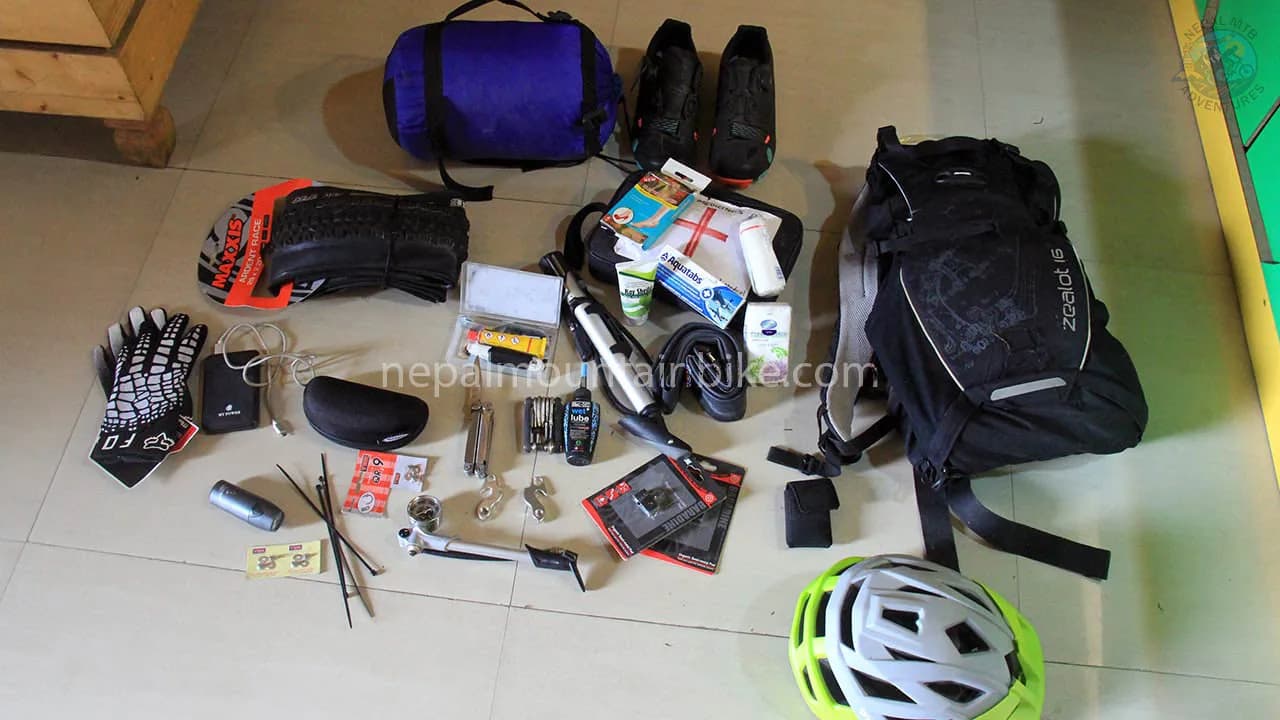
Certified mountain bike helmet (required)
Knee pads (strongly advised for Mustang and Pikey Peak)
Full-finger gloves, padded shorts, quick-drying tops
Sunglasses with strong UV protection
Riding shoes that are comfortable to walk in
Layers
Warm mid layer: fleece or light down jacket
Waterproof, windproof shell
Warm down jacket for evenings on high routes, where mornings can be well below freezing
Warm hat and gloves
Small things that matter
2 to 3 litre hydration pack and water purification tablets
Power bank
Sun cream, lip balm, personal medicines and a small first aid kit
If you bring your own bike: spare hanger, two tubes, tubeless plugs, multi-tool
The full list, season by season, is in our mountain biking checklist for Nepal.
Getting to Nepal
Flights. Almost every rider flies into Kathmandu. We meet you at the airport.
Visa. Most nationalities can get a visa on arrival at Kathmandu airport. Bring a passport photo and cash in a major currency for the fee, or fill in the online form before you fly.
Kathmandu to Pokhara. Most of our tours start from Pokhara. It's a 25-minute flight or a 6 to 8-hour drive, and we arrange either.
Money. Nepal uses the Nepali rupee (NPR). ATMs and cards work in Kathmandu and Pokhara. Higher up, lodges take cash only, so draw enough before the trail.
Phone. A local SIM card from the airport gives cheap data in towns. Signal fades above the main valleys.
Life on tour
Where you sleep and what you eat
In Kathmandu and Pokhara you stay in hotels. On the trail you stay in teahouses: family-run lodges with simple twin rooms, often a shared bathroom higher up, and a warm dining room with a stove. On a few remote sections, the lodges are very basic.
Food is plentiful and mostly carbohydrates, which is what you need. Dal bhat (rice with lentil soup, vegetables and pickle) is Nepal's everyday meal, and second helpings are normal. Lodges also serve noodles, soups, pasta, eggs, porridge and bread. Vegetarians eat well everywhere. Higher up, many riders skip meat, because it has often travelled a long way without a fridge.
Drink more than you think you need. Altitude and dry air dry you out fast.
> Guide's tip. Lodges higher up often charge a small fee for hot showers, phone charging, and Wi-Fi. Keep some rupees in small notes.
Safety on the trail
Guides. Leaders on multi-day trips are WFR-trained, and every guide carries a full first aid kit.
Bikes. We check bikes before the tour and every evening. Our mechanic carries spares for common breakages: hangers, brake pads, chains, tubes and tyres.
Support. On supported routes, the vehicle follows the group with water, food and room for a tired rider.
Communication. Mobile signal disappears above the main valleys, so we carry satellite communication on remote routes
Weather. Storms build in the afternoon, Mustang can be very windy, and snow can close a high pass in any month. We start early and change the plan when we need to. Your guide makes that call.
Your part. Ride within your limits, follow your guide on technical sections and through villages, and tell us straight away if anything isn't right.
The people and places you ride through
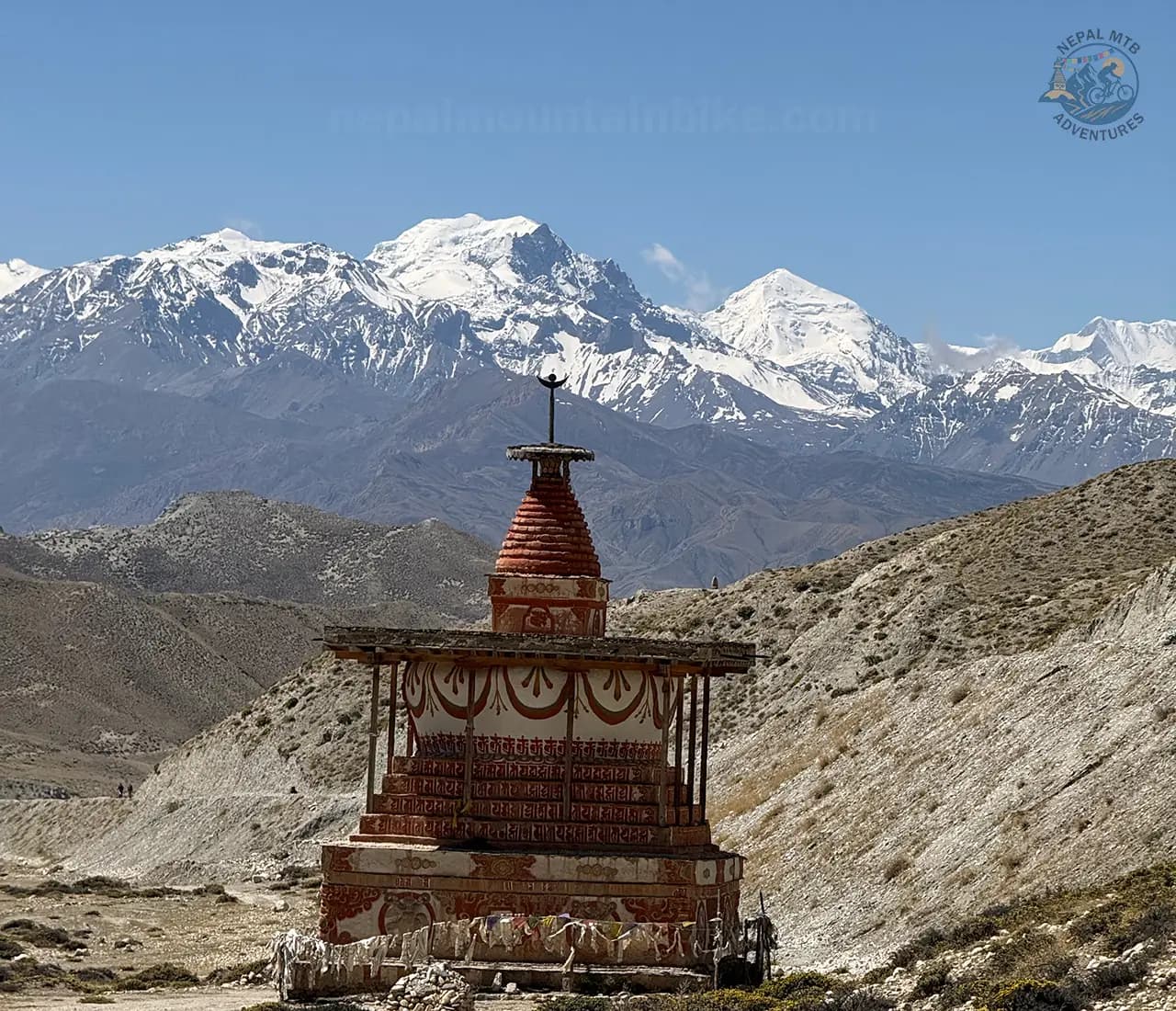
The trails you ride are local roads, linking villages that often have no other way in or out. Lower down you'll pass Gurung, Magar, Newar and Tharu communities. Higher up, in Manang and Mustang, the culture is Tibetan Buddhist: prayer flags, stone prayer walls, small white shrines called chortens, and monasteries hundreds of years old.
You could see one-horned rhinos and deer near Chitwan, langur monkeys and many kinds of birds in the middle hills, and blue sheep in Mustang. In spring, rhododendron forests, Nepal's national flower, turn red and pink.
Easy habits that matter
Pass prayer walls and chortens on your left.
Ask before photographing people.
Take your shoes off in monasteries.
Slow right down in villages. Children and animals use the trail.
Don't skid. It wears away paths people walk every day.
Give way to walkers and pack animals.
Carry your rubbish out, gel wrappers included.
The lodges, guides and village kitchens on our tours are local, so your money stays in the communities whose trails you ride. More on our community and sustainability page.
Booking your tour with us

What's included in our tours
Prices depend on group size, season, whether the route needs flights or a vehicle, and the hotel level in Kathmandu and Pokhara. Each tour page on our mountain bike tours page shows the price and the exact inclusions for that tour. On our multi-day tours:
Included
Licensed English-speaking mountain bike guide, WFR-trained on multi-day trips
Hotels in Kathmandu and Pokhara, and the best available lodges on the trail
Breakfast, lunch and dinner on riding days
ACAP and restricted area permits where your route needs them
Mechanic and spare parts on supported routes
Airport transfers, support vehicle and internal transport as listed on the tour
First aid kit and oxygen on high passes
Not included
International flights and your Nepal visa
Travel insurance
Bike rental, if you don't bring your own
Personal riding gear
Bottled drinks, alcohol, snacks, and lodge charges for showers and charging
Tips for guides, mechanics, and drivers
Activities on free days in Kathmandu and Pokhara
How booking works
1. Tell us about your trip. Your dates, how many days you have, how many of you are riding, and how you ride at home.
2. Get a plan. We suggest the best-fit tour, with an itinerary and a quote. If another tour suits you better, we'll say so.
3. Adjust it. Change the dates, the pace, the route, or the bikes until it's right.
4. Confirm and pay the deposit. Deposit, payment methods, balance dates, and cancellation terms are on our booking information page.
5. Send your documents. Passport scan, photos, and insurance details, so we can get your permits.
6. Prepare. Train, check your insurance, and pack using the lists above.
7. Arrive a day early. We meet you at the airport, fit your bike, and brief you before day one.
When to book. For an October or November mountain biking holiday in Nepal, book multi-day tours by spring, because October fills first. Day tours and short rides can often be arranged within a day or two. See last-minute mountain bike tours in Nepal.
Why we wrote this guide
Our aim is simple: to help riders from around the world come to Nepal for mountain biking and travel here easily and safely. Planning a bike trip in a country you've never visited raises a lot of questions about trails, permits, altitude, bikes, seasons, and what to expect each day. This guide answers them in one place, so you can arrive prepared, ride with confidence, and enjoy every day on the trail.
We're Nepal MTB Adventures, a Pokhara mountain bike company founded by Jagan Biswakarma in 2004. Bikes are what we do: we have our own fleet, mechanics, workshop, and support vehicles, and our guides ride these trails every season. We update this guide after each season with what we've seen on the trails and any rule changes. Meet the people you'd ride with on our team page, and read our story on About Us.
Ready to plan your tour?
Tell us when you're coming, how many days you have, and what kind of riding you enjoy. We'll suggest the tour that fits, and if a different one would suit you better, we'll tell you.
Frequently asked questions
How do mountain bike tours in Nepal work?
We arrange your guide, permits, bike, transport, hotels, lodges, and meals on riding days. On longer routes, a mechanic and a support vehicle come too. You ride with a day pack, and your main bag goes ahead to the next lodge.
What types of mountain bike tour are there in Nepal?
Day tours, overnight and short tours, multi-day expeditions, e-MTB tours, enduro and downhill tours, heli-biking, hike-and-bike tours, and family tours. Each can run as a group departure, a private tour, or a custom tour.
Is Nepal good for mountain biking?
Yes. Most trails are old footpaths between villages, so the riding is natural and varied, with long climbs, long descents, and real villages along the way. Lodges on the main routes mean you can ride high without carrying camping gear.
Do I need a guide to mountain bike in Nepal?
On most multi-day routes, yes. Foreign visitors in protected areas must have a licensed guide, and the rule includes cyclists. Upper Mustang also requires a registered agency. Short rides around Pokhara and Kathmandu can be done on your own.
What permits do I need?
It depends on your route. The Annapurna region needs an ACAP permit. Upper Mustang needs a restricted area permit at USD 50 per person per day, plus ACAP. We arrange all permits for our tours.
When is the best time for a mountain bike tour in Nepal?
October and November, then March to May. In the June to August monsoon, Upper and Lower Mustang stay mostly dry while most other routes are wet.
How fit do I need to be?
For multi-day tours, fit enough to ride 4 to 6 hours with about 1,000 metres (3,300 ft) of climbing, day after day. Valley day tours need much less. An e-MTB makes the climbs easier.
Can beginners do a mountain bike tour in Nepal?
Yes. Our Pokhara and Kathmandu Valley tours suit beginners and families, at low altitude with a hotel each night. The Annapurna Circuit and Upper Mustang aren't beginner tours.
Should I rent a bike or bring my own?
Rent if your trip is under two weeks or you'd rather not fly with your bike. Bring your own if fit is very important to you. For an e-MTB, you need to rent, because airlines don't carry e-bike batteries.
How many days do I need?
One day for a taste, 3 to 5 days for an overnight trip, 10 to 11 days for a first multi-day route, and 15 to 17 days for the Annapurna Circuit or Upper Mustang. Add a spare day at each end.
Is a mountain bike tour in Nepal safe?
The main risks are altitude, remote trails, and the time it takes to reach help, not crime. We manage them with a well-paced itinerary, trained guides, a mechanic and support vehicle, and by making sure your insurance covers your route.
What insurance do I need?
A policy that covers mountain biking, covers you to the highest altitude on your route (5,416 m for the Annapurna Circuit), and includes helicopter evacuation.
Can I ride a mountain bike to Everest Base Camp?
No. Mountain bikes aren't allowed in Sagarmatha National Park. For Everest views from the bike, we ride Pikey Peak, just outside the park.
Can I do an e-bike tour in Nepal?
Yes. We run e-MTB tours around Pokhara and Kathmandu and on longer routes such as Lower and Upper Mustang, using our own e-MTBs, with charging planned around the lodges and the support vehicle.