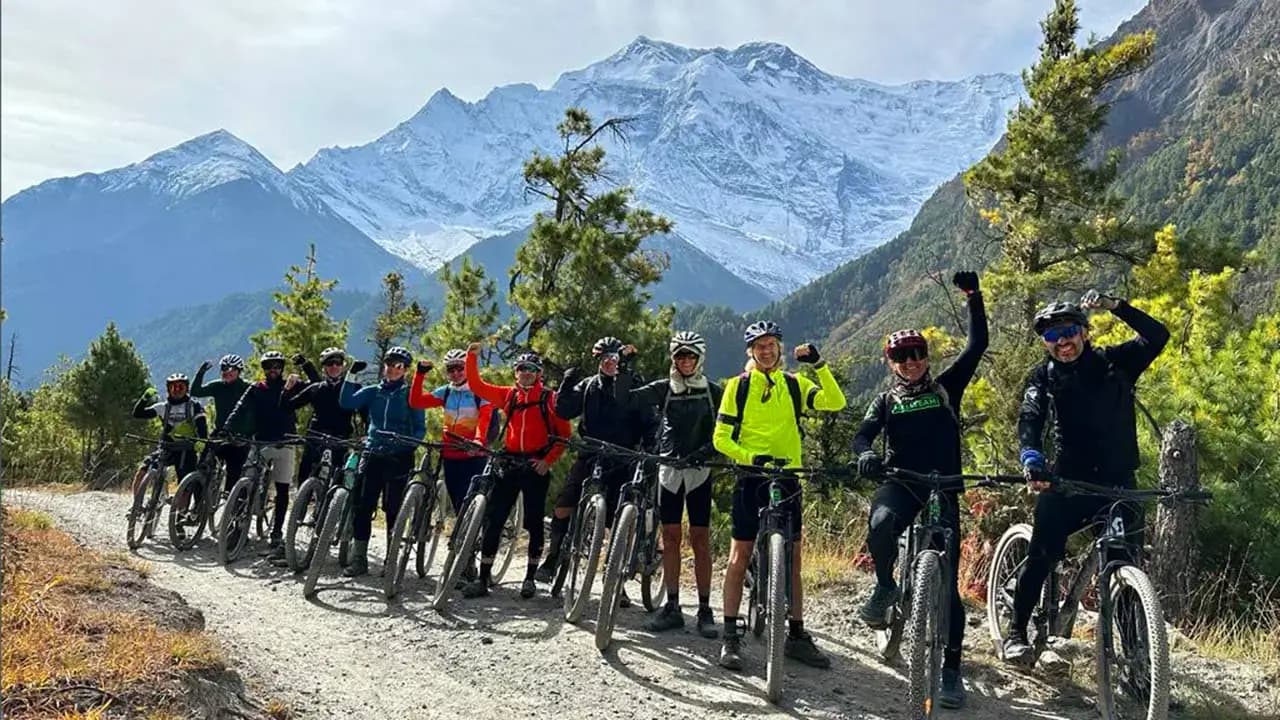


The Kathmandu Valley is ringed by hills, and almost every one of them has a trail down it. Within an hour of Thamel, you can be on an EWS-qualifier enduro track, a Newari farm path through paddy fields, or a forest road climbing to 2,782 m.
That variety is the point. The valley floor sits at roughly 1,400 m, and the rim rises past 2,700 m, so you can pick your day: a flat two-hour spin through villages, or 1,300 m of climbing to the highest point on the rim.
Below are the eight rides we send people on, what each one actually asks of you, and what it costs to get in. We are Nepal MTB Adventures; we have guided in Nepal since 2004, and we run bike and guided days in both Kathmandu and Pokhara.
The eight trails at a glance
Trail | Difficulty | Character | Highest point |
Khokana to Bhainsepati | Easy | Paddy fields, Newari villages, grassy paths | ~1,400 m |
Shivapuri to Helipad | Easy to moderate | Wide gravel climb, optional technical descent | ~2,000 m |
Lakuri Bhanjyang | Moderate | Village cross-country, big valley views, long descent | ~1,900 m |
Kakani and Shivapuri NP | Moderate | Highway approach, then forest trail | ~2,070 m |
Godavari to Phulchowki | Hard | The valley's biggest climb, technical descending | 2,782 m |
Chandragiri | Hard | Rough dirt road climb, forest descents | 2,551 m |
Nagarkot | Moderate to hard | Purpose-ridden enduro tracks, ridge singletrack | ~2,175 m |
Hattiban to Pharping | Hard | Jumps, berms, gaps. Gravity riding | ~1,800 m |
Two of these run as scheduled guided day tours from USD 101 per person, bike included. The rest we run as private custom days on request. Bike only, no guide? Rentals start at USD 30 a day.
Three ways to ride these
Option | What it costs | Best for |
Rent a bike and go | From USD 30 a day, helmet and repair kit included | Confident riders doing the easier valley routes |
Guided day tour | From USD 166 per person, bike included | Anyone who wants the singletrack rather than the road version of it |
Private custom day | On request | Groups, specific trails, or riders who want Nagarkot or Phulchowki properly |
If you’re ready to ride, see the bikes and rental rates for a self-guided trip, or ask about a guided day if you’d like help choosing and riding a trail.
The trails
1. Khokana to Bhainsepati
Easy | Newari villages and paddy fields | rideable from the city
A leisurely ride through the countryside south of the ring road, on grassy paths and between paddy fields. In harvest season, you ride past people working the crops, and Khokana itself is a living Newari town rather than a restored one.
This is the ride for a first day on the bike, for a rest day, or for anyone who wants the culture without the climbing. Take your time and stop to eat.
2. Shivapuri to Helipad
Easy to moderate climb, optional hard descent | wide gravel | park fees apply
The friendliest introduction to climbing in the valley. Start at Budhanilkantha and follow a gravel road that winds up through Shivapuri Nagarjun National Park, with the city opening up below you as you gain height. The track is wide, and the gradient is steady, so it rewards patience rather than power.
Note: You share parts of this trail with jeeps and heavy vehicles, so ride the climb expecting traffic around blind corners. And this is inside a national park with fees, covered below.
Ride it with us: Our Thamel to Budhanilkantha day tour runs this route from USD 101 per person, with the bike, the guide, and the park fees handled. You start from Thamel, so there is no question about where the trail begins.
3. Lakuri Bhanjyang
Moderate | village cross-country | long descent home
A pass on the southeastern rim, reached through a string of small villages. The climb is steady rather than brutal, and the payoff at the top is a sweep across the entire Kathmandu Valley with the snow line behind it on a clear day.
Stop for lunch at a local place at the top, or carry food and eat on the pass. Then take the descent back, which is the reason most people ride it.
Godavari sits close enough that experienced riders link the two into one long day.
4. Kakani and Shivapuri National Park
Moderate | a full day | forest trail and Himalayan views
Start at Balaju, take the Trishuli highway out of the valley, then turn off to Kakani on the northwestern rim. From there, you drop into a forest trail inside Shivapuri Nagarjun National Park, which is quiet in a way nothing else this close to the city is.
The views north are the draw. On a clear morning, the Himalaya sit on the horizon through gaps in the trees, then the trail turns down and gives you the descent.
Ride it with us: The Kakani Sky Trail day tour is from USD 103 per person and includes the bike, the guide, the park entry, and the transfer past the highway section, which is the part of this ride nobody enjoys.
5. Godavari and Phulchowki
Hard | the valley's biggest climb | 2,782 m
Phulchowki is the highest point on the Kathmandu Valley rim at 2,782 m, roughly 1,300 m above the valley floor, and the climb from Godavari is the benchmark ride for local cross-country riders. It is long, it is sustained, and the descent off it is steep and technical enough to reward everything you put into getting up.
There is a beginner version. Satdobato to Godavari is a gentle ride through the botanical garden area with none of the suffering, and it is a genuinely good half day.
6. Chandragiri
Hard climb | 2,551 m | forest descents
Chandragiri stands at 2,551 m on the southwestern rim, looking across the valley toward the Himalaya. The climb from the valley floor is roughly a thousand metres on dirt road, and the honest word on that road is that it is rough and heavily potholed. It is a grind rather than a pleasure.
The riding at the top is the reward: forest trail through old trees and streams, with routes ranging from short beginner loops to committed descents, plus the fort and gardens at the summit if you want a break off the bike.
7. Nagarkot
Moderate to hard | Nepal's best-known enduro trails | ~2,175 m
Nagarkot sits on the northeastern rim about 32 km from Kathmandu, and it is the most serious mountain biking destination in the valley. It hosts the Asian Enduro Series, an Enduro World Series qualifier, which is why the trails here are cut and maintained to a standard nothing else in the valley matches.
There are four to five distinct enduro trails off the ridge, including the Eco, Gold, Ninja and Ranger lines. Between them, you get ridge running, tight switchbacks, real drops and long descents through quiet villages, terraced farmland and dense forest.
Two ways to ride it. Shuttle to the Nagarkot view tower and descend, which is what most riders do. Or climb from Bhaktapur, which is a proper effort: muddy through the monsoon, dusty and loose the rest of the year.
If you only have one day in the valley and you can ride, ride Nagarkot. We run it as a private day with a shuttle to the ridge and a guide who knows which lines are running. Ask us for dates and a price.
8. Hattiban to Pharping
Hard | gravity riding | jumps, berms and gaps
The valley's gravity playground. The trails off Hattiban Hill down toward Pharping are built with jumps, berms and gaps, and they are ridden by people who came to jump rather than to sightsee.
The full line runs Hattiban to Pharping with climbs and descents throughout, so it is not purely downhill, but the character of the day is gravity. Bring a full-suspension bike, bring pads, and get somebody who knows the lines to show you them the first time.
Ride it with us: We run Hattiban as a private gravity day with a full-suspension bike, pads, and a guide who rides these lines. Get a price.
Permits and park fees
Shivapuri Nagarjun National Park covers the Shivapuri, Budhanilkantha, helipad, and Kakani rides. Foreign visitors pay an entry fee, and mountain bikes are charged separately on top of it. The bike fee is not a token amount; it is the larger part of what you pay.
Bring Nepali rupees in cash. The gates do not take cards.
The other trails on this page, Khokana, Lakuri Bhanjyang, Godavari, Chandragiri, Nagarkot and Hattiban, sit outside the national park and do not carry a park fee, though individual sites may charge small local entry.
Which bike for the valley
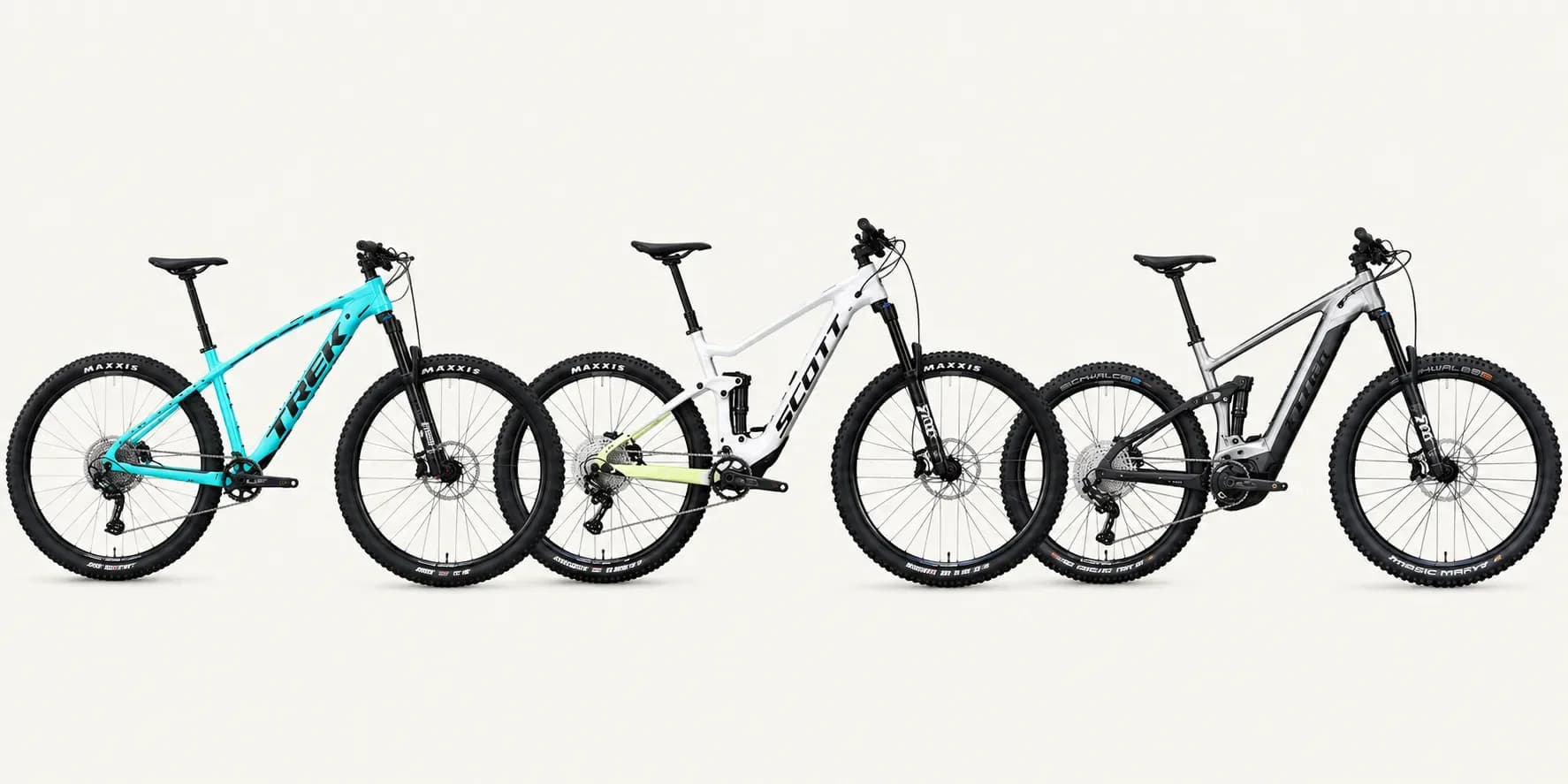
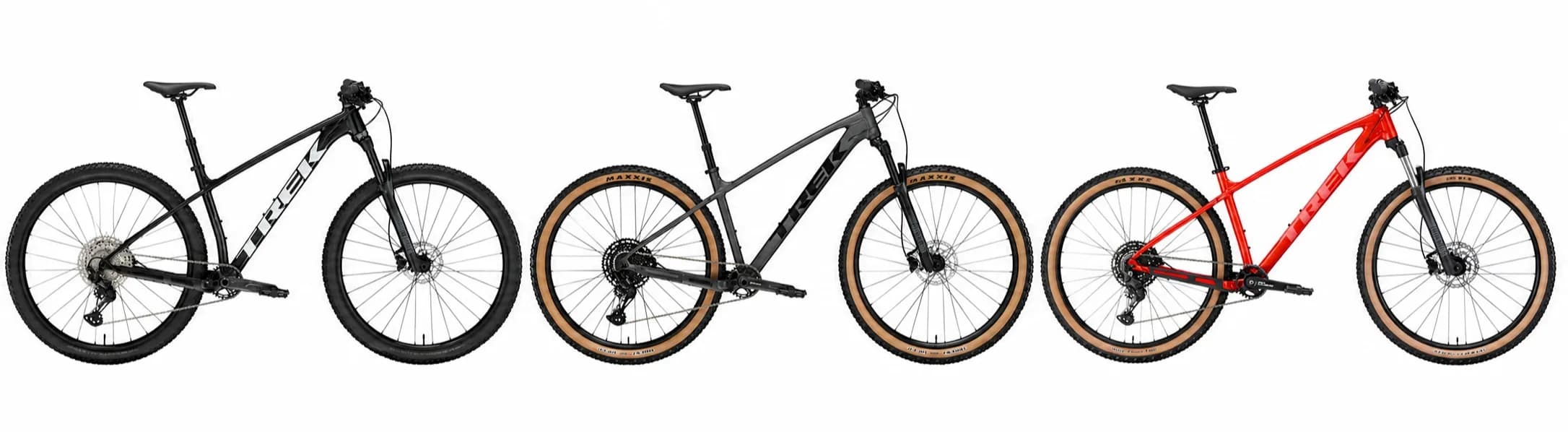
A hardtail handles most of it. Khokana, Lakuri Bhanjyang, the Shivapuri gravel climb, and the Kakani forest trail are all rideable on a decent hardtail, and it will climb better than a full-suspension bike on the long gravel ascents.
Take full suspension for three of them: Nagarkot, Hattiban, and the Phulchowki descent. All three are steep, rough, and technical enough that travel changes the day rather than just adding comfort.
An e-MTB changes the maths on the climbs. Phulchowki is 1,300 m of ascent, and Chandragiri is close to a thousand on bad road. Pedal assist turns both from an endurance test into a ride you enjoy.
Our rates, helmet and basic repair kit included on every bike:
Bike | Per day | Good for |
Hardtail | USD 30–45 | Khokana, Lakuri Bhanjyang, Shivapuri, Kakani |
Full suspension | USD 70–75 | Nagarkot, Hattiban, Phulchowki descent |
E-MTB | USD 100 | Phulchowki and Chandragiri without the suffering |
Multi-day hires work out cheaper per day. Send us your dates, and we will price the block. See the full fleet. If you want the grading system we use across Nepal so you can judge these trails against ones you know: mountain bike trail grading in Nepal.
When to ride the Kathmandu Valley
The valley rides all year, but three things change with the season: grip, visibility, and air.
October and November are the best months. Dry trails, settled weather, and the clearest Himalayan views of the year from Nagarkot, Kakani, and Chandragiri.
March to May is warm and dry underfoot, but haze builds through spring, and the mountain views go first. Good riding, fewer views.
June to September is the monsoon. The Bhaktapur to Nagarkot climb turns to mud, forest trails get slick, and leeches appear in the wet forest sections. Rides still happen, usually early in the day, and the valley is at its greenest.
December to February is cold in the mornings and often the sharpest visibility of the whole year. Layer up, start late, and take the views.
More detail by region: best time to mountain bike in Nepal.
Riding culture, and what you pass on the way
Biking the valley is not only about the trails. You ride between UNESCO World Heritage sites, and the ordinary route between two trails takes you past temples, courtyards, and towns that have been lived in for centuries.
Boudhanath Stupa, Pashupatinath, Bhaktapur Durbar Square and Patan Durbar Square are all reachable on a bike, and the villages in between, Khokana in particular, are working Newari towns rather than preserved ones.
The valley is the historic home of the Newar people, and the food, the architecture and the festivals you ride past are theirs. Stop for a meal in a village rather than eating at a bar at the top of a climb. It is the better ride and the better day.
To plan your time off the bike, discover more things to do in Kathmandu.
Riding safely in the valley
Kathmandu has hazards that a trail-only guide will not warn you about.
Traffic. Getting out of the city is the most dangerous part of any valley ride. Traffic is dense, lane discipline is loose, and dust is constant. Where a ride can be shuttled past the city section, shuttle it.
Air quality. Valley air is poor in winter and worst in the mornings. If you are sensitive, ride the higher rim trails where the air clears, and go later in the day.
Shared trails. Jeeps and heavy vehicles use parts of the Shivapuri road. Assume something is coming around every blind corner.
Dogs and livestock. Both are on village trails. Slow down; do not sprint past.
Gear. Helmet always. Pads for Nagarkot and Hattiban. Carry water, a tube, a pump, and levers, and enough Nepali rupees in cash for park fees and lunch.
Monsoon. Wet stone, roots, and clay are far more slippery than they look, and trails change after heavy rain.
Yes, we are based in Pokhara. We run Kathmandu ourselves.
Worth saying plainly, because it is the first thing people ask.
Our workshop is in Pokhara, and that is where we started in 2004. The Kathmandu Valley days on this page are ours. Our guides, our bikes, our vehicles, our booking. When you book a valley ride with us, you are not being passed to a third-party operator who then runs the day under their own name.
That matters for three practical reasons.
One company is accountable end to end. The person who answers your email is the company that puts you on the bike. If the weather turns, the trail is closed, or you want to change the route in the morning, you deal with us, not with a chain of two companies pointing at each other.
You get the same standard you would get in Pokhara. Same guides, same bike preparation, same mechanic carrying spares that fit the bike you are on. Nothing is subcontracted and then hoped for.
We are in the valley constantly anyway. Kathmandu is where our long routes start and finish. The Kathmandu to Pokhara traverse, the e-MTB version of it, and the Pikey Peak and the Tibet routes all run through the capital. We have been moving riders, bikes, and vehicles in and out of Kathmandu for over twenty years, and the valley trails are ones our guides ride, not ones they read about.
Being headquartered in Pokhara is a fact about our address. It is not a limit on where we operate.
Guided days and bike rental in Kathmandu
The valley network is farm tracks, walking paths, and forest trails, most of it unmapped. First-timers reliably find the road version of a ride and miss the singletrack running alongside it, which is exactly what happened to the person who wrote the trail notes you find on most other sites.
Logistics eat the day. Getting out of the city, park fees, shuttling past the highway sections, and finding the trailhead all cost time. On a guided day, that is handled, and you ride.
Our two scheduled Kathmandu Valley day tours:
Tour | From | The ride |
USD 166 per person | Out of the city and up into Shivapuri Nagarjun National Park. Starts from Thamel. | |
USD 166 per person | The northwestern rim, rolling singletrack, and a descent through oak forest. |
Both are full days, and both include the bike.
Want a trail that is not on that list? Nagarkot, Phulchowki, Chandragiri, and Hattiban all run as private custom days. Tell us the trail, the date, and how many of you there are. Get a price.
Riding beyond the valley from Kathmandu:
Kathmandu to Pokhara, a mid-hills traverse between the two cities.
Pikey Peak, the Everest region without the Everest crowds.
The e-MTB Kathmandu to Pokhara tour if you would rather have the assist.
Everything we run from the capital sits on the Kathmandu destination page.
Bikes. We rent hardtails, full suspension, and e-MTBs, with a helmet and repair kit on every hire. See the fleet and rates.
Frequently asked questions
What is the best mountain bike trail near Kathmandu?
Nagarkot, if you can ride. It hosts the Asian Enduro Series, an Enduro World Series qualifier, and has four to five maintained enduro trails off the ridge. If you want scenery and culture instead of technical riding, Khokana to Bhainsepati or Lakuri Bhanjyang are better days out.
Do I need a permit to mountain bike near Kathmandu?
For Shivapuri Nagarjun National Park, yes. It covers the Shivapuri, Budhanilkantha, helipad, and Kakani rides, and foreign riders pay an entry fee plus a separate mountain bike fee on top. Bring Nepali rupees in cash. The other trails on this page sit outside the park and carry no park fee.
How hard are the Kathmandu Valley trails?
The full range. Khokana is flat enough for a first-timer. Phulchowki is roughly 1,300 m of climbing to 2,782 m, the highest point on the valley rim. Nagarkot and Hattiban are technical enough that pads are sensible. The valley floor sits at about 1,400 m, and the rim tops out past 2,700 m, so difficulty is mostly a question of how much of that you want to climb.
Can I ride these trails without a guide?
Yes, and people do. What you lose is the trails themselves, because the valley network is largely unmapped and unsignposted, and riders on their own usually end up on the road version of a route and miss the singletrack next to it. Most people take a guide for one day, then use what they learned.
What is the highest point in the Kathmandu Valley?
Phulchowki, at 2,782 m, on the southern rim above Godavari. It is the biggest single climb available from the valley floor and the benchmark ride for local cross-country riders.
Do I need a full-suspension bike?
Not for most of it. A hardtail handles Khokana, Lakuri Bhanjyang, the Shivapuri gravel, and the Kakani forest trail, and climbs better on the long ascents. Take full suspension for Nagarkot, Hattiban, and the Phulchowki descent, which are steep and rough enough that travel genuinely changes the day.
When is the best time to mountain bike in Kathmandu?
October and November: dry trails, settled weather, and the clearest mountain views. March to May is dry but hazy. June to September is monsoon, when the Nagarkot climb turns to mud and forest trails get slick. December to February is cold in the morning, with often the sharpest visibility of the year.
Can I rent a mountain bike in Kathmandu?
Yes. We rent hardtails, full suspension, and e-MTBs with a helmet and repair kit included on every bike. Tell us your height and what you plan to ride, and we will have it sized and set up before you arrive. See the fleet.
How do I get to the trailheads from Thamel?
Khokana, Lakuri Bhanjyang, and Budhanilkantha are all rideable from the city. For Nagarkot, Kakani, and Chandragiri, most riders shuttle out and ride back, because the road sections are dense with traffic and dust and cost you the best hours of the day. On a guided day, we handle the transfer.
Is mountain biking in Kathmandu safe?
The trails are no more dangerous than rugged riding anywhere. The real hazards are city traffic on the way out, poor winter air quality in the valley, and jeeps sharing the Shivapuri road. Wear a helmet, shuttle the city section where you can, and ride the rim trails if the air is bad.
You are based in Pokhara. Can you actually run tours in Kathmandu?
Yes, and we run them ourselves. Our workshop is in Pokhara, but the Kathmandu Valley days are our guides, our bikes, and our vehicles, not a booking passed to another company in Thamel. Kathmandu is also where several of our long routes start and finish, including the Kathmandu to Pokhara traverse and Pikey Peak, so we have been operating in and out of the capital since 2004.
How much does a guided mountain bike day cost in Kathmandu?
Our scheduled valley day tours start at USD 101 per person for Thamel to Budhanilkantha and USD 103 for the Kakani Sky Trail, both full days with the bike included. Private custom days on the other trails, including Nagarkot, Phulchowki and Hattiban, are priced on request and depend on the trail and your group size.
How much is bike rental in Kathmandu?
Hardtails are USD 30 to 45 a day, full suspension USD 70 to 75, and e-MTBs USD 100, with a helmet and a basic repair kit on every bike. Multi-day hires work out cheaper per day, so send us your dates, and we will price the block rather than the day.
Can I combine a Kathmandu ride with a longer trip?
Yes, and it is the sensible way to use the valley. Ride a valley day or two to shake down the bike and your legs, then head out on a longer route. Kathmandu to Pokhara and Pikey Peak both start from the capital.
Ready to ride the valley?
Tell us how many days you have, how hard you want to ride, and whether you need a bike. We will tell you which of these eight to do and in what order, including when the easy one is the right answer.
Booking a guided day? Thamel to Budhanilkantha from USD 101 or Kakani Sky Trail from USD 103.
Just want the bike? Rentals from USD 30 a day.
Want Nagarkot, Phulchowki, Chandragiri, or Hattiban? Those run as private days. Ask us for a price.
Riding beyond the valley? See everything we run from the capital on the Kathmandu destination page.
Reserve ahead for October and November. That is peak season here, and the full-suspension bikes go first.