


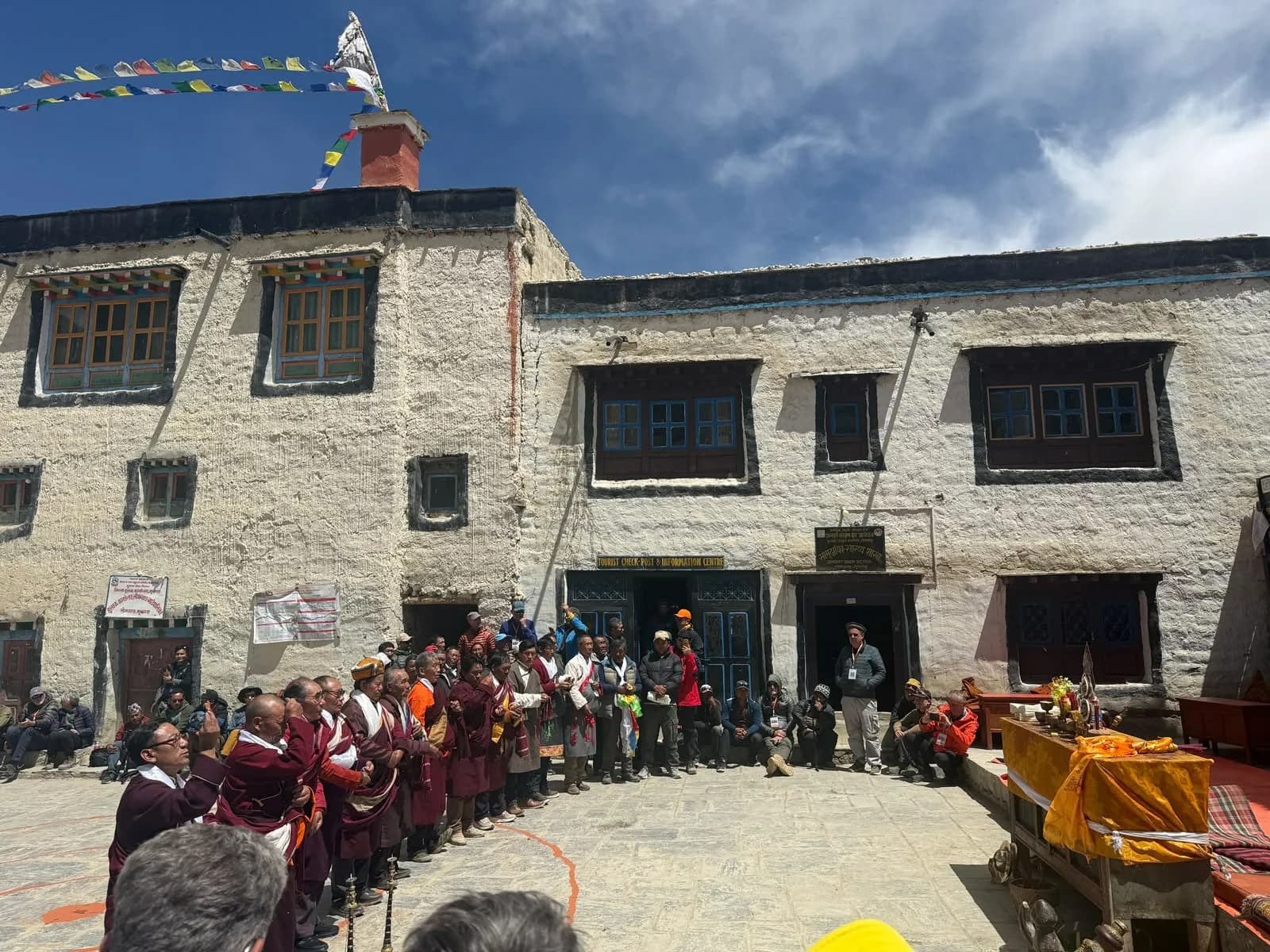
The wind on the Upper Mustang plateau carries dust for most of the year. For three days in early summer it carries something else: the low note of copper horns, the crack of cymbals, and the sound of several hundred people packed into a courtyard under a 600-year-old mud brick wall.
Tiji is not a show. It is a working ritual, performed by the monks of Chode monastery inside the walls of Lo Manthang, in a town that has kept the same three days in its calendar for centuries. Nobody sells tickets. Nobody arranges it around cameras. The Loba families who live in Lo build their year around it, and visitors are welcome to sit at the edge and watch.
Key takeaways
Tiji 2027 runs from 1 to 3 June in the palace courtyard at Lo Manthang, 3,840 m. The dates follow the Tibetan lunar calendar, so reconfirm before booking flights.
One ritual over three days, not three events. Day one clears the ground, day two builds the celestial assembly, day three is the Rha Chham and the banishment.
Two permits, and you cannot buy them yourself. USD 50 per person per day for the Restricted Area Permit, plus ACAP at NPR 3,000, through a registered agency with a licensed guide.
No ticket and no charge to watch. Foreign visitors sit at the edges of the courtyard, permits aside.
Three ways in, all from Jomsom. Bike or e-MTB in 15 to 16 days, jeep in 10 to 12, foot trek in 12 to 14.
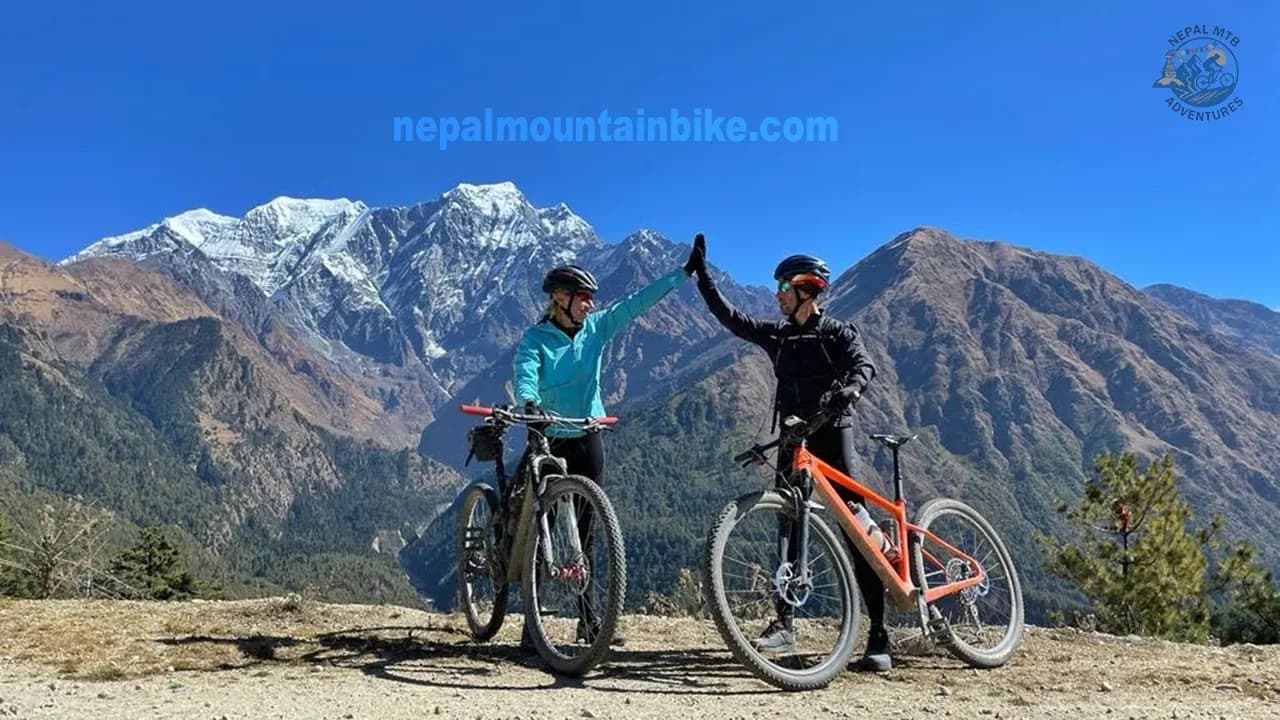
Riding in is hard, and it is the best way to arrive. About 145 km, passes to 4,010 m, and most riders take the festival days off the bike.
Arrive two nights early. That protects your acclimatisation at 3,840 m and leaves a buffer for weather.
Beds inside the walls are limited. Six to twelve months of notice gives you the most choice, and every trip we run can be reshaped around your dates.
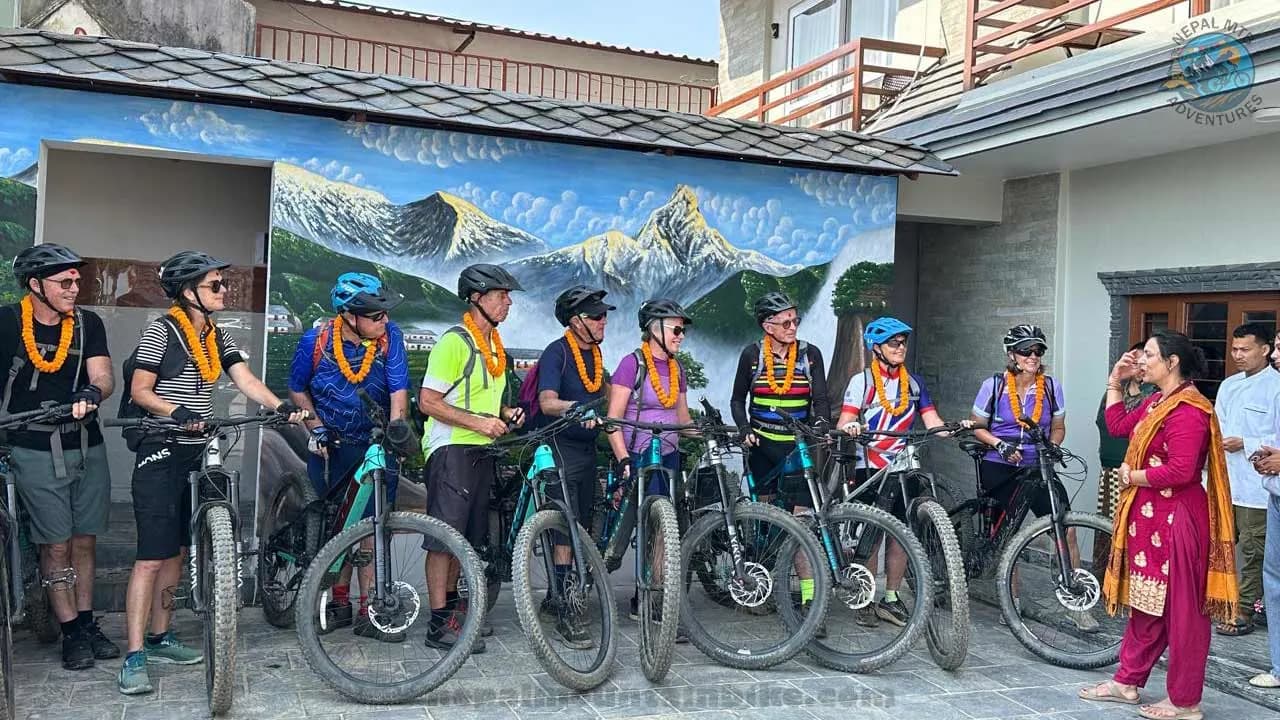
We have written this guide because we are there for it. Every year we run mountain bike and e-MTB tours timed to Tiji, so our guides have ridden that corridor in festival week season after season, held beds inside the walls for our riders, and sat in that courtyard through all three days with them. None of this is researched from a desk in Kathmandu. It is what we tell our own riders before they come, written down.
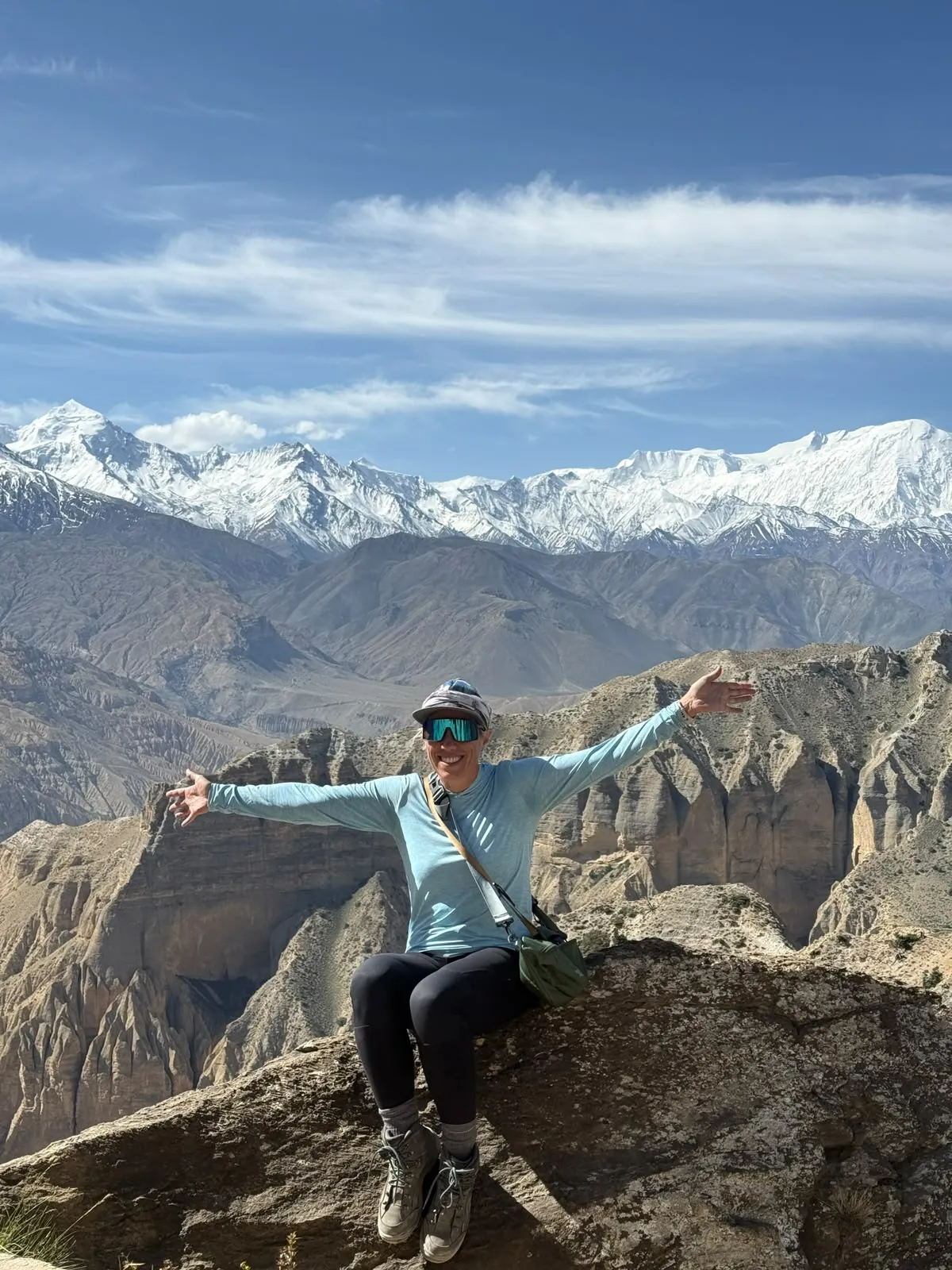
Why travellers come from all over the world for these three days
Jagan Bishwakarma: I have been taking riders into Mustang ever since. This is what I have seen up there.
This is a kingdom, not a village with a festival. Lo was founded in 1380 and had its own king until 2008. The dances happen in the courtyard of his palace.
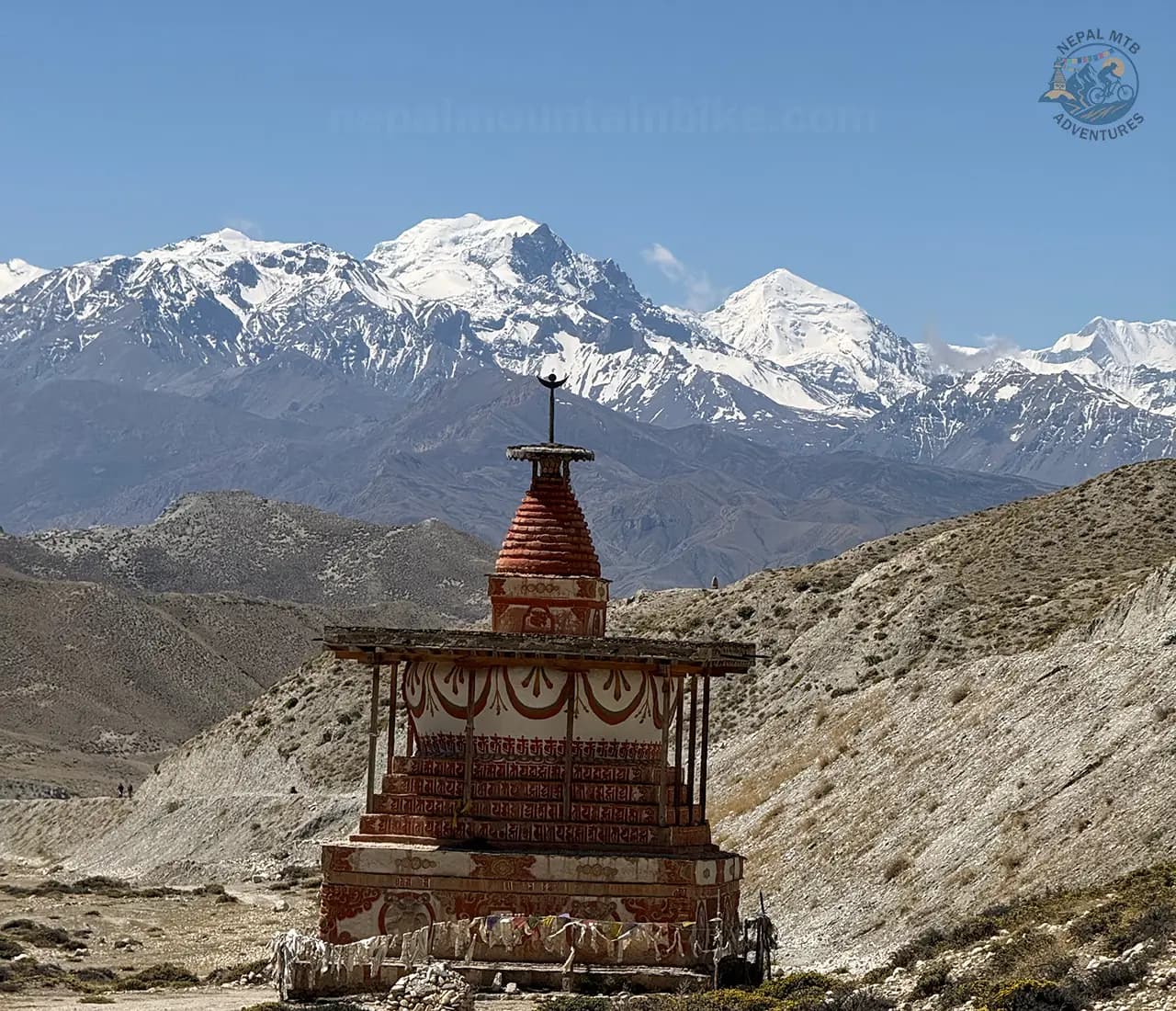
The terrain is like nowhere else in Nepal. North of Kagbeni, the green stops. Bare sandstone, red cliffs at Dhakmar, cave cities in the valley walls. People come for the riding alone.
The culture is Tibetan and still being lived. Language, dress, food, monasteries, calendar. This valley was closed to outsiders until 1992, so none of it is a museum piece.
The tradition exists in one place on earth. These Sakya dances, this courtyard, the monks of Chode. Three days a year, and the next chance is twelve months later.
Nobody up there is performing for you. You can watch a cultural show in Kathmandu. In Lo Manthang, the monks dance because the community believes the year depends on it, and you sit at the edge and watch.
Riders tell me the same thing every year. They cannot find this culture or this tradition at home, and they cannot find it anywhere else in the world either. That is why Tiji stops being one more stop on a Nepal trip and becomes the reason for the whole trip, with everything else planned around those three days.
Tiji at a glance
Detail | What You Need to Know |
What it is | Three days of masked ritual dance, called Cham, performed to drive misfortune out of the country for the year ahead. |
Where | The royal palace courtyard inside the walls of Lo Manthang, Upper Mustang, Nepal. |
Elevation | 3,840 m (12,598 ft) |
2027 dates | 1–3 June 2027. The dates are set by the Tibetan lunar calendar and confirmed by Chode Monastery, so reconfirm before booking flights. |
Tradition | Sakya lineage of Tibetan Vajrayana Buddhism |
Performed by | The monks of Chode Monastery, also written Chhoedhe, in Lo Manthang. |
What the name means | Tiji is short for Tenpa Chirim, usually translated as “prayer for world peace.” |
Permits | Restricted Area Permit: USD 50 per person per day, plus Annapurna Conservation Area Permit: NPR 3,000. A licensed guide and a registered Nepali agency are required by law. |
Ways in | Mountain bike or e-MTB expedition, 4WD jeep, or foot trek. All three routes run along the Kali Gandaki corridor from Jomsom. |
Riding grade | Hard. Roughly 145 km between Jomsom and Lo Manthang on our route, with passes reaching about 4,010 m and terrain including high-desert singletrack, jeep track, and shale. |
Time needed | 15–16 days from Kathmandu for the full riding expedition; 10–12 days by jeep; 12–14 days on foot. |
What Tiji is, and what the name means
Tiji is three days of masked ritual dance, called Cham, performed by monks in the palace courtyard at Lo Manthang. Over those three days they dance the defeat of a demon who once brought drought and disease to Mustang, gather the past year's misfortune into a single object, and destroy it beyond the town wall.
The quick facts on the name:
Tiji is short for Tenpa Chirim. Usually translated as a prayer for world peace.
In Lo Manthang, you get a wider answer. The wish is that the Buddhist teaching benefits every living being, which is why the ritual is aimed outward at the whole valley rather than at the people watching.
Tenchi and Tenji are the same festival. Different ways of writing one Tibetan word in English letters. Search all three spellings when you are hunting for confirmed dates, because monastery notices and Nepali news reports do not agree on one.
Here is the part worth carrying with you. Tiji is not a performance about a myth. For the community, it is the myth happening again. The monks are not actors playing deities. Inside Vajrayana practice, they take on the form and the power of those deities for those hours, after years of training and months of preparation.
That is why the courtyard does not feel like a theatre. People pray through it, older women count prayer beads through it, and children run around the edges while nobody minds. Nobody is putting it on for you, and you are a guest at somebody else's most important religious event of the year. That is what makes it worth crossing the Himalaya to see, and it is also why the etiquette section further down this page is not optional reading.
The Kingdom of Lo: the walled city that carries the festival
To understand why Tiji happens in this particular courtyard, you need the town. Upper Mustang was once the independent Kingdom of Lo, and Lo Manthang was its walled capital, built on the salt road between Tibet and the Indian plains. The festival is held in the courtyard of the royal palace on the main square, which is why it belongs to this town and to no other.
The kingdom in seven facts:
Detail | What You Need to Know |
Founded | 1380, by Ame Pal, a Buddhist warrior king from western Tibet. |
The name | Lo is the kingdom's own name. Manthang comes from man, meaning medicine, and thang, meaning plain — “the plain of medicine.” |
The wall | Roughly 2,472 ft around and about 26 ft high, with 14 watchtowers and one gate that was traditionally shut at dusk. |
The monarchy | Survived Nepal's unification as a subordinate state and was only formally dissolved in 2008. |
The last king | Jigme Dorje Palbar Bista, whose lineage traced 25 generations back to Ame Pal, died in 2016. |
The palace | A five-storey palace still stands on the main square. The Tiji festival is danced in the courtyard below it. |
Closed to outsiders | Lo Manthang remained closed to outsiders until 1992. Permits, guides, and visitor limits came with its opening. |
Two of those deserve a sentence more. The plain of medicine sounds like a strange name for a bare high desert until you stand in it, and realise this flat, watered pocket of ground at 3,840 m is the one place for many days in any direction where a large settlement could feed itself. And the wall was never decorative. A rich trade capital on a salt road attracts raiders, so the gate closed every night and 14 towers watched the approaches.
The 1992 date is the one that matters most for travellers. Everything on this page is visible to you because of a fairly recent decision to open the ground north of Kagbeni, and it was opened with conditions attached. The permit rules in section 17 are the direct descendants of that decision, and they are a large part of the reason the place still looks the way it does.
For the country you ride through on the way in, our Upper Mustang mountain biking guide covers the region end to end, and the destination page for Upper Mustang is the shorter overview.

Where Tiji came from: three layers of history
This history is written from what the people of Lo Manthang told us, in the town itself, over many seasons of going up there. Ask them how old Tiji is, and nobody gives you one number. They give you a sequence, because the festival was founded once, rebuilt once, and restored once.
Layer one, the early 15th century. The earliest form of the ritual is credited to Khenchen Sonam Lhundrup, a son of Mustang's second king who became one of the great scholars of the region. He is the figure most often named as the person who first established Tiji in Lo. That places the origin within a couple of generations of the founding of the kingdom itself.
Layer two, the 17th century. The tradition was substantially rebuilt when King Samdup Rabten invited the Sakya master Ngawang Kunga Sonam to Lo Manthang. He performed a Vajrakila ritual understood to purify the walled city and protect it from famine and misfortune. Much of the structured three-day form danced today comes from that revival. This is the layer that most published accounts pick up on when they call Tiji a 300-year-old festival, which is true of the shape of it and misses the two centuries of ritual that came before.
Layer three, 1963. After a period of disruption in the region, the tradition was restored, and it has run without a break since. That matters more than it sounds. A great many Himalayan festivals now performed for visitors were rebuilt in the last few decades after a gap of years. In Lo Manthang there is an unbroken line of monks teaching this choreography to the next set of monks since at least 1963, and a far longer line behind that.
Under all three layers sits something older. The tantric practice at the centre of Tiji is Vajrakila, carried from India into Tibet in the 8th century by Padmasambhava and other tantric masters, and first taught as sacred dance at Samye monastery in Tibet long before it reached Mustang. The steps in that courtyard have a lineage that runs back past the kingdom, past the wall, and out of Nepal entirely.
The legend of Dorje Jono and the demon Ma Tam Ru
Every Loba child grows up with this story. Know it before you arrive, and the three days stop being confusing and start being readable.
The demon. Ma Tam Ru, also written Ru Ta, tormented the Mustang Valley. He dried the springs, spread disease through the herds, and brought drought and hunger to a place already living close to the edge. In a high desert, a demon who takes your water is the worst disaster anyone can picture.
The hero. Dorje Jono, understood as an emanation of the wrathful deity Vajrakila, known in Tibetan as Dorje Phurba, was born to end him.
The twist that gives it weight. The demon was his own father. Dorje Jono had to subdue the thing he came from.
The ending. Through ritual battle and wrathful meditation, he defeats Ma Tam Ru and drives him out of the country. The water returns, the harvest returns, and the valley can live again.
The three days tell that story in order. Day one prepares the ground and calls in the protective forces, day two builds the celestial machinery that gives Dorje Jono his power, and day three is the fight, the banishment, and the clearing out.
Hold on to one thing while you watch. The Loba do not describe this as remembering an old victory. They describe it as renewing a protection that would otherwise wear thin. The demon is not gone forever. He is driven out once a year, and this year's dance is what keeps him out until the next one.
Vajrakila, the Sakya lineage and Chode monastery
Tiji belongs to Vajrayana Buddhism, and specifically to the Sakya lineage, one of the four main schools of Tibetan Buddhism. Upper Mustang is one of the strongest surviving Sakya areas anywhere, which is part of why scholars pay close attention to what happens here.
The monastery that runs the festival is Chode, also written Chhoedhe. It sits inside the walls of Lo Manthang, and it is the working monastery of the town, home to roughly 65 resident monks drawn from Lo Manthang and the villages around it. Chode keeps the ritual calendar for the whole community, and Chode's monks are the ones who dance Tiji.
Lo Manthang has other great buildings that visitors mix up with it, so it is worth being clear about which is which:
Jampa Lhakhang, the god house, is the oldest of the three main temples and holds a huge Maitreya Buddha along with mandala murals that specialists travel a very long way to see.
Thubchen is the great assembly hall. One vast cold room under a forest of carved wooden pillars, with the light dropping in from high windows.
Chode is the working monastery, the monastic school, and the home of the Tiji dancers.
Namgyal, just outside the walls, was historically the judicial seat as well as a religious one. Disputes in Lo were settled there, which is a role very few monasteries anywhere have ever held.
The deity at the centre of the ritual is Vajrakila, whose name means something close to diamond dagger. The physical form of that idea is the phurba, a three-sided ritual dagger you will see in the dancers' hands on days two and three. In the practice, the phurba pins down and immobilises hostile forces so they can be transformed rather than simply chased away. When a dancer drives a phurba downward at a spot on the ground, that is what is being shown.
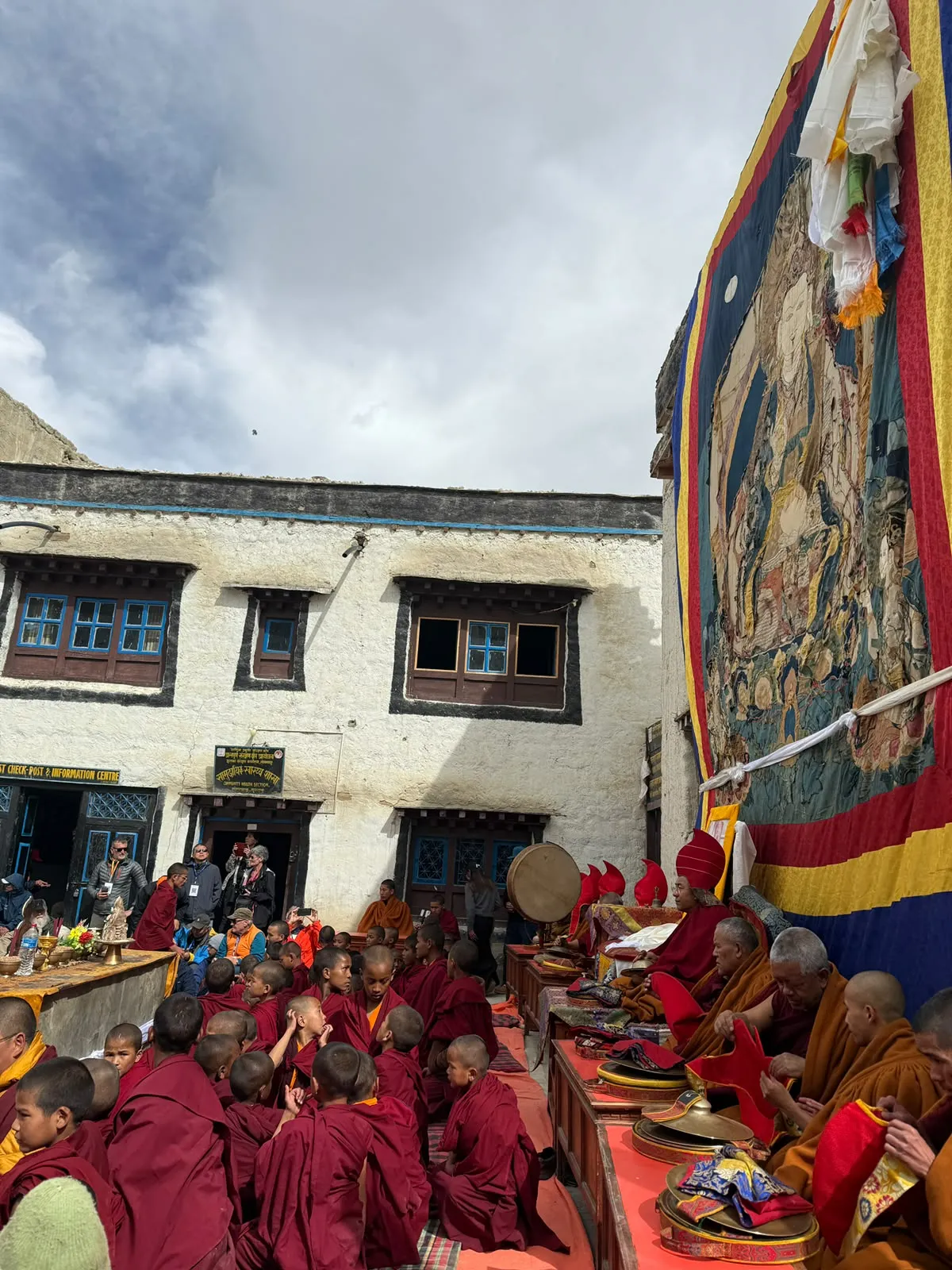
The three days, in order
Over three days, the palace square becomes an open-air sacred stage. The monks dance the Dorje Jono story from beginning to end, in sequence, and each day has its own job inside the story.
A note on timing before the details. The dances usually start around the middle of the day and run into the afternoon, and they finish when they finish. There is no printed schedule pinned to a wall. Your guide will walk down to the monastery in the morning and ask, and that is genuinely how the timing is confirmed. Build your day around being free from late morning onward.
Day one: opening and invocation
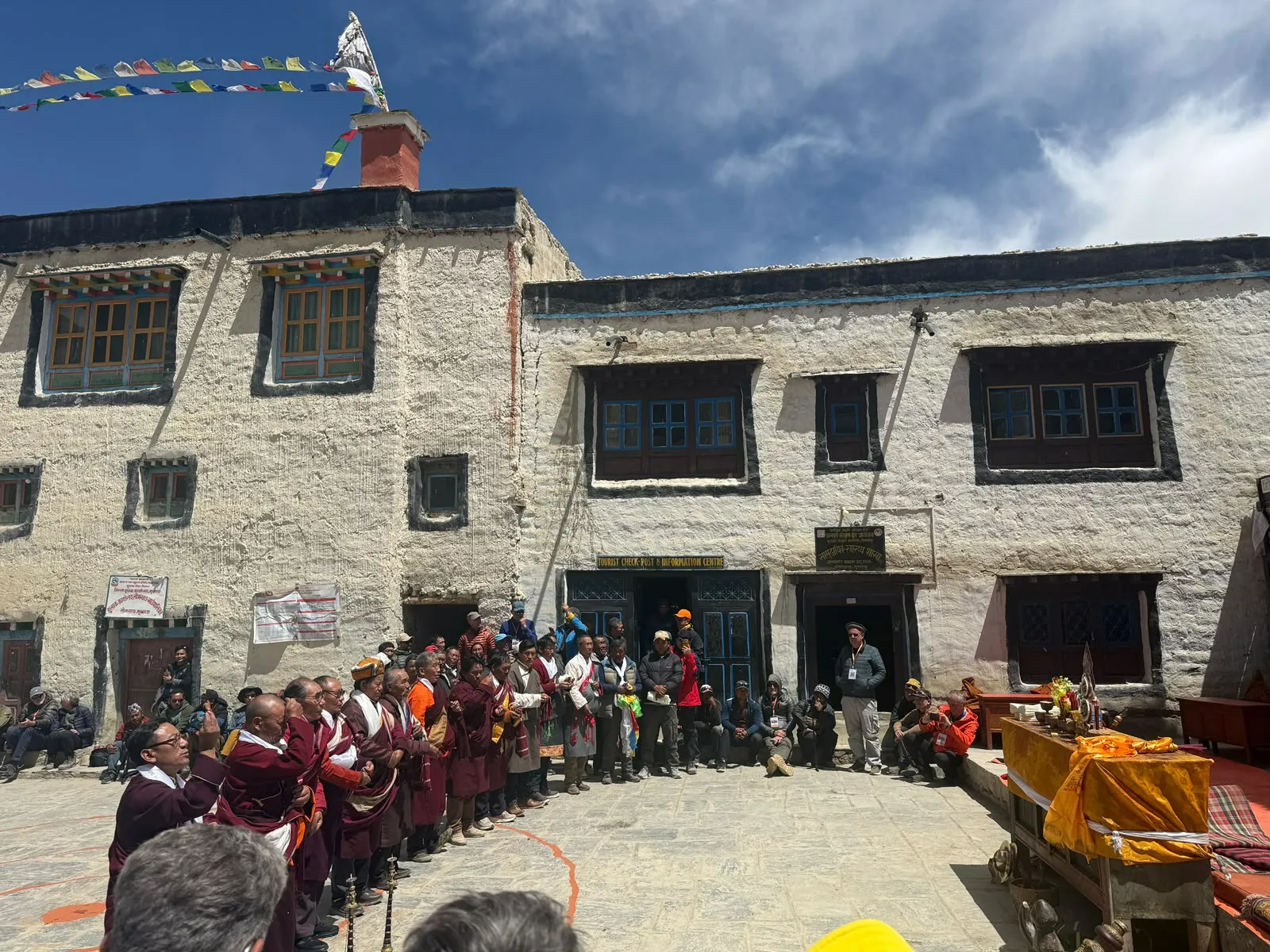
The festival opens around midday. A large embroidered thangka showing Guru Rinpoche is unfurled down the courtyard wall of the palace, and that is the moment the square stops being a square and becomes a ritual space. Long horns, drums, and cymbals announce the monks coming in.
The dances on this day establish the ground. In plain terms, they clear the space of hostile forces and set the boundary inside which everything else will happen, before the story proper begins. Visually, it is the most orderly of the three days: slow, circular, deliberate movement, heavy robes, and a lot of standing and waiting between sequences while the monastery does what it needs to do.
If you only get one day, this is not the one to choose. It is, though, the best day for photographs of the whole scene, because the crowd is still settling and you can move around the edges more easily than you will be able to on day three.
Day two: the celestial assembly
The second day is where the ceremony intensifies. Monks take on wrathful deity forms in elaborate brocade, animal masks and skull crowns, and the choreography is built around the phurba and other ritual implements. Local women appear in traditional dress, heavy coral and turquoise jewellery brought out for the occasion, and the seating around the edges of the courtyard is fuller than it was the day before.
What is being built here is the machinery of the story. The dances generate the celestial palaces and the deities who will eventually give Dorje Jono the power to defeat the demon. If you have read section five before you arrive, this is the day where the reading pays off, because you can follow what is being assembled rather than watching a sequence of striking costumes.
Day three: Rha Chham, the exorcism and the banishment
The final day is the climax, and it is the day nobody should miss. Led by the monk dancing Dorje Jono, the monks perform the Rha Chham, the most physically demanding and most dramatic dance of the three days.
The torma effigy, which by now carries the accumulated ill fortune of the community, is carried out in procession, ritually destroyed, and cast outside the city walls. Traditionally, this is accompanied by celebratory gunfire and music, and the noise is part of the point. The demon is not being asked to leave politely. He is being driven out.
The festival closes with blessings given out to the community, and with the monks escorting local dignitaries to exchange closing greetings with the head lama. The crowd thins slowly. People stay in the square for a long time afterwards.
An honest note on the details
Exact step counts, individual dance names and the precise closing sequence are described slightly differently by different sources, and they can vary from year to year depending on which senior lama leads the ritual and who is available to dance. What is written above is the structure that is most consistently corroborated and that our partners in Lo Manthang recognise.
If you want the exact choreography for a specific year, the person to ask is your guide on the ground, who will have spoken to the monastery directly that week. Any page that gives you a minute-by-minute programme for a lunar festival that has not happened yet is telling you more than it can know.
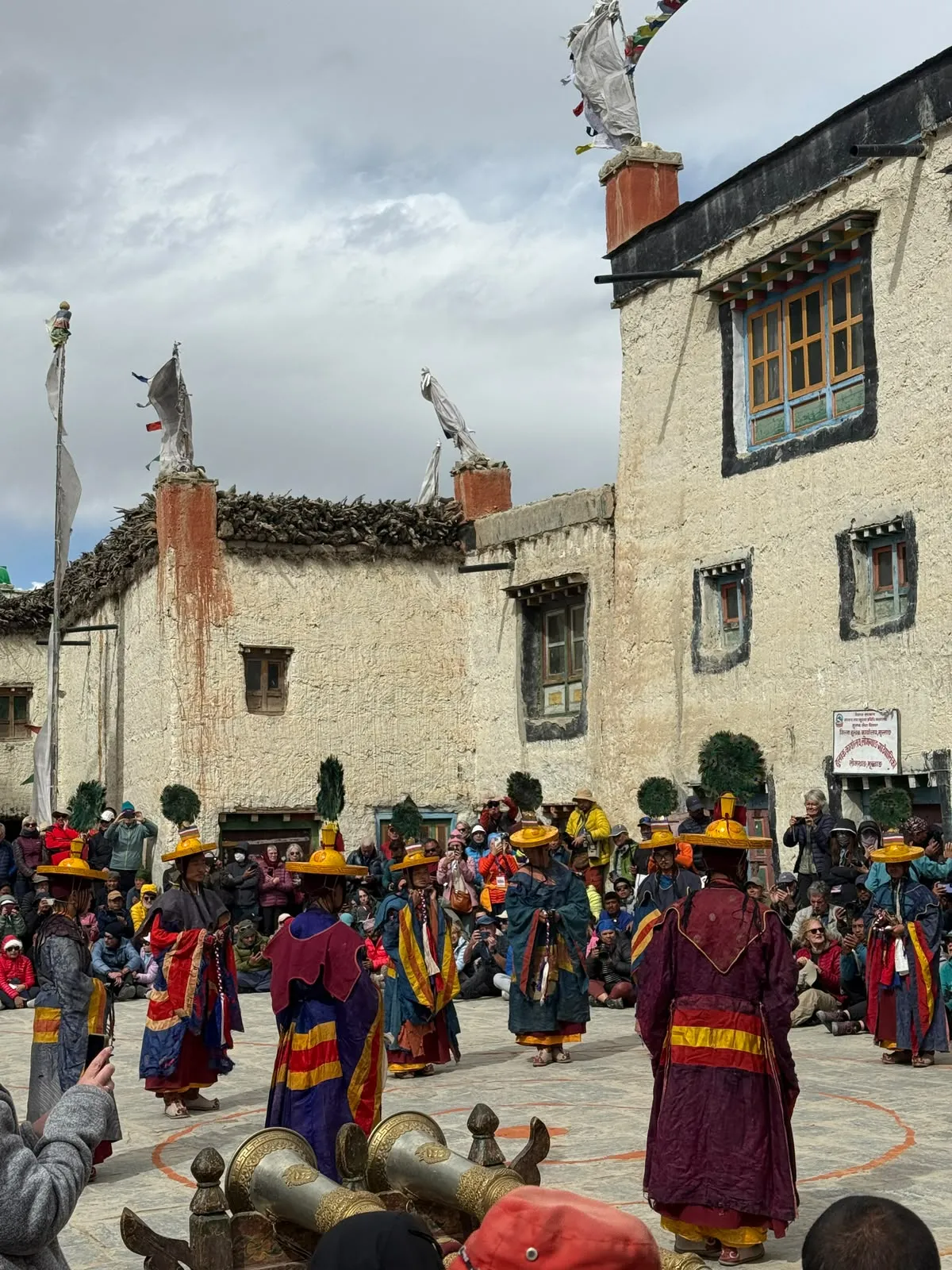
What the town feels like during festival week
The town around the dances is half of the experience, and it is the half that surprises people.
Lo Manthang is small. The walled section holds a few hundred residents in ordinary weeks. During Tiji, families come in from Charang, Ghami, Chhoser, Tingkhar, Namgyal and the villages further out, and horses and motorbikes fill the lanes outside the gate. People who have moved away to Kathmandu, Pokhara or abroad come back for it, so the festival is also the annual family reunion of a whole district.
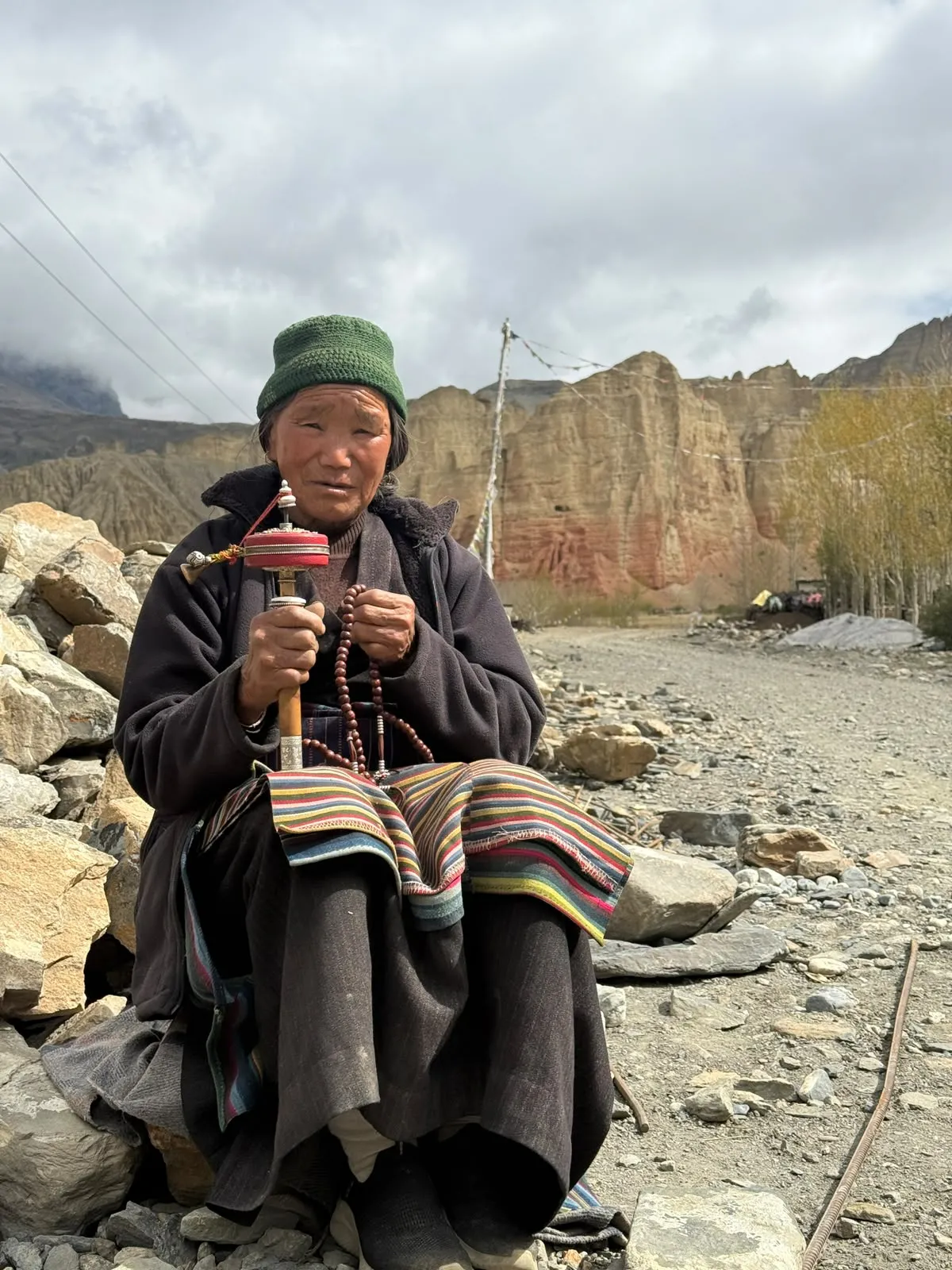
Everyone wears their best. The chuba, the heavy wrap coat, comes out in good wool with bright sashes. Coral, turquoise and old silver jewellery that lives in boxes for the rest of the year is on display. Older women bring their own low stools and stake out the shaded edge of the courtyard early. Nobody hurries.
Around the ritual there is a small fair. Traders set up, tea and food are sold, and children spend the day running between the legs of the crowd. Two things happen at once inside the same square: a solemn tantric ritual, and the biggest social event of the year. Visitors sometimes expect a silent, church-like atmosphere and are briefly thrown by the noise. Take the cue from the crowd. Quiet respect during the dances, ordinary friendliness in the gaps.
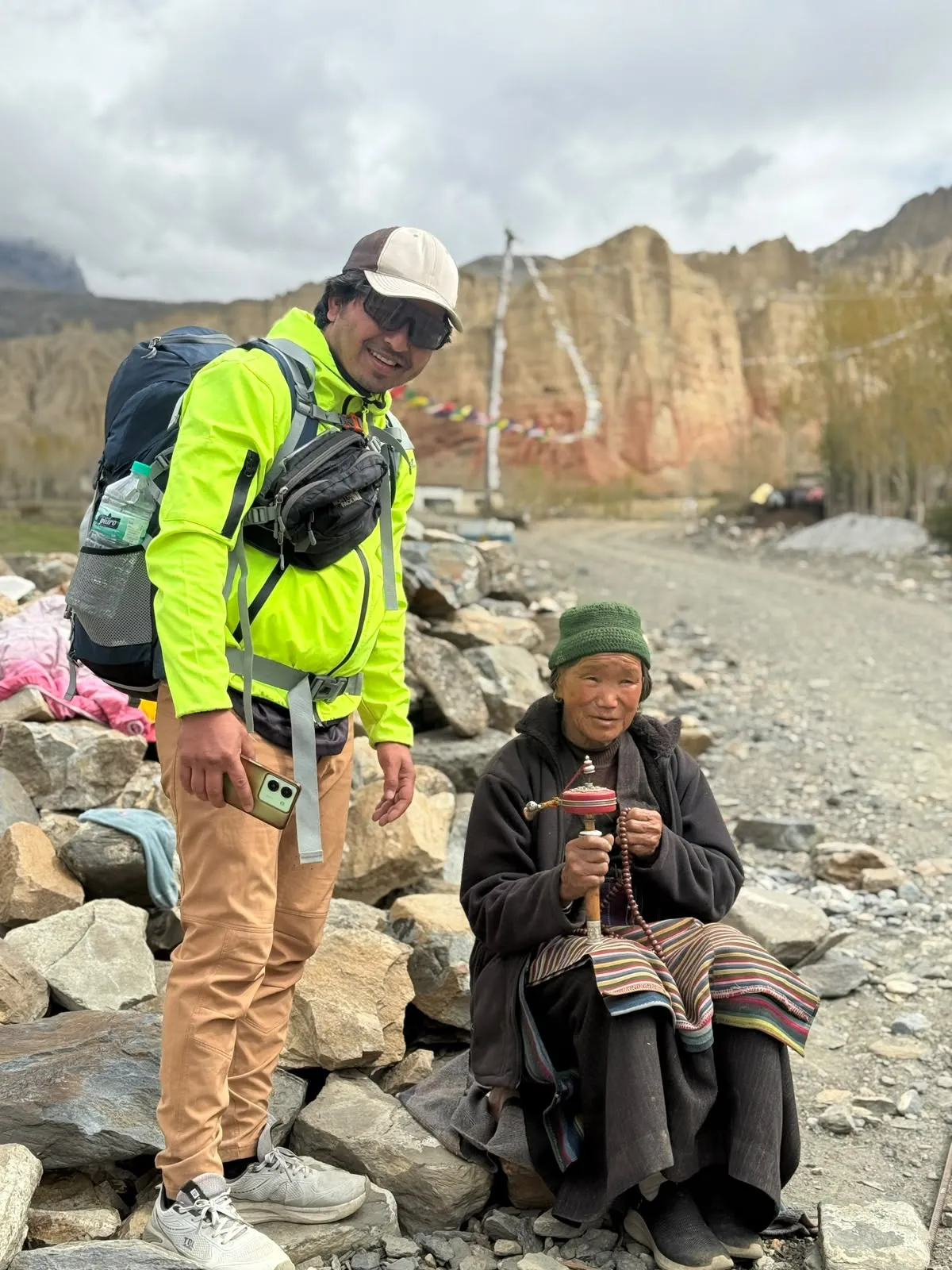
Practically, that combination means the town is at capacity. Lodges are full, the water system is under strain, and the lanes are busy. It also means the doors are open in a way they are not the rest of the year, and if you are travelling with a guide who has family or working relationships in Lo, you will end up drinking tea in somebody's kitchen. That is the part of the trip people talk about a year later.
A living tradition under pressure
What makes watching Tiji different from watching a well-preserved cultural performance elsewhere in the Himalaya is simple: it may not look the same in a generation.
Accounts from within Lo Manthang describe a shrinking pool of monks able to perform the hardest dances, which are physically punishing at 3,840 m under a heavy mask. At the same time, the younger generation is being pulled away from the valley toward education and work in Kathmandu, Pokhara, and abroad, which is a normal and reasonable thing for young people to do and also a real problem for a monastery that needs a certain number of trained bodies every year.
This is not manufactured urgency to make you book something. It is an openly acknowledged concern inside the community. The honest version is that Tiji is not in danger of vanishing next year, but the depth of the bench that supports it is thinner than it was.
There is a straightforward consequence for travellers. Permit fees and money spent inside Lo Manthang are among the few economic arguments that keep this specific tradition viable in its original form, performed by monks who trained under monks who trained under monks. Where you sleep, who guides you, and which shops and kitchens your money passes through are not neutral choices during festival week. Section 24 of this page is about how to check that in practice before you book.
Tiji 2027 dates, and why they move every year
Tiji Festival 2027: 1 to 3 June 2027, Lo Manthang, Upper Mustang.
Tiji follows the Tibetan lunar calendar, not the Gregorian one, so the dates move every year. They are worked out and confirmed by Chode Monastery through its own astrological calculations, and the confirmation usually comes a few months ahead rather than years ahead. The festival generally falls in the second half of May or the first days of June, which puts it right at the front of the dry summer riding window in Upper Mustang.
Because of that, treat any published date as provisional until it is close. We reconfirm the date with our partners in Lo before every departure and update this page when it changes. If you are planning independently, ask your agency to confirm in writing which dates they have from the monastery, not which dates they found online.
Why the date is good news for riders. Late May and early June are the mildest nights and, on average, the calmer part of the wind season in Upper Mustang. The monsoon that soaks the rest of Nepal barely reaches behind the Annapurna and Dhaulagiri wall, so this corner of the country stays rideable while the mid hills turn to mud. The festival and the best conditions of the year are not two separate reasons to come. They are one reason.
Build in buffer days. Two things can move: the festival dates themselves, and you. Flights to and from Jomsom are weather-dependent, road conditions change, and altitude does not always cooperate on schedule. Any Tiji itinerary that arrives in Lo Manthang the afternoon before day one, with no spare days anywhere, is a plan with no room in it. Ours puts the arrival two days early and treats the festival days as fixed points that the rest of the trip is built around.
Year | Tiji Dates | Status |
|---|---|---|
2027 | 1–3 June | Confirmed with our partners in Lo; reconfirm before travel |
2028 | Expected in late May or early June | Not yet officially published by the monastery |
The rest of the Lo calendar: Yartung and the April race
Tiji is the biggest event of the year in Lo Manthang, but it is not the only dateable reason to pick a particular month.
Yartung. The end-of-summer festival, held around the Janai Purnima full moon in August or September, so like Tiji it moves each year. Yartung is horse racing, archery, and a great deal of celebrating, held in Lo Manthang and also at Muktinath further south. Where Tiji is monastic and solemn at its core, Yartung is the community letting go at the end of the growing season. Horses matter enormously in Lo, and this is the day they matter most. For riders, Yartung sits at the other end of the same dry summer window, so it is the natural alternative if June does not work for you.
The Mustang Trail Race, April. This is a running race, not a bike race, and we mention it so nobody turns up with a bike expecting a start line. It is an eight-stage, roughly 170 km foot race that runs Kagbeni to Lo Manthang to Yara and out via Muktinath. We mention it for one reason only: an eight-stage foot race needs trail rather than jeep roads. That this race has run this ground for years is independent evidence that a real off-road network exists here away from the road, and that it is long established rather than invented for a brochure. For what that network feels like under wheels, see Upper Mustang trails, a biker's dream.
Losar. Tibetan New Year falls in February, which is the deep cold and low season in Upper Mustang. Lodges close, the passes are unpleasant, and most visitors are not there. It is mentioned here for completeness rather than as a recommendation.
Event | When | What it is | Where |
|---|---|---|---|
Tiji | Late May or early June; 2027: 1–3 June | Three-day festival of masked monastic dances and religious rituals | Chode Monastery, inside the walls of Lo Manthang |
Yartung | Janai Purnima full moon, usually August or September | Horse racing, archery and community celebrations | Lo Manthang and Muktinath |
Mustang Trail Race | April | Eight-stage running race covering roughly 170 km | Kagbeni → Lo Manthang → Yara → Muktinath |
Losar | February | Tibetan New Year; winter celebrations across the region | Across Mustang; many lodges are closed |
Three ways to reach Lo Manthang for Tiji
Everybody arrives up the same corridor. What changes is what carries you, how long it takes, and how hard the days are. Here are the three real options side by side before we go into the riding route in detail.
Mountain bike or e-MTB | 4WD jeep | Foot trek | |
|---|---|---|---|
Total trip from Kathmandu | 15–16 days | 10–12 days | 12–14 days |
Jomsom to Lo Manthang | 4–5 riding days | 1–2 driving days | 4–5 walking days |
Physical demand | High. Sustained climbing at altitude on loose ground | Low. Long, rough and dusty vehicle journeys | Moderate to high. Long days and big ascents |
Skill needed | Real off-road riding experience. Not a first mountain bike trip | None | Normal trekking fitness |
Best for | Experienced riders and bikepackers who want to experience the terrain and festival | Photographers, families, older travellers and those short on time | Traditional trekkers and slow-travel travellers |
Acclimatisation | Good when the itinerary is planned properly; altitude increases gradually | Weakest. A jeep can take you to high altitude quickly | Best. Gradual walking ascent allows more time to adjust |
Our product | Upper Mustang MTB Expedition, 16 days, from USD 3,850 and e-MTB Upper Mustang, 15 days | Private departures available. Contact us | Private departures available |
Route A: mountain bike or e-MTB expedition
For riders, bikepackers and endurance cyclists asking whether you can actually mountain bike to the Tiji Festival, the answer is yes, and it is one of the best ways to arrive. The full details are in section 14 below.
Route B: 4WD jeep
For photographers, families and travellers who want the culture without the physical demands. The route follows the same corridor by vehicle: Pokhara to Tatopani, up the Kali Gandaki gorge through Jomsom to Kagbeni, into the restricted area past Ghami, and on to Lo Manthang. Along the way you get the red cliffs, the sky caves and long views of the Annapurna and Nilgiri massifs. Seating for the festival days is arranged in advance.
Two honest points about the jeep. First, it is not comfortable in the way that word usually means. It is many hours on a rough road, and the dust is constant. Second, it is the option with the highest altitude risk, because a vehicle can lift you from 2,720 m at Jomsom to 3,840 m at Lo Manthang faster than your body adapts. A good jeep itinerary builds in a night at an intermediate elevation instead of driving straight through. Ask about that specifically.
Route C: classic foot trek
For traditional trekkers and slow travel purists. The full trekking route usually runs 12 to 14 days round trip: fly into Jomsom, walk through Kagbeni and Chele on the old trade paths, cross the passes via Syangbochen and Ghami, pass the long mani wall at Charang, and enter Lo Manthang in time for the full three days. The return leg is often routed via the blood-red cliffs at Dhakmar and Ghar Gompa, which is the better way round for scenery.
It is the slowest option and the kindest to your body. You acclimatise at exactly the rate you move, and you arrive in Lo Manthang having earned it.
Riding to Tiji: the route in detail
This section is for the riders. If you are coming by jeep or on foot, skip to section 16.
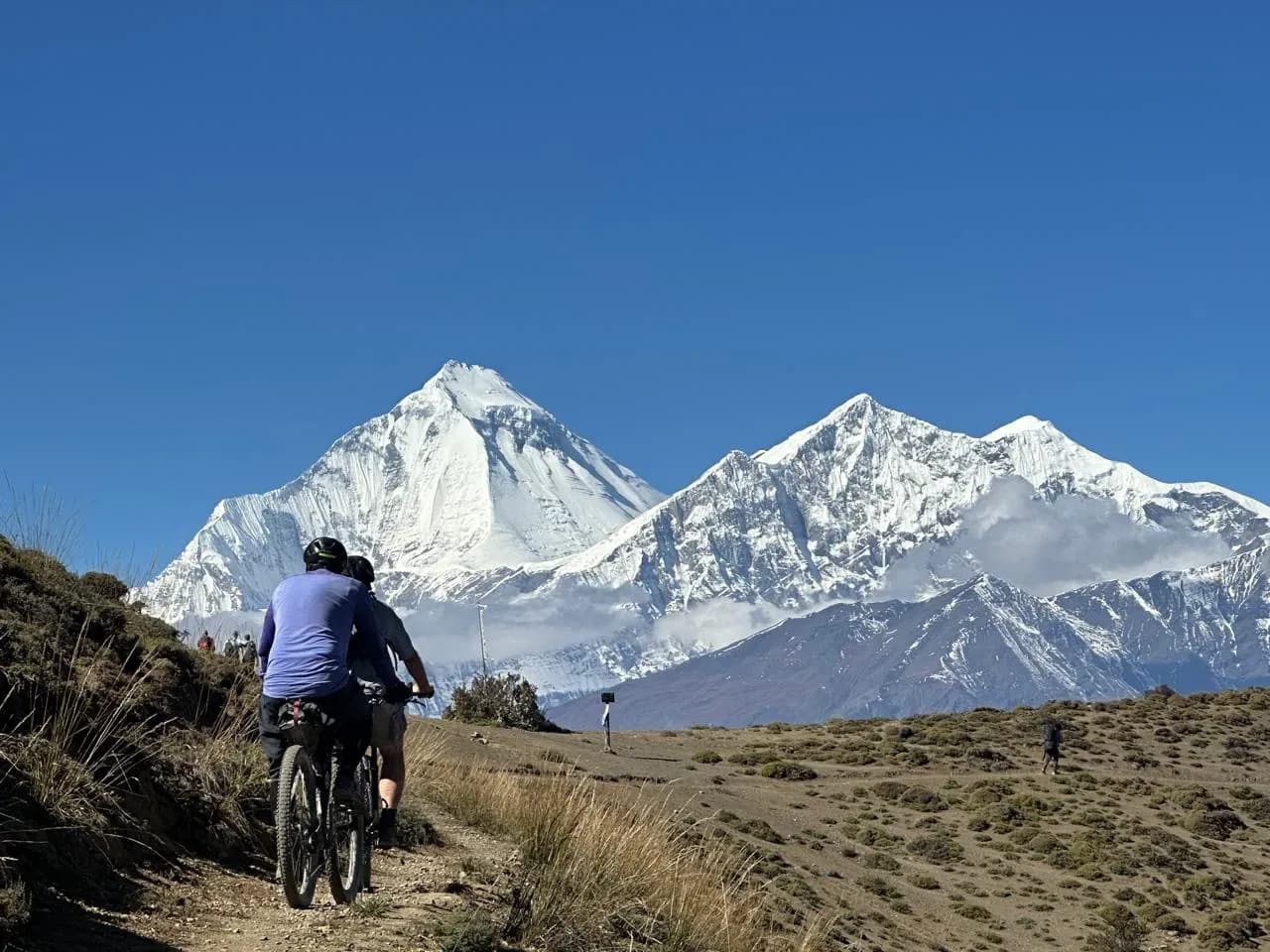
The classic approach follows the Kali Gandaki corridor north from Jomsom through Kagbeni, climbs out of the river valley at Chele, then crosses the passes of Upper Mustang through Samar, Syangbochen and Ghami before reaching Charang and finally Lo Manthang. It is a demanding mix of exposed high desert singletrack, old caravan trail, jeep track and steep shale switchbacks, with several passes above 3,700 m.
Distance | Roughly 145 km one way from Jomsom to Lo Manthang, following our riding route |
Maximum altitude | About 4,010 m on the main route; up to about 4,660 m if adding the Korala border day |
Grade | Hard. Class 3–4 technical terrain |
Surface | High-desert singletrack, old trade trails, jeep tracks, shale switchbacks, canyon trails and some road sections |
Bike | Full-suspension mountain bike or e-MTB recommended. A hardtail is rideable but less comfortable |
Suited to | Advanced riders with genuine high-altitude and off-road experience. Not suitable for beginners |
The passes you cross
These are the named cols on the standard line north. Published elevations for them differ by 30 to 50 m depending on the source, so treat these as close rather than exact, and take the confirmed profile from your pre-departure briefing.
Pass | Approximate elevation | Where it sits |
|---|---|---|
Taklam La | About 3,620 m | Above Samar, early in the restricted section |
Dajori La | About 3,735 m | Between Samar and Syangbochen |
Bhena La | About 3,830 m | Before Yamda |
Yamda La | About 3,850 m | On the approach to Ghami |
Nyi La | About 4,010 m | Highest point on the standard corridor |
Ghami La | About 3,765 m | Between Ghami and Charang |
Lo La | About 3,950 m | Final pass; first view of the walled city from the top |
Lo La is the one riders remember. You climb the final pass, the plateau opens out, and the walled town appears below you on its plain with the Tibetan border wall of mountains behind it. It is the single best moment on the route, and it arrives at the end of four days of work.
Riding during festival week
Most riders stop riding for the three festival days and pick the route up again afterwards. That is the right call. The dances are the reason you came; they run from late morning into the afternoon, and trying to squeeze a hard ride in around them means you watch the climax of a 600-year-old ritual while thinking about your legs.
Treat the festival days as rest and recovery days for riders and for bikes. It is the ideal window for the mechanic to strip and service drivetrains that have had four days of Mustang dust in them, which is exactly what our support crew does with that time.
The mornings are a different matter. Tiji generally runs in the afternoon, which leaves mornings genuinely free, and the light before ten is better anyway. Section 20 covers what to do with them.
The wind, and why you start early
This is the single most useful piece of route knowledge in Upper Mustang, and it has nothing to do with the festival. The Kali Gandaki corridor funnels a strong up-valley wind that builds through the late morning and blows hard through the afternoon. Riding north into it after midday is genuinely miserable and occasionally unsafe on exposed ground.
So the days start at sunrise and finish early. That is not to catch nice light. It is a wind avoidance rule, and it decides when you eat, when you cross exposed sections, and when the day ends. During festival week it also happens to align perfectly, because you want your riding done before the dances begin.
What breaks out there
There is no bike shop north of Jomsom. Not a small one, not a workshop in a village that can help you out. Whatever leaves Jomsom with the group is what the group has for the next ten days.
Dust is the main enemy. It eats chains, drivetrains and suspension seals, and it gets into everything. Loose shale punishes tyres and rims. Cold nights harden seals and stiffen everything. What that means in practice is that your operator should be carrying a real spares kit and someone who can use it. Ours carries a mechanic with the group and a support vehicle with a mobile workshop and expedition spares. If you are riding your own bike, bring your own spare derailleur hanger, because that one part is bike-specific and nobody in Mustang will have it.
Our general kit list for Nepal is in the mountain biking checklist, and if you want to understand how the grading on this route compares with the rest of the country, see mountain bike trail grading in Nepal.
E-MTB power and charging at 3,840 m
Upper Mustang is one of the best e-MTB destinations in Nepal, and the reason is not laziness. The route has long sustained climbs at altitude where a motor lets a rider spend their oxygen on enjoying the country instead of surviving the gradient. It widens the group of people who can do this trip, including riders in their fifties and sixties who ride well but do not want a five-hour climb at 3,800 m.
It also introduces one hard constraint: power.
Battery range drops at altitude and in the cold. Cold cells hold less usable charge, and the climbing here is relentless, so plan on getting noticeably less range per charge than you get at home on similar terrain. Riders who assume their home numbers will hold are the ones who end up pedalling an unpowered 24 kg bike up a pass.
Charging is real, but it is not unlimited. Lodges along the main corridor generally have solar or grid power, and charging is usually possible. The parts that are not guaranteed are how much power is available at once, how long it stays on, and whether five riders can all charge overnight in a lodge that also needs to run its kitchen and lights. During festival week, when Lo Manthang is full, that pressure is at its highest point of the year.
What a serious e-MTB plan looks like:
At least one spare battery per bike in the support vehicle, in the 500 to 750 Wh range for a Bosch system
Dual fast chargers travelling with the group so two bikes can charge at once
A generator or vehicle charging capability with the support vehicle, so the group is not entirely dependent on lodge power
Batteries carried indoors overnight rather than left on the bike in the cold
Eco and Tour modes as the default riding modes, with Turbo saved for the steepest ramps
Buffer days built into the schedule around the festival rather than assuming every overnight top-up will work
This is exactly the logistics we handle on our Upper Mustang e-MTB expedition. If you are still deciding between a motor and your own legs for this terrain, we wrote a full comparison of traditional mountain biking or e-MTB in Nepal.
Choose your trip: departures, prices and what is included
This is the practical part. Here is what we run, what it costs, and who each trip suits. Prices are per person and vary with group size, so the figures below are the starting price at our normal group size. Ask us for the exact number for your group.
Trip | Length | Style | From (USD) | Who it suits |
|---|---|---|---|---|
16 days | Guided MTB with support vehicle | 3,850 | Experienced riders who want the full corridor and a departure timed for Tiji | |
15 days | Guided e-MTB with support vehicle | 4,808 | Riders who want the terrain with less climbing effort, including mixed-ability groups | |
22 days | Guided MTB expedition | 4,574 | Riders with time to combine the Annapurna Circuit with Upper Mustang and Lo Manthang | |
11 days | Guided MTB, no restricted-area permit | 2,650 | Riders who want Mustang riding and long descents without the restricted-area cost | |
10 days | Helicopter-supported MTB | 7,757 | Riders short on time who have the budget for a faster approach | |
Private Jeep Departure for Tiji | 10–12 days | 4WD, non-riding | On request | Photographers, families and mixed groups where not everyone rides |
These are our own packages, and none of them is fixed. We design and run every trip in the table with our own guides, our own bikes and our own support crew, so we can change any part of it for you. Tell us your days, your dates, and how hard you want the riding, and we build the itinerary around that.
Things riders regularly ask us to change:
Add the Korala border day at about 4,660 m
Start from Kagbeni instead of Jomsom
Ride out south through Lower Mustang instead of returning the same way
Put non-riding partners in the support vehicle for the harder stages
Mix e-MTB and standard bikes in one group
Add days so there is more time in Lo Manthang around the dances
If you want something that is not in the table at all, tell us what you have in mind, and we will price it properly.
Why the 16-day expedition is the one we time to Tiji. It has the room in it. The festival takes three days out of the middle of the trip, so a shorter itinerary either arrives too late to acclimatise or leaves before day three. The 16-day version gets you into Lo Manthang two days early and still gives you a proper ride out.
What is included on our expeditions
The Restricted Area Permit and the ACAP permit, arranged by us as a registered Nepali agency
A lead guide and a sweep guide on every departure, so the group is never split with nobody at the back
A mechanic travelling with the group, plus 4WD support and a mobile workshop carrying expedition spares
Our own Trek, Scott and Bergamont fleet, maintained in our own workshop in Pokhara, or your own bike if you prefer
Accommodation on the route, and beds held in Lo Manthang for the festival nights
Guides with Wilderness First Responder certification and emergency oxygen carried by the group
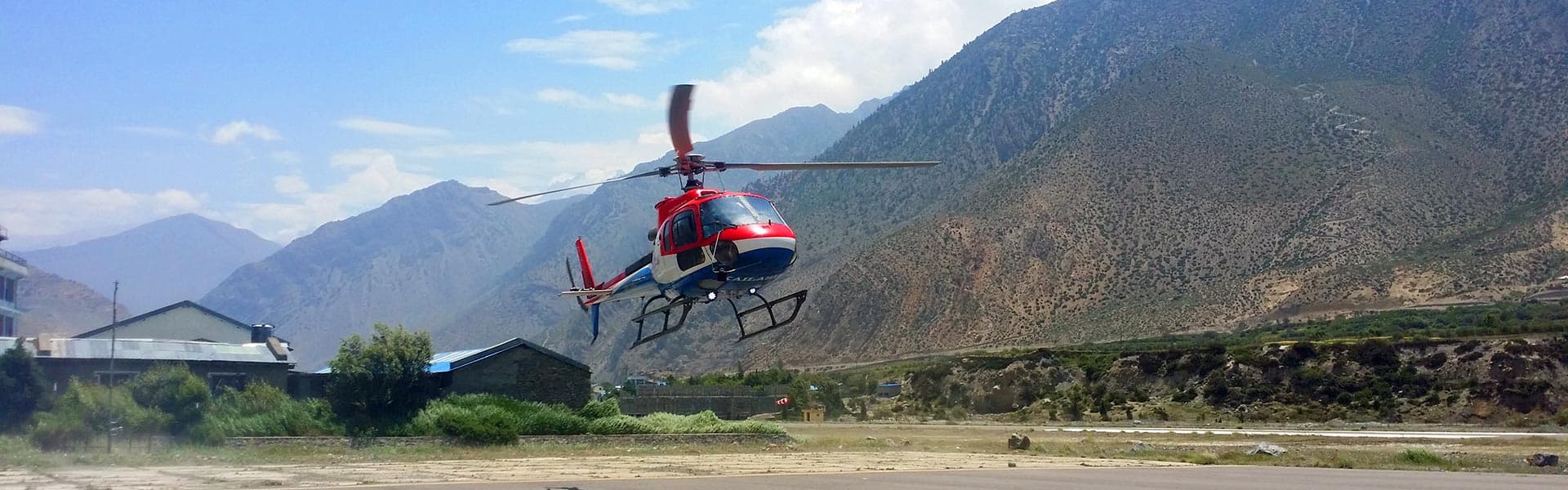
Internal transport on the itinerary, including the Pokhara to Jomsom leg
What is not included
International flights to Nepal and your Nepal visa
Travel insurance, which must cover mountain biking at altitude and helicopter evacuation. This is not optional on this route
Personal riding kit, helmet aside if you are renting from us, and personal spares for your own bike
Lunches and dinners in Kathmandu and Pokhara, tips, and anything personal
How booking works
Tell us your dates and group size through the contact page or on WhatsApp. For Tiji, do this six to twelve months out.
We confirm the festival dates with Lo Manthang, check bed availability for those nights, and send you a dated itinerary with a firm per-person price for your group size.
A deposit confirms the departure and lets us start the permit paperwork and hold beds.
We need your passport scan and passport photographs for the Restricted Area Permit. The permit is issued in Kathmandu before you travel north.
The final balance is settled before departure, and the pre-departure briefing in Kathmandu or Pokhara covers the route profile, the bikes, and the festival week plan.
Bikes can also be rented separately if you are arranging your own trip in Nepal. Our fleet and daily rates are on the bike rental page.
Permits, rules, and a worked cost example
Upper Mustang is a restricted area. The rules exist to protect a fragile culture and a fragile environment, not as bureaucratic friction, and they are enforced at a physical checkpoint.
The Restricted Area Permit, or RAP. It is issued by the Department of Immigration and costs USD 50 per person per day, counted from the day you cross the Kagbeni checkpoint. It must be processed through a registered Nepali agency, and you must travel with a licensed guide.
The Annapurna Conservation Area Permit, or ACAP. NPR 3,000, which is roughly USD 22 to 25. Upper Mustang sits inside the conservation area, so this one is needed on top of the restricted permit.
What changed in March 2026, and how to date any article you read. The old structure ended on 22 March 2026. Until then, the restricted permit was a flat USD 500 for ten days, plus USD 50 for each extra day. It is now USD 50 per day from day one. This gives you a free test of any page you read about Upper Mustang. If a guide still quotes USD 500 for ten days, everything else on that page is the same age, including its altitudes, its route, and its rules about who can hold a permit.
The two-person minimum was scrapped at the same time. A solo rider can now legally hold a restricted area permit. You still need a licensed guide and a registered agency, so nobody is riding into Lo Manthang alone and unaccompanied, but the old rule that you needed a second traveller to make an application is gone. This is recent, so it is worth confirming the current position with your agency rather than relying on older information.
Carry the right documents. A passport with at least six months of validity, plus spare passport photographs. The permit is checked physically at Kagbeni, and your name has to match your passport exactly.
For riders specifically. The law requires a licensed guide. It does not specify a mountain bike guide. We send a bike-specific guide anyway, because a trekking guide who has never ridden the corridor cannot judge a rider's line, pace a group on shale, or make sensible calls about surface and wind for a bike. Comprehensive insurance covering high altitude cycling and helicopter evacuation matters for the same reason. Many policies cover trekking and exclude mountain biking as an activity, so read the wording rather than the summary page.
A worked cost example
Here is what the permits actually add up to for a festival-timed trip. This is permit cost only, not the trip price.
Item | Days | Rate | Total |
|---|---|---|---|
Restricted Area Permit | 10 days inside the restricted area | USD 50/day | USD 500 |
ACAP | Whole trip | NPR 3,000 | About USD 25 |
Total mandatory permits | About USD 525 per person |
A shorter six-day permit window comes to USD 300, and a fourteen-day window comes to USD 700. Since the change, trip length is partly a budget decision, and there is a real tension in it: fewer days inside the zone costs less and acclimatises you worse. On our expeditions, both permits are included in the trip price, so this table is here to help you check anybody's quote, including ours.
Responsible travel, in specifics rather than slogans
Book with operators who employ local Loba guides and porters, and ask the question directly rather than assuming
Stay in local lodges rather than arrangements that route the money out of the valley
Treat monasteries and ritual spaces the way you would treat any active place of worship, because that is what they are
Take nothing out of the caves and nothing out of the riverbed. Collecting and exporting shaligram, the fossil stones of the Kali Gandaki, is restricted, and beyond the legal position, these are objects of worship for a very large number of people
Carry your waste out. There is no waste collection in Upper Mustang at all, so everything that goes in has to come out, including tyre packaging, gel wrappers, and old sealant
Refill and treat water rather than buying bottled water in a desert where every load is trucked or carried in
Ride single file, do not skid on the switchbacks, and do not cut a new line for a photograph. On dry, loose ground, a locked rear wheel leaves a scar that is still visible in five years
Permit fees and visitor spending feed school programmes, heritage restoration and healthcare across the Mustang valley, so where and how you book genuinely matters to the community you came to visit.
Altitude on a festival timed trip
Lo Manthang sits at 3,840 m, and you reach it after several days of climbing whichever way you travel. Altitude is the one part of this trip that does not care about your schedule, and a fixed festival date gives people a reason to rush, which is exactly the wrong instinct.
Four things that matter more than fitness:
Sleeping height, not riding height. Top a 4,010 m pass and sleep at 3,520 m, and that is a good day for your body. Have an easy day and sleep 900 m higher than the night before, and that is a bad one.
Arrive two nights before day one. You then spend three long afternoons sitting still in a cold courtyard already adapted, rather than meeting your first bad night at altitude on the morning of the dances.
Sitting still is harder than it sounds. You are generating no heat, at the top of your acclimatisation curve, with the afternoon wind coming through the square. Riders who felt strong on the way in sometimes feel rough on festival day one for exactly this reason.
Tell your guide early. A guide can reshape a plan on day one and can do very little about it on day three.
Symptoms to take seriously: headache, nausea, poor sleep, loss of appetite, and unusual breathlessness at rest. The answer is never to push through for the sake of the dances. Descent is the treatment that always works, and every group carries emergency oxygen as a bridge rather than a cure. There is a health post at Jomsom, and that is the level of care in the region, so anything serious goes to Pokhara.
What helps: drink far more than you feel like drinking, because the dry air takes water out of you with every breath. Eat properly even when your appetite drops. Go easy on alcohol at 3,840 m. If you have a heart or lung condition, or take medication that affects breathing or fluid balance, have that conversation with your doctor before you book rather than after you arrive.
Getting to the start line: flights, jeeps and the road
Every route in this guide starts from Jomsom, and getting to Jomsom is the part of the plan most likely to move.
Leg | How | What to know |
|---|---|---|
Kathmandu to Pokhara | 25-minute flight or 6–7 hours by road | Many trips fly one way and travel by road the other. We handle this transfer |
Pokhara to Jomsom | 20-minute flight, mornings only | Weather-dependent. Flights depart from Pokhara’s old domestic terminal, not the international terminal |
Pokhara to Jomsom | Jeep, one long day | The road alternative when flights are not operating; expect a long, rough journey |
Check the flight situation for your dates. Scheduled Pokhara to Jomsom services have been suspended for extended periods during recent monsoon seasons, and Tiji sits right at the edge of that window. Confirm before you commit to an itinerary that depends on flying.
Ask your operator what happens if the flight is canceled. The answer should be a specific plan involving a jeep and a timeline. This is the single most useful question you can ask about a festival trip.
The road is improving. The Kali Gandaki corridor road is being upgraded in stages, with roughly 90 km of about 202 km blacktopped as of mid 2026 and the Jomsom to Kagbeni section under construction. Good news for reliability, mixed news for riding, since a jeep road replaces the old trail in places. It is one reason the line we ride does not simply follow the road.
Put your buffer days at the front, not the back. A cancelled flight on the way in threatens the festival itself. A cancelled flight on the way out threatens your international connection, which is why nobody should book a flight home for the evening of the day they expect to reach Kathmandu.
Festival mornings: side trips around Lo Manthang
Tiji runs from late morning into the afternoon, so your mornings are free. The light is better before ten and the wind has not started, so this is the best part of the day to be out anyway.
Where | Time needed | What it is |
|---|---|---|
Chhoser and Jhong Cave | Half day, easy ride | A multi-storey network of dozens of chambers cut into the cliffs, linked by internal ladders. Used for living quarters, storage and refuge. A standout excursion from Lo Manthang |
Niphu and Garphu | Add to the Chhoser ride | Cliffside monasteries associated with the Nyingma and Sakya traditions, with centuries-old murals and manuscripts |
Namgyal and Tingkhar | 2–3 hours | A gentle loop northwest. Namgyal was the judicial seat of the former kingdom; Tingkhar was the village where the king's summer residence stood. Among the quietest areas near town during festival week |
Korala border pass | Full day, about 4,660 m | Historic Nepal–Tibet trade border with wide views across the plateau. Requires a strong, well-acclimatised group and a spare day |
Inside the walls | One morning | Visit Jampa Lhakhang, Thubchen and Chode with a guide who can arrange access to the interiors |
Dhakmar and Ghar Gompa | On the route in or out | Mustang's deep-red cliffs and Ghar Gompa, one of the region's oldest monasteries |
Two practical notes. Jhong Cave is dark, steep, and tight rather than scenic, and stiff-soled riding shoes make the ladders harder than they need to be, so carry something else to change into. Some chambers at Niphu, Garphu and the cave monasteries need a monk present to open them, so your guide will ask ahead and opening times are a real constraint on the day.
Korala deserves one warning. This is politically sensitive ground, and you cannot cross. Keep drones packed away, be careful what you photograph, and treat your guide's instructions as fixed. It is a look-and-turn-around point, and the ride up is the reward.
If you only do one thing inside the walls, make it Jampa Lhakhang. The mandala murals in there are among the most important surviving Tibetan Buddhist art anywhere, and you see them by the light coming through a doorway rather than under gallery lighting.
Etiquette, photography and drones
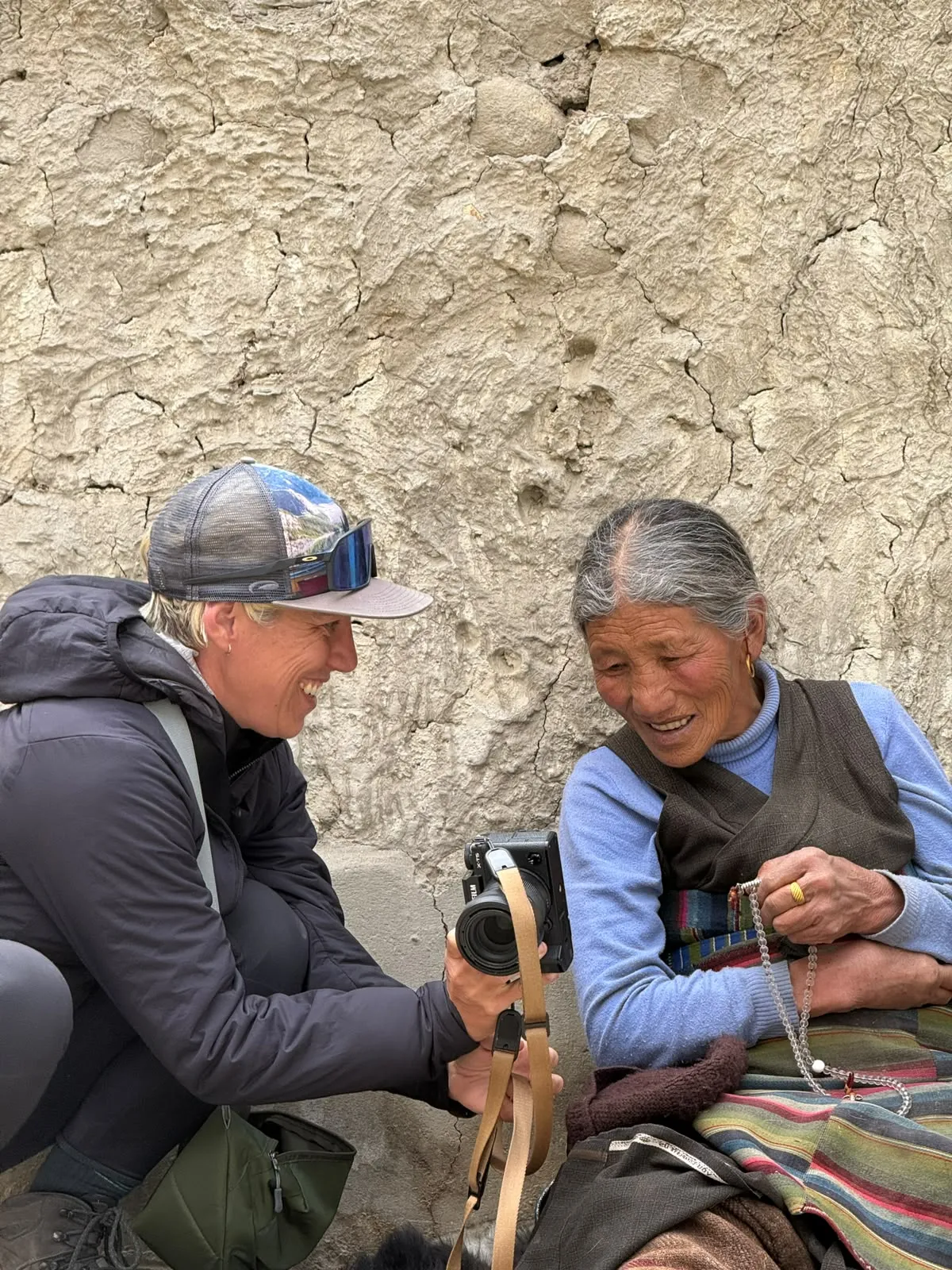
Read this one twice. You are a guest at a religious ritual, and the difference between a welcome visitor and an irritating one is made up entirely of small choices.
Do
Arrive early, take a spot at the back or the side, and stay in it. Your guide will show you where visitors sit
Ask before photographing individual people, especially monks and older residents, and accept a no
Cover shoulders and knees, and change out of riding kit before you sit down
Keep your voice down during the dances, and put your phone on silent
Receive a blessing with both hands
Leave around the outside of the crowd if you need to go
Do not
Step into the open dancing ground for a better angle, even between sequences
Stand up in front of seated elders
Use flash near the dances or near old murals
Applaud. This is not a performance, and clapping marks you out immediately
Eat in the seating area during ritual sequences
Hand money or sweets to children. Give through the monastery, a school, or a local shop instead
Drones: no. This is a religious ritual in a walled town near a sensitive international border. Assume the answer is no unless the monastery and the local authorities have agreed in advance, which is not something arranged on the day. Bringing one out embarrasses your guide and causes real problems for everybody.
Inside the monasteries, some chambers do not allow photography at all. The response to that is to put the camera away rather than negotiate.
One line to carry through the week. Follow your guide's lead on when it is appropriate to approach, and when it is not.
Money, beds, food, power and health in Lo Manthang
What to expect | |
|---|---|
Money | No ATMs in Upper Mustang; Jomsom has the last reliable ATM. Bring all the cash you will need in small notes, plus a margin for extra days |
Beds | Basic teahouse rooms, usually twin-share, with shared bathrooms. Some buildings have one heated room. Beds inside the walls are limited and can be taken months ahead during Tiji |
Food | Dal bhat, Tibetan bread, thukpa, noodles, potatoes, eggs and tea. Filling but repetitive; vegetarian meals are generally easy to find |
Power | Solar and grid power are available, but neither is fully reliable. Charging is usually possible for a small fee |
Signal | Coverage is available in Lo Manthang but patchy along the route. Some lodges offer Wi-Fi. Plan to be largely offline |
Water | Drink treated or boiled water where available, or refill and treat your own. At altitude, drink regularly even when you do not feel thirsty |
Health | Basic medical care is available in Lo Manthang, with a health post in Jomsom. Serious cases may require evacuation to Pokhara. Travel insurance with helicopter evacuation cover is essential |
Washing | Squat toilets are common. Hot showers are available in some places for an additional fee. Expect dusty conditions throughout the trip |
Festival week makes all of this tighter. Kitchens are cooking for a full town so meals take longer, water pressure and hot water are under strain, and lodge power is shared with more people than usual.
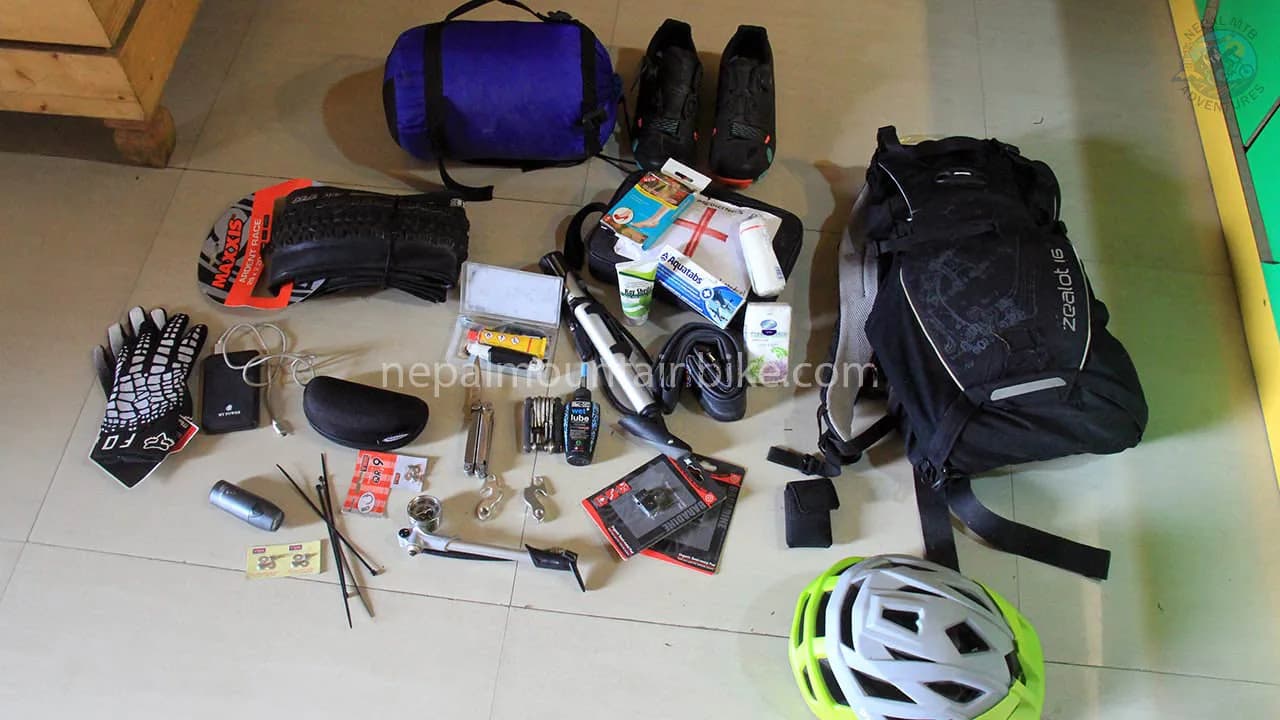
Two things to sort before you travel. Send any serious dietary requirements ahead in writing rather than raising it at the table, since supply chains at 3,840 m are long. And pack a personal medical kit: painkillers, rehydration salts, blister and wound care, prescription medication in original packaging with spares for delay days, high-factor sunscreen and lip balm. The sun here burns much faster than most visitors expect, including through thin cloud.
For bike groups, ask where the bikes sleep before you accept a lodge. Secure overnight storage matters as much as the beds do, and it narrows the options during festival week.
What to pack for Tiji week
The riding kit list for Nepal is covered in our mountain biking checklist. This is the shorter list of what Tiji specifically demands on top of normal expedition packing.
For sitting still in a cold courtyard for three afternoons:
A warm insulated jacket, because you are not moving and you are at 3,840 m
A hat and gloves that are not riding gloves
Clothing that covers shoulders and knees, and something clean to change into out of riding kit
A foam sit pad or a folded jacket. The ground and the low walls are cold stone
Sunglasses and high-factor sunscreen, since the courtyard is mostly in the sun until late afternoon
A buff or dust mask, useful in the wind and in the crowd
For the camera:
Spare batteries, kept warm in an inside pocket, because cold cells die early
A mid-range zoom is more useful than anything extreme. You are shooting from the edge of a courtyard, not the front row
A lens cloth and a blower, because the dust gets into everything
No flash, and no drone
For the riding week around it:
Layers that work between a freezing sunrise start and a hot exposed midday
Full sun cover for arms, neck and face. The sun here is brutal, and the wind hides it
Your own spare derailleur hanger if you brought your own bike
Enough Nepali rupees in small notes for the whole restricted section
A power bank, and a headtorch for lodges after the generator goes off
What to ask any operator before you book
A festival trip has more ways to go wrong than an ordinary one, because it has a fixed date in the middle of it. These are the questions worth asking, whoever you book with, and our answers are below them.
Which dates do you have from the monastery, and how did you get them? The right answer names Chode Monastery or a named local contact, not a website.
Do you have beds held in Lo Manthang for those exact nights, and where do the bikes sleep? During Tiji, a maybe is a no.
How many nights do we have in Lo Manthang before day one of the festival? Fewer than two, and the acclimatisation plan is thin.
What is your plan if the Pokhara to Jomsom flight is cancelled? There should be a specific answer involving a jeep and a timeline, not a shrug.
Are the Restricted Area Permit and ACAP included, or added later? The restricted permit is charged per day inside the zone, so this is a real number.
Is the guide a licensed mountain bike guide, or a trekking guide? Both are legal. Only one of them can pace a group of riders on shale.
Who is on the trip besides the lead guide? Ask about a sweep guide, a mechanic, a support vehicle, and spares.
What medical cover travels with the group? First responder training and emergency oxygen are the baseline at this altitude.
What is the group size, and the ratio of guides to riders?
Are the guides and staff local, and how much of the trip cost stays in the valley? A fair question, and worth asking everywhere you travel.
We have written this checklist down for one reason. Upper Mustang is a long way from help, and we would rather every traveller heading to Tiji has an easy, well-organised trip, whoever ends up taking them. Ask these ten questions of anybody you are considering, including us. Good answers come back quickly and with specifics, and that is worth more to you than any brochure.
Our answers, without decoration. A lead guide and a sweep guide on every departure. A mechanic with the group, plus 4WD support and a mobile workshop carrying expedition spares. Our own Trek, Scott and Bergamont fleet, maintained in our workshop in Pokhara. A registered Nepali agency that files its own restricted area permits, with the Restricted Area Permit and ACAP included in the trip price. Guides with Wilderness First Responder certification and emergency oxygen carried by the group. Beds are held in Lo Manthang for the festival nights before we confirm your departure. And a company that has been riding this region out of Pokhara since 2004. You can read about Jagan Bishwokarma and the guide team before you ask us any of it.
If you are still weighing up whether to travel with a company at all, our comparison of guided or self-guided mountain biking in Nepal is worth ten minutes, with one caveat for this trip: in a restricted area, self-guided is not one of the options.
Book your Tiji Festival expedition
The high plateau is a long way from anywhere, and that is the point. Whether you want to ride technical high desert singletrack on a mountain bike or e-MTB, cover the ground comfortably by 4x4, or walk in along the old salt road, arriving in Lo Manthang in time for Tiji is one of the few journeys left in the Himalaya that still feels like it belongs to the place rather than to the people watching.
Because permits are limited and lodge space inside the walled city is fixed, festival departures fill months ahead. Plan early, and talk to us before you book flights.
Reserve your Tiji departure with Nepal MTB Adventures. We build custom mountain biking and e-MTB expeditions timed to the festival, private 4WD groups for non-riders and mixed families, and cultural research trips. Our Upper Mustang mountain biking expedition and Upper Mustang e-MTB expedition pages carry current departures and pricing, and the contact page is the fastest way to start a conversation about dates.
Nepal MTB Adventures Pvt. Ltd.
Hallan Chowk, Lakeside 06, Pokhara, Nepal
Website: www.nepalmountainbike.com
Email: [email protected] or [email protected]
WhatsApp and phone: +977 9804134788 and +977 61 456224
Riding this region since 2004, from our own workshop in Pokhara.
Frequently asked questions
When is the Tiji Festival in 2027?
Tiji 2027 runs from 1 to 3 June in Lo Manthang, Upper Mustang. The dates follow the Tibetan lunar calendar and are confirmed by Chode Monastery through its own astrological calculations, so they move every year and are usually settled only a few months in advance. We reconfirm them with our partners in Lo before each departure and update this page when they change. If you are booking international flights around the festival, build in a couple of buffer days rather than arriving on the morning of day one.
When is Tiji in 2028, and can I plan that far ahead?
The 2028 dates have not been published yet, and anyone giving you a firm date this far out is estimating. The pattern is reliable enough to plan around, though: Tiji almost always falls in the second half of May or the first days of June. You can safely book a trip window now and let the exact dates settle later, which is what most of our festival riders do. The parts that need early commitment are beds and permits, not your calendar precision.
How much does it cost to visit Upper Mustang for the Tiji Festival?
Beyond your trip package, the mandatory permits are a Restricted Area Permit at USD 50 per person per day and an ACAP permit at NPR 3,000, which is roughly USD 22 to 25. A ten-day permit window therefore costs about USD 525 per person in permits alone. On our expeditions, both permits are included in the trip price, which starts from USD 3,850 per person on the 16-day guided mountain bike expedition. Always reconfirm current permit rates before booking, because the rules here changed in March 2026 and have changed more than once in recent years.
Can I buy the Upper Mustang permit myself?
No. The Restricted Area Permit is issued to a registered Nepali agency on your behalf, and you must travel with a licensed guide. You cannot walk into an office as a foreign traveller and buy one over the counter, and you cannot enter the restricted area without one, because it is physically checked at the Kagbeni post. What you can do is choose which agency arranges it, which is the decision that actually matters. Have your passport, at least six months of validity on it, and spare passport photographs ready.
Can I travel to Upper Mustang alone?
The old rule that required a minimum of two travellers on a single permit application was scrapped in March 2026, so a solo traveller can now legally hold a restricted area permit. You still need a licensed guide and a registered agency, so you are not riding unaccompanied, but you no longer need to find a second person to make the trip legal. This is a recent change, and permit rules here have moved more than once, so confirm the current position with your agency when you book.
Is the Tiji Festival open to foreign visitors, and do I need a ticket?
Yes, foreign visitors are welcome to watch, and there is no ticket. What you need is the permits and the licensed guide that Upper Mustang requires of every visitor, festival or not. Seating in the courtyard is informal and organised by custom rather than by rows and numbers, with visitors at the edges and the local community, elders and dignitaries in the established places. Arrive early on each day if you want a decent position, and let your guide place you.
Is there any religious or cultural barrier to attending? Can people of other faiths watch?
No. Nepal is a secular country, and there is no rule anywhere that keeps people of another religion, culture, or nationality out of Tiji. Buddhists, Hindus, Christians, Muslims, people of no faith at all, Nepali visitors and foreign visitors all sit in the same courtyard and watch the same dances. Nobody will ask what you believe, and no part of the festival is closed to you for that reason. What is expected of every visitor is the same thing expected of every guest anywhere: sit where your guide places you, keep quiet during the dances, dress modestly, ask before photographing people, and follow the etiquette in section 21.
Is it possible to cycle to Lo Manthang for the Tiji Festival?
Yes, and it is one of the best ways to arrive. Upper Mustang's high desert trails, old caravan paths, and jeep tracks make it a genuine mountain biking destination rather than only a trekking region, and riding in gives you the country as well as the festival. The route from Jomsom crosses several passes, tops out at about 4,010 m on the standard line, and is graded Moderate to Hard, so it needs real high-altitude and off-road experience. Most riders stop riding for the three festival days and pick up the route afterwards.
Is Upper Mustang mountain biking suitable for beginners?
Not on the classic Jomsom to Lo Manthang route. It is graded hard, with technical singletrack, loose shale, exposure, and sustained climbing at altitude, and it suits riders with previous off-road and high-altitude experience. Beginners who want to combine cycling with this region usually join the jeep-supported version and add shorter rides around Lo Manthang once they are acclimatised, which works well. If you want to build up to the Mustang corridor, Lower Mustang is the more forgiving introduction to the same landscape.
What kind of bike do I need for the Tiji Festival route?
A full-suspension mountain bike or a full-suspension e-MTB is what we recommend, because the mix of shale, loose rock and long descents punishes a rigid back end and punishes you with it. A hardtail is rideable, and plenty of people have done it, but it is a longer, rougher week. Whatever you ride needs tyres in good condition, a fresh drivetrain and, if it is your own bike, a spare derailleur hanger that matches it. We run our own Trek, Scott and Bergamont fleet if you would rather not fly a bike across the world.
Can I combine an e-MTB tour with the Tiji Festival dates?
Yes, and it is one of the most popular ways to time an Upper Mustang expedition. We build multi-day e-MTB itineraries that arrive in Lo Manthang before the festival, treat the three festival days as rest days off the bike, and ride out afterwards or return by jeep. The thing that makes or breaks an e-MTB trip here is power management: spare batteries, dual chargers, vehicle charging capability, and batteries kept warm overnight. Ask any operator how they charge five bikes in a full lodge at 3,840 m and see whether the answer is specific.
Can I ride during the three festival days?
You can, but almost nobody does, and we would gently talk you out of it. The dances run from late morning into the afternoon, which leaves only a short morning window, and it is hard to enjoy a 600-year-old ritual while your legs are still recovering. What most riders do is treat the three days as rest and recovery, with easy morning outings on the bike to Chhoser or Namgyal and the afternoons in the courtyard. It is also the natural window for the mechanic to strip and service everything after four dusty days on the way in.
What is the Tiji Festival actually celebrating?
Tiji reenacts the story of Dorje Jono, an emanation of the wrathful deity Vajrakila, defeating the demon Ma Tam Ru, who had brought drought and disease to the Mustang valley. Over three days, the monks of Chode monastery dance that story, gather the community's accumulated misfortune into a barley flour effigy, and then destroy it and cast it beyond the town wall. For the Loba people, this is not a historical reenactment for visitors but a living ritual that renews the spiritual protection of the valley for another year. The name, short for Tenpa Chirim, is usually translated as prayer for world peace.
What time do the dances start and how long does each day last?
The dances usually begin around the middle of the day and run into the afternoon, often for three to four hours, and they end when the ritual ends rather than at a scheduled time. There is no printed programme. Your guide confirms the day's timing by walking down to the monastery in the morning and asking, which is genuinely how it works. Plan to be free from late morning onwards on all three days, and do not book anything else into those afternoons.
If I can only see one day, which should it be?
Day three. The final day is the climax, with the Rha Chham dance, the destruction of the effigy and the procession that carries it out beyond the walls, and it is the most dramatic and most physically demanding of the three. Day two is the second choice, because that is when the wrathful deity forms, the skull crowns and the phurba dances appear. Day one is the most orderly and the easiest to photograph from a distance, but on its own it is the least satisfying. Honestly, though, the point of coming this far is to see all three, and the trips that only catch one day are usually the ones that arrived too late.
Can I take photographs, and can I fly a drone?
Photography of the dances from the edge of the courtyard is generally accepted, and you will see plenty of cameras there. Ask before photographing individual people, especially monks and older residents; do not use flash, and respect the chambers inside the monasteries where photography is not allowed at all. Drones are a different matter entirely: this is a religious ritual in a walled town near a sensitive international border, and you should assume the answer is no. Bringing one out will embarrass your guide and can cause real problems for everybody.
What should I wear at the festival?
Cover your shoulders and knees, and bring something to change into so you are not sitting in a crowd in riding kit. Warm layers matter more than people expect, because you sit still for hours at 3,840 m and the afternoon wind moves through the square even when the sun is out. A hat, sunglasses, high-factor sunscreen, and a buff for dust make the day much more comfortable. A foam sit pad or a folded jacket is worth carrying, since the seating is cold stone and low walls.
What is the weather like in Lo Manthang in early June?
Dry, bright, and windy, with big swings between day and night. Upper Mustang sits in the rain shadow behind the Annapurna and Dhaulagiri wall, so it stays largely dry when the monsoon soaks the rest of Nepal, and early June is one of the mildest windows of the year up there. Days can feel hot in the sun and nights drop close to or below freezing. The constant is the wind, which builds through the late morning and blows hard up the valley through the afternoon.
How high is Lo Manthang, and will I get altitude sickness?
Lo Manthang sits at 3,840 m, and the passes on the way in reach about 4,010 m. Whether you have problems depends far more on how fast you gained height than on how fit you are, which is why our itinerary arrives two days before the festival and why the sleeping altitudes matter more than the riding altitudes. Watch for headache, nausea, poor sleep, loss of appetite, and breathlessness at rest, and tell your guide early rather than pushing through. Descent is the treatment that always works, and every group carries emergency oxygen as a bridge, not a cure.
How do I get to Jomsom, and what happens if the flight is cancelled?
Most trips fly Pokhara to Jomsom in the early morning, from the old Pokhara domestic airport, and the flight is short, spectacular, and weather-dependent. Scheduled services have also been suspended for extended periods in recent monsoon seasons, and Tiji sits at the edge of that window, so check the situation for your dates. The fallback is a long jeep day up the Kali Gandaki corridor, which is dusty but reliable. Any operator running a festival trip should be able to tell you exactly what happens if your flight cancels on the morning you were meant to fly.
How many days do I need in total from Kathmandu?
Allow 15 to 16 days for the full guided mountain bike expedition, 10 to 12 days for a jeep-based trip, and 12 to 14 days for the foot trek. Those figures include the Kathmandu and Pokhara transfers at each end and the buffer days that make a fixed festival date survivable. You can do it faster, but faster means less acclimatisation and no room for weather, which is a poor trade on a trip with a date in the middle of it. Do not book an international flight home for the same evening you expect to arrive back in Kathmandu.
How crowded does Lo Manthang get during Tiji?
Busy by Upper Mustang standards and small by any other standard. Families come in from Charang, Ghami, Chhoser, Tingkhar and villages further out; people who work elsewhere in Nepal return home for it, and a modest number of foreign visitors join them. The courtyard is full, the lanes are busy, and the lodges are at capacity, but you are still talking about hundreds of people rather than thousands. It feels like a district gathering rather than a tourist event, which is exactly why it is worth seeing.
Where do I stay, and how far in advance should I book?
Accommodation in Lo Manthang is basic teahouse style, twin share, with shared bathrooms in most lodges and one heated room in the building. There is a fixed and small number of beds inside the walls, and during Tiji they are taken months ahead, so six to twelve months of notice is normal for a festival departure. Bike groups also need secure overnight storage for the bikes, which narrows the options further. If an operator cannot confirm held beds for the festival nights, treat the trip as unconfirmed.
Are there ATMs, and how much cash should I carry?
There are no ATMs in Upper Mustang. Jomsom has the last cash machine on the route, and everything you need north of it has to travel with you in Nepali rupees. Budget for lodge extras, hot showers, charging, drinks, snacks, monastery offerings, souvenirs and tips, then add a margin for delay days, and bring it in small notes. Running out of cash in a walled town at 3,840 m during the busiest week of its year is a solvable problem but not a pleasant one.
Is there phone signal or wifi?
There is mobile coverage in Lo Manthang and patchy coverage along the route, and some lodges sell wifi that works well enough for a message and badly for anything else. During festival week, when the town is full, everything gets slower. Plan to be largely offline, tell people at home that in advance, and carry a power bank because charging is neither fast nor guaranteed. If you need reliable communication for work reasons, this is not the trip for that fortnight.
Is Tiji suitable for children or older travellers?
Yes, with the right route. The festival itself is family-friendly, with local children everywhere and a relaxed atmosphere around the ritual, and the courtyard is a sitting event rather than a walking one. The constraints are altitude and the journey in, which is why families and older travellers usually come by jeep with a gradual profile rather than riding or trekking. Talk to us about the acclimatisation plan first, since 3,840 m deserves respect at any age.
Can I go by jeep instead of riding or trekking?
Yes, and for a lot of people it is the right answer. The 4WD route follows the same corridor from Pokhara through Jomsom and Kagbeni to Lo Manthang, with the red cliffs, sky caves, and mountain views along the way, and it can be arranged as a private departure timed to the festival. Two honest notes: the road is rough and dusty, and a vehicle can gain height faster than your body adapts, so ask for an itinerary with a night at an intermediate elevation rather than a straight run up. Mixed groups often combine both, with riders on bikes and non-riders in the vehicle.