


What your policy has to say before you ride in the Himalaya, from the Pokhara team that has to make the phone call if something goes wrong.
Most travel insurance is written for a week on a beach. Most insurance guides about Nepal are written for trekkers. Neither fits a rider, because insurers treat mountain biking as its own activity, with its own exclusions and often its own altitude limit.
We've run mountain bike tours from Pokhara since 2004, and we ask every rider for their policy before they fly. This guide is what we look for when we read it. It covers mountain bike travel insurance in general, then the parts that are particular to Nepal: altitude, permits, helicopter rescue and who pays for it. We don't sell insurance and we earn nothing from any insurer named here.
Mountain bike travel insurance for Nepal in brief
Does normal travel insurance cover mountain biking? Often not. Many policies cover only casual cycling on roads, or exclude off-road and downhill riding.
Check your policy in four steps: off-road mountain biking is named, the altitude limit clears your route, helicopter evacuation is included, and so are medical treatment and the journey home.
Altitude to buy: 6,000 m (19,685 ft) for the Annapurna Circuit and Tilicho Lake, 5,000 m (16,400 ft) for Mustang and Pikey Peak, 3,000 m (9,840 ft) for Pokhara rides.
Your bike: almost never covered by travel insurance. It needs its own policy.
Helicopter rescue: usually USD 3,000 to 6,000 for the flight alone. The helicopter doesn't fly until someone guarantees payment.
The rule that protects your claim: your insurer's emergency line is called before any helicopter is arranged.
When to buy: the day you pay your trip deposit, in your home country.
What mountain bike travel insurance is, and four steps to the right policy
Mountain bike travel insurance is travel insurance that names mountain biking as a covered activity, so your medical bills, rescue and trip costs are paid when the reason for the claim is a ride.
That sounds obvious. It isn't how most policies work.
Does normal travel insurance cover mountain biking?
Sometimes, and rarely in the way a riding trip needs. Insurers sort activities into risk bands. Walking and casual cycling sit in the lowest band and come as standard. Mountain biking usually sits higher, and what you get depends on the exact words in the policy.
Here is how insurers commonly split riding. The left column is their wording, not ours.
How the policy describes it | What it usually means | Good enough for a Nepal riding trip? |
|---|---|---|
Cycling, incidental to the trip | A hire bike for an afternoon on roads or paths | No |
Cycling on an organised tour, or cycle touring | Road and gravel touring, often with a low altitude limit | Rarely |
Mountain biking, off-road or cross-country | Trail riding on natural paths | Yes, if the altitude also fits |
Mountain biking graded by trail colour (green, blue, red, black) | Cover rises with the grade you declare | Yes, if you declare the hardest grade you'll ride |
Downhill, enduro, freeride, bike park, uplift | Gravity riding, usually an upgrade | Needed for our enduro and downhill trips |
Racing or competition | Usually excluded unless you buy an event add-on | Not needed on our tours |
Mountain biking as the main purpose of the trip | Some policies cover riding only when it's a side activity | Check this line carefully |
Three traps come up again and again in the policies riders send us.
The road-only trap. The summary says cycling is covered. The small print limits it to sealed roads.
The "not the main purpose" trap. The policy covers mountain biking only when it's a side activity on a general holiday. A bike tour is a trip where riding is the main purpose.
The low ceiling trap. Some mainstream policies cover cycling only up to 1,000 m (3,300 ft). Ben Nevis is 1,345 m (4,413 ft). Pokhara's ridge trails are higher than that before lunch.
So the honest answer to "is mountain biking covered by travel insurance" is: only if the policy wording says off-road mountain biking, for a trip where riding is the main purpose, at the height you're going to.
How to check any policy in ten minutes
We can't tell you whether one named insurer covers you, because wordings differ by country and change every year. This method works on all of them.
Open the full policy wording, not the summary page or the advert.
Search it for six words: biking, cycling, off-road, downhill, altitude, metres.
Find the activities list. Note which band or pack mountain biking sits in, and whether that band is included or costs extra.
Look for a separate altitude limit attached to cycling. It's often lower than the trekking limit in the same document.
Look for the words "incidental" or "main purpose".
If any answer is unclear, email the insurer (there's a template in Part 7) and keep the reply.
Three kinds of policy riders buy
Kind of policy | What it's good at | Where it falls short for Nepal |
|---|---|---|
Standard travel policy with an adventure or sports add-on | Medical, cancellation, baggage, and often trekking to 6,000 m | May not name off-road mountain biking, or may treat it as a side activity only |
Specialist cycling or mountain bike travel policy | Names every kind of riding, including downhill and enduro | Often has an altitude limit built for the Alps. Two UK cycling policies we read in October 2026 stopped at 5,000 m and 5,500 m for guided riding. |
Mountain-sports or trekking policy | High altitude and helicopter rescue | Built around walking. You must confirm the bike is included. |
This is the Nepal problem in one table. A policy built for cyclists tends to cover the riding and stop short on height. A policy built for trekkers tends to cover the height and stay silent on the bike. You need one document that says both.
Four steps to the right policy
Whatever kind of policy you buy, work through these four steps in order. Move to the next step only when the one before it is settled.
Step 1: Find mountain biking in the activities list.
The wording has to say off-road mountain biking is covered, on a trip where riding is the main purpose. If it only says "cycling", or covers riding as a side activity, stop here and ask the insurer or look at another policy.
Step 2: Check the altitude limit against your route.
Look for the limit that applies to biking, not only to trekking. It has to be above the highest point you'll ride. Part 2 gives the number for each of our trips.
Step 3: Check helicopter evacuation.
The policy has to include emergency helicopter evacuation, with the limit written down. USD 100,000 or more is a sensible figure to look for.
Step 4: Check medical treatment and the journey home.
The helicopter only takes you to a hospital. It doesn't pay the hospital. The policy has to cover treatment, hospital admission and repatriation, which means getting you home with medical care if you need it.
Once all four are settled, ask one last question. Does your insurer guarantee payment directly to the helicopter company, or do you pay first and claim it back? The answer decides whether you're asked for a credit card on the mountain. Part 5 explains why.
Travel insurance and evacuation membership are different things
Two products are sold to people going to the Himalaya. Buying one when you needed the other is the most expensive mistake in this guide.
Travel insurance pays for medical treatment, hospital admission, the journey home, and usually emergency evacuation as one of its benefits. It also covers cancellation and baggage. This is the product our booking terms require.
Evacuation membership is a service that moves you from a remote place to medical care. Global Rescue is the best known. It is not travel insurance. It doesn't pay your hospital bill, and it doesn't cover cancellation or baggage. If your route goes above 4,600 m (15,000 ft), Global Rescue also asks members to add its high-altitude evacuation package, and that applies to the Annapurna Circuit and Tilicho Lake.
The safe combination for a high trip is a medical travel policy that you've taken through the four steps, with an evacuation membership alongside it if you want one. Buying only the membership is the trap.
Insurers that riders bring to Nepal
These are the names we see most on riders' certificates. We list them to describe them, not to rank them. Check the current wording yourself before you buy.
World Nomads. Its mountain biking cover lists on-road, off-road, cross-country and downhill trails, and it excludes riding above 6,000 m. You must select the activity when you buy. In its UK wording, loss or damage to the bike and personal liability while cycling are not covered. Terms differ by your country of residence.
True Traveller. Sold to residents of the UK and Europe. Mountain biking cover rises by trail grade (green and blue, then red, then black) and trekking cover rises by altitude, in separate packs. You need the right pack for both.
Mountain-sports insurers and alpine clubs. The British Mountaineering Council, Snowcard, and alpine clubs such as the Austrian Alpine Club and the German Alpine Club (DAV) offer or include cover built for mountains. Ask each one the bike question and the organised-tour question. The DAV's member cover, for example, lists mountain biking but applies to package tours only inside Europe.
Global Rescue. A paid membership, not an insurance policy. If you're injured or ill somewhere remote, its team arranges and pays for getting you out, by helicopter, vehicle or on foot with a ground team, and on to a hospital that can treat you. It stops there. It doesn't pay the hospital bill, and it doesn't cover cancellation, delays or baggage. For any trip that goes above 4,600 m (15,000 ft), which includes the Annapurna Circuit and Tilicho Lake, members have to add its high-altitude evacuation package. Riders who carry it hold a medical travel policy as well, so one pays for the rescue and the other pays for the treatment and the journey home.
Matching the cover to your riding and your altitude
Tell your insurer exactly what you'll ride and how high you'll go, because a policy only covers the activity you declared.
What to declare for each kind of trip
The trip you're doing with us | What to tell your insurer | The line to look for in the wording |
|---|---|---|
Day rides and overnight trips around Pokhara and Kathmandu | Guided off-road mountain biking on natural trails, up to about 2,800 m | Mountain biking, off-road or cross-country |
Multi-day routes: Lower Mustang, Upper Mustang, the Annapurna Circuit, Tilicho Lake | Guided multi-day off-road mountain biking as the main purpose of the trip, with your highest point | Mountain biking with an altitude limit above your high point |
Enduro and downhill trips with jeep uplift, such as Pokhara enduro and Pikey Peak | Enduro and downhill mountain biking on natural trails with vehicle uplift, not racing | Downhill, enduro or freeride named as covered |
Mountain biking with a helicopter lift to the start of the descent | Ask in writing. Some policies exclude helicopter-accessed sport. | |
E-MTB tours | Guided off-road riding on a pedal-assist electric mountain bike | E-bikes named, or written confirmation (see Part 3) |
Both trekking and mountain biking to 5,416 m | Both activities covered to the same altitude |
Nepal's trails are old footpaths and aren't graded by colour the way UK trail centres or US bike parks are. If your insurer asks for a grade, our trail grading guide shows how our grades compare, and we'll tell you the grade for your route.
The altitude number for your trip
Buy cover to at least the highest point on your route, and where the insurer sells altitude in bands, take the band that clears it by a real margin.
Most standard travel policies stop covering you somewhere between 3,000 and 4,000 m (9,840 and 13,120 ft). That is fine for most riding at home. It doesn't work here. Thorong La, the high pass of the Annapurna Circuit, is 5,416 m (17,769 ft). That's four times the height of Ben Nevis, more than three times the height of Denver, and higher than any summit in the Alps or the lower 48 US states.
Trip | Highest point | Buy cover to at least |
|---|---|---|
Pokhara day rides and overnight trips | about 2,050 m (6,725 ft) | 3,000 m (9,840 ft) |
Kathmandu Valley rides | about 2,780 m (9,120 ft) | 4,000 m (13,120 ft) |
about 3,800 m (12,470 ft) at Muktinath | 5,000 m (16,400 ft) | |
Pikey Peak | 4,065 m (13,337 ft) | 5,000 m (16,400 ft) |
about 4,200 m (13,780 ft) | 5,000 m (16,400 ft) | |
Tilicho Lake | about 4,920 m (16,140 ft) | 6,000 m (19,685 ft) |
Annapurna Circuit, all versions | 5,416 m (17,769 ft) at Thorong La | 6,000 m (19,685 ft) |
5,416 m (17,769 ft) at Thorong La | 6,000 m (19,685 ft) |
A 5,500 m band leaves you 84 m (276 ft) above Thorong La. That is not a margin. A missed turn or a detour around snow can use it up. Buy 6,000 m. The next band up usually costs very little.
> Guide's tip. Check that the altitude limit applies to the biking. We've read policies that cover trekking to 6,000 m and cycling to 3,000 m in the same document.
Does travel insurance cover altitude sickness?
Yes, when the policy covers the altitude you were at. Altitude illness is treated as a medical emergency like any other. It's refused when you were above the policy's limit, when the trip wasn't declared, or when a known heart or lung condition wasn't declared.
On these routes, altitude illness is the most likely reason you would ever use the cover. Read that clause first.
Region, dates and trip length
Region. Nepal needs a worldwide policy. Many insurers sell "worldwide excluding USA and Canada" for less, and that includes Nepal. A Europe-only policy does not.
Dates. Cover the whole trip, door to door, including the spare days we ask you to add at each end.
Trip length on annual policies. Annual multi-trip policies often limit each trip to about 30 days and may not include your activity or altitude at all. Check both.
Stopovers. If you break the journey in Doha, Dubai, Istanbul or Delhi, the policy has to cover that country too.
Your bike, e-bikes and the gaps most riders miss
Travel insurance covers you, not your bike. Treat the bike as a separate problem with a separate policy.
Your own bike
Standard travel insurance rarely covers a bicycle properly. Many policies limit any single item to a few hundred dollars or pounds, and some exclude bicycles outright. Specialist mountain bike travel policies usually exclude crash damage and theft of the bike as well. They insure the rider.
If you're bringing your own bike, you need one of these:
Specialist bicycle insurance that covers the bike worldwide, in transit, and in use off-road.
A written extension to your home contents insurance covering the bike abroad, away from home, in transit and while being ridden. Get the altitude and country in the reply.
Your bike on the plane
An airline's liability for checked baggage on international flights is capped by the Montreal Convention at 1,519 Special Drawing Rights per passenger, which is roughly USD 2,000. That cap covers everything you checked in, not only the bike. It's far below the value of a modern full-suspension bike.
Photograph the bike and the packed box before you check in.
If the box arrives damaged, report it at the airport before you leave the baggage hall, and get the report number.
Put the claim to the airline in writing within seven days.
If your bike policy has in-transit cover, tell that insurer the same day.
A rental bike
If you rent a bike, you are responsible for it during the rental. That's standard, and it's in our terms and conditions: a security deposit is taken for each rental, and if the bike is lost or stolen you pay for its replacement or the missing parts. We don't sell insurance for rented bikes.
So look in your policy for a section called hired sports equipment or rental equipment, and check that it includes bicycles and gives a limit close to the value of the bike. Many riders find this easier than insuring their own bike for the flight, which is one reason most of our riders use ours. You can see the fleet on our bike rental page.
E-bikes and e-MTB tours
Don't assume a policy that covers mountain biking also covers an electric mountain bike. Ask.
Insurers differ. Some list e-bikes next to ordinary cycling. Some say nothing. Some have a general exclusion for motorised vehicles that could be read to include an e-bike. In the UK and the EU, a pedal-assist bike with a 250 watt motor that stops assisting at 25 km/h (15.5 mph) is legally a bicycle, and that's the wording insurers there tend to follow. In the US, ask about Class 1 pedal-assist.
The e-MTBs on our tours are pedal-assist mountain bikes with no throttle. Airlines don't carry e-bike batteries, so on an e-MTB tour you ride one of ours, and the rental bike section above applies.
Seven gaps riders miss
Gap | What happens | What to do |
|---|---|---|
Personal liability while cycling | Several policies exclude it. If you injure a walker or damage property while riding, you're not covered. | Look for personal liability that isn't switched off for cycling |
Safety equipment conditions | Cover can depend on wearing a helmet and using recommended protection | Wear your helmet on every ride. Our terms require it anyway. |
Undeclared medical conditions | The most common reason a genuine high-altitude claim is refused | Declare everything, to the insurer and to us |
Riding above your altitude limit | No cover, even by a small margin | Buy the band above your high point |
Riding where a guide is required, without one | Outside the rules, so the insurer has a clean reason to refuse | Ride restricted and protected areas with a licensed guide |
Travel against government advice | If your government advises against travel to an area and you go, most policies are void there | Check your government's Nepal advice before you fly |
Alcohol | A standard exclusion everywhere | Keep the beer for after the riding day |
Cancellation, delay and cutting a trip short
Cancellation. Our deposit is non-refundable, though it can be moved to another trip, and cancellation charges rise as the start date gets closer. The tiers are on our booking information page. Cancellation cover is what gets that money back if you break a collarbone at home a month before you fly. It only protects you from the day the policy starts.
Cutting a trip short. If altitude illness or an injury ends your ride on day six, curtailment cover pays for the unused part of the trip and the changed flights.
Delay. Mountain flights to and from Jomsom and Pokhara wait for weather. Travel delay and missed connection cover, plus a spare day before your international flight, deals with that.
What Nepal's rules require
Nepal has no single law that makes every visitor carry travel insurance, but you can't join one of our tours without it, and restricted-area trips can't be filed without it.
Is travel insurance mandatory for Nepal?
Not at the border. Nobody at Kathmandu airport asks for a certificate, and the counters that issue Annapurna Conservation Area permits check your permit, not your policy.
That doesn't make it optional. It means nobody will stop you riding uninsured, and nobody will help you pay when something goes wrong. The UK government's Nepal advice tells travellers to make sure their insurance includes mountain rescue and helicopter costs. We go further: insurance that clears the four steps in Part 1 is a condition of every tour we run, and we ask for the details before you travel.
Restricted areas: Upper Mustang and the combined trip
Upper Mustang is a restricted area. So are Manaslu, Tsum Valley, Nar Phu and others, across 13 districts. The rules changed on 22 March 2026, and this is how they stand now.
Rule | How it works |
|---|---|
Who can apply | Only a registered agency. You can't apply as an individual. |
Group size | One rider can now hold a permit. The old two-person minimum was removed on 22 March 2026. |
Guide | A licensed guide is required for the whole trip, with no more than seven visitors per guide. |
How it's filed | Online, through the Department of Immigration's permit system. It can be started before you arrive in Nepal. |
Who is responsible in an emergency | The agency. The rules say the agency bears full responsibility for emergency rescue. |
That last line is why insurance isn't our house preference on these trips. We are answerable for your rescue, so we don't file a restricted-area application until we hold a certificate that covers helicopter evacuation and medical costs to 6,000 m.
This applies to our Upper Mustang mountain bike tour, the Upper Mustang e-MTB tour and the Annapurna Circuit and Upper Mustang trip. Permit fees and the rest of the paperwork are in our Upper Mustang guide.
Open areas: the Annapurna Circuit, Tilicho and Lower Mustang
These sit inside the Annapurna Conservation Area. You need the conservation area permit, which we arrange. Foreign visitors in Nepal's national parks and protected areas must also go with a licensed guide, and that matters for insurance, because most policies require you to follow local law. Our guided or self-guided guide explains the rule area by area.
Helicopter rescue in Nepal: how it works, what it costs, who pays
Helicopter rescue in Nepal is a private, paid service, and the aircraft doesn't leave the ground until someone has guaranteed the bill.
Who flies the helicopter
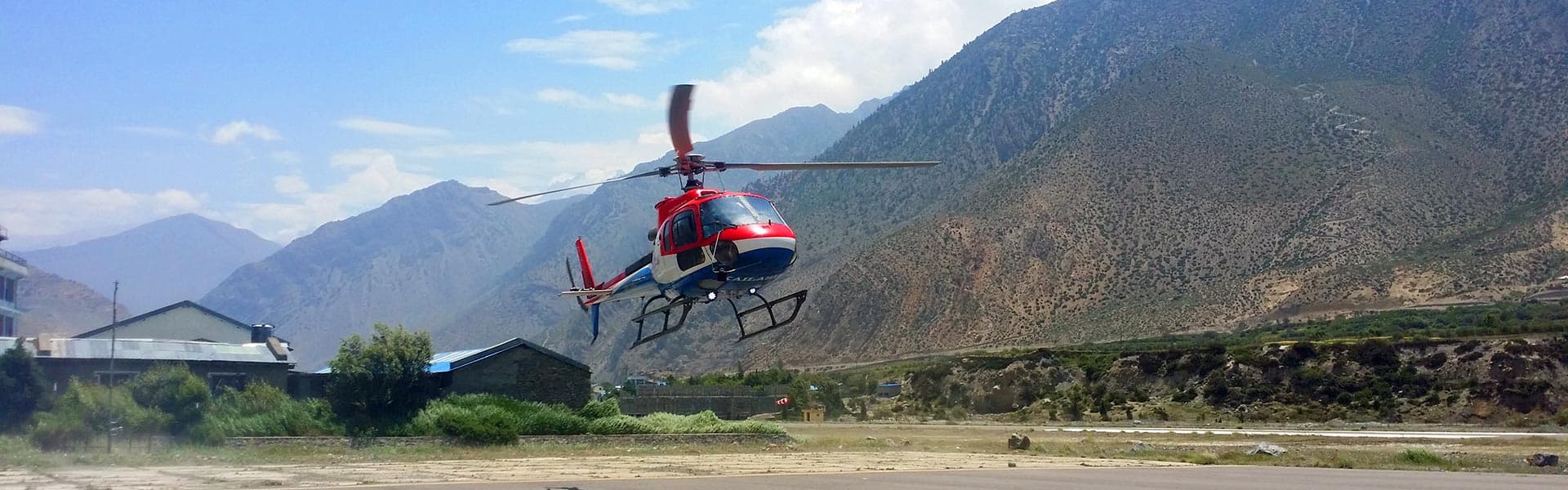
There's no free state mountain rescue service of the kind riders know from the Alps or from US search and rescue teams. The army flies some operations, but the helicopter that comes for a visitor is almost always a commercial one, run by a private helicopter company licensed by the Civil Aviation Authority of Nepal.
Most rescue flying is done in the Airbus H125, the type that made the highest helicopter landing ever recorded. It's used because it performs in thin air. Performance still falls with height, which is why a pickup at Jomsom is routine and a pickup near Thorong Phedi is not.
You don't choose the helicopter company. Your insurer's assistance team does, or agrees to it, because they're the ones paying.
The rule that protects your claim
Your insurer's 24-hour emergency line must be called before a helicopter is arranged. Insurers say this in plain words: you're only fully covered if their assistance team is involved before the evacuation. They decide whether the flight is medically necessary, and they authorise it.
A helicopter booked first and reported afterwards is the classic way a genuine rescue turns into a refused claim. On our tours your guide and our Pokhara office make that call with you, using the policy details you sent us before the trip.
The guarantee of payment
Before a helicopter launches, the helicopter company wants one of two things: a guarantee of payment from an insurer, or a credit card from you.
When the system works, the order is this. Your guide reports the emergency. Our office calls your insurer's emergency line with your policy number, your location and the medical picture. The insurer checks the policy, authorises the flight, and sends a guarantee of payment (also called a letter of guarantee) to the helicopter company. Now there's a payer, and the helicopter launches.
Policies handle the money in two ways.
Direct payment. The insurer guarantees and settles the bill. You pay nothing on the day.
Pay and claim. You or your family pay the bill and claim it back. That means finding several thousand US dollars at short notice while you're unwell at 4,500 m (14,760 ft).
Ask your insurer which one you have, and keep the answer in writing.
What a helicopter rescue costs in Nepal
What | Typical cost | Notes |
|---|---|---|
Helicopter evacuation from the Annapurna or Mustang region | USD 3,000 to 6,000 | The range riders, trekkers and insurers most often report. One UK insurer puts the average Nepal rescue at about USD 6,000. |
Higher pickups and longer flights to Kathmandu | Upper end of that range, or above | Thin air limits what the aircraft can lift, and flight time is what you pay for |
Hospital admission and treatment | Several thousand dollars for a short stay, far more for intensive care | Paid separately from the flight |
Medical flight home with an escort | Often the largest bill of all | This is what repatriation cover is for |
The flight is never the whole bill. That's why an evacuation limit on its own isn't enough, and why Step 4 in Part 1 exists.
How a rescue unfolds, step by step
Riders picture a helicopter arriving within the hour. The real order is slower, and knowing it changes what you do on the mountain.
Step | What happens |
|---|---|
1 | Your guide spots the problem and starts treating it. With altitude illness that means going down, not waiting. |
2 | The guide contacts our Pokhara office. Mobile signal reaches most villages on the Annapurna and Mustang routes and drops out in gorges and on high ground, so our guides also carry satellite communication on remote sections. |
3 | Our office calls your insurer's 24-hour line with your policy number, location and symptoms. This is where an incomplete policy fails, and why we ask for your details before you fly. |
4 | The insurer authorises the flight and sends the guarantee of payment. Thirty minutes to two hours is normal. In a clear life-threatening emergency it can be minutes. |
5 | Weather decides. Helicopters here fly by sight. Cloud, poor visibility or strong wind stops flying above 4,000 m (13,120 ft). In the Kali Gandaki valley the wind builds from around midday. |
6 | You keep descending. Losing 500 m (1,640 ft) often does more for altitude illness than any medicine. The helicopter meets you lower down if it can. |
7 | Pickup and transfer to hospital. When the weather allows, a high evacuation usually takes two to four hours from the first call. |
A request made late in the afternoon may not be flown until the next morning. That's why our riding days on the Mustang side start early, and why going down starts straight away. The seasons that fly best are in our best time to mountain bike in Nepal guide.
Where the helicopter can reach you on our routes
Place | Height | Access |
|---|---|---|
Chame | 2,670 m (8,760 ft) | On the road. Reachable by jeep as well as by air. |
Humde airstrip | 3,325 m (10,910 ft) | Just below Manang. A simple landing site. |
Manang | 3,540 m (11,610 ft) | The key point on the eastern side of the Circuit. Good helicopter access, road access, and the Himalayan Rescue Association aid post. |
Yak Kharka to Thorong La | 4,050 to 5,416 m (13,290 to 17,769 ft) | No road and no airstrip. The highest and least accessible part of the route. |
Muktinath | about 3,800 m (12,470 ft) | On the road from Jomsom |
Jomsom | 2,720 m (8,920 ft) | The main option on the western side, with an airport. Mornings are far more reliable than afternoons because of the valley wind. |
The hard section is the reason our Annapurna Circuit itinerary puts a full rest day at Manang before it. On the Tilicho side, options thin out beyond Khangsar, and the ground between Shree Kharka and Tilicho Base Camp crosses an active landslide slope. We plan those days around conditions and don't improvise them.
Where they take you
Kathmandu. CIWEC Hospital and Travel Medicine Center is where most trekkers and riders are taken in a serious case. It has treated travellers since 1982, is known for its work on altitude illness, and deals with international insurers every day. Norvic International Hospital and Grande International Hospital also take serious cases.
Pokhara. If the case isn't critical you may be flown to Pokhara instead, which is closer and cheaper. Jomsom to Pokhara is about 20 minutes by air. CIWEC has run a hospital in Lakeside, Pokhara since 2014, with a 24-hour emergency department.
On the trail. The Himalayan Rescue Association runs a seasonal aid post at Manang, staffed by volunteer doctors in the spring and autumn riding seasons, with a free daily talk on altitude. It's the most useful medical point on the Circuit. Going to that talk is part of what our Manang rest day is for.
The rescue fraud case and how to protect your claim
Insurers now examine every Nepal helicopter claim closely, so the way a rescue is called and recorded matters as much as the policy.
What happened
In March 2026, Nepal's Central Investigation Bureau charged 32 people over fake and inflated helicopter rescues of foreign visitors between 2022 and 2025. Police put the money taken from insurers at USD 19.69 million or more. Three rescue coordination firms were examined in detail. Out of 2,320 charter flights, 317 rescues were found to be fake or suspicious. Staff of helicopter companies, hospitals and trekking agencies were among those charged.
It worked in a few simple ways.
Several passengers shared one helicopter, and each person's insurer was billed as if the flight had been chartered for them alone.
Charter prices were inflated. A flight costing about USD 4,000 was claimed as USD 12,000.
Flight records and hospital paperwork were falsified.
Visitors who were only tired, or mildly unwell, were pushed into evacuations they didn't need.
The cases reported were on trekking routes, with Everest Base Camp named most often. Governments had already noticed. The UK's travel advice for Nepal warns about guides who take inexperienced trekkers high too fast and then call a helicopter they earn a cut from. Canada's advice suggests asking for a medical assessment before agreeing to a helicopter, where that's possible.
We have never been part of any of this. We tell you about it because it explains why your insurer may ask more questions than you expect, and because an informed rider is a safer one.
How to keep your claim clean
Your insurer's emergency line is called before any helicopter is arranged, and you or your guide speak to them directly.
You ask why a flight is being recommended and what the alternative is. A real evacuation is a medical decision, made because going down by trail or vehicle is unsafe or too slow. It is not a shortcut past a hard day.
You note who else is on the helicopter. If you share a flight, tell your insurer.
You keep the medical report, the discharge summary, the doctor's name, the flight paperwork and every receipt.
You ride with a registered agency and licensed guides. Ours are listed on our team page.
> Guide's tip. If you feel pressured toward a helicopter by anyone, on any trip, ask to speak to your insurer's doctor on the phone first. That one call protects your health and your claim.
A word from our founder: insure the trip, don't fear the helicopter
By Jagan Biswakarma, founder, Nepal MTB Adventures
You've just read a lot about helicopters, hospitals and fraud. I know how that sounds when you're at home planning a holiday. So here's what I'd tell you over a cup of tea in our shop in Pokhara.
Compulsory insurance is a very good thing.
We won't take anyone on a tour without it, and more routes in Nepal are asking for it now. I've done this since 2004, and I've seen what a big hospital bill does to a family that didn't plan for one. When you're insured and something goes wrong, your only job is to get better.
Don't let the word "helicopter" scare you.
Helicopter cover is like your helmet. You wear it every day, and we both hope it does nothing all trip except keep the sun off. What keeps you safe is the careful, boring work we do so nobody needs one:
We go up slowly. Every high tour is built around acclimatisation, with rest days. On the Annapurna Circuit that's a full day in Manang before Thorong La.
We keep an eye on you. Your guide asks how you slept, ate and feel. Up high on the Circuit, we check your heart rate and blood oxygen twice a day.
We act early. If you're not doing well, we rest or drop to a lower village. Your guide makes that call on the spot.
We bring backup. A support vehicle where there's a road, first aid, oxygen on high routes, and a way to call out with no phone signal.
We start early. We're in the lodge before the afternoon wind picks up.
Do all that properly and the helicopter is the last thing in the bag. It's there. It's not the plan.
The one thing I ask from you.
If you don't feel right, tell your guide straight away. The people who get into real trouble are nearly always the ones who kept quiet about a headache. Most of the time the answer is ginger tea and an easy afternoon.
So get the right policy, send it to us, and stop thinking about it. You're coming here to ride.
Jagan Biswakarma
Buying your policy: when, where and what to ask
Buy your policy in your home country on the day you pay your trip deposit, and get the four answers in writing before you fly.
When to buy
Buy when you book, not the week before you fly.
Cancellation cover only protects you from the day the policy starts. Our deposit is non-refundable, so every uninsured day is a risk.
For a restricted-area trip, we need your certificate before we file the permit.
In the US, cover for pre-existing medical conditions often depends on buying within a set number of days of your first trip payment, usually 10 to 21.
Can I buy travel insurance after I've left home, or in Nepal?
Arrange it before you leave. Most insurers only sell to people who are still in their home country. A few sell to travellers already abroad, usually with a waiting period before cover starts. Insurance sold locally in Nepal is not built for foreign visitors and won't give you the altitude, evacuation and repatriation cover you need.
What changes by country
Where you live | What to know |
|---|---|
United Kingdom | The NHS and the GHIC card don't work in Nepal. UK medical limits are usually in the millions of pounds, so the things to check are the activity, the altitude and the helicopter wording. Read the FCDO's Nepal advice, because travelling against it voids most policies. |
United States | Medicare and most domestic health plans pay little or nothing abroad. Trip insurance and travel medical insurance are different products, and many plans exclude "hazardous" or "adventure" sports unless you add a rider. Check the medical and evacuation limits in dollars. They're often far lower than on UK policies. |
Canada | Provincial health plans pay only a small part of costs abroad. Private travel medical cover is essential, with the same activity and altitude checks. |
Australia and New Zealand | Medicare and the public system don't cover Nepal. Many policies sell adventure activities and altitude as paid extras, and some charge a higher excess for helicopter evacuation in Nepal. |
Germany, Austria, Switzerland and the EU | Statutory health insurance and the EHIC don't apply in Nepal, so you need private travel health insurance. Alpine club membership often includes rescue cover for mountain biking, but check whether it applies to an organised tour outside Europe and how much medical treatment it pays for. |
How much does mountain bike travel insurance cost?
It depends on your age, where you live, the trip length, the trip cost you're insuring and the altitude band. As a rough guide, full cover with cancellation tends to run at about 5 to 10 percent of what the trip costs, and more if you're over 65 or adding high altitude and gravity riding. Medical-only cover without cancellation is much cheaper.
Get two or three quotes for the same dates and the same declared activity. Compare the wording before the price. The cheapest policy is the one that pays.
Credit card and annual policies
Credit card travel insurance. Usually written for ordinary holidays. Most cards exclude adventure sports or high altitude, or both. Read the wording the same way as any other policy.
Annual multi-trip policies. Check the maximum length of each trip, whether mountain biking is included as a main purpose, and the altitude limit. Many riders need a single-trip policy for Nepal even though they hold an annual one.
Age. Premiums rise from about 65, and some adventure policies stop at 70 or 75. Ask early if this applies to you.
The email to send your insurer
Copy this, fill in the brackets, and send it before you buy. Keep the reply as a PDF.
> I am booked on a guided mountain bike tour in Nepal from [date] to [date]. Mountain biking is the main purpose of the trip. Please confirm in writing:
That off-road mountain biking on natural trails is covered under [policy name and activity pack], including [enduro and downhill with vehicle uplift / an electric pedal-assist mountain bike / a helicopter lift to the start of the ride] if that applies.
That this cover applies up to [highest point of the route] metres, and that the altitude limit for cycling is the same as for trekking.
That emergency helicopter evacuation and medical repatriation are covered in Nepal, and the limit for each.
Whether you issue a guarantee of payment directly to the helicopter company and the hospital, or whether I must pay and claim back.
The 24-hour emergency number my guide should call, and whether you must authorise an evacuation before it happens.
Whether a rented bicycle is covered under hired equipment, and the limit.
If you'd like a second pair of eyes, send us the policy wording before you book. We'll tell you whether it fits your route.
What we do, what you do, and what to carry
A rescue goes well when the policy is right and the details are already in our office.
What we do
Licensed local guides lead every trip. Lead guides on our multi-day trips are Wilderness First Responder trained.
Itineraries gain height gradually. On the Annapurna Circuit there's a full rest day at Manang before Thorong La.
On the Annapurna Circuit, guides check and record every rider's heart rate and blood oxygen twice a day from Day 5.
We carry a wilderness first aid kit and emergency oxygen on high routes, and satellite communication on remote sections.
A support vehicle follows wherever there's a road.
If something goes wrong, your guide starts the descent and our Pokhara office calls your insurer and coordinates the evacuation.
What you do
Buy a policy that clears the four steps in Part 1, before you travel
Get your insurer's answers to the six questions in writing
Send us the insurer's name, your policy number and the 24-hour emergency number before departure
Give the same details to your emergency contact at home
Declare any medical condition to your insurer and to us
Tell your guide early if you feel unwell. A headache mentioned on day six can mean a rest day. Hidden until day eight, it can mean a helicopter.
What to carry
Your policy certificate: a PDF on your phone and a printed copy in the pack you ride with, not in the duffel that goes ahead by vehicle.
Your policy number, written somewhere separate from the certificate.
Your insurer's 24-hour emergency number, saved under a name you'd find in a panic, and written on paper.
Your emergency contact's details.
A note of your medication, allergies and any condition you've declared.
Phones break, and batteries die fast in the cold. Paper still matters. The rest of your kit is in our mountain biking checklist for Nepal.
Paperwork for a claim
If you do need to claim, collect these before you leave Nepal:
Medical report and discharge summary, with the doctor's name
Itemised hospital bill and receipts
Helicopter invoice and flight details, including who else was on board
The insurer's case or reference number from the first call
A short written statement from your guide. We provide this.
For a bike or baggage claim: photos, the airline damage report or a police report, and proof of value
Send us your policy before you book
Not sure whether your insurance fits your route? Send us the policy wording and the trip you're looking at. We'll take it through the four steps and tell you what's missing, before you pay for anything.
Frequently asked questions
Does normal travel insurance cover mountain biking?
Often not. Many standard policies cover only casual cycling on roads, treat mountain biking as a side activity, or exclude off-road and downhill riding. Check the activities list in the full policy wording for off-road mountain biking, and check that it applies when riding is the main purpose of your trip.
What is mountain bike travel insurance?
It's travel insurance that names mountain biking as a covered activity. It pays for medical treatment, rescue, the journey home and cancellation when the claim comes from riding. It doesn't usually cover the bike itself.
What travel insurance do I need for mountain biking in Nepal?
Check your policy in four steps: it names off-road mountain biking, its altitude limit is above your route's highest point, it includes helicopter evacuation, and it includes medical treatment and repatriation. For the Annapurna Circuit that means cover to 6,000 m (19,685 ft).
My policy covers trekking to 6,000 m. Am I covered on a bike?
Not necessarily. Insurers rate trekking and mountain biking separately, and the cycling altitude limit in the same policy can be much lower. Get written confirmation that off-road mountain biking is covered to your altitude in Nepal.
What altitude does travel insurance cover?
Most standard policies stop between 3,000 and 4,000 m (9,840 and 13,120 ft). Higher cover is sold in bands, commonly up to 4,500 m, 5,000 m and 6,000 m. Thorong La is 5,416 m (17,769 ft), about four times the height of Ben Nevis, so the Annapurna Circuit needs the 6,000 m band.
Is travel insurance mandatory for Nepal?
There's no law requiring every visitor to hold it, and nobody checks at the airport. It's a condition of all our tours, and for restricted areas such as Upper Mustang we don't file the permit until we hold your certificate, because the agency is responsible for rescue there.
Does travel insurance cover downhill and enduro mountain biking?
Only if the policy names it. Downhill, enduro, freeride and uplift riding usually sit in a higher band or an upgrade. Racing is nearly always separate again. For our enduro and downhill trips, ask for downhill and enduro on natural trails with vehicle uplift.
Does travel insurance cover e-bikes?
Some policies do and some are silent. Ask your insurer in writing whether a pedal-assist electric mountain bike is covered off-road. In the UK and EU, a 250 watt pedal-assist bike limited to 25 km/h is legally a bicycle, which is the definition insurers there tend to use.
Does travel insurance cover my bike?
Almost never to its real value. Most policies limit a single item to a few hundred dollars or pounds, and even specialist mountain bike travel policies usually exclude crash damage and theft. Use specialist bicycle insurance or a written extension to your home insurance.
Does travel insurance cover my bike on the plane?
The airline's liability for all your checked baggage is capped at roughly USD 2,000 per passenger on international flights. Anything above that needs bicycle insurance with in-transit cover. Report damage at the airport and claim in writing within seven days.
Does travel insurance cover a rental bike?
Only if the policy has a hired sports equipment section that includes bicycles. With us, you're responsible for a rented bike during the rental and we don't sell insurance for it, so check that section and its limit.
Does travel insurance cover altitude sickness?
Yes, if you were within the policy's altitude limit and had declared your trip and your medical history. Policies without altitude cover, or with a limit below where you were, generally refuse it.
Does travel insurance cover helicopter rescue?
Good adventure and high-altitude policies do, as emergency evacuation. Two conditions apply almost everywhere: the flight must be medically necessary, and the insurer's emergency line must authorise it before it happens.
How much does a helicopter rescue cost in Nepal?
The flight usually costs USD 3,000 to 6,000 from the Annapurna and Mustang regions, and more for higher pickups or a flight straight to Kathmandu. Hospital treatment and a medical flight home are separate and can cost far more.
Who pays for a helicopter rescue in Nepal?
You do, through your insurer. There's no free rescue service for visitors. With a direct-payment policy the insurer guarantees the bill and you pay nothing on the day. With a pay-and-claim policy you pay first and claim it back.
How long does a helicopter rescue take?
Authorisation usually takes thirty minutes to two hours. In good weather, a high evacuation takes two to four hours from the first call. Weather is the limit, not the aircraft, and a late afternoon request may not fly until the next morning.
Which hospital would I be taken to?
For a serious case, usually Kathmandu, most often CIWEC Hospital. Norvic International and Grande International also take serious cases. For less urgent cases from Mustang or Manang you may be flown to Pokhara, where CIWEC also has a hospital.
Is Global Rescue the same as travel insurance?
No. Global Rescue is a membership that gets you from a remote place to medical care. It doesn't pay hospital bills or cover cancellation or baggage, and above 4,600 m (15,000 ft) it needs a high-altitude add-on. It works alongside a medical travel policy, not instead of one.
Does my NHS, GHIC, Medicare or home health insurance work in Nepal?
No. The NHS and the GHIC card don't apply in Nepal, US Medicare and most US health plans pay little or nothing abroad, and Australian Medicare doesn't cover Nepal. You need private travel medical cover.
Does my credit card travel insurance cover mountain biking in Nepal?
Usually not. Most card policies exclude adventure sports, high altitude or both. Read the wording for off-road mountain biking and an altitude limit before you rely on it.
Can I buy travel insurance after I've left home?
Most insurers require you to buy before you leave your home country. A few sell to travellers already abroad, often with a waiting period. Buy when you pay your deposit, so cancellation cover starts straight away.
How much does mountain bike travel insurance cost?
As a rough guide, about 5 to 10 percent of the trip cost for full cover with cancellation. It rises with age, trip length, altitude and gravity riding. Compare the wording first and the price second.
Do I need a guide for my insurance to be valid?
In restricted areas, yes in practice. The permit rules require a licensed guide through a registered agency, and riding outside the rules gives an insurer grounds to refuse. In protected areas a guide is also required, and most policies expect you to follow local law.
What happens if I have no insurance and need a rescue?
You're personally liable for the full amount, and the helicopter company will want a credit card or a payment guarantee before it flies. That's a hard conversation to have from 4,500 m while unwell, and it's why we don't take riders without insurance.
Are helicopter rescues in Nepal a scam?
Real rescues save lives every season. A fraud case in March 2026 led to charges against 32 people for fake and inflated rescues, mostly on trekking routes. Protect yourself by having your insurer called before any flight, asking why the flight is needed, and keeping all paperwork.
What should I ask my insurer before a mountain bike trip?
Six things: whether off-road mountain biking is covered as the main purpose of the trip, the altitude limit for cycling, the helicopter and repatriation limits, whether they pay the helicopter company directly, the emergency number and whether they must authorise a rescue first, and whether a rented bike is covered.