


Flying with a bike is easier than most riders expect. You take the bike partly apart, pack it in a box or a bag, book it onto every flight, and check it in as sports equipment. Almost every airline will carry it. The work is in the packing and in reading the rules before you buy the ticket.
Two questions worry riders most. Will the bike come out of the hold in one piece? And what will the airline charge? Both are settled before you leave home. A well-packed bike in a free cardboard box will survive a long-haul flight with a connection. A badly packed bike in an expensive case may not.
The guide follows the journey in order, from choosing a box to building the bike at the other end. The last four parts are for riders flying with a bike to Nepal, where it lands in Kathmandu and reaches us in Pokhara by road.
Flying with a bike in brief
Can you do it: yes. Airlines carry bikes in the hold as sports equipment.
The container: a cardboard bike box, a padded bike bag, or a hard case
The packing: pedals off, handlebar off the stem, wheels out, rear derailleur unbolted, spacers in the brakes
The weight to aim for: under 23 kg (50 lb), box included
The booking: add the bike to every flight on your ticket, at least 72 hours ahead
What can't fly: e-bike batteries and CO2 cartridges
To Nepal: one connection on the way, then your bike travels from Kathmandu to Pokhara by road
Can you fly with a bike?
Yes. You can fly with a mountain bike on almost any airline, as long as it's packed in a box or bag and booked on to the flight.
Airlines treat a bike as sports equipment or as oversized baggage. It goes in the hold, never in the cabin. Every airline asks for the same three things:
Partly taken apart. Pedals off, handlebar turned or removed, and usually the front wheel out.
In a box or a bag. A bare bike is not accepted.
Booked. Most airlines want to know about the bike before you reach the airport, because space for large items is limited.
What happens, and when
When | What you do |
|---|---|
Before you buy the ticket | Read the bike rules for every airline on the route. Check the weight limit, the size limit, and how the bike is charged. |
When you book | Add the bike to each flight, or call the airline to add it. Get it confirmed in writing. |
A week before | Find your box or bag. Gather the padding and tools. |
One or two days before | Pack the bike and weigh the box. |
At the airport | Check in early. Take the box to the oversized baggage desk. |
When you land | Collect the box from the oversized baggage area. Check it before you leave the hall. |
Is it worth it?
It depends on the trip. Flying your own bike makes sense for a long trip on a bike you know well. For a shorter trip, hiring a good bike where you ride is often simpler. Part 10 sets out both sides for Nepal.
> Guide's tip: read the bike rules before you buy the ticket, not after. Two airlines on the same route can treat the same box very differently.
Bike box, bike bag or hard case
A cardboard bike box is the lightest and cheapest choice. A padded bike bag is the easiest to live with. A hard case protects the bike best and weighs the most.
Feature | Cardboard bike box | Padded bike bag | Hard case |
|---|---|---|---|
Protection | Good, if you pad the bike well | Good, better with a solid base and stiff inserts | The best |
Its own weight | About 2 kg (4.5 lb) | In between | 10 kg (22 lb) or more |
Cost | Often free | High | Highest |
Moving it | Bulky, no wheels. You need an airport trolley. | Usually has wheels | Has wheels |
At your destination | Fold it flat, store it, or recycle it and get another | Folds or rolls down for storage | Needs a lot of storage space |
Rain | Weak when wet | Fine | Fine |
Best for | One-off trips, and trips that start and end in different places | Riders who fly with a bike most years | Expensive bikes on simple there-and-back trips |
A cardboard bike box for flying
Bike shops receive every new bike in a cardboard box, and most will give you one for free. Call ahead, because they don't keep them for long. Ask for a box from a mountain bike in your frame size or one size up. A box from a road bike is often too short for a modern mountain bike.
Tape every seam and reinforce the hand holes, because baggage handlers lift the box by them.
Weight decides more than you think
Most airlines set their standard limit at 23 kg (50 lb) for one piece. Most trail mountain bikes weigh 13 to 16 kg (29 to 35 lb). Do the sum before you choose:
What you pack | Rough total | Under 23 kg (50 lb)? |
|---|---|---|
Bike in a cardboard box with padding | About 17 to 20 kg (37 to 44 lb) | Yes, with room for your helmet and shoes |
Bike in a hard case | About 24 to 28 kg (53 to 62 lb) or more | Often not. You may pay an overweight charge. |
A heavy case can cost you more in overweight fees than the box would have cost in padding.
Hiring a bike bag or case
If you fly with a bike once every few years, hire a bag or a hard case for the trip. Many bike shops and online hire companies offer them by the week.
> Guide's tip: a packed bike has to go through the airport's large X-ray machine on its side. Keep the box under one metre (39 in) across. Under 90 cm (35 in) is safer.
How to pack a mountain bike for a flight
Take off the parts that stick out, protect the parts that bend, and stop anything from moving inside the box. Allow two hours the first time.
What you need
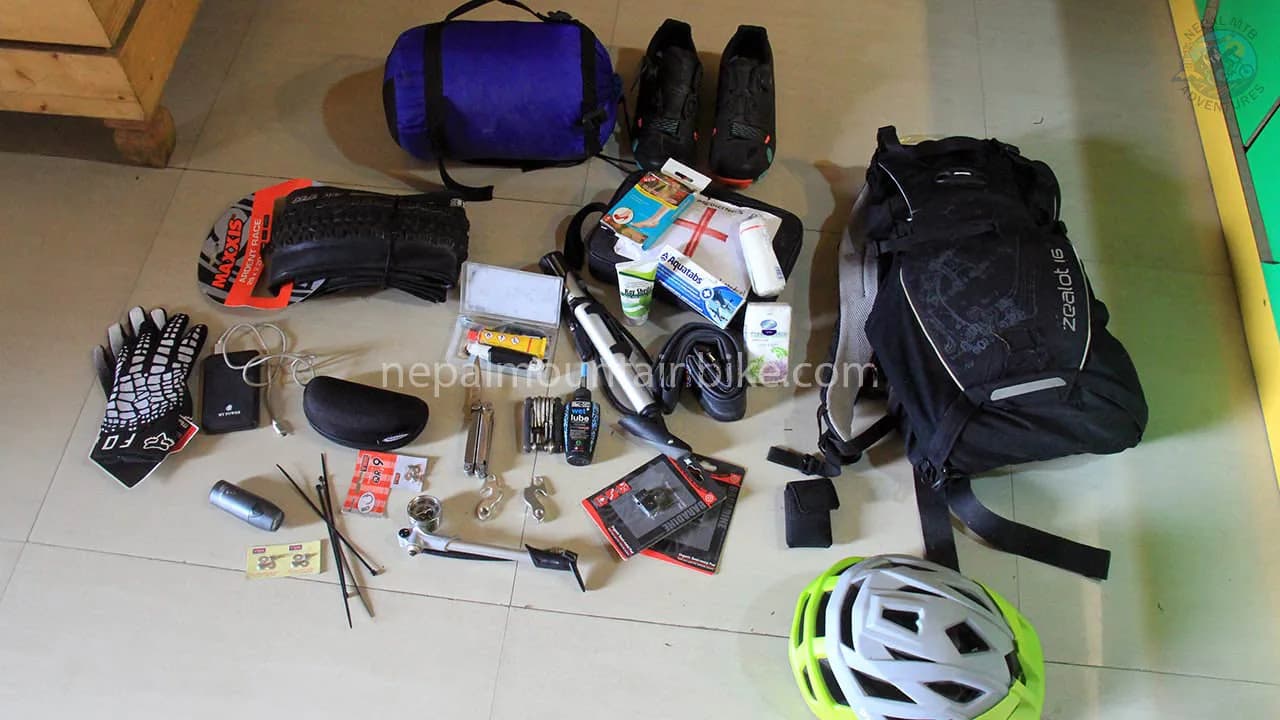
Your multi-tool, a pedal spanner or 8 mm hex key, and a shock pump
Foam pipe insulation and bubble wrap
Reusable cable ties or straps
Plastic brake pad spacers, or folded cardboard
A small bag for bolts and loose parts
Strong packing tape and a marker pen
Luggage scales
Pack in this order
Clean the bike. A clean bike is easier to pack, and some countries inspect bikes for soil.
Record your settings. Photograph the bike. Write down your saddle height, tyre pressures, and the pressure in your fork and shock. Mark the seatpost height with tape.
Remove the pedals. The left pedal has a reverse thread, so it loosens clockwise.
Lower the saddle. Drop the dropper post all the way. If the bike is still too tall for the box, slide the post down into the frame or take it out with the saddle attached.
Take the handlebar off the stem. Undo the stem's faceplate, lift the bar away, and refit the faceplate bolts so you don't lose them. Strap the bar beside the fork or top tube. Don't kink or stretch the brake hoses and cables.
Take the wheels out. Put the thru-axles back into the fork and the frame. They stop the fork legs and rear end from being squeezed together.
Put spacers in both brake calipers. Without a rotor between the pads, one pull on the lever pushes the pistons together. Don't touch the levers once the wheels are out.
Protect the brake rotors. The safest way is to unbolt them and pack them flat in a clean bag. If you leave them on, face them inwards and pad them. Keep oil and tyre sealant off them.
Unbolt the rear derailleur. Take it off the hanger, wrap it and strap it inside the rear triangle. Leave the chain and cable attached. The derailleur hanger is the part most often bent in the hole.
Let some air out of the tyres. Leave enough in tubeless tyres to keep the bead seated, or the sealant will leak.
Leave the suspension alone, or lower it a little. If your airline asks you to reduce the pressure, lower it, but never to zero. An empty fork or shock can stick down.
Pad the frame. Cover every tube with pipe insulation. Wrap the fork lowers, stanchions, chainring, and crank ends.
Load the box—frame in first, then the wheels on either side with padding between wheel and frame. Bag the pedals, bolts, and small parts and tape the bag inside the box.
Stop it moving. Fill the gaps. If your airline allows other items in the box, your helmet, shoes, and riding kit make good padding.
Weigh it, then tape it shut.
Label it inside and out. Write your name, phone number, email, and the address where you're staying.
Spares to pack in the box
A spare derailleur hanger for your exact frame
Spare brake pads
Two spare tubes and tubeless plugs
A few spare bolts, cable ties and a roll of tape for the flight home
> Guide's tip: pack the bike yourself, even if a shop offers to do it. You're the one who has to build it at the other end, and then pack it again for the flight home.
Airline rules and what it costs to fly with a bike
Airlines charge for a bike in one of two ways. Either it counts as a normal checked bag, or you pay a set sports equipment fee for each flight.
How the airline charges | What it means for you | Airlines that work this way |
|---|---|---|
The bike counts as a normal checked bag | You pay nothing extra if the box is inside your ticket's baggage allowance. You pay the usual bag fee or overweight fee if it isn't. | United, Delta, American Airlines, Alaska Airlines, British Airways, Qantas, Lufthansa, Emirates, Qatar Airways |
A set fee for a bike on each flight | You pay the fee each way, even if your ticket includes a checked bag. It's cheaper to add online than at the airport. | easyJet, Ryanair, Air Canada, KLM, Turkish Airlines |
Rules as published in early October 2026. Airlines change them often, so check your airline's own sports equipment page before you book.
The numbers that matter
Rule | What to know |
|---|---|
Standard weight limit | 23 kg (50 lb) for one piece on most airlines |
Heaviest single piece | 32 kg (70 lb) on most airlines. Above that the bike has to travel as cargo. |
Size limit | It varies. Delta and American Airlines allow a bike up to 292 cm (115 in) when you add length, width and height. Lufthansa allows 280 cm (110 in) and Emirates 300 cm (118 in). British Airways sets a box size of 190 x 95 x 65 cm (75 x 37 x 26 in). |
Notice | It varies. Emirates and Air Canada ask for 24 hours, KLM 48 hours and Lufthansa 72 hours. Turkish Airlines requires a reservation for the bike. |
Other things in the box | Some airlines, easyJet among them, don't allow anything but the bike in the box. |
How to book a bike on to a flight
List every airline on your route, including the one that operates each flight. On a shared flight, the rules of the operating airline apply, not the airline whose name is on your ticket.
Read each airline's sports equipment page. Note the weight limit, the size limit, the charge, and the notice period.
Measure and weigh your packed box. Add length, width, and height to get the total size.
Add the bike when you book, or call straight after. Booking at least 72 hours ahead covers almost every airline.
Get it in writing. Print the confirmation and carry it to check-in.
Pay for the bike online. Where a fee applies, the airport price is higher.
The full cost of flying with a bike
Add up four things before you compare flying your bike with hiring one:
The bike charge or extra bag fee, each way, on every airline
Any overweight charge
The box, bag or case, bought or hired
A larger vehicle at each end, because a bike box doesn't fit in a small taxi
> Guide's tip: on a ticket with two airlines, the strictest rule on the route is your rule. Pack to the lowest weight limit and the smallest size limit of the two.
What can't fly: e-bike batteries, CO2, and tools
An e-bike battery can't fly on a passenger aircraft, and CO2 cartridges are usually taken from your bag. Almost everything else can travel in the bike box.
Item | In the bike box (hold) | In the cabin | What to do |
|---|---|---|---|
E-bike battery | No | No | Passenger flights don't carry lithium batteries over 160 watt-hours. An e-MTB battery is usually 500 watt-hours or more. Leave the e-bike at home and hire one where you ride. |
CO2 cartridges | Usually not | Usually not | Security staff often remove them. Leave them at home and carry a pump. |
Tools, pedal spanner, multi-tool | Yes | No | Pack every tool in the box. Cabin security can take them. |
Tubeless sealant, in the tyres or a small bottle | Yes | No | Liquids are fine in the hold. Seal the bottle in a bag. |
Chain lube | Yes, in a sealed bag | No | Don't pack aerosol cans. Buy lube when you arrive. |
Power bank and spare batteries for lights | No | Yes | Spare lithium batteries go in your cabin bag only. |
Shock pump and tyre pump | Yes | Check with the airline | Pack them in the box. |
Flying with an e-bike
You can't fly with a standard e-bike because the battery isn't allowed in the hold or the cabin. Some airlines also refuse the bike itself, with or without its battery. Turkish Airlines, for example, doesn't accept motorised or battery-powered bikes.
If you want to ride an e-MTB in Nepal, hire one here. Our e-MTB tours include the bike, and our rental fleet has e-MTBs for riders who ride on their own.
At the airport, if your bike arrives late or damaged
Check in early, watch the box go, and inspect the bike before you leave the baggage hall when you land. If something is wrong, report it at the airport.
Checking in
Arrive at least three hours before a long-haul flight
Bring the printed confirmation that the bike is booked
Find a trolley as soon as you arrive
Check in at the desk, then take the box to the oversized baggage desk
Keep the baggage tag receipt until the bike is in your hands
Photograph the sealed box before it goes
Security staff may open the box. Pack it so that someone else can close it again, and leave a roll of tape inside.
When you land
Bike boxes don't come out on the normal belt. Go to the oversized baggage area. Before you leave the hall:
Look for crushed corners, holes, or wet patches on the box.
Open it and check the derailleur hanger, the rotors, the fork, and the rear end of the frame.
Take photos of anything that looks wrong.
If the bike is late
A late bike is more common than a lost one, and a tight connection is the usual cause. Go to the airline's baggage desk before you leave the airport and fill in a report. Give them the address where you're staying and a phone number that works locally. A delayed bike usually follows on a later flight, and the airline delivers it to your address.
If the bike is damaged
Report it at the airport. Ask the baggage desk for a property irregularity report, and keep your copy.
Claim in writing within seven days if you only find the damage later.
Keep everything: the baggage tag, your photos, the box and a repair quote.
Under the Montreal Convention, the treaty that covers most international flights, an airline's liability for baggage is capped at 1,519 Special Drawing Rights for each passenger. That is roughly USD 2,000, which is less than many mountain bikes are worth.
Insure the bike
Check the single item limit on your travel insurance. It's often far below the value of the bike.
A cycle insurance policy can cover the bike for its full value while it's in the air.
Some cycle policies don't cover a bike that flies in a cardboard box. Read the wording before you choose your box.
> Guide's tip: put a small luggage tracker in the box. When a bike misses a connection, knowing which airport it's in makes the airline's search much quicker.
Flying with a bike to Nepal
You fly to Kathmandu with one connection, and your bike changes planes with you. Choose the airline by its bike rules and the length of the connection, not only by the fare.
There's no non-stop flight to Kathmandu from the UK or the US. Most riders connect in Doha, Istanbul, Dubai or Delhi. From the UK, the journey takes about 12 to 16 hours. From the US, it usually takes 20 to 30 hours.
The airlines riders use most
Route | Airline | How it treats a bike |
|---|---|---|
Through Doha | Qatar Airways | Sports equipment travels inside your checked baggage allowance. On flights to and from the Americas, each piece is limited to 158 cm (62 in) in total, so you buy an extra sports equipment allowance for a bike box of up to 300 cm (118 in). |
Through Istanbul | Turkish Airlines | A special baggage fee applies on international flights, and you must reserve the bike. Battery-powered bikes aren't accepted. |
Through Dubai | Emirates and flydubai | Emirates carries a bike as part of your baggage allowance, up to 300 cm (118 in) in total, and asks you to call at least 24 hours ahead. Many Dubai to Kathmandu flights are operated by flydubai, even on an Emirates ticket, so check flydubai's rules too. |
Rules as published in early October 2026. Check the airline's own page before you book.
Five rules for the long flight
Book the whole journey on one ticket. Your bike is then checked through to Kathmandu, and the airline is responsible for the connection.
Leave at least three hours between flights. A bike box is the last thing to be moved between aircraft.
Check the rules for the airline on each flight. A US or UK airline may fly the first part of your trip, with its own limits.
Land in Nepal at least two days before you start riding. If the bike comes a day late, your trip still starts on time.
Book early for the main seasons. October, November, and March to May are the busiest months, and aircraft have limited space for large items. Our guide to the best time to mountain bike in Nepal has the details by month.
From Kathmandu airport to the trail
Your bike arrives at Kathmandu's international airport, travels to Pokhara by road, and is built and checked in our workshop before your first ride.
Arriving in Kathmandu
Immigration. UK and US passport holders can buy a tourist visa on arrival. Pay in US dollars, in cash.
Baggage. Collect your other bags, then ask for the oversized baggage area. Bike boxes often come out last.
Check the box before you leave the hall, as in Part 6.
Customs. Tell the officer it's your own bicycle for your own trip, and that it leaves Nepal with you.
Transport. A bike box doesn't fit in a small city taxi. Tell us your flight number and that you're bringing a box, and we'll send a vehicle that takes it.
Kathmandu to Pokhara with a bike box
How | Does it suit a bike box? |
|---|---|
Private vehicle | Yes. The simplest way, and the box travels inside with you. |
Tourist bus | Yes. The box goes in the luggage hold or on the roof. Tell the bus company when you book. |
Domestic flight | Often not. The aircraft are small and the baggage allowance is low. Ask us before you book one with a bike. |
Mountain flights
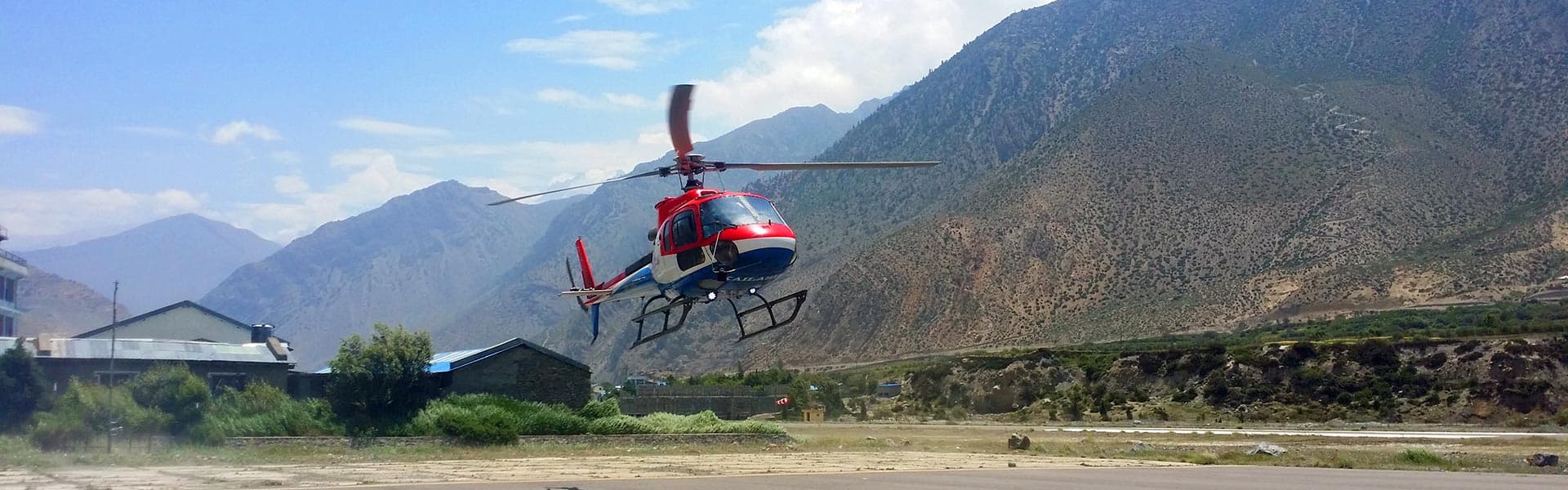
Flights into the mountains, such as Pokhara to Jomsom, use very small aircraft. The allowance is about 10 kg (22 lb) of checked baggage and 5 kg (11 lb) of hand baggage. A bike doesn't fit inside that, so bikes go up by jeep.
Building the bike in Pokhara
Bring the box to our workshop in Pokhara. We build the bike with you, or check your own build, before you ride.
What we check on every bike that has flown
The derailleur hanger is straight and the gears index cleanly
The rotors are true and don't rub
The brake levers feel firm. A bike that has travelled on its side or upside down can get air in the brakes.
The stem, handlebar, axle, and seatpost bolts are tightened to the right torque
The fork and shock are back at your pressures
The tyres are at pressure, and the sealant is still liquid
The headset has no play
A short test ride before the first trail
> Guide's tip: don't let your first ride after a flight be a long descent. Ride ten easy minutes, then check the stem and axle bolts again.
Your box while you ride, and the flight home
Leave the box or bag with us in Pokhara while you ride, and pack the bike for the flight home the day before you travel.
Where the box goes
With us. We store your box or bag at the workshop while you're on the trail.
At your hotel. Most hotels in Kathmandu and Pokhara keep luggage for guests who are away in the mountains. Ask when you book.
A cardboard box. Fold it flat and keep it dry and off the floor. Damp cardboard goes soft and won't protect the bike on the way home.
If your trip ends in a different town from where it started, a cardboard box is the easy answer. Recycle the first one, and we'll give you another for the flight home

Garret Smithopen: "Yesterday, I closed the loop from Pokhara to Thorong La Pass and back to Pokhara. My journey was finished.
It was time to repack my bike for the long journey back to South Korea.
I had stopped by Nepal MTB Adventures before to fix a skewer problem. They helped me out at the beginning of the journey, so I decided to see if they could help me with the exhausting part after being on the road for several days.
They said it was no problem and that they would both wash my bike and repack it for me.
I'm totally capable of doing it myself, but this is supposed to be a "vacation"!
They did a thorough job of tetris-ing everything into my large box and making sure it was packed safe for both the bus back to Kathmandu and the airport.
If you're in need of MTB tours, some mechanical work, or a re-boxing like me, these guys are the best in Pokhara!
"
Read Full reviews on Google:
Packing for the flight home
Wash the bike properly. Clean the tyres, the frame, and under the saddle. Australia and New Zealand inspect bikes for soil at the border, and a dirty bike can be held for cleaning.
Let it dry before it goes into the box.
Pack it the day before you fly, at our workshop if you'd like a hand.
Use your photos from the first pack to put everything back in the same place.
Weigh the box again. Things you bought on the trip add up.
Reconfirm the bike on your return flights at least 72 hours ahead.
Leaving from Kathmandu
Allow most of a day to get from Pokhara to Kathmandu by road, and don't plan to travel on the same day as an international flight. Arrive at the airport at least three hours before you fly. Check-in for large items takes longer.
Bring your own bike or rent one in Nepal
Bring your own bike if you know it well, your trip is long, and your airline carries it at a fair price. Rent one of ours if your trip is short, your bike is expensive, or you'd rather travel light.
Bring your own bike | Rent from us | |
|---|---|---|
Fit and feel | Exactly what you know | We size the bike to you before you ride |
Travel | A box on every flight, and a larger vehicle at each end | You fly with a normal bag |
Risk in the air | Yours. Airline cover is limited. | None |
Setup for Nepal | You change tyres, gears and pads before you fly | Already done in our workshop |
Spares on the trail | You bring the parts made for your frame | We know the bikes and hold the parts |
E-MTB | Can't fly | Yes |
Makes most sense for | Trips of three weeks or more, or riders with a very particular fit | Trips of up to two weeks, and anyone connecting through two or more airports |
If you bring your own
Before you fly, fit fresh brake pads, fresh sealant, and tyres with plenty of tread. Bring a spare derailleur hanger and any part that only fits your bike. Tyres, sealant, chain lube, and common parts are in our shop. For what to carry on the ride itself, see our mountain biking checklist for Nepal.
If you rent from us
Our fleet is Trek and Scott, with hardtails, full-suspension bikes, and e-MTBs. Every bike is serviced in our own workshop before it goes out. You can see the bikes on our bike rental page. On our guided mountain bike tours, the bike is part of the trip.
Many riders who rent still bring a few things from home:
Their own pedals and shoes
Their helmet and gloves
Their saddle, if they're particular about it
If you're choosing a bike for the high routes, read our guide to the best bike for the Annapurna Circuit. If you plan to ride without a guide, read guided or self-guided mountain biking in Nepal.
Bringing a bike to Nepal?
Tell us your flight, your dates, and what you ride. We'll tell you what to pack, where your box can stay, and whether one of our bikes would save you the trouble.
Frequently asked questions
Can you take a bike on a plane?
Yes. Airlines carry bikes in the hold as sports equipment. The bike must be partly taken apart, packed in a box or bag, and booked on to the flight in advance.
How much does it cost to fly with a bike?
It depends on the airline. Some count the bike as a normal checked bag, so it costs nothing extra inside your allowance. Others charge a set sports equipment fee for each flight. Add any overweight charge, the cost of the box or bag, and larger transport at each end.
Do I need a bike box to fly?
You need a box, a bag, or a hard case. A cardboard bike box from a bike shop is accepted by most airlines and is often free. A few airlines ask for a purpose-made bag or case, so check before you pack.
Is a cardboard bike box safe for flying?
Yes, if you pad the bike well, tape every seam, and keep the box dry. It's also the lightest choice, which helps you stay under the weight limit.
How heavy can a bike box be?
Most airlines allow 23 kg (50 lb) as standard and won't take a single piece over 32 kg (70 lb). A mountain bike in a cardboard box usually comes in under 23 kg.
Do I need to deflate my tyres to fly?
Let some air out, because most airlines ask for it. Don't empty tubeless tyres completely, or the bead can come off the rim, and the sealant will leak.
Do I have to let the air out of my suspension?
No, not usually. If your airline asks you to, lower the pressure a little, but never to zero. Write down your pressures first so you can set them again.
Can you fly with an e-bike?
No. E-bike batteries are far over the limit for passenger flights, and they aren't allowed in the hold or the cabin. Hire an e-bike where you ride.
Can I fly with CO2 cartridges?
Usually not. Security staff often remove them from checked and cabin bags. Carry a pump.
How early should I tell the airline about my bike?
When you book, if you can. Notice periods run from 24 to 72 hours depending on the airline, and space for bikes is limited.
What do I do if the airline damages my bike?
Report it at the airport before you leave, and get a property irregularity report. If you find the damage later, claim in writing within seven days. Keep the baggage tag, photos and the box.
Can I fly with a mountain bike to Nepal?
Yes. You fly to Kathmandu with one connection, usually in Doha, Istanbul, Dubai or Delhi. Book the bike on every flight and leave at least three hours for the connection.
Can I take my bike on a domestic flight in Nepal?
Often not. Domestic aircraft are small, and baggage allowances are low. Bikes travel between Kathmandu, Pokhara and the trailheads by road.
Where can I leave my bike box in Nepal?
At our workshop in Pokhara, or at your hotel. Keep a cardboard box flat and dry so it's fit for the flight home.
Should I fly my bike to Nepal or rent one there?
For trips of up to two weeks, most riders are better off renting. For longer trips on a bike you know well, flying your own can be worth it. Tell us your plans and we'll help you decide.