


If you are planning to ride the Annapurna Circuit, choosing the right bike is one of the first real decisions you will make. This route genuinely pulls in two directions.
Here is why it is not a simple answer. Over 386 kilometres, you climb around 10,295 metres, and about half of that is on jeep road, where a lighter and more efficient hardtail is a real pleasure to ride. You also carry your bike for roughly five kilometres to reach the Thorong La at 5,416 metres, and up there every kilogram you are not carrying is a kindness to yourself. But the descent off the far side drops about 1,600 metres in nine kilometres, over loose scree and rocky switchbacks, and that is exactly where a full-suspension bike comes into its own.
Plenty of riders finish the Circuit delighted on a hardtail, and plenty finish delighted on full-suspension. It is much less about which bike is better and much more about which one suits the trip you are hoping to have.
If you are riding the jeep road version of the Circuit and your priority is getting over the pass, take a hardtail.
If you are riding the singletrack alternates and you came for the descents, take a full-suspension bike.
If you are unsure, take the full-suspension. Over twelve to fifteen days, the extra comfort matters more than most riders expect, and the descent off the Thorong La is the reason many people book this trip in the first place.
And yes, an e-MTB works on this route. We are building that trip now.
First, understand what the route actually asks of a bike
You cannot choose a bike for the Annapurna Circuit until you know what you are riding, because the route is not one thing. It is four different types of ground, and they reward different bikes.
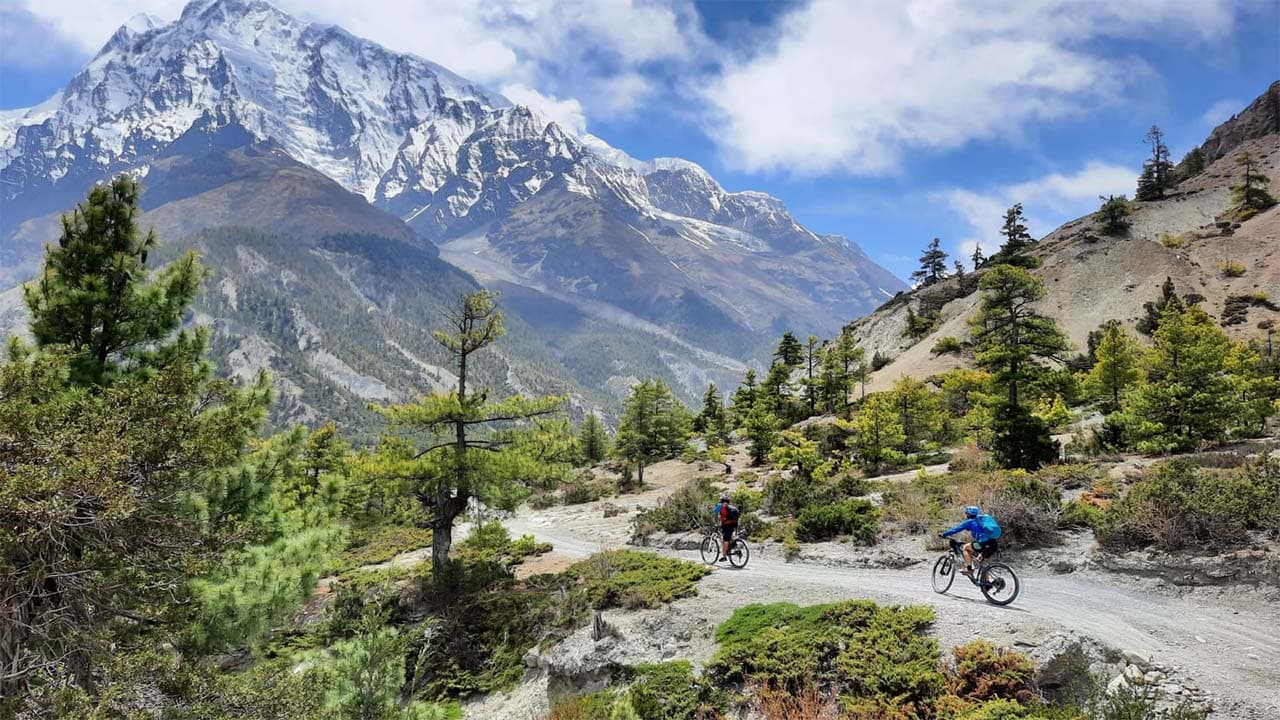
The jeep road, roughly half the distance
Besisahar to Chame on the eastern side, and Jomsom down to Beni on the western side, are now vehicle track. Gravel, hardpack, dust, embedded rock, and washboard where jeeps have braked. This is fast, open riding with long sustained climbs.
→ On this ground a hardtail is genuinely better. It puts more of your power into the pedals and less into a shock, and you feel that on a 1,200 metre climbing day.
Doubletrack and old trail
→ Between the road sections there is a lot of old walking trail widened into doubletrack. Loose over hardpack, rock steps, water bars, stone staircases in places. This is where the two bikes start to separate. A hardtail is survivable here. A full-suspension bike is quicker and much less tiring.
The singletrack alternates
Upper Pisang to Ghyaru to Ngawal on the high route, the NATT waymarked trails, the Lupra valley line into Jomsom, the west bank of the Kali Gandaki. These are the best riding on the whole Circuit and they are properly technical: exposed, loose, narrow, with real consequences.
→ This is full-suspension ground. A skilled rider will get a hardtail down it. Most riders will have more fun, go faster and be safer on a full-suspension bike.
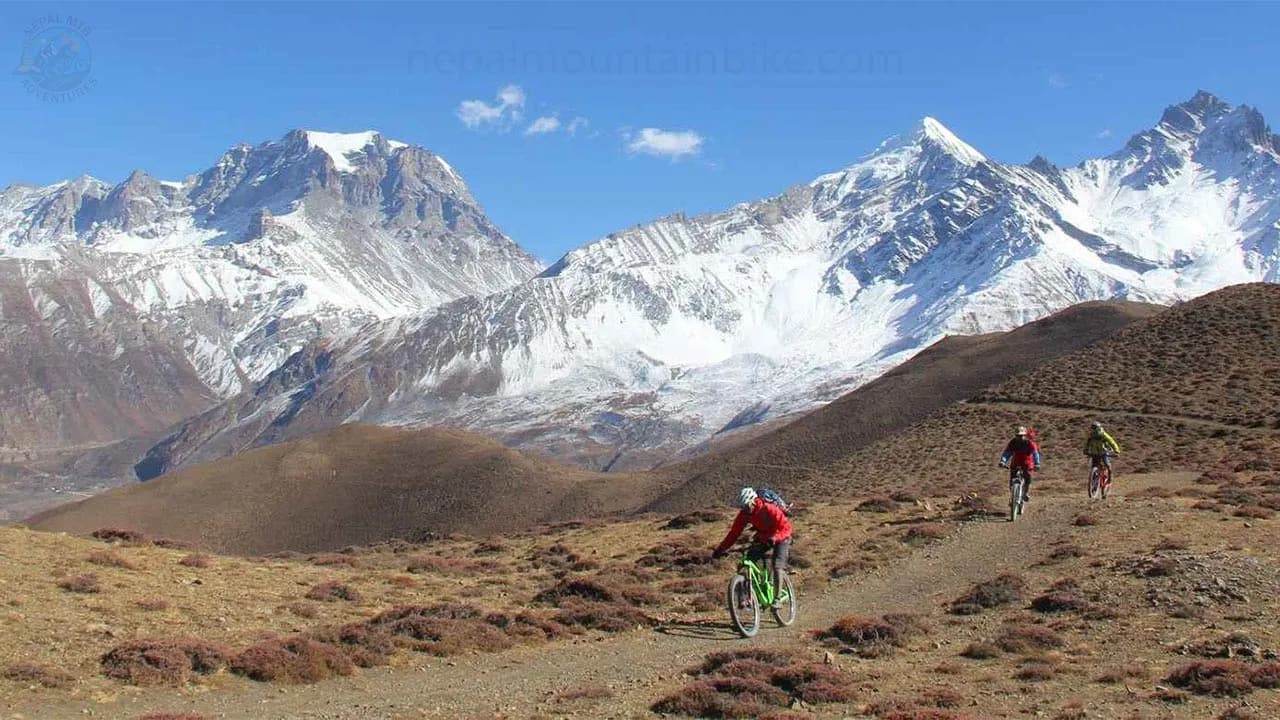
The Thorong La descent
From 5,416 metres down to Muktinath at 3,760 metres, roughly 1,600 metres of descent in about nine kilometres. Loose scree at the top, then rocky switchbacks, then faster open trail. It is regularly called one of the best descents in the world.
→ This is the single strongest argument for full-suspension on the entire route. You will have spent a week and a half earning this descent. It is worth arriving on the right bike.
Another major thing you should consider here:
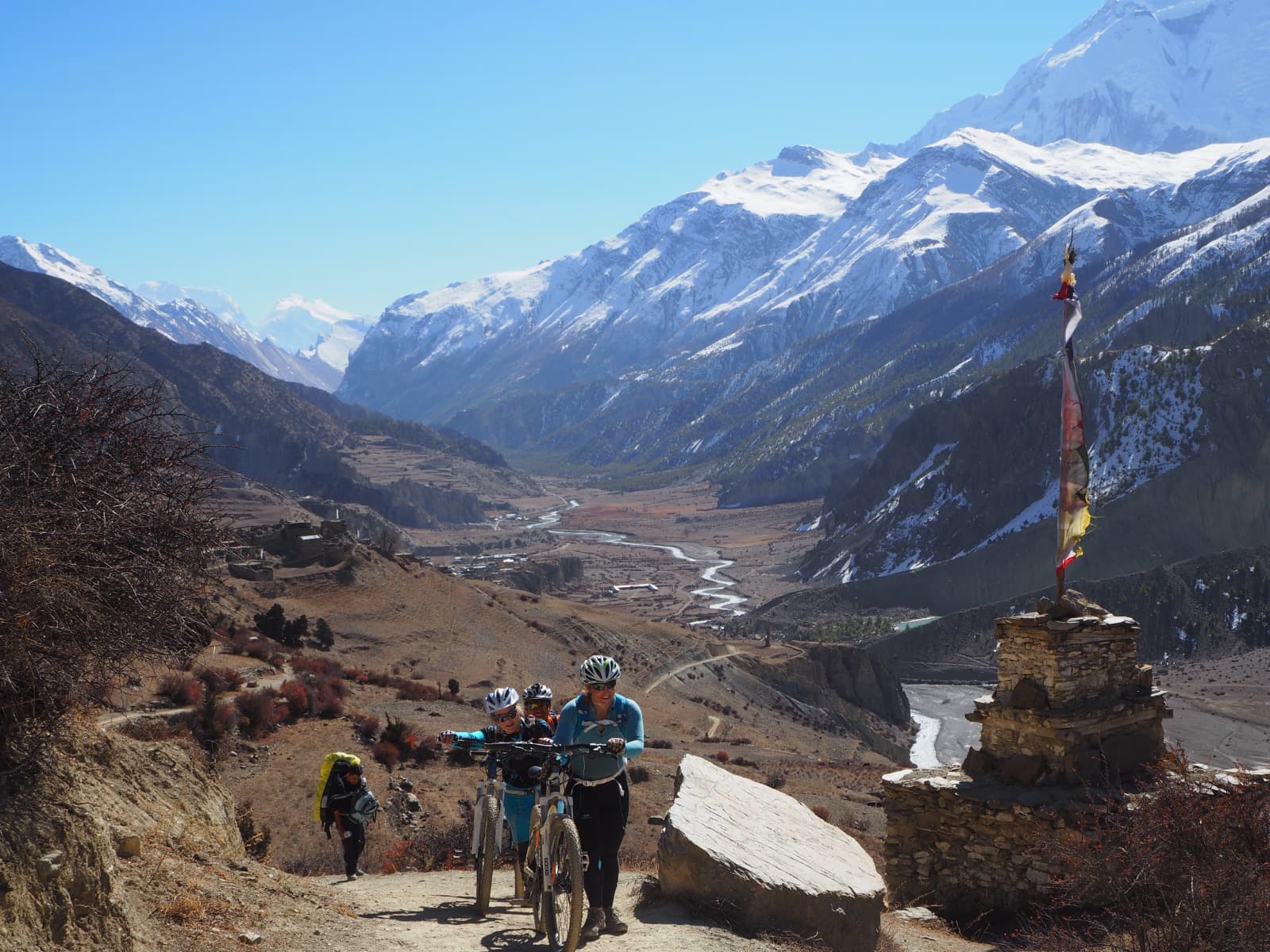
Roughly five kilometres of hike-a-bike to reach the pass, taking three to six hours. You are pushing and at times shouldering the bike at over 5,000 metres, in the cold, on legs that have already done ten days.
This is the one place where a hardtail wins outright, because it is two to three kilograms lighter. Two kilograms sounds like nothing at sea level. At 5,300 metres, on your shoulder, it does not.
What we actually recommend, from expert: Jagan Biswakarma
People ask me which bike is best for the Annapurna Circuit and expect a long answer. It is short. Two bikes work here. A hardtail and a dual suspension. Everything else is a compromise you will regret somewhere on the route.
I say that because I have watched it happen for twenty years. Riders arrive with a bike chosen for the trails at home, and the Circuit does not care what those trails are like. It gives you jeep road for half the distance, old walking trail for a lot of the rest, and then one descent off the pass that most people will remember for the rest of their lives.
“A hardtail is the right bike if you are here for the journey. It climbs well, it is lighter on your shoulder for the carry to Thorong La, and there is less on it to break when you are three days from a workshop. Most of our clients who choose a hardtail are happy with it, and they get up the hill faster than everyone else.”
“A dual suspension is the right bike if you are here for the riding. On the descent from the pass, and on the singletrack above Pisang and down through Lupra, it is a different trip. It also keeps you fresher. By day nine the hardtail riders are the ones asking me for a shorter day, and they are usually not asking because of the climbing.”
Hardtail or full-suspension: the honest comparison
Hardtail | Full-suspension | |
Jeep road, long climbs | Better | Good |
Doubletrack, old trail | Acceptable | Better |
Singletrack alternates | Hard work | Much better |
Thorong La descent | Survivable | The reason to bring one |
The 5km carry | 2–3kg lighter | 2–3kg heavier |
Reliability, days from a mechanic | Fewer parts to fail | More parts to fail |
Dust tolerance | Better | Needs more care |
Fatigue over 12–15 days | Builds up | Much less |
The way we put it to clients is this. Ask yourself what you came for.
If you came to cross the Thorong La, to see Manang and Muktinath, and to say you rode the Annapurna Circuit, a hardtail will do that job well and will make the carry easier.
If you came to ride, and the descent off the pass and the singletrack above Pisang is why you booked, take the full-suspension bike. You will use it every day, and you will be glad of it on the days that matter.
Hardtail Bikes for Annapurna Circuit
A hardtail has a suspension fork at the front and nothing at the back, and that single difference shapes the whole trip.
On the smoother ground, which is most of the Circuit, it feels quick and direct. Everything you put into the pedals goes straight to the back wheel, and on a long climbing day you notice it. On the rough ground, your legs and arms do the job the rear suspension would have done for an hour that is fine. Over twelve to fifteen days it becomes the thing you think about most.
What it gives you on this route
Pedalling efficiency. No power lost to suspension bob; every watt reaches the rear wheel. Over 10,295m of climbing on the Annapurna Circuit, mostly road and doubletrack, that adds up daily.
Weight. Hardtails run 2–3kg lighter than equivalent full-suspension bikes. On the climb to Thorong Phedi and the carry to the pass, that's the difference between hard and grim.
Simplicity. No rear shock, pivots, or linkages, fewer parts to fail, days from a mechanic. Our guides carry tools and spares, but some things can't be fixed at Yak Kharka.
Dust tolerance. The Circuit's dry-season dust, especially on the jeep roads and through the Kali Gandaki, kills suspension pivots and shock seals. Hardtails have far less to contaminate.
Cost. Hardtails rent from $30/day, full-suspension from $70. Over fifteen days, that's a real difference.
What it costs you
The descents. Every one of them. You will be slower, you will be working harder to hold a line, and you will feel it in your hands, forearms, and lower back.
Fatigue that accumulates. This is the part riders underestimate. A single rough descent on a hardtail is fine. Twelve days of them, at altitude, on a body that is not recovering properly because of the thin air, is a different proposition. Riders on hardtails are usually the ones asking for a shorter riding day by day nine.
Traction on loose ground. A rigid rear end skips over loose scree rather than tracking through it. On the upper Thorong La descent, where the surface is loose and the exposure is real, that matters.
The hardtails we run
Our hardtail fleet is Trek and Scott, all alloy frames.
Bike | Per day | Frame | Fork | Notes |
USD 30 | Alpha Silver Aluminium | RockShox | Entry-level, modern geometry, internal derailleur and rear brake routing | |
USD 30 | Alloy | Remote lockout | Shimano disc brakes, Syncros finishing kit | |
USD 30 | Alloy | RockShox | Lightweight cross country hardtail | |
USD 35 | Alloy | RideLoc lockout | Shimano disc brakes, Syncros finishing kit | |
USD 35 | Alloy | RockShox | 1x Shimano drivetrain, hydraulic disc brakes, built for fast laps and long days | |
USD 35 | Alpha Silver Aluminium | RockShox Judy Silver, 100 mm | Trail series geometry, balanced and forgiving | |
USD 40 | Alpha Silver Aluminium | RockShox Judy | Modern trail geometry, stable climbing, responsive descending | |
USD 45 | Alpha Platinum Aluminium | RockShox Judy Silver, 120 mm | Race-ready XC geometry, the most capable hardtail we run |
If you are set on a hardtail for the Circuit, ask for the Procaliber 6. The 120 mm fork is 20 mm more travel than any Marlin in the fleet, and on the rocky ground above Manang and the descent off the pass, that 20 mm is the difference between controlled and hanging on. It is the closest thing to a trail hardtail we have.
The Marlin 7 Gen 3 at 100 mm is the next best choice, and the Marlin 6 and Aspect 920 at USD 30 are better suited to the Pokhara day rides than to a fifteen-day circuit.
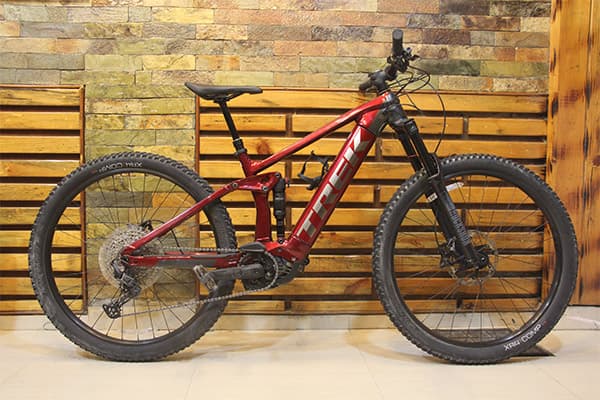
Full-suspension Bikes for Annapurna Circuit Mountain Biking
A full-suspension bike has a fork at the front, and a shock at the back, so the rear wheel can move with the ground instead of being bounced off it.
What that buys you is not really comfort, although it is more comfortable. It is contact. A wheel that stays on the ground is a wheel that can still brake and still steer, and on loose scree above Muktinath or on an exposed traverse at 4,000 metres, that is worth a great deal.
What it gives you on this route
Traction. A wheel that stays planted can brake and turn; this is safety, not comfort. On the loose upper Thorong La descent and the exposed singletrack between Ghyaru and Ngawal, it matters.
Control on the descents. Thorong La, the drop into Muktinath, the Lupra valley into Jomsom, the long run to Tatopani, full suspension turns these from survived to enjoyed.
Less accumulated fatigue. Rear suspension absorbs impacts that would otherwise hit your spine. Over 12–15 days at altitude, where recovery is slower, that adds up, you arrive at the pass fresher.
Confidence for non-racers. Full suspension forgives a slightly wrong line. At 4,000m on exposed trail, that forgiveness is worth a lot.
What it costs you
Weight on the carry. Two to three kilograms more, exactly where you least want it. This is a genuine trade-off and we will not pretend otherwise.
More to go wrong. Pivot bearings, a rear shock, linkage bolts. Dust and river crossings are hard on all of it. Our guides carry tools and spares and are trained to service these bikes, but a seized pivot bearing at 4,500 metres cannot be fixed on the trail.
Slower on the road sections. Some of your effort goes into moving the suspension rather than the bike. Modern platforms with a climb switch reduce this a lot, but it does not disappear.
Cost. From 70 US dollars a day against 30 for a hardtail.
The full-suspension bikes we run
Bike | Per day | Frame | Suspension | Drivetrain & notes |
$70 | Alloy | Marzocchi fork, ~150mm | SRAM Eagle, Syncros. Trail bike that still climbs, the balance this route needs | |
$75 | Alloy | TwinLoc system | Shimano 12-speed, Syncros | |
$75 | Alloy | Trail travel | Do-everything trail bike, smooth singletrack to technical descents | |
$75 | Lightweight alloy | RockShox, ~160mm | SRAM GX Eagle. More descending-focused than the others |
For the Annapurna Circuit specifically, the Fuel EX 7 or the Genius 950 are the sweet spot. Both climb well enough for the long road ascents and descend far better than any hardtail.
The Genius 940 deserves a mention for one feature that matters here more than in most places. Its TwinLoc system firms up the fork and shock together from the handlebar, so on the long jeep road climbs out of Besisahar and up the Marsyangdi you can lock the bike down and get much of a hardtail's efficiency back, then open it up again for the descent. On a route that is roughly half road climbing and half proper riding, that is genuinely useful.
The Remedy 8 is a superb bike, and it is more bike than this route needs unless you are riding every alternate line and skipping nothing. Worth knowing: a full-face helmet is included with the Remedy 8 rental.
What about a gravel bike?
Riders ask, because it has been done, and done fast. It works on the road sections, and it is very quick on the Kali Gandaki corridor.
It is a poor choice for everything else. You will walk sections you would have ridden, the descent off the pass will be unpleasant and slower, and you will not be able to ride the alternates at all, which are the best trails on the route.
If you are a strong drop bar rider doing a self-supported speed run, a gravel bike makes sense. For a guided trip where the point is to ride the good ground, it does not. We do not run gravel bikes on this route.
Can I bring my own bike for Annapurna Circuit?
Yes, and we would encourage it if you have a bike you love.
There is a lot to be said for riding your own bike here. You already know how it behaves, the fit is right, the controls are where your hands expect them, and none of that is a small thing over twelve to fifteen days on unfamiliar ground. Riders who bring their own bike almost always say they were glad they did.
Tell us at the time of booking, and we will take care of the rest.
What do we do for riders who bring their own bike?
Full workshop check in Pokhara. We rebuild your bike, torque every bolt, true the wheels, bleed the brakes if needed, and set the suspension for your weight and the terrain. This service is included at no extra cost.
Route setup. We check your gearing and tyres and recommend any upgrades needed for Himalayan trails before you start.
Transport and logistics. We handle bike transfers throughout the itinerary, including jeep transport where required.
Trail support. Our mechanic and guides carry tools and common spares, so help is available if your bike needs attention on the route.
Secure bike box storage. Your bike box or bag stays safely at our workshop in Pokhara until you return.
Two practical things to sort before you fly
Bring a spare rear derailleur hanger for your exact frame, and ideally two. It is the one part we cannot improvise for you, because it is model-specific and no shop between Besisahar and Beni will have yours. It weighs almost nothing.
Check your insurance covers the bike itself. Standard travel policies often cap a single item at a few hundred dollars, so if your bike is valuable, arrange specialist bicycle cover or a written extension to your home insurance for transit and for the trip.
Note: One thing worth asking us about early: if your itinerary includes a domestic mountain flight, baggage limits on those routes are tight and a boxed bike needs planning.
And why also an e-bike for Annapurna Circuit?
For years the answer to this was no, and the objections were always the same three. You cannot charge a big battery reliably above Manang. The pass is a hike-a-bike anyway, so a motor does not help. And if the system fails, there is nobody between Besisahar and Beni who can fix it.
We have spent a long time working on exactly those three problems, because we already run e-MTB expeditions in Upper Mustang and Lower Mustang and we know what these bikes can do at altitude.
Batteries are not a theoretical problem for us. We already position and carry them, and our porters are used to moving spare batteries on high routes. Our guides are trained technicians on these systems, not just riders who can change a tube.
So the honest 2026 answer is: why not. It is why also.
We are building an e-MTB Annapurna Circuit trip now. It is not on sale yet, and we are not going to sell it until we are satisfied it works exactly as it should at 5,416 metres.
If you want to be told when it opens, tell us, and we will let you know first.
Frequently asked questions
What are the recommended bikes for Annapurna Circuit biking tours?
Two types of bike are suited to this route: a hardtail mountain bike and a full-suspension, or dual suspension, mountain bike. Both should have 29-inch wheels, hydraulic disc brakes, a wide-range cassette and tubeless tyres with a tough casing. Gravel bikes, cross country race bikes with short travel forks and anything without a proper suspension fork are not suitable for the Thorong La descent.
Is a hardtail good enough for the Annapurna Circuit?
Yes. Plenty of riders complete the Circuit on hardtails every season, and it is a perfectly sound choice, particularly if you are riding the jeep road version and want the lightest bike for the carry to the pass. What you give up is comfort and control on the descents, and that adds up over twelve to fifteen days. If you take a hardtail, take the most capable one you can, which in our fleet is the Trek Procaliber 6 with its 120 mm fork.
Is full-suspension worth the extra cost on this trip?
For most riders, yes. The descent from the Thorong La is around 1,600 metres in nine kilometres, and it is one of the great descents anywhere. The singletrack alternates above Pisang and through the Lupra valley are the best trails on the route. A full-suspension bike turns those from something you get through into the reason you came. It also leaves you less beaten up by day ten, which matters more at altitude than at home.
How much heavier is a full-suspension bike on the hike-a-bike?
Two to three kilograms, depending on the models compared. That is the honest trade-off. The carry to the Thorong La is around five kilometres and takes three to six hours at over 5,000 metres. If the carry is the part of the trip you are most worried about, that weight is a fair reason to choose a hardtail.
What size wheels should I use?
29 inches. Our whole fleet runs 29-inch wheels, and it is the right choice here. Bigger wheels roll over embedded rock and water bars better, hold speed on the long jeep road sections, and give more contact patch on loose ground.
What tyres do I need for the Annapurna Circuit?
At least 2.3 inches wide, and a tough casing matters more than the exact width. The shale above Manang and through the Kali Gandaki cuts thin sidewalls. Run tubeless with sealant less than three months old. Our bikes come set up this way.
What gearing do I need?
Lower than you would use at home. You will be climbing at 3,000 to 4,500 metres where your power output drops significantly. An 11-42 cassette is the practical minimum on an older bike, and a modern wide range setup is better. This is one of the strongest arguments for using our bikes, because they are already geared for this route.
Will my brake pads last the whole trip?
Not necessarily. The Thorong La descent alone is 1,600 metres of near continuous braking, and there are two more long descents after it. Fit fresh pads before the trip and carry a spare set. Running out of pad on the descent to Tatopani is a genuinely dangerous situation, and it happens every season.
Can I ride the Annapurna Circuit on a gravel bike?
It has been done, and it is fast on the road sections and through the Kali Gandaki. You will push sections you could have ridden, the descent from the pass will be unpleasant, and the singletrack alternates are effectively off limits. We do not run gravel bikes on this route.
Do I need a dropper post?
You do not need one, but the descents are long and steep enough that you will use it constantly and be glad of it. If your bike has one, keep it. If you are choosing between two of our bikes and one has a dropper, take that one.
Should I bring my own bike or use yours?
If you own a good trail bike, you are happy boxing it, and your itinerary does not include a domestic mountain flight, bring it. Otherwise, use ours. Mountain route flights in Nepal cap checked baggage at around 10 kilograms; a boxed bike is far heavier, and standard travel insurance usually will not cover your bike to its real value.
Which of your bikes do you recommend for the Annapurna Circuit?
For most riders, the Trek Fuel EX 7 Gen 6 or the Scott Genius 950. Both climb well enough for the long road ascents and descend far better than any hardtail. If you want a hardtail, the Trek Procaliber 6 with its 120 mm fork. If you are riding every technical alternate and want maximum descending capability, ask us about the Trek Remedy. Our usage also may vary according to package type: standard or premium.
Can I ride the Annapurna Circuit on an e-MTB?
You will be able to, with us. We already run e-MTB expeditions in Upper and Lower Mustang; our porters carry spare batteries as standard on high routes, and our guides are trained technicians on these systems. We are building an Annapurna Circuit e-MTB trip now, and it will go on sale when we are satisfied it performs properly at 5,416 metres. Ask us, and we will tell you the moment it opens. Until then, our Upper Mustang e-MTB expedition is the best e-bike riding in Nepal.
Do you service the bikes between trips?
Yes. We own the fleet, and we run our own workshop, so every bike is stripped, checked, and set up before it goes out. That is also why our guides can fix most things on the trail: they are working on bikes they know.