

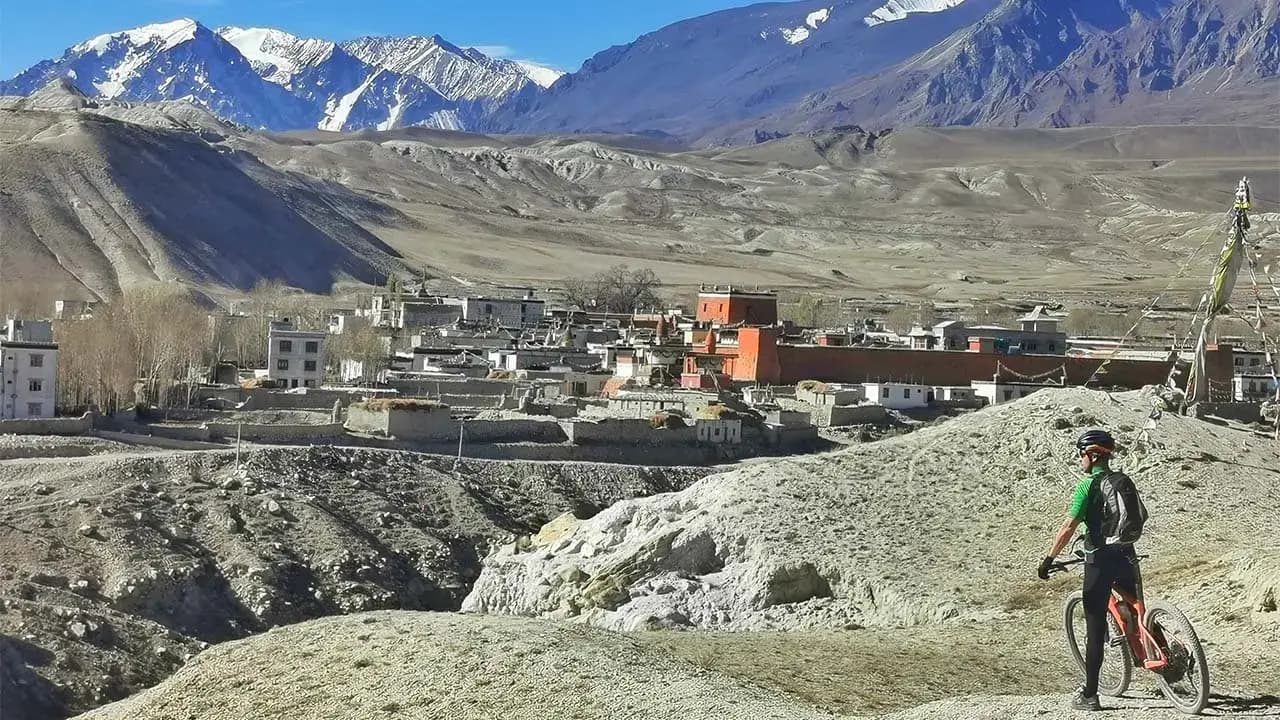
Upper Mustang is the northern part of Mustang District in Nepal: a high desert on the Tibetan border, behind Dhaulagiri and the Annapurna range. It was once the Kingdom of Lo. Its capital, Lo Manthang, is a walled town at 3,840 metres (12,598 ft) that still has its earthen wall, its royal palace and three old monasteries.
Foreign visitors were not allowed into Upper Mustang until 1992, which is why it is often called the Forbidden Kingdom. Today you can visit with a special permit and a licensed guide, on foot, by jeep or by mountain bike.
We are Nepal MTB Adventures, a mountain bike company in Pokhara, the nearest city to Mustang, and we have taken riders to Lo Manthang for more than ten years. This page is our overview of Upper Mustang: where it is, what there is to see, when to go, how to get there and what the permit rules are in 2026.
Upper Mustang at a glance
Field | Details |
Where | Northern Mustang District, Gandaki Province, north-central Nepal, on the border with Tibet (China) |
Also Known As | The Kingdom of Lo; the Forbidden Kingdom |
Main Town | Lo Manthang, 3,840 m (12,598 ft), the old walled capital |
Gateway | Jomsom, 2,720 m (8,924 ft), accessible by air or road from Pokhara. The restricted area starts just north of Kagbeni, 2,800 m (9,186 ft). |
Altitude | About 2,800 m to 4,200 m (9,186 to 13,780 ft) on the usual routes |
Landscape | High desert in the rain shadow of the Himalaya, featuring bare cliffs, canyons and irrigated village oases |
People | The Loba, who speak a Tibetan language and follow Tibetan Buddhism |
Opened to Visitors | 1992 |
Known For | The walled city of Lo Manthang, thousands of cliff “sky caves,” red cliffs at Dhakmar, old monasteries and the Tiji festival |
Best Time to Visit | March to May and September to November. June to August is also possible because the region receives little monsoon rain. |
Permits | Restricted Area Permit: USD 50 per person per day, plus the Annapurna Conservation Area Permit (ACAP): NPR 3,000 |
Guide Requirement | Required by law. Solo travellers have been allowed since 22 March 2026, with a licensed guide. |
Ways to Visit | Trekking, jeep tours or mountain biking |
Time Needed | Approximately 10–16 days from Kathmandu, depending on your mode of travel |
Where is Upper Mustang?
Upper Mustang is in north-central Nepal, about 100 km (60 miles) north of Pokhara as the crow flies. It forms the upper half of Mustang District and pushes north into the Tibetan plateau, so Tibet lies on three sides of it.
The Kali Gandaki river runs through the middle, from the Tibetan border south past Lo Manthang to Kagbeni and Jomsom. To the south stand two of the world's highest mountains, Dhaulagiri, 8,167 m (26,795 ft), and Annapurna I, 8,091 m (26,545 ft). They block the monsoon clouds that come up from India, and that is why Upper Mustang is a desert while the country south of it is green.
The line that matters to a visitor is at Kagbeni. South of it you are in Lower Mustang, which needs no special permit. Just north of the village the restricted area begins. From Jomsom, the district capital, it is 96 km (60 miles) by road to Lo Manthang, and another 21 km (13 miles) to the border at Korala.
Upper Mustang and Lower Mustang: what is the difference?
Comparison | Upper Mustang | Lower Mustang |
Where | North of Kagbeni, extending to the Tibetan border | Jomsom, Kagbeni, Muktinath, Marpha and the Kali Gandaki Valley to the south |
Altitude | About 2,800–4,200 m (9,186–13,780 ft) | About 1,200–3,800 m (3,900–12,470 ft) |
Permit | Restricted Area Permit (USD 50 per person per day), plus the conservation area permit | Conservation area permit only |
Guide Requirement | Required | Rules vary; confirm the current requirements before travelling |
Main Sights | Lo Manthang, sky caves, Dhakmar, Ghar Gompa and Tsarang | Muktinath Temple, Kagbeni, Marpha and the Lubra Valley |
Overall Experience | Remote, dry and quiet, with the cultural heritage of a former kingdom | Busier, more accessible and part of the Annapurna Circuit |
Time Needed | 10–16 days | 5–11 days |
More about the southern half: Lower Mustang.
The Kingdom of Lo: why Upper Mustang is called the Forbidden Kingdom
Upper Mustang was a separate kingdom for centuries. By tradition, a ruler named Ame Pal founded the Kingdom of Lo around 1380 and built its walled capital, Lo Manthang. The kingdom grew rich on trade. Salt and wool came south from Tibet along the Kali Gandaki, grain went north, and Lo taxed the caravans.
From the late 18th century Lo was tied to Nepal but kept its own king, the raja of Mustang. In the 1960s Tibetan resistance fighters used Mustang as a base, the border was sensitive, and Nepal kept the region closed to foreigners. It opened to visitors in 1992, with a special permit that is still required today. That long closure is where the name "Forbidden Kingdom" comes from.
Nepal became a republic in 2008 and the king's official title ended. The last king, Jigme Dorje Palbar Bista, died in 2016. His family's palace still stands in the middle of Lo Manthang.
The name Mustang itself comes from Manthang, the name of the capital, usually translated as "fertile plain" or "plain of aspiration".
Lo Manthang, the walled city
Lo Manthang is the old capital of Lo and the place most visitors come to see. It stands on a plateau at 3,840 metres (12,598 ft), enclosed by an earthen wall about 6 metres (20 ft) high. Inside are narrow lanes, whitewashed houses, the old royal palace and three monasteries. People still live here; it is a working town, not a ruin. Since 2008 it has been on UNESCO's tentative list for World Heritage status.
What to see in Lo Manthang:
The wall and the town gate. Walk the lanes inside and the path around the outside.
The royal palace. A tall whitewashed building of several storeys in the centre of the town.
Jampa Lhakhang. The oldest monastery, consecrated in 1448, with a giant statue of Maitreya, the future Buddha.
Thubchen. A great assembly hall, consecrated in 1472, with carved wooden pillars and old murals.
Chode Monastery. The working monastery, whose monks perform the Tiji festival.
Chhoser and the sky caves. A half-day trip north of the town (see below).
Most visitors stay two nights. That gives a full day for the town and Chhoser, and it helps your body adjust to the altitude.
Places to see in Upper Mustang
Place | Altitude | What It Is |
Kagbeni | 2,800 m (9,186 ft) | Mud-walled village at the gate of the restricted area, where permits are checked |
Chhusang and Chele | About 3,000 m (9,800 ft) | Red cliffs with caves above the Kali Gandaki; the climb out of the valley starts here |
Samar | 3,650 m (11,975 ft) | A small village among poplars, the first night at altitude for many visitors |
Ghami | 3,520 m (11,549 ft) | A large village with one of the longest mani (prayer) walls in Nepal |
Dhakmar | About 3,820 m (12,533 ft) | A village under deep red cliffs |
Ghar Gompa (Lo Gekar) | About 3,950 m (12,959 ft) | A monastery that tradition dates to the 8th century and to Padmasambhava |
Tsarang (Charang) | 3,560 m (11,680 ft) | The old second town of Lo, with a ruined palace, a monastery and a library |
Lo Manthang | 3,840 m (12,598 ft) | The walled capital |
Chhoser | North of Lo Manthang | Cliff caves you can enter, including the five-storey Shija Jhong cave |
Yara and Luri Gompa | 3,650 m (11,975 ft) | Eroded sandstone towers, and a cave monastery with old wall paintings |
Tangge | 3,240 m (10,630 ft) | A remote village on the quiet east side of the region |
Korala | About 4,660 m (15,289 ft) |
The sky caves
The cliffs of Upper Mustang hold thousands of caves cut by hand, some stacked in tiers high above the valley floor. People lived, prayed and buried their dead in them. Expeditions between 2007 and 2010 found Buddhist murals, caches of old manuscripts, and burials around 1,500 years old. At Chhoser you can climb inside one, Shija Jhong, through five storeys of rooms joined by ladders.
The legend of Dhakmar
Local legend says the Buddhist master Padmasambhava killed a demon in this valley. Its blood stained the Dhakmar cliffs red, and the long mani wall at Ghami is said to lie over its remains. Ghar Gompa, nearby, is said to have been built to keep the demon down.
People and culture
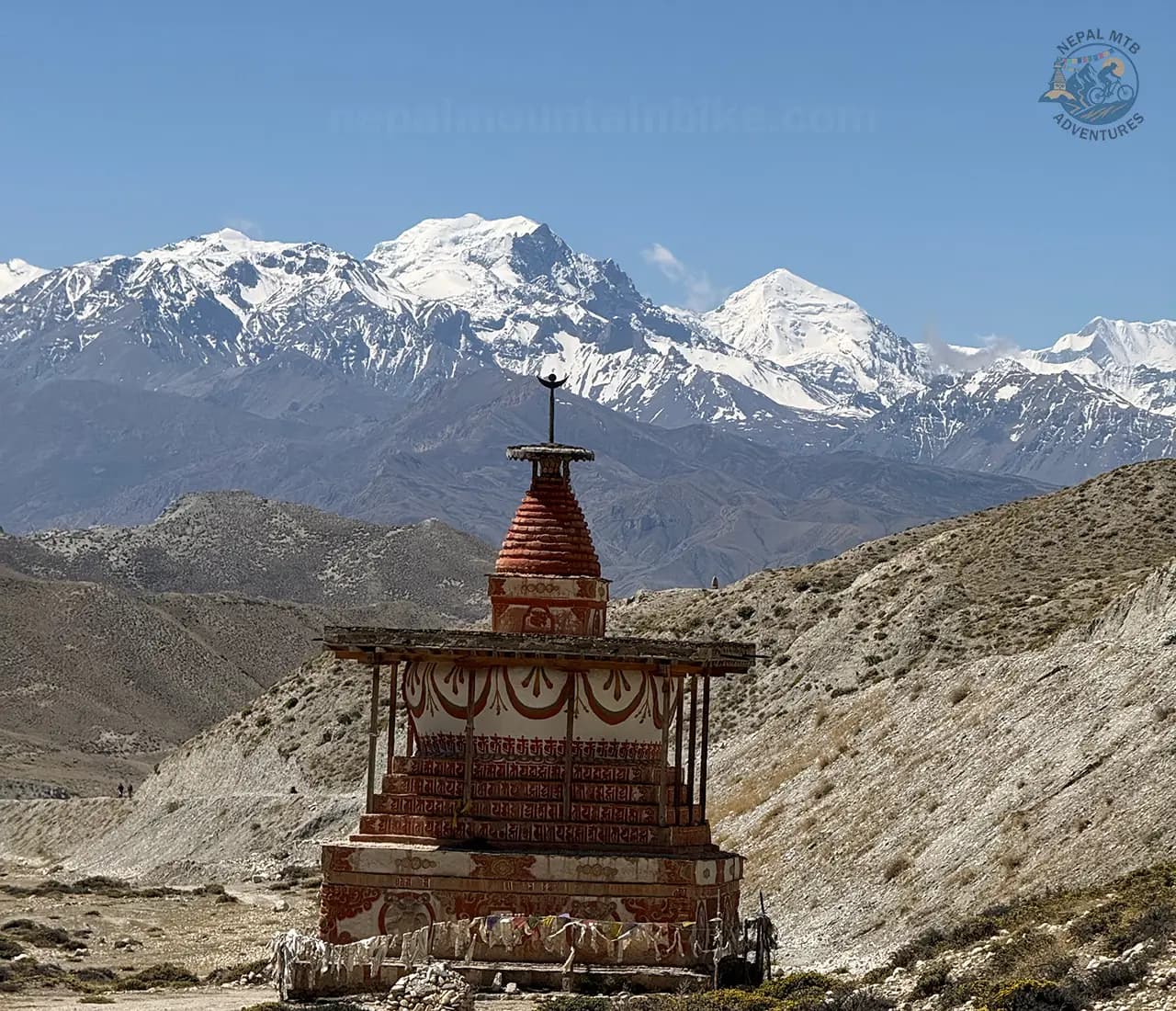
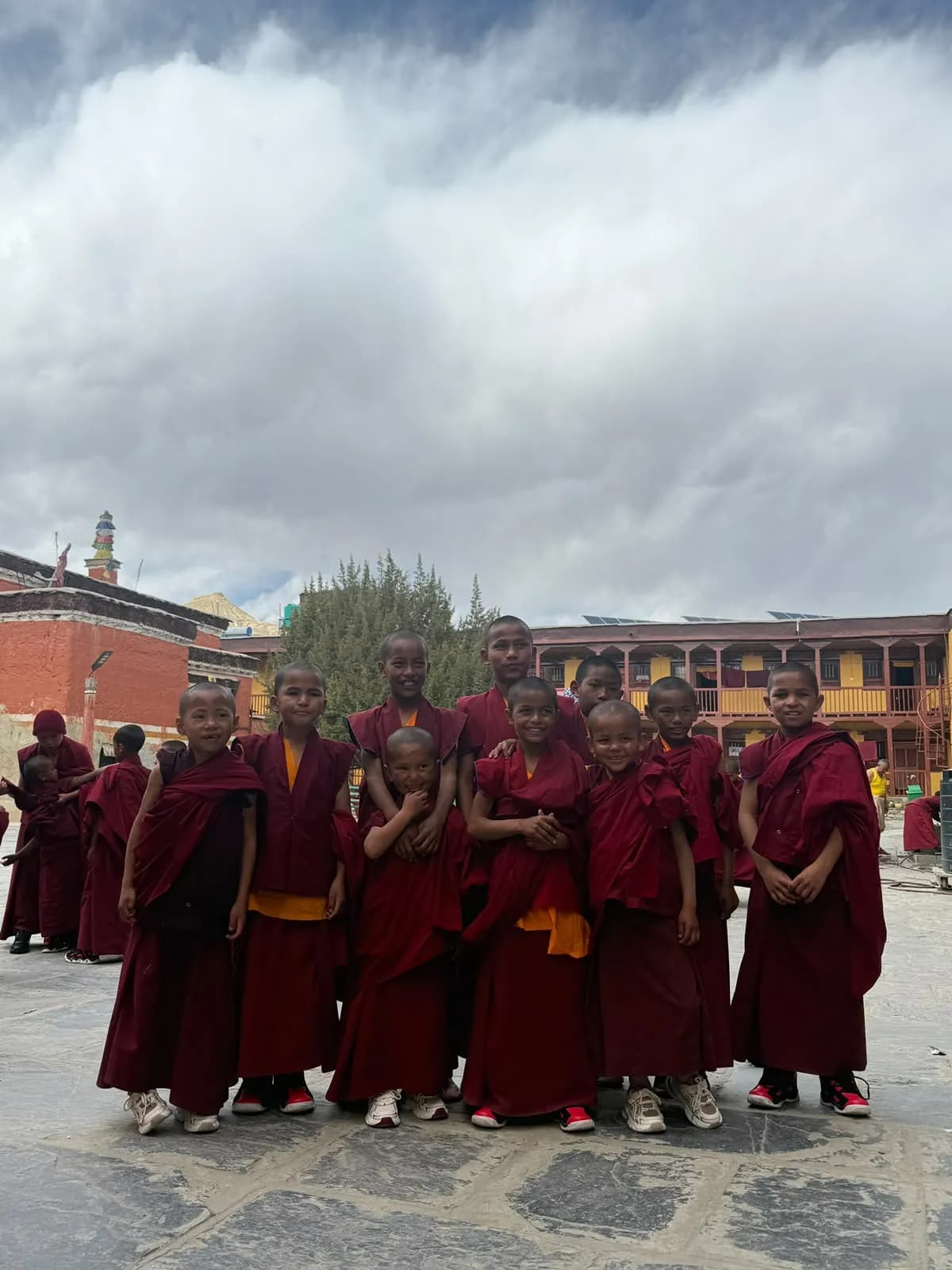
The people of Upper Mustang call themselves Loba, the people of Lo. They speak Lo-ke, a Tibetan language, and follow Tibetan Buddhism. Monasteries, chortens (stupas), prayer flags and mani walls are part of every village.
Life depends on water. Villages sit where a side stream can be led into fields of barley, buckwheat and mustard, with poplars and willows along the channels. Families keep yaks, goats and horses. In winter many move south to warmer places and return in spring.
Pass mani walls and chortens on the left, so they stay on your right.
Ask before you photograph people, and inside monasteries.
Dress modestly in villages and monasteries.
Leave caves, fossils and old objects as you find them.
Festivals: Tiji and Yartung
Tiji is Lo Manthang's great festival: three days of masked dances in the square below the palace, performed by the monks of Chode Monastery. It tells the story of a deity defeating a demon, and people come in from all over Upper Mustang. The date follows the Tibetan calendar and falls in late May or early June. In 2027 it is expected on 1 to 3 June. Lodges in Lo Manthang fill weeks ahead, so plan a festival visit months out. Our Tiji festival guide has the full story.
Yartung marks the end of summer, with horse racing, archery and feasting in Lo Manthang and at Muktinath. It falls in late summer, usually in August, on a date set by the lunar calendar.
Landscape, climate and wildlife
Upper Mustang lies in a rain shadow. The Himalaya takes most of the monsoon rain before it gets here. Jomsom, at the southern edge, gets about 290 mm (11 in) of rain a year, and Pokhara, a short flight south, gets more than ten times that. The result is a desert of sandstone and gravel, eroded into cliffs, pillars and canyons in reds, ochres and greys.
It is a land of big temperature swings. Days are sunny and can be warm even in autumn. Nights are cold, and in October the temperature at Lo Manthang drops to around freezing. A strong wind blows up the Kali Gandaki valley from late morning almost every day. It is the reason flights to Jomsom run only in the early morning.
The climate is changing. The Lo Manthang area used to get under 200 mm of rain a year; in 2023 the weather station at Chhoser measured 331 mm.
Wildlife is easiest to see early in the day: blue sheep on the slopes, and griffon vultures and lammergeiers overhead. Snow leopards live in the wider region, but do not expect to see one.
Best time to visit Upper Mustang
Months | What it is like |
|---|---|
March to May | Warming days, clear air, long daylight. Windy afternoons. The Tiji festival comes at the end of this season or just after it. |
June to August | Much drier than the rest of Nepal, with the mildest nights of the year. Some rain, and the roads and flights that bring you here are less reliable in the monsoon. |
September to November | Stable weather, the clearest mountain views, cold nights. |
December to February | Very cold and windy, with snow on the passes. Many families move south and lodges close. |
For a sense of the temperatures: at Jomsom, 2,720 m (8,924 ft), October averages about 18°C (64°F) by day and 5.5°C (42°F) at night, and August about 23°C (73°F) and 14°C (57°F). Lo Manthang is more than 1,000 metres higher and several degrees colder.
Month-by-month detail for all of Nepal is in our guide to the best time to mountain bike in Nepal.
How to get to Upper Mustang
1. Fly to Kathmandu, Nepal's main international airport. Since 23 September 2026 there is also a daily direct flight from Dubai to Pokhara.
2. Kathmandu to Pokhara. A 25 to 30 minute flight, or a full day by road.
3. Pokhara to Jomsom. A 20 to 25 minute flight up the Kali Gandaki gorge, in the early morning only, or most of a day by road. Flights are often delayed or cancelled by wind and cloud, and they usually pause for much of the monsoon.
4. Jomsom to Kagbeni. A short drive, ride or half-day walk. Permits are checked at Kagbeni, and the restricted area starts just beyond it.
5. Kagbeni to Lo Manthang. About 85 km (53 miles) by the jeep road, or three to five days on foot or by bike over a series of passes.
Upper Mustang permits and rules in 2026
Upper Mustang is a restricted area. Every foreign visitor needs two permits, and two of the rules changed in the last year.
The rules:
You need a licensed guide. Travelling without one is not allowed in the restricted area.
You can travel solo. Since 22 March 2026 a single traveller can hold the permit; the old two-person minimum is gone. You still need the guide.
The permit must be filed by a registered Nepali agency. You cannot buy it yourself, online, or at the checkpoint.
You pay for the days you spend inside the area, so the total depends on your itinerary. Nine days costs USD 450.
A TIMS card is not needed for Upper Mustang.
Drones need prior permission.
We are a registered agency. We file both permits before you arrive, and both are included in every Upper Mustang trip we run. The full permit detail is in our Upper Mustang rider's guide.
Ways to visit Upper Mustang: trek, jeep or mountain bike
There are three ways to travel in Upper Mustang, and all three need the same permits and a guide.
Trek | Jeep | Mountain bike | |
Time | About 10 to 14 days from Pokhara and back | About 6 to 10 days from Pokhara and back | About 15 to 16 days from Kathmandu and back, with 7 to 9 days in the restricted area |
What it is like | The classic way. You walk village to village, three to five days each way to Lo Manthang. | The quickest way. Jomsom to Lo Manthang takes six to seven hours of driving, usually split over two days. | You cover more ground than a walker, and can leave the road for the old trails on the east side. |
Good to know | Parts of the walking route now follow or cross the jeep road, with dust when vehicles pass. | You gain height fast, so altitude needs care. You see the main sights but less of the land between them. | Hard riding at altitude. It suits fit, experienced riders; an e-MTB makes the climbs easier. |
Mountain biking in Upper Mustang
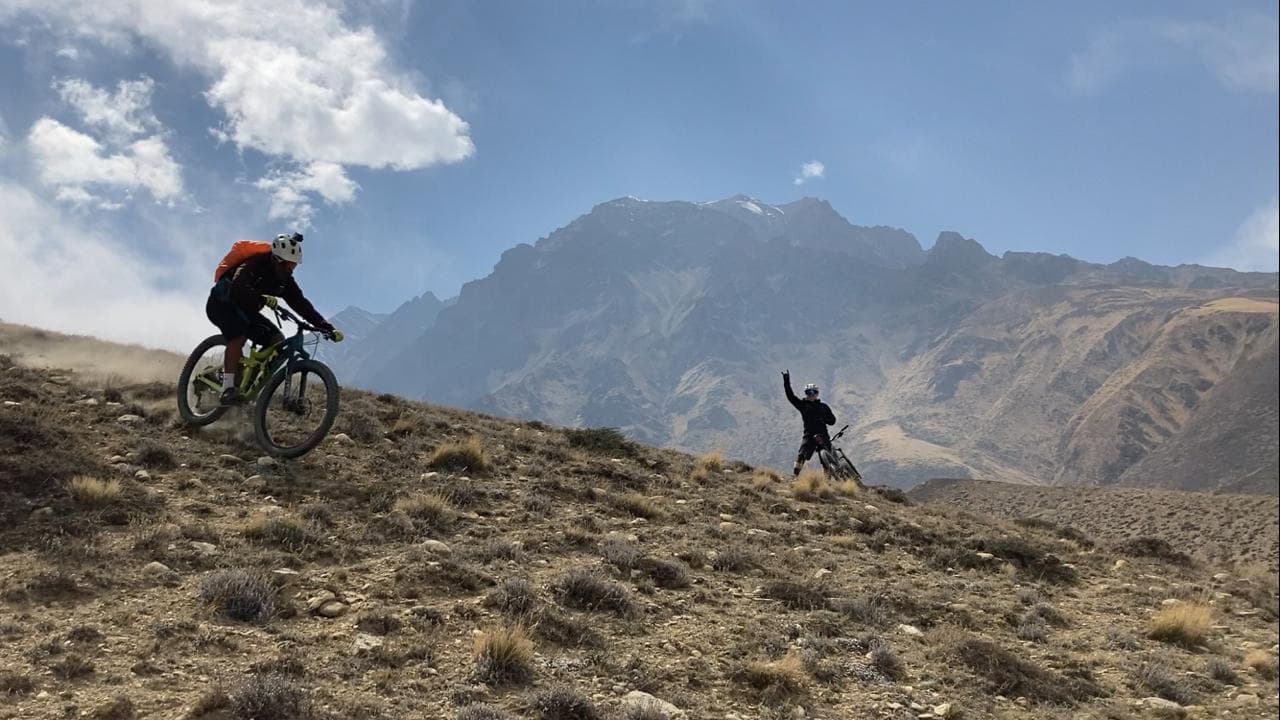
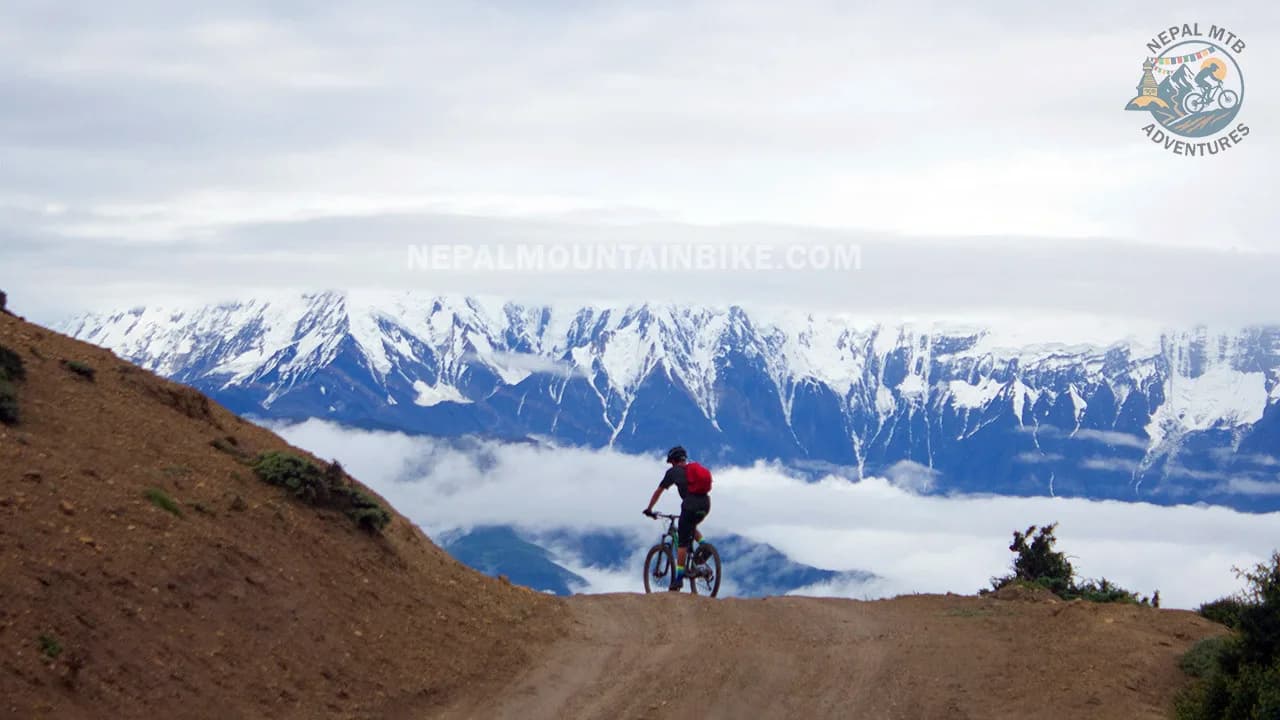
Upper Mustang is expedition riding: old caravan trails, jeep track and desert singletrack, with a pass most days between about 3,700 and 4,200 metres (12,140 to 13,780 ft).
The route north follows the old trade route from Kagbeni through Samar, Ghami and Tsarang to Lo Manthang, crossing Nyi La, about 4,010 m (13,156 ft), and Lo La, about 3,950 m (12,959 ft).
The route home can go by the east side, through Yara, Luri Gompa and Tangge, mostly on trail, and over the Paha pass at about 4,210 m (13,812 ft).
The riding days are 16 to 50 km (10 to 31 miles), with up to 1,150 m (3,800 ft) of climbing. They are harder than the distances suggest, because of the altitude.
Some sections are a push or a carry, and days start at first light to avoid the wind.
The trip usually ends with long descents through Muktinath, the Lubra valley and the Kali Gandaki, in Lower Mustang.
It suits riders who are comfortable on loose, rocky trail and can ride several days in a row. An e-MTB makes the climbs easier and suits groups of mixed strength. You can bring your own bike or ride one of ours from our Pokhara workshop: mountain bike rental in Pokhara. Everything a rider needs to know is in our Upper Mustang mountain biking guide.
Altitude and health
Almost every night in Upper Mustang is spent above 3,000 metres (9,843 ft), and Lo Manthang is at 3,840 metres (12,598 ft). Altitude sickness is the main health risk, and it can affect anyone, however fit.
Go up gradually. Take three or four days from Kagbeni to Lo Manthang, not one.
Know the signs. Headache, nausea, poor sleep and unusual breathlessness. If they get worse, go down.
Drink plenty. The air is very dry.
Protect yourself from sun and wind. Sunglasses, sunscreen, lip balm and a buff for the dust.
Check your insurance. It should cover the height you will reach (at least 4,500 m / 14,764 ft) and helicopter evacuation. Talk to your doctor before you travel.
There are health posts in the larger villages, and the nearest hospitals are in Jomsom and Pokhara.
Where to stay and what to eat
Every village on the main routes has family-run lodges. Rooms are simple: twin beds and thick blankets, and more and more lodges now have private bathrooms. The dining room has a stove and is the warm room of the house. Bedrooms are not heated, so bring a good sleeping bag in autumn.
Food is filling: dal bhat (rice, lentils and vegetables, with refills), Tibetan bread, noodle soup, potatoes and eggs, with butter tea if you want to try it. Power comes from solar panels and small hydro schemes, and charging a phone or camera can cost extra. Bring enough cash from Pokhara or Jomsom for drinks, snacks, showers and charging.
Visit Upper Mustang with us
We take riders to Upper Mustang on five trips. Each includes the permits, a licensed guide who knows these trails, lodges and meals, and transport in and out. We run private departures for solo riders, couples and groups, and set dates for the Tiji festival.
Trip | Days | Choose this if |
16 | You want the whole region: north to Lo Manthang, home by the east side, out through Muktinath. The right first choice for most riders. | |
15 | You want Lo Manthang with electric assist, or you are travelling with someone stronger or weaker than you. | |
16 | You want to be in Lo Manthang for all three days of Tiji. | |
15 | You want Lo Manthang by the main route north and back, with shorter riding days. | |
22 | You want both: the Annapurna Circuit over Thorong La, then north to Lo Manthang. |
Riders have reviewed their Upper Mustang trips with us since 2013. Two of them:
> "The scenery in the Upper Mustang was absolutely incredible, not to mention blue sky and sunshine every day."
> "We cycled from Jomsom to Lo Manthang over 5 days and although some days were very tough, the scenery was amazing and the overnight stops were awesome."
Have a question about Upper Mustang, or dates that do not match ours? Ask us.
Frequently asked questions about Upper Mustang
Where is Upper Mustang?
Upper Mustang is the northern part of Mustang District in north-central Nepal, on the border with Tibet. It lies north of Dhaulagiri and the Annapurna range and begins just north of the village of Kagbeni, 2,800 m (9,186 ft). Its main town is Lo Manthang, 3,840 m (12,598 ft).
Why is Upper Mustang called the Forbidden Kingdom?
Upper Mustang was the Kingdom of Lo, with its own king, and Nepal kept it closed to foreign visitors until 1992 because of its sensitive position on the Tibetan border. The name stuck. It is still a restricted area, and visitors need a special permit and a licensed guide.
What is Lo Manthang?
Lo Manthang is the old capital of the Kingdom of Lo: a walled town at 3,840 m (12,598 ft) in Upper Mustang. By tradition it was founded around 1380. Inside its earthen wall are the old royal palace and three monasteries, Jampa Lhakhang, Thubchen and Chode. It has been on UNESCO's tentative World Heritage list since 2008.
How high is Upper Mustang?
The usual routes run from about 2,800 m (9,186 ft) at Kagbeni to passes of about 4,000 to 4,200 m (13,123 to 13,780 ft). Lo Manthang is at 3,840 m (12,598 ft). Most nights are spent above 3,000 m, so altitude sickness is possible and a gradual ascent matters.
Do you need a permit for Upper Mustang?
Yes. Foreign visitors need the Upper Mustang Restricted Area Permit and the Annapurna Conservation Area permit. Both must be arranged in advance by a registered Nepali agency.
How much is the Upper Mustang permit in 2026?
The Restricted Area Permit costs USD 50 per person per day spent inside the area, under a Cabinet decision of November 2025. It replaced the old fee of USD 500 for 10 days, and there is no minimum stay. The Annapurna Conservation Area permit costs NPR 3,000.
Can you visit Upper Mustang solo, or without a guide?
You can visit as a solo traveller. Since 22 March 2026 one person can hold the permit, and the old two-person minimum is gone. You cannot visit without a guide. A licensed guide is required, and the permit must be filed by a registered agency.
When is the best time to visit Upper Mustang?
March to May and September to November. Autumn has the clearest views and cold nights. Spring is warmer and ends with the Tiji festival. June to August is also possible, because Upper Mustang lies in the rain shadow and gets little monsoon rain. December to February is very cold.
Can you visit Upper Mustang in the monsoon?
Yes. The Himalaya blocks most of the monsoon rain, so Upper Mustang stays much drier than the rest of Nepal from June to August. The journey there is less reliable, because flights to Jomsom usually pause and the road can be blocked by landslides. Allow spare days.
How do you get to Upper Mustang?
Fly to Kathmandu, then to Pokhara. From Pokhara, take the early-morning flight of 20 to 25 minutes to Jomsom, or travel by road. From Jomsom it is a short trip to Kagbeni, where the restricted area begins, and about 85 km (53 miles) more to Lo Manthang.
Is there a road to Lo Manthang?
Yes. A jeep road runs 96 km (60 miles) from Jomsom to Lo Manthang and on to the Tibetan border at Korala. Most of it is gravel, and sections are being upgraded. Trekkers and riders can still follow older trails away from the road for parts of the way.
How many days do you need for Upper Mustang?
About 6 to 10 days from Pokhara by jeep, 10 to 14 days on foot, and 15 to 16 days from Kathmandu for a mountain bike trip. Allow at least two nights in Lo Manthang, and spare days for flight delays.
How long is the Upper Mustang trek?
Most Upper Mustang treks take 10 to 14 days from Pokhara and back. The walk from Kagbeni to Lo Manthang takes three to five days each way, with two nights in Lo Manthang. Parts of the walking route now follow the jeep road.
Can you mountain bike in Upper Mustang?
Yes. Bikes are allowed with the same permits and a licensed guide. Riders follow old caravan trails, jeep track and desert singletrack to Lo Manthang, with a pass most days between about 3,700 and 4,200 m. It is hard riding at altitude. Our trips take 15 or 16 days from Kathmandu.
What is the difference between Upper Mustang and Lower Mustang?
Lower Mustang is the area around Jomsom, Kagbeni, Muktinath and Marpha. It needs no restricted permit and is easier to reach. Upper Mustang is the restricted region north of Kagbeni: higher, drier and more remote, with Lo Manthang at its end.
When is the Tiji festival?
Tiji is a three-day festival of masked dances in Lo Manthang, performed by the monks of Chode Monastery. It follows the Tibetan calendar and falls in late May or early June. In 2027 it is expected on 1 to 3 June.