

We are Nepal MTB Adventures, the official dealer for Trek and Scott bikes in Nepal, and we have been running bikes out of Pokhara since 2004. The mechanics who service these bikes are the same people who guide the trails they go out on, which is why we can tell you which bike suits which ride rather than just handing you one.
If you only want a cycle for a gentle ride around the lake, a hardtail is the right bike and the cheapest one we rent.
You can see every bike, with full specs and current daily rates, on our mountain bike rental. Every rate includes a helmet and a basic repair kit. Multi-day bike hire works out cheaper per day, so send us your dates, and we will price the block rather than the day.
Key Takeaways
Prices: USD 30 to 45 a day for a hardtail, USD 70 to 75 for full suspension and USD 100 for an e-MTB, with lower daily rates on multi-day hires.
Included: a fitted helmet, a basic repair kit, and a quick fit on every bike. No security deposit, just a valid ID and a minimum age of 16.
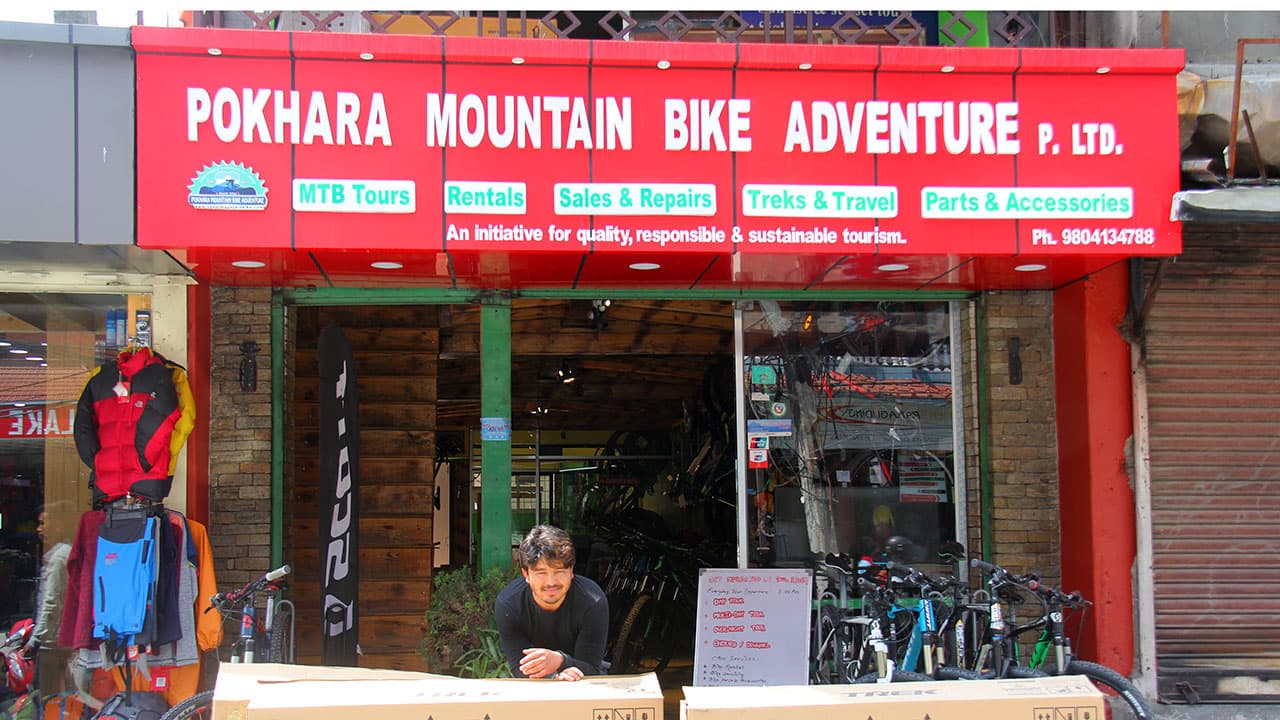
Where: our own workshop at Baidam, Hallan Chowk, Lakeside, run by the official Trek and Scott dealer in Nepal, and fifteen minutes from Pame, Phewa Lake, and the Sarangkot climb.
Which bike: a hardtail for most valley rides, full suspension for the Peace Pagoda descents and gravity trails, and an e-MTB for the Sarangkot sunrise climb.
Guides and permits: you do not need a guide in the Pokhara valley, and only Australian Camp needs an ACAP permit.
When to book: ahead in October and November and from March to May. The rest of the year you can usually walk in and ride the same day.
What You Can Rent in Pokhara
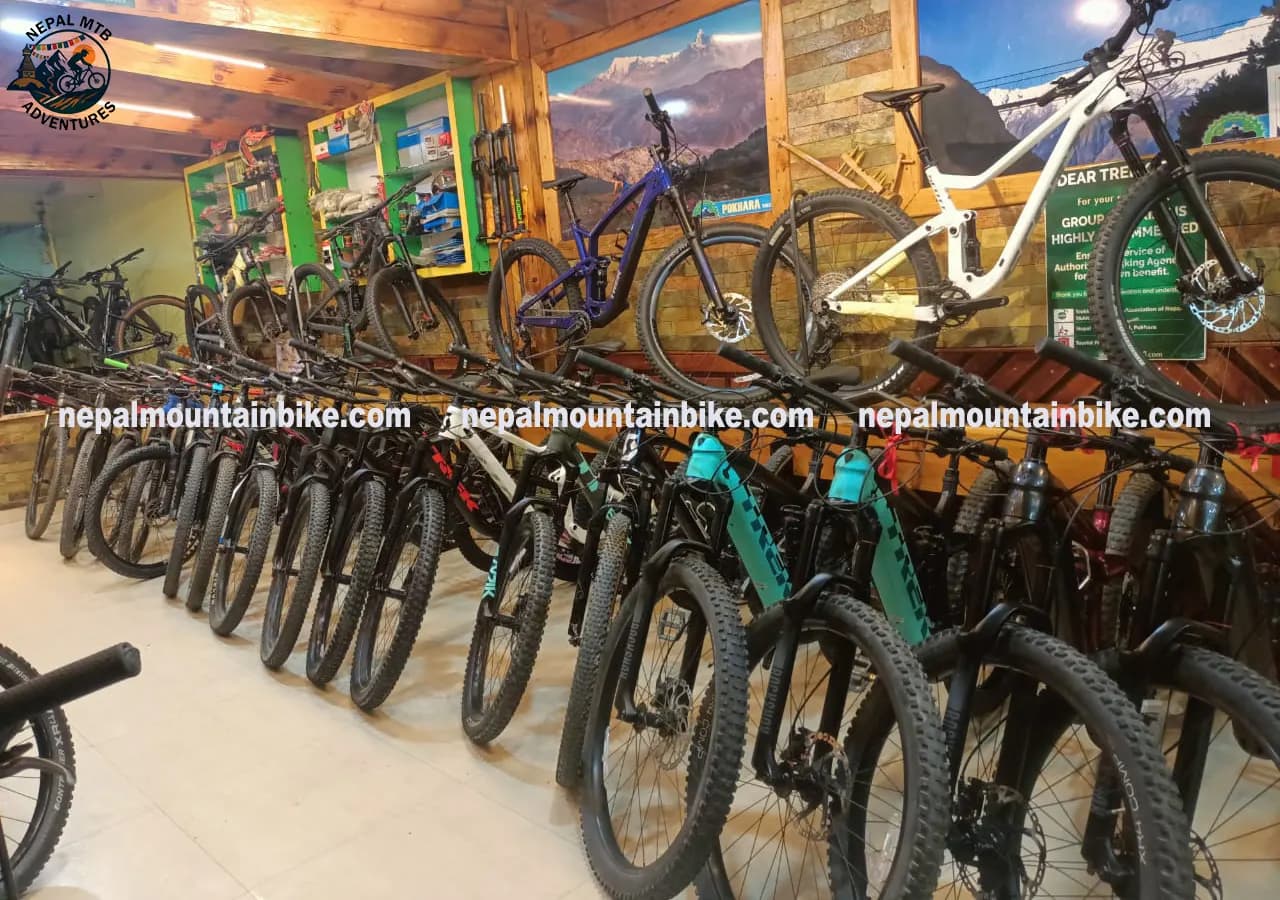
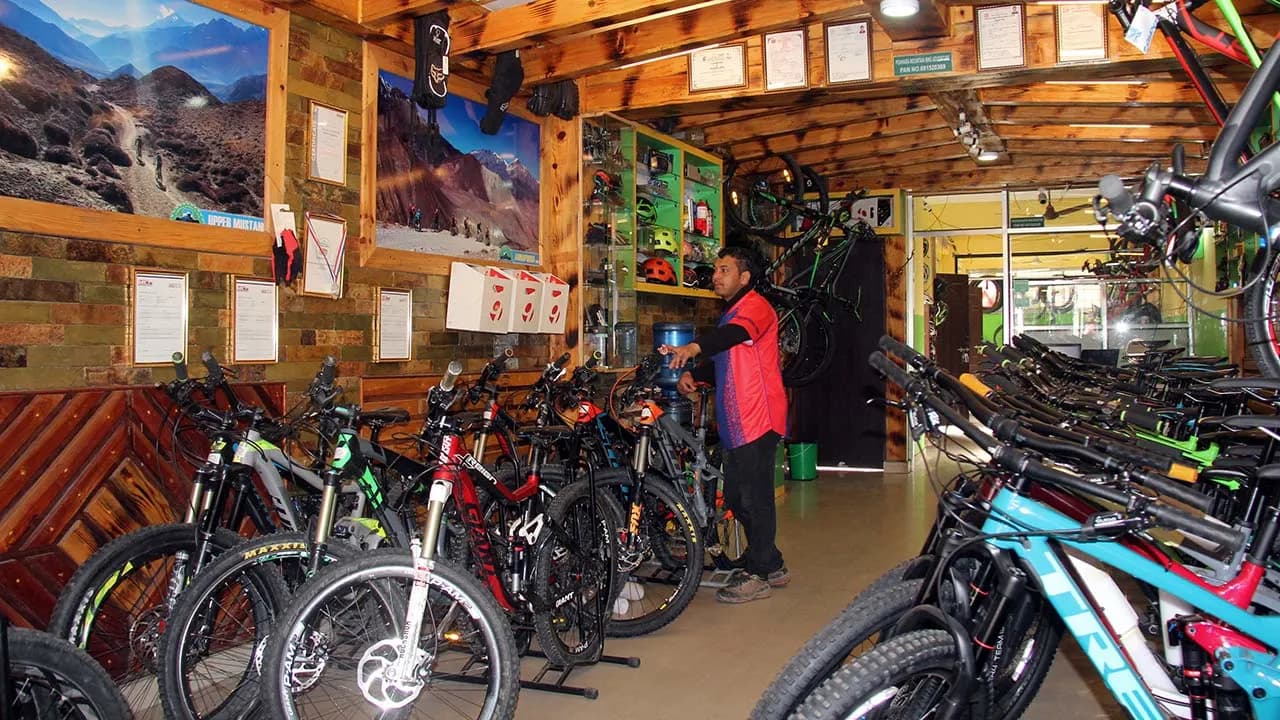
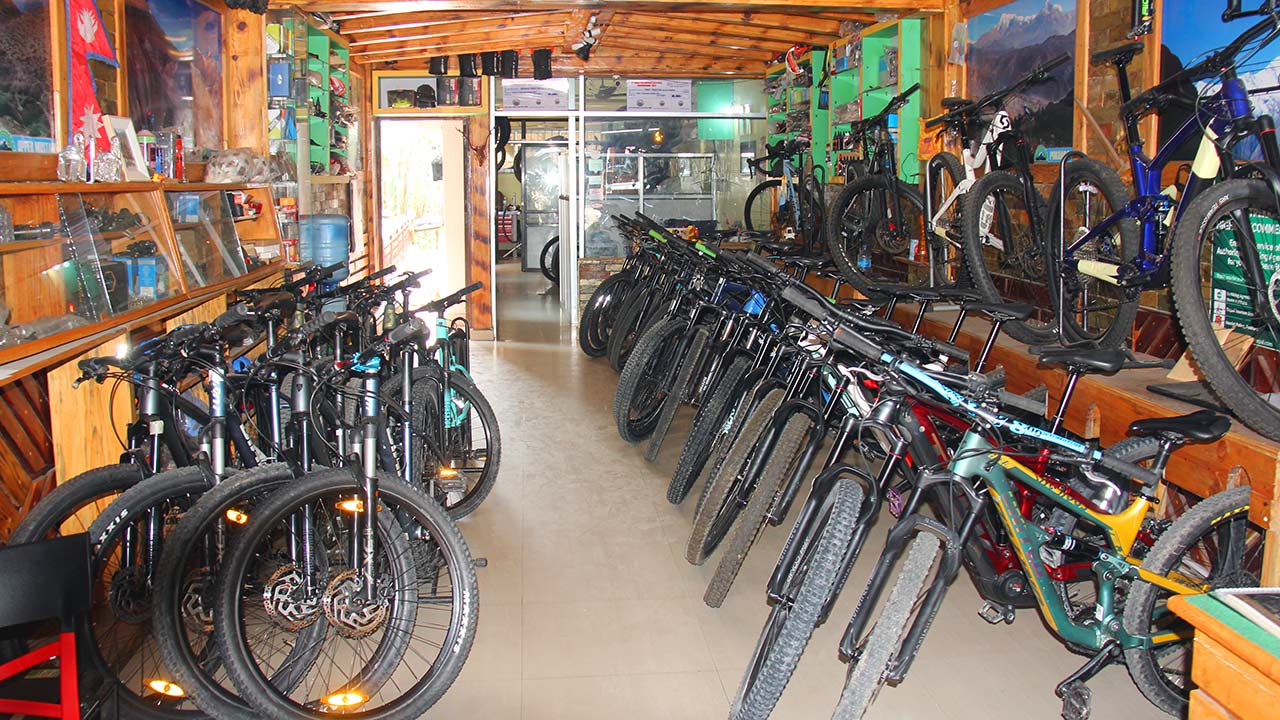
This is our own fleet, not a directory of what is available around town. Every bike below sits in our workshop, has its own page with full specs, and can be reserved for the dates you want. If you like a bike enough to keep it, our bike shop sells the same Trek and Scott models.
> "My friend and I just rented bikes for the day and took them out ourselves to ride around the lake in Pokhara. We both mountain bike in the uk but wanted to push ourselves in more challenging terrain. The bikes at this shop allowed us to do so. With top of the range bikes at affordable rental prices, the day couldn't have been more of a success!"
> > Ed Lofts, TripAdvisor, September 2023. Read the full review
Hardtails
The workhorses of the valley, and the right choice for most riders here. Lighter, simpler, cheaper, and more than enough of a bike for the lakeside loops, Pame, Begnas, and the Sarangkot climb.
Trek Marlin 6 Gen 3 and Marlin 7 Gen 3, the 2026 models, plus the Marlin 7 and Marlin 8 Gen 3.
Trek X-Caliber 8, a step up in weight and gearing for longer cross-country days
Trek Procaliber 6 for riders who want a faster, lighter climb
The Marlin series runs an Alpha Silver aluminium frame, hydraulic disc brakes and Shimano drivetrains, with wheel size matched to frame size. The X-Caliber 8 steps up to a lighter Alpha Gold aluminium frame and runs 29-inch wheels on every size.
The Scott Aspect 910 runs a Shimano Deore 12-speed with a RockShox Judy Silver fork and 100 mm of travel, at roughly 14.1 kg. The Aspect 920 has a Suntour air fork with a remote lockout and weighs about 14.3 kg. Scott numbers its bikes backwards, so the 910 is the better-equipped bike of the two, which is why it costs more.
Full suspension
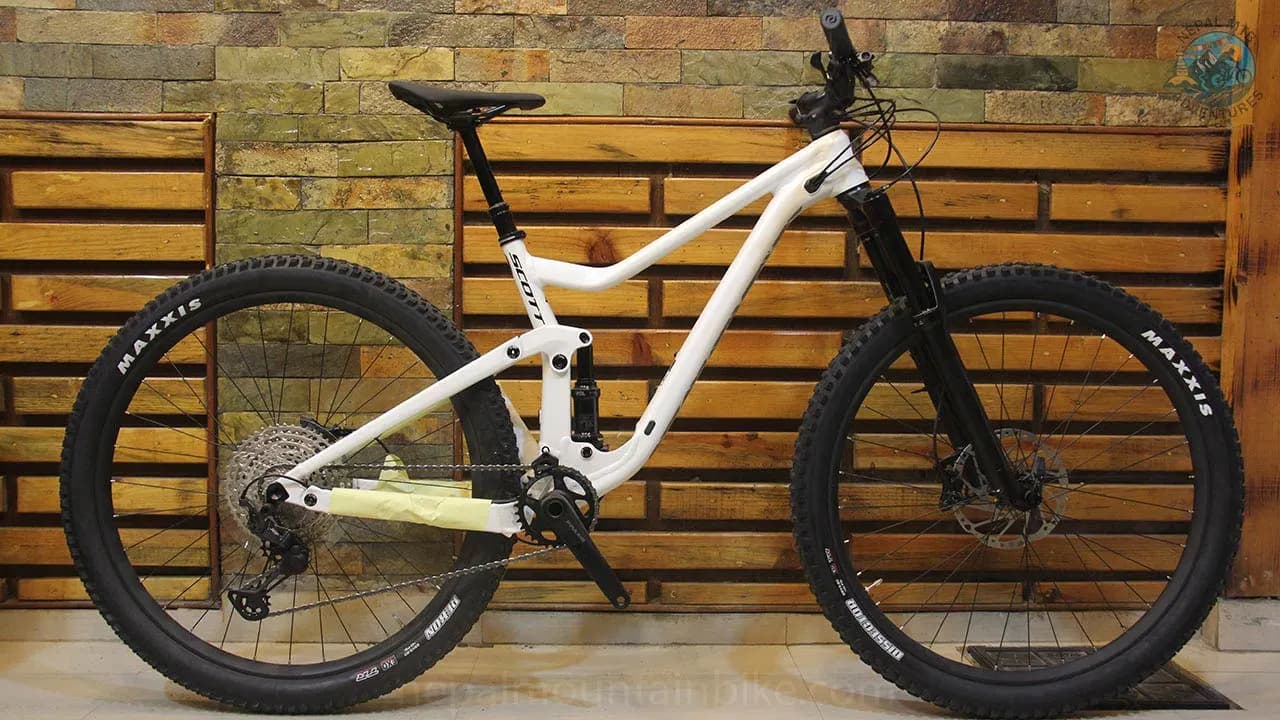
Worth the extra money on two things in Pokhara: the technical descents off the World Peace Pagoda ridge and the shuttle-assisted gravity trails that drop about 1,000 m from Sarangkot, where a jeep or the Annapurna cable car carries you and your bike to the top. On flat lakeside riding, you will not notice it.
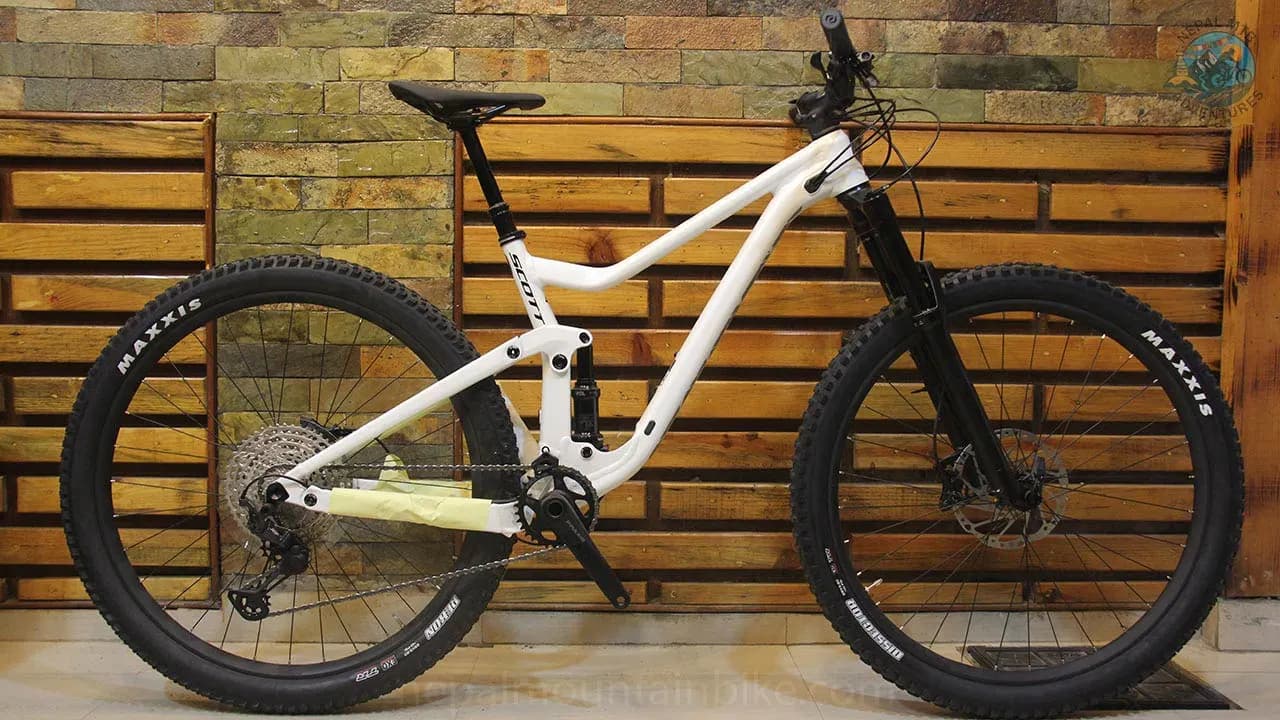
Trek Fuel EX 7 Gen 6, the all-round trail bike
Trek Remedy 8, longer travel for gravity days
E-MTB
Trek Rail 5 Gen 3 and the Bergamont E-Trailster, both full suspension on Bosch systems
The one thing pedal assist changes here more than anything else is Sarangkot. That climb is around 800 m of vertical, usually in the dark if you are going for sunrise. On an e-MTB, it is a comfortable hour. Without one, most people take the jeep and miss the ride.
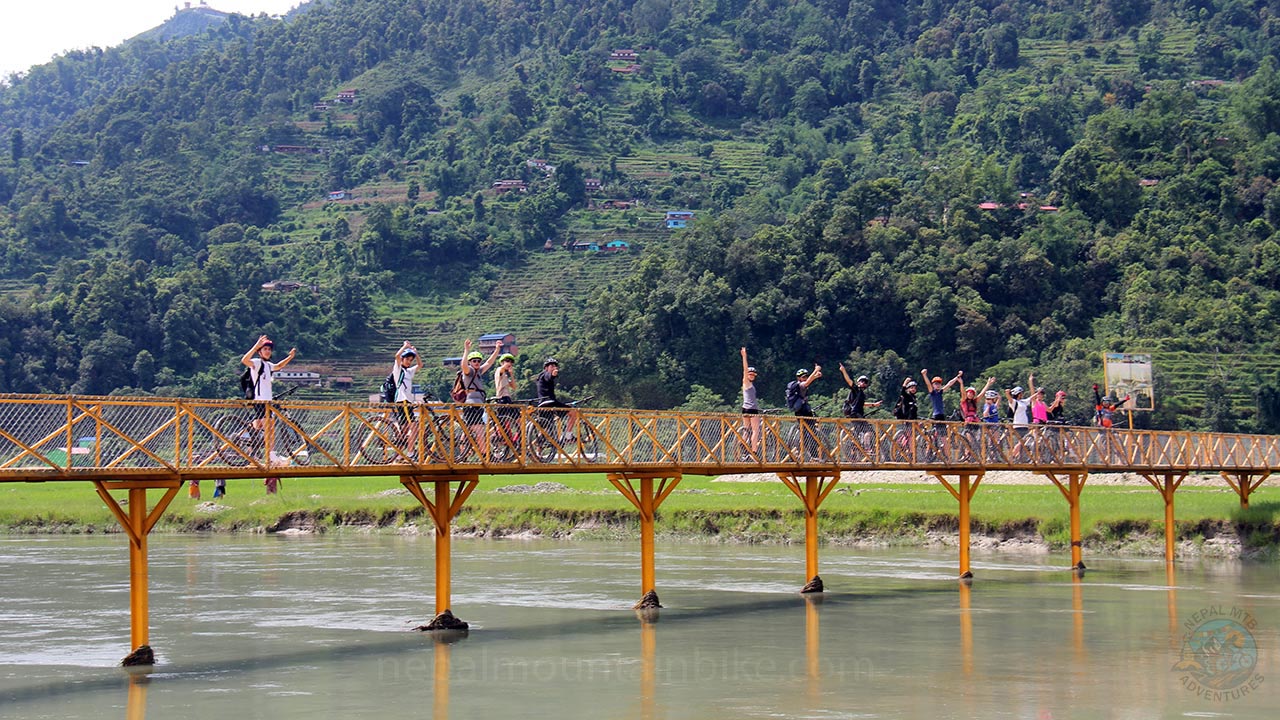
Bike Rent in Pokhara: What Is Included
Included with every rental: the bike, a fitted helmet, a basic repair kit with a pump, tube, and levers, and a quick fit and adjustment before you leave.
Available on request: knee and elbow pads, gloves, a rear rack or panniers, a phone or GPS mount, a lock and key, and a spare tube for longer days.
Not included: trail entry fees where they apply, transport to a trailhead if you want a shuttle, and personal travel insurance. Check that your policy names mountain biking rather than just cycling, because plenty exclude it.
No deposit, damage, or theft. We do not take a security deposit. You need a valid ID and must be at least 16 years old. Normal trail wear is expected and is on us. Crash damage, a bent rotor or a torn tyre is charged at parts cost, and we will show you the part before we charge for it. Theft is your responsibility, so ask for a lock and do not leave a bike outside a restaurant in Lakeside unlocked, which is where almost every theft happens.
> "They provided us with helmets, a multitool, pump, first-aid kit and spare tubes at no extra charge, which was extremely reassuring for such a long and demanding ride. The bikes were in great condition, tubeless, and performed flawlessly throughout the trip."
>> Nick M, TripAdvisor, November 2025. Read the full review
Hardtail or Full Suspension for Pokhara?
We put most riders on a hardtail, and that is not us saving you money for the sake of it.
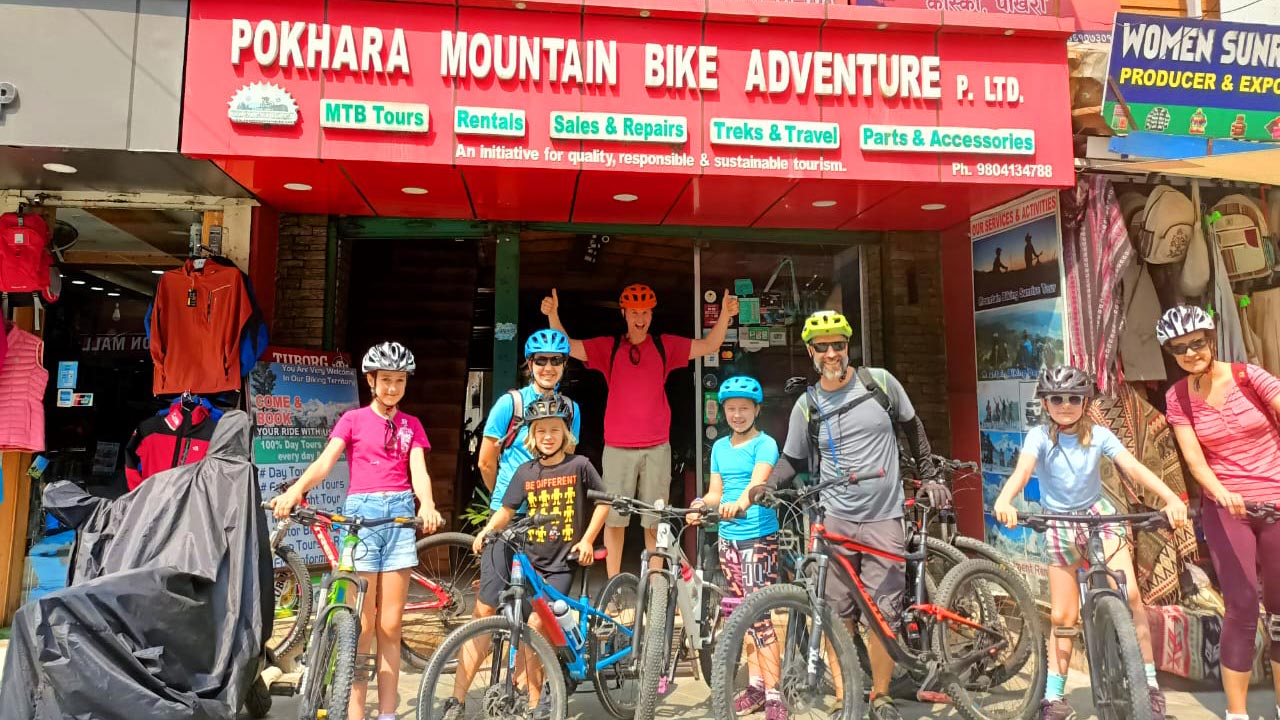
Most of the valley is dirt road, farm track, buffalo trail, and moderate singletrack. A hardtail is lighter, climbs better, costs less than half as much per day, and handles all of it. If you are riding the Phewa Loop, Pame, Begnas or the Sarangkot climb, we will put you on a hardtail and tell you to spend the difference on more days.
We will steer you to full suspension if you are here for the descents. The World Peace Pagoda ridge and the gravity trails above Lakeside are steep, loose, and rough enough that 130 mm of travel changes the day. If you ride 150 mm at home, you will want it here too.
And we will suggest an e-MTB if you are riding with a group of mixed fitness, or if you want to climb Sarangkot in the dark and still enjoy the descent afterwards.
Getting the Right Size
A bike that does not fit will ruin a week faster than any trail will. Tell us your height and inside leg when you book, and the bike will be set up before you arrive.
When you collect it, check three things:
You can put a foot down flat at a stop.
Your knee is almost straight at the bottom of the pedal stroke.
You are not stretching to reach the bars.
If anything feels wrong, tell us at the counter. A saddle takes thirty seconds to adjust in the workshop.
Shorter riders and teenagers: the smallest Marlin frames come on 27.5-inch wheels rather than 29, so they fit shorter riders well.
Riding with children? Send us ages and heights, and we will tell you honestly what fits. The flat Pame Valley suits younger riders, or join our guided family mountain bike tour.
Before You Ride Off: A Six-Point Check
We run through this with you at handover. Do it again each morning of your hire, because it takes two minutes and catches the things that ruin a day.
1. Brakes. Squeeze both levers hard. They should firm up well before touching the bar.
2. Tyres. Press hard with a thumb. Firm, not soft. Check the sidewalls for cuts.
3. Quick releases and thru-axles. Both wheels tight, nothing rattling.
4. Gears. Shift through the full range while the wheel spins. Listen for grinding.
5. Headset. Front brake on, rock the bike forward and back. There should be no knock.
6. Saddle and bars. Both tight, saddle level, bars square to the front wheel.
If anything fails, bring it back before you leave Lakeside. Once you are out, carry more water than you think you need, pick trails that match your skill rather than your ambition, and keep your helmet on for the road sections too, because the traffic around Lakeside is the riskiest part of most rides.
Where You Can Ride From the Shop
Pokhara sits at about 800 m, with ridges climbing past 2,000 m on every side, so mountain biking in Pokhara runs from flat lakeside tracks to long forest climbs without leaving the valley. On a clear day, the Annapurna range fills the northern skyline, with Machhapuchhre (6,993 m), Annapurna I (8,091 m), Dhaulagiri (8,167 m) and Manaslu (8,163 m) visible from the higher ridges. The rides below are grouped by our trail grades.
Easy
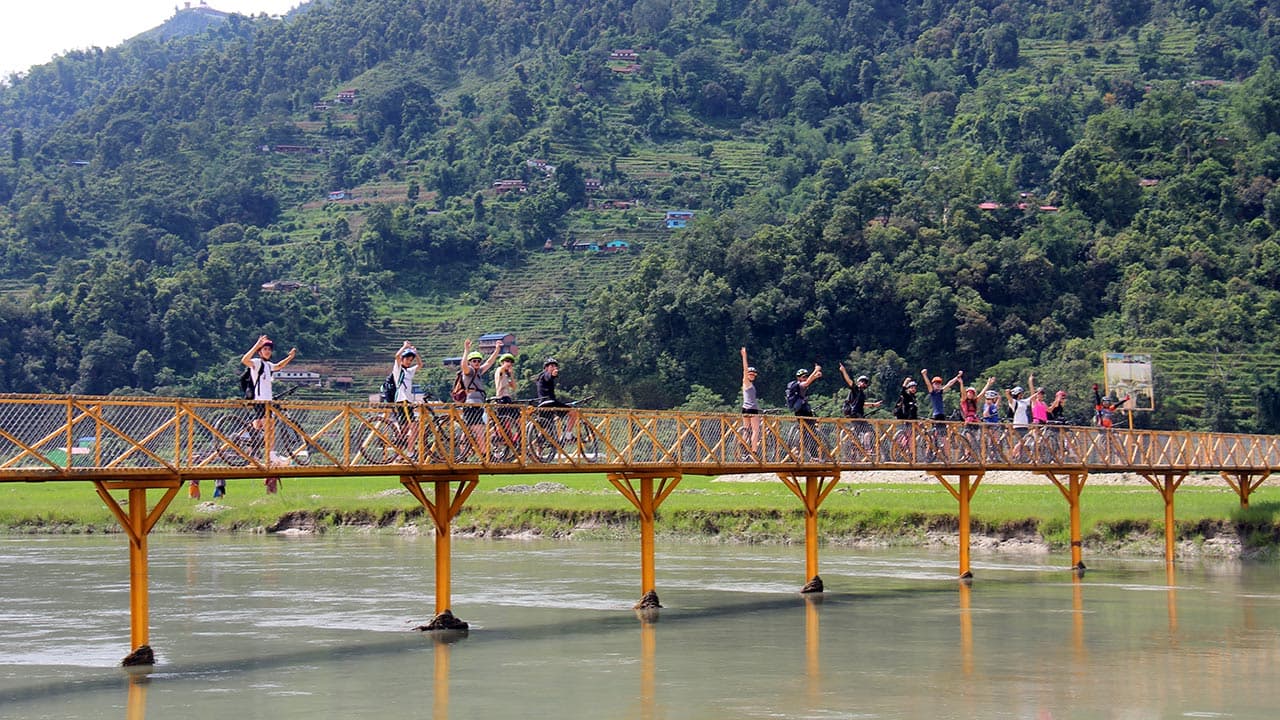
Pame Valley. Flat, gentle farmland along the western arm of Phewa Lake, starting straight from Lakeside. Rideable by someone who has never been on dirt. Half a day.
Round Phewa Lake. A scenic loop with lake views the whole way and easy gradients, passing below the World Peace Pagoda on the south shore.
Begnas and Rupa lakes. East of town in quieter farmland, past rural villages and local fishing communities. The full loop runs out through Dobilla, Bagmara and Talchok to Begnas, then back via Bijayapur, Ramghat, Mahendrapul and Parsyang, mixing paddy fields, quiet tarmac and off-road sections. Riders with more legs climb to Kalikasthan, at about 1,370 m, for views across both lakes.
Intermediate
Sarangkot. The signature ride. Around 800 m of climbing from Lakeside to the ridge at 1,592 m, with Phewa Lake below you and Machhapuchhre in front, then a descent back into town. Best at sunrise, and you can pair the sunrise ride with rafting on the Upper Seti River the same day. Riders often carry on along the ridge to Bhumdi village, at about 1,520 m.
World Peace Pagoda and Anadu Hill. Climbs the south shore through forest and villages to the white stupa at about 1,100 m, then hands you flowing singletrack and switchbacks with the whole valley below. The ride back into town passes Chhorepatan, Davis Fall, and Gupteshwor Cave.
Kristi village. Terraced farmland and village trail with real singletrack sections, topping out on Kristi Ridge at about 1,144 m, southeast of the lake.
Royal Trek. Named after the route Prince Charles once walked, it heads east into the foothills on wide trails and ridgelines to the village of Kalikasthan. About 35 km, climbing from 800 m to around 1,350 m, and best ridden as an overnight with a guesthouse or homestay at the top.
Advanced
Methlang and Anadu ridges. Two ridge climbs in one day: Methlang above the north shore, with forest singletrack below Gyarjati coffee farm, then Anadu Hill and the Peace Pagoda in the afternoon. About 36 km with around 950 m of climbing, all under your own power.
Panchase. The big one from the valley, climbing through rhododendron forest to Panchase Bhanjyang at about 2,065 m, with Panchase Peak at 2,517 m above it. A full committed day, or better as an overnight.
Kaskikot and the Khaste to Chapakot line. Steep climbs, technical descents, rough surface. This is where the local riders go.
Australian Camp. A ridge village at about 2,060 m above Dhampus, with sunrise views of Annapurna and Dhaulagiri. It is around 60 km and worth an overnight rather than a rush. Australian Camp is inside the Annapurna Conservation Area, so you need an ACAP permit.
> "After a few days mountain biking around Pokhara, we decided to do a tougher all day bike trip... We did a tough traverse which descend to Begnas Lake and back to Pokhara... A good choice of new dual suspension and hard tail bikes available for hire."
> > sahil2011, TripAdvisor, June 2016. Read the full review.
When to Rent a Bike in Pokhara
Pokhara rides in all twelve months, so the question is less whether you can ride and more what each time of year gives you. Our guide to the best time to mountain bike in Nepal goes month by month; this is the short version for Pokhara.
Season | What riding is like |
|---|---|
October and November | Dry trails and the clearest mountain views of the year. Our busiest months, so book ahead. |
December to February | Cool, clear and quiet. Cold early mornings, comfortable riding by late morning. |
March to May | Warm and green, with rhododendron in the forests. Views get hazier as May heats up, so ride early. |
June to August | The green season. Fewer riders, lush valleys and wetter, slower forest trails. Rain is usually heaviest in the afternoon, so plan morning rides. |
September | The rain eases and the paddy fields are at their greenest. A good month before the autumn rush. |
Good times to rent a bike in Pokhara:
Sunrise on Sarangkot. Start in the dark and reach the ridge as the Annapurna range lights up.
A rest day after a trek. A gentle ride to Pame or around Phewa Lake loosens legs that have spent a week walking.
A slow afternoon by the lake. The Lakeside roads and the lakeshore trail are at their best in the late afternoon light.
A few days before a bigger ride. A day or two on the valley trails is the best way to get used to the bike before the Annapurna Circuit or Mustang.
A family day out. The flat Pame valley suits children and first-time riders.
Renting Alone, or Riding With a Guide?
We will tell you straight: you do not need a guide in the Pokhara valley. Most of it is an open area, there is no permit requirement beyond a small area fee in places, and we hand bikes to riders who go out on their own every day.
Where one of our guides earns the money is on the trails that are hard to find rather than hard to ride. The valley network is a web of buffalo trails, farm tracks and old walking paths, most of it unmapped and none of it signposted. A first-timer on their own will usually find the road version of a ride and miss the singletrack running parallel to it.
Our advice for most people: rent for the easy days, take a guide for one, then use what you learnt for the rest of the week. The rules are different for the rest of Nepal, where some areas need a licensed guide.
> "In addition to doing the tour, friends and I rented mountain bikes to do some exploring and Jagan and his staff helped us plan our route."
> > Emily M, TripAdvisor, May 2022. Read the full review.
How to Book
Book ahead in October and November and from March to May, when our full-suspension bikes and e-MTBs go first. The rest of the year you can usually walk into the workshop and ride the same day.
Tell us your height, the dates, and what you plan to ride, and the bike will be built and adjusted before you arrive. Pickup is from our workshop at Baidam, Hallan Chowk, Lakeside, Pokhara, or we can deliver the bike to your hotel anywhere in Pokhara.
Message us on WhatsApp at +977 9804134788 or call +977 61 456224.
If your trip starts in Kathmandu, we rent there too, at the same rates.
> "Because we wanted to start in Katmandu, the bicycles were brought to Katmandu from Pokhara, which is of course a top service."
> > Guus, TripAdvisor, December 2023. Read the full review.
Riding Responsibly on a Rental Bike
When you ride without a guide, you are the one the villages meet. The trails around Pokhara are the everyday paths of farmers, schoolchildren, porters and livestock, and a few simple habits keep them open and friendly for the riders who come after you.
On the road
Keep left. Traffic in Nepal drives on the left, and the Lakeside roads are busy with buses, taxis and scooters.
Use lights before dawn. If you are climbing Sarangkot for sunrise, you start in the dark. Ask us for lights when you collect the bike.
On the trail
Give way to people and animals. Slow down or stop for walkers, porters and buffalo, and let them pass first. A friendly "namaste" goes a long way.
Ride slowly through villages. Children, dogs and goats can step onto the path without warning.
Stay on the trail. Riding around muddy or rocky patches widens the path and damages the terraced fields beside it.
Brake smoothly. Skidding tears up the surface, especially on stone steps and wet forest singletrack.
Walk your bike at temples and stupas, including the grounds of the World Peace Pagoda.
Leave nothing behind
Carry your rubbish back to Lakeside, and refill a bottle instead of buying plastic ones on the trail.
Ask before you photograph people or their homes.
Leave No Trace is part of how we run every ride, and our sustainability policy sets out the rest.
Frequently Asked Questions
1. How much does it cost to rent a mountain bike in Pokhara?
Our rates are USD 30 to 45 a day for a hardtail, depending on the model, USD 70 to 75 for full suspension, and USD 100 for an e-MTB. A helmet and a basic repair kit are included on every bike. Multi-day hires work out cheaper per day, so send us your dates and we will price the whole block.
2. How much is bike rent in Pokhara for a week?
A week on our cheapest hardtail comes to USD 210 at the daily rate, and we price multi-day hires below that. Hires of 10 days or more get our long-term rate. Send us your dates and the bike you want, and we will quote the whole week.
3. Can I rent a cycle in Pokhara for a lakeside ride?
Yes. For a relaxed ride around Phewa Lake or out to Pame, rent one of our hardtails from USD 30 a day. It is a proper mountain bike, so it handles the dirt roads and farm tracks around the lake far better than a city cycle would.
4. Where is your rental shop in Pokhara?
Our workshop is at Baidam, Hallan Chowk, Lakeside, Pokhara 33700, within fifteen minutes' ride of Pame, the Phewa Lake shore trails and the start of the Sarangkot climb. You collect and return the bike there. WhatsApp +977 9804134788 or call +977 61 456224.
5. Can I get a bike on rent in Pokhara for just one day?
Yes. Most of our rentals are day hires, from USD 30 for a hardtail. Outside October, November and March to May you can usually walk into our Lakeside workshop and ride the same day. Tell us the evening before if you want the bike sized and ready first thing.
6. I am not staying in Lakeside. Do I have to come to your workshop, or can you deliver the bike?
Yes, we deliver. If you are staying outside Lakeside, we can bring the bike to your hotel anywhere in Pokhara and collect it when you finish. Tell us your hotel, your dates and your height when you book, and the bike will arrive sized and set up, with the helmet and repair kit.
7. Do I need to book ahead?
In October and November, and from March to May, yes, especially for full suspension and e-MTBs, which go first. The rest of the year you can usually walk in and ride the same day, though booking a day ahead means the bike is sized and set up before you arrive.
8. Do you take a deposit, and what documents do I need?
We do not take a security deposit. You need a valid ID and must be at least 16 years old to rent a bike.
9. Can I rent an electric mountain bike in Pokhara?
Yes. For e-bike hire we keep the Trek Rail 5 Gen 3 and the Bergamont E-Trailster, both full suspension on Bosch systems, at USD 100 a day. The Sarangkot sunrise climb is the ride that converts people, because 800 m of vertical in the dark becomes a comfortable hour instead of a grind.
10. Do I need a permit to ride around Pokhara?
Not for most rides. The valley rides need nothing more than a small area fee in a couple of places. Australian Camp is the exception: it is inside the Annapurna Conservation Area, so you need an ACAP permit.
11. Can I rent a bike in Pokhara and ride to Mustang?
Yes, and plenty of riders do. For multi-day trips beyond the valley, talk to us first rather than just riding off. Riders regularly take our bikes around the Annapurna Circuit and down from Jomsom through Lower Mustang, and we can help with jeep transport to the start and with route advice. Upper Mustang is a restricted area that can only be ridden on a guided trip.
12. What if something breaks while I am out?
Every bike goes out with a pump, tube, and levers, and we show you the basics before you leave. For anything beyond a puncture, call the workshop. We are in Pokhara, not a call centre, and the valley rides are all close enough that we can reach you.
Ready to Ride
Pokhara is the easiest place in Nepal to get onto a mountain bike, and we are fifteen minutes from where the dirt starts. Pick the bike, tell us your dates, and we will have it ready.