Nepal MTB Adventures
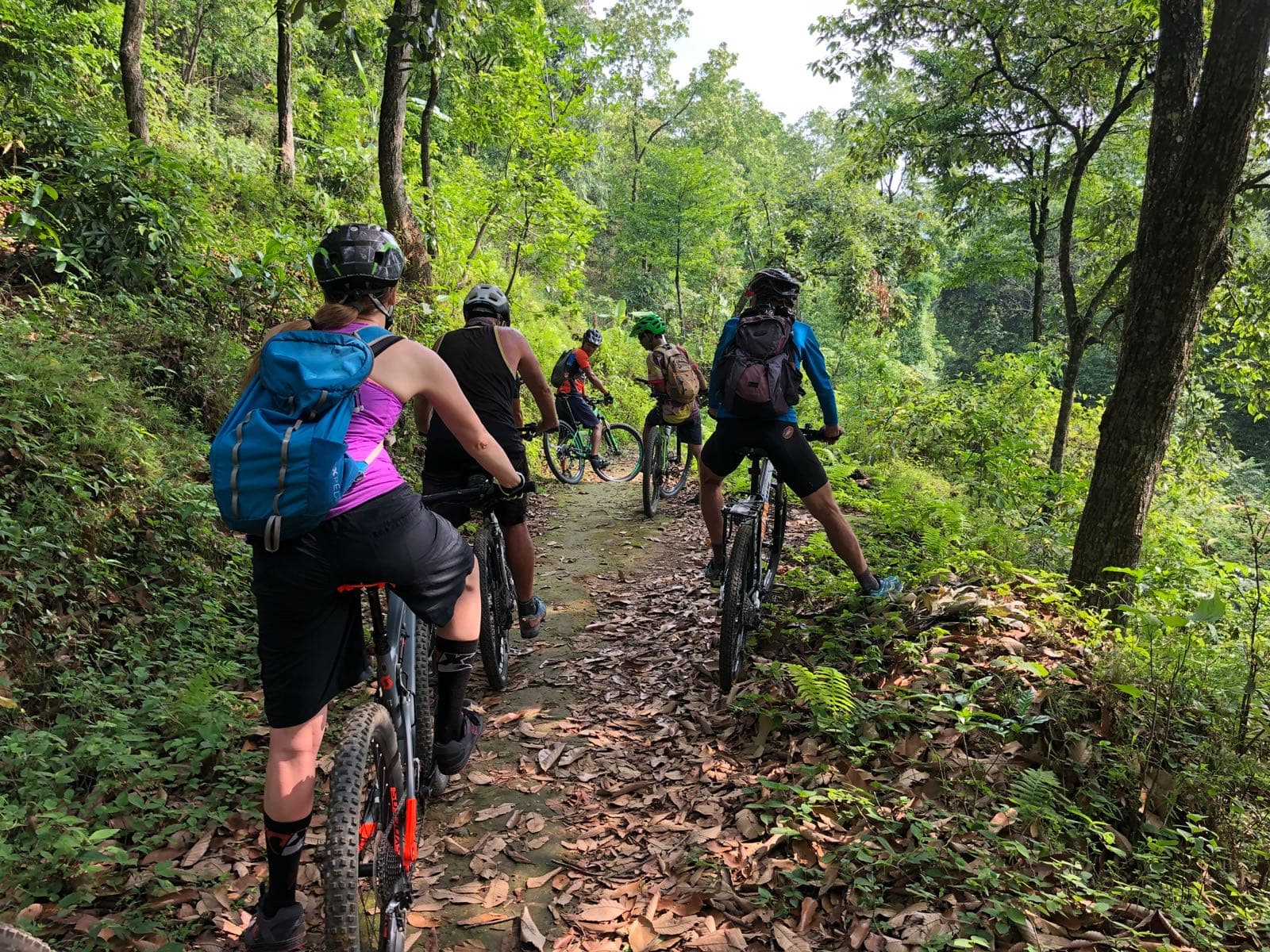
forestsingletrackgroupride.jpeg
1Day

Dual Ridge Challenge: Mountain Bike Day Tour in Pokhara

Rated 5 out of 5 on Tripadvisor443 Reviews in TripAdvisor
Recommended by 99% of travelers

Departures Run Daily

This trip runs every day within the dates below — travel on the day that suits you.

Departs Daily

17 Aug – 16 Oct 2026

Choose any date in this window

2 package options

Don't see a suitable departure?

Reserve the trip privately and choose your own travel dates.

Tour Information

DestinationPokhara
Duration1 Day
Difficultymoderate
Tour TypeMTB

Overview

The Dual Ridge Challenge is a guided mountain bike day tour in Pokhara designed for riders seeking a physically demanding day on real off-road terrain. The loop links the Methlang and Anadu ridges across the Phewa Lake basin, and it mixes sustained climbing with gravel tracks, forest singletrack, loose shale, roots, rocky sections, and paved valley roads.

This is a mountain bike ride, not a sightseeing cycle. Over about 36 km you climb around 950 m and descend around 930 m, all under your own power. There is no shuttle and no uplift. You earn every descent, with a coffee stop at Gyarjati to break the day between the two big climbs.

The ride starts and finishes in Lakeside, Pokhara, and includes a cultural loop past the World Peace Pagoda, Davis Fall, and Gupteshwor Cave. It is designed for intermediate and advanced mountain bikers. Beginners and casual cyclists should pick a gentler route.

Daily departures are available from Lakeside, Pokhara, subject to booking and suitable weather, trail and access conditions. So if you have a spare day in Pokhara and the legs for it, you can usually ride it tomorrow.

Quick Overview:

Detail

Information

Activity

Guided mountain bike day tour

Location

Pokhara, Nepal

Distance

Approx. 36 km

Total climb

Approx. +950 m

Total descent

Approx. -930 m

Total time

Approx. 4.5 to 5.5 hours riding

Difficulty

Challenging

Rider level

Intermediate to advanced

Physical demand

High, sustained climbing

Terrain

Steep concrete, gravel, jeep track, forest singletrack, loose shale, roots, rocky sections, paved roads

Recommended bike

120 to 160 mm trail full-suspension bike, or a capable aggressive hardtail

Start and finish

Lakeside, Pokhara

What makes this different from other Pokhara day rides

  • You see the same lake from both sides. Methlang rises above Phewa Lake's north shore, and Anadu Hill and the World Peace Pagoda above the south. Most Pokhara rides climb one and come back down the same side. 

  • You climb it yourself. No jeep, no cable car, no shuttle. Every metre of descending here is a metre you earned. If that sounds like the wrong trade, our shuttled enduro day trip is the better booking.

  • The surface never settles. Tarmac, concrete switchbacks, jeep track, singletrack, loose shale, roots, stone ramps, rock, then city asphalt. You read the ground and adjust all day, which is why this route punishes a rider who only knows one kind of trail.

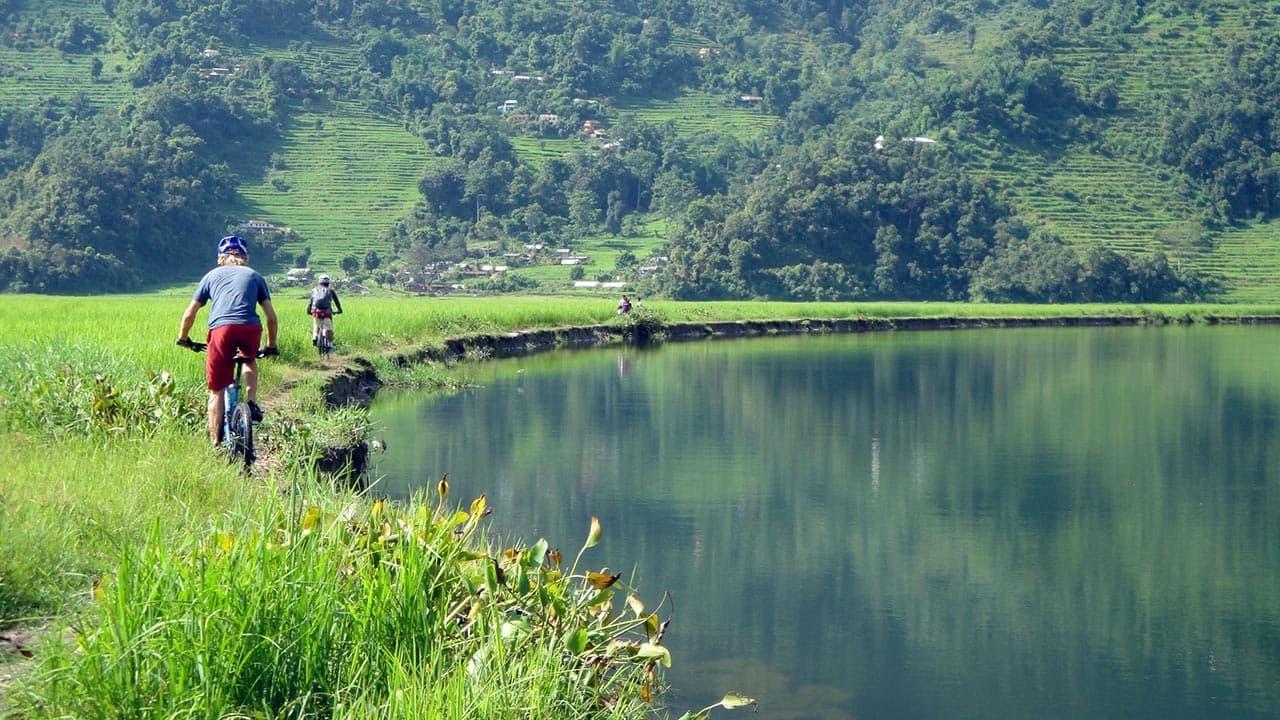
  • It is a rural day that ends at the landmarks. Between Methlang and Pame, you ride through working countryside, terraced fields and farm homes. 

How Hard Is It, and Is This Ride for You?

The number that decides it is 950 m of climbing. Not the 36 km, and not the technical grade. Thirty-six kilometres is short by road standards, but you gain and lose almost a kilometre of height inside it, and there is no shuttle to do any of it for you.

The climbing comes in two blocks, not spread evenly.

Climb

Where

Length

Gain

What it feels like

Climb 1

Lakeside up to the Methlang ridge

About 11 km

+520 m

Starts gently on quiet roads, then bites. The concrete switchbacks are far steeper than the stage average suggests.

Climb 2

Pame basin up to Anadu Hill

About 8 km

+430 m

Shorter, but it arrives with 25 km already in your legs, in the heat of the day. This is the one riders remember.

There is no altitude problem. Everything here sits well under 1,500 m, so no thin air and no acclimatisation. If Mustang or the Annapurna Circuit is later in your trip, this is a good hard day to have early.

A quick self-test

You are ready for this ride if you can honestly say yes to most of these:

  • You ride off-road regularly, not once or twice a season.

  • You have done 800 m to 1,000 m of climbing in a single ride before, and finished it in reasonable shape.

  • You are comfortable staying on the bike for four to five hours.

  • You have descended loose, rooty, and rocky trail without walking most of it.

  • You control your speed on steep ground with progressive braking, not by grabbing the rear brake.

Said no to the climbing question but yes to the rest? You are probably still fine. Ask about the e-MTB option, which takes the sting out of the two climbs without taking away the descents.

Who should book something else?

  • First-time mountain bikers, and road cyclists new to off-road.

  • Anyone wanting a mostly flat, paved or casual sightseeing ride.

  • Anyone not comfortable with sustained climbing or technical descending.

  • Families or groups with a wide spread of ability.

Pokhara has better days for you, and you will enjoy them more than you would enjoy this one. Start with the easy Pame Valley ride or the Around Fewa Lake tour.

Terrain & Riding Conditions

Section

Main surfaces

Rider focus

Lakeside–Methlang–Gyarjati

Quiet roads, steep concrete switchbacks and gravel jeep track

High physical demand; maintain traction and a sustainable climbing pace.

Gyarjati–Pame Basin

Forest singletrack, loose shale, roots, drainage features and jeep track

Technical descending; line choice, progressive braking and awareness of shared trails matter.

Pame–Anadu–Peace Pagoda

Paved transition, dirt singletrack and uneven stone/cobblestone ramps

Second sustained climb; expect changing traction and uneven surfaces.

Peace Pagoda–Chhorepatan–Lakeside

Rocky/uneven descent followed by urban asphalt

Technical descending gives way to a paved return; traffic awareness is important.

Bringing your own bike

You are welcome to. It needs to be in good mechanical condition and genuinely suited to steep climbing and rough descending, and your guide will check it before departure. If you are choosing what to bring, this route wants:

Component

What the route asks for

Frame and travel

120 to 146 mm trail full-suspension, or a capable aggressive hardtail with an air fork

Drivetrain

1×11 or 1×12, with gearing low enough for sustained steep pitches. Under-geared is the single most common mistake here.

Brakes

Hydraulic disc, rotors sized for the bike, your weight and the terrain

Tires

Around 2.35 to 2.4 inch trail tires, tubeless where available

Tire pressure

Set to your weight, casing, rim width and the day's conditions. There is no one correct pressure.

Dropper post

Strongly recommended. The descents are long enough that saddle height matters.

Protection

Helmet and full-finger gloves (both provided). Knee pads strongly recommended.

What we carry for you

  • A professional local MTB guide with mechanical and first-aid support.

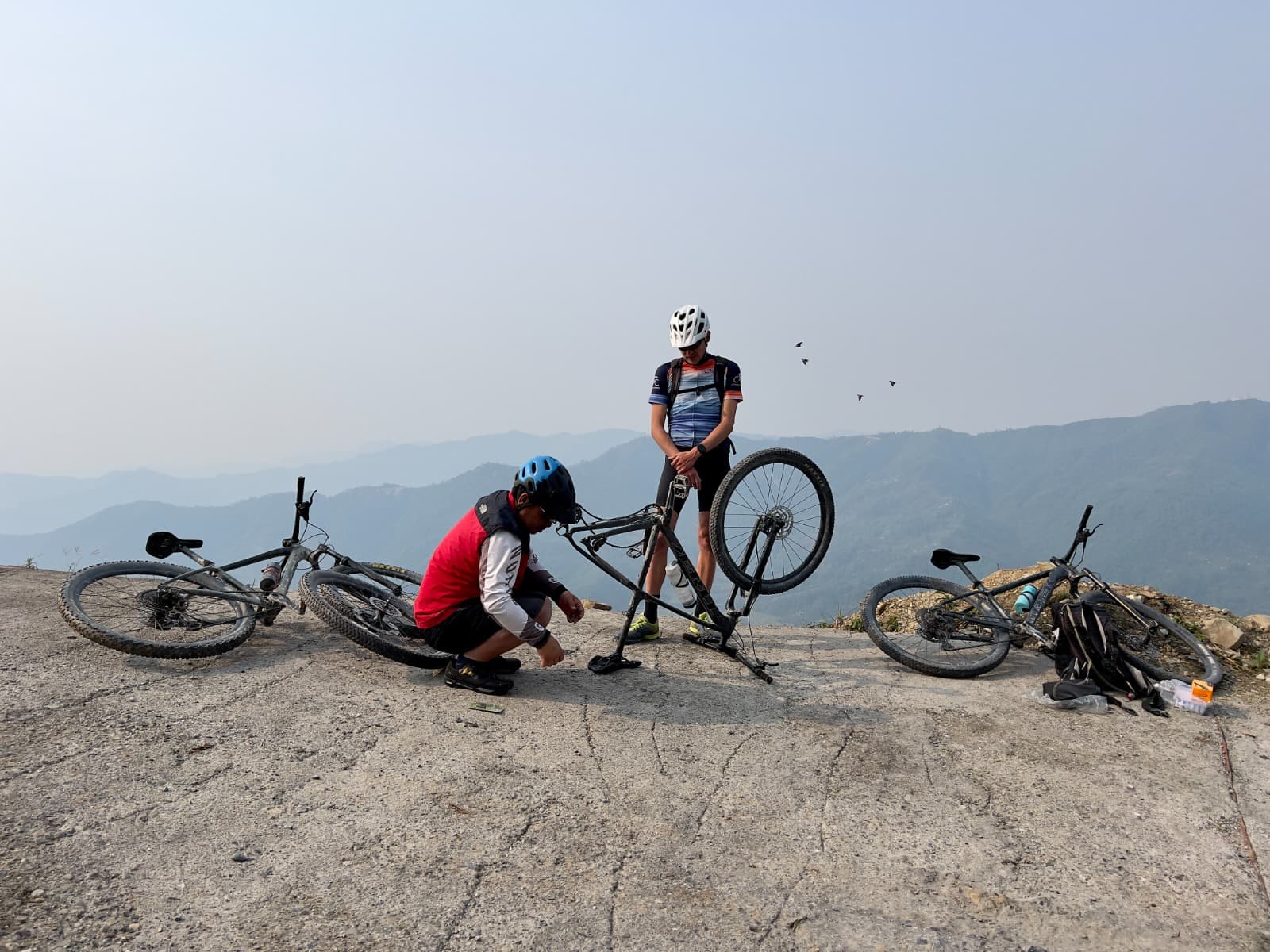
  • Tubes, pump, chain links and selected spare parts, so a puncture or a broken chain is a ten-minute stop, not the end of your day.

  • Hydration refills, energy snacks and seasonal fruit.

  • A pre-ride safety briefing, plus a basic suspension and tire pressure check before departure.

Your guide may change the trail line, the stage order, or the route itself when weather, trail maintenance, access, or safety call for it. A plan that ignores conditions is not a safety plan.

Best Time to Ride & Seasonality

Season

Typical riding considerations

March–May

Generally favorable riding conditions, with warmer weather and often drier trails. Mountain visibility can vary with haze.

June–September

Monsoon conditions can make roots, rocks, concrete and loose surfaces much more slippery. The guide may modify or shorten the route.

October–November

Often among the more favorable periods for drier trails and clearer mountain views.

December–February

Cooler mornings and evenings; clear days can still provide good riding conditions.

Trail difficulty is condition-dependent. A section that is manageable when dry can become considerably more technical after rain. The guide assesses current conditions and may adjust the route for safety.

Trail difficulty is condition-dependent, and your guide checks current conditions before departure. For the wider picture across the country, see the best time to mountain bike in Nepal.

How the Day Works

Daily departures run from Lakeside, Pokhara, subject to booking and suitable weather, trail, and access conditions.

Time

What happens

From about 8:15 AM

Hotel pickup within the Lakeside area, then bike fitting, setup, and safety briefing

About 8:30 to 9:30 AM

Departure from Lakeside 

Mid-morning

Methlang climb and viewpoint

Late morning

Gyarjati coffee stop, then the singletrack descent to Pame

Early afternoon

Anadu climb and the World Peace Pagoda

Mid-afternoon

Descent to Chhorepatan, Davis Fall and Gupteshwor Cave

Late afternoon

Return to Lakeside

How we ride here

These are not purpose-built bike trails. They are working rural paths, and Methlang and the Peace Pagoda are both popular walking routes. How you ride decides whether bikes stay welcome on them.

  • Yield to pedestrians, hikers, and livestock. Always, and without being asked.

  • Ride slowly through villages and do not skid. Skidding tears up loose singletrack and is the fastest way to lose trail access.

  • Respect homes, farms, and private land, and follow your guide about where you can and cannot ride.

  • At the World Peace Pagoda, Davis Fall and Gupteshwor Cave, follow the site rules and dismount where required. These are places of worship.

  • Ask before photographing residents, farm workers or children.

  • Carry your waste out with you.

Route Accuracy & Local Conditions

The published route figures and stage descriptions are based on the current Dual Ridge Challenge itinerary. Exact trail lines, access, surface condition, and GPS elevation can change because of weather, erosion, construction, maintenance, and local access. The guide confirms current conditions before departure and may make sensible route changes when required.

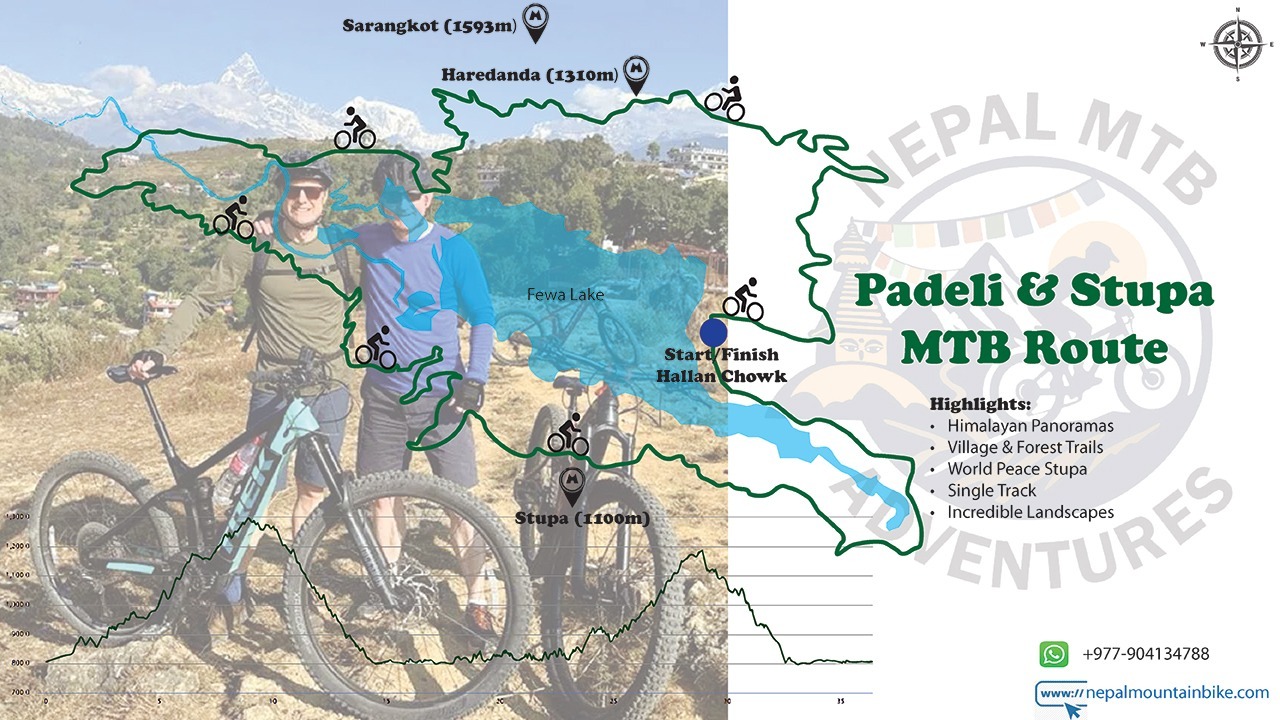
Lakeside → Methlang Ridge → Gyarjati Coffee Farm → Pame Basin → Anadu Hill → World Peace Pagoda → Chhorepatan → Davis Fall → Gupteshwor Cave → Lakeside
Tour Highlights

  • Two ridge climbs in one loop: Methlang in the morning and Anadu Hill in the afternoon
  • 36 km with around 950 m of climbing, all ridden under your own power
  • Phewa Lake and the Annapurna skyline from both sides of the basin
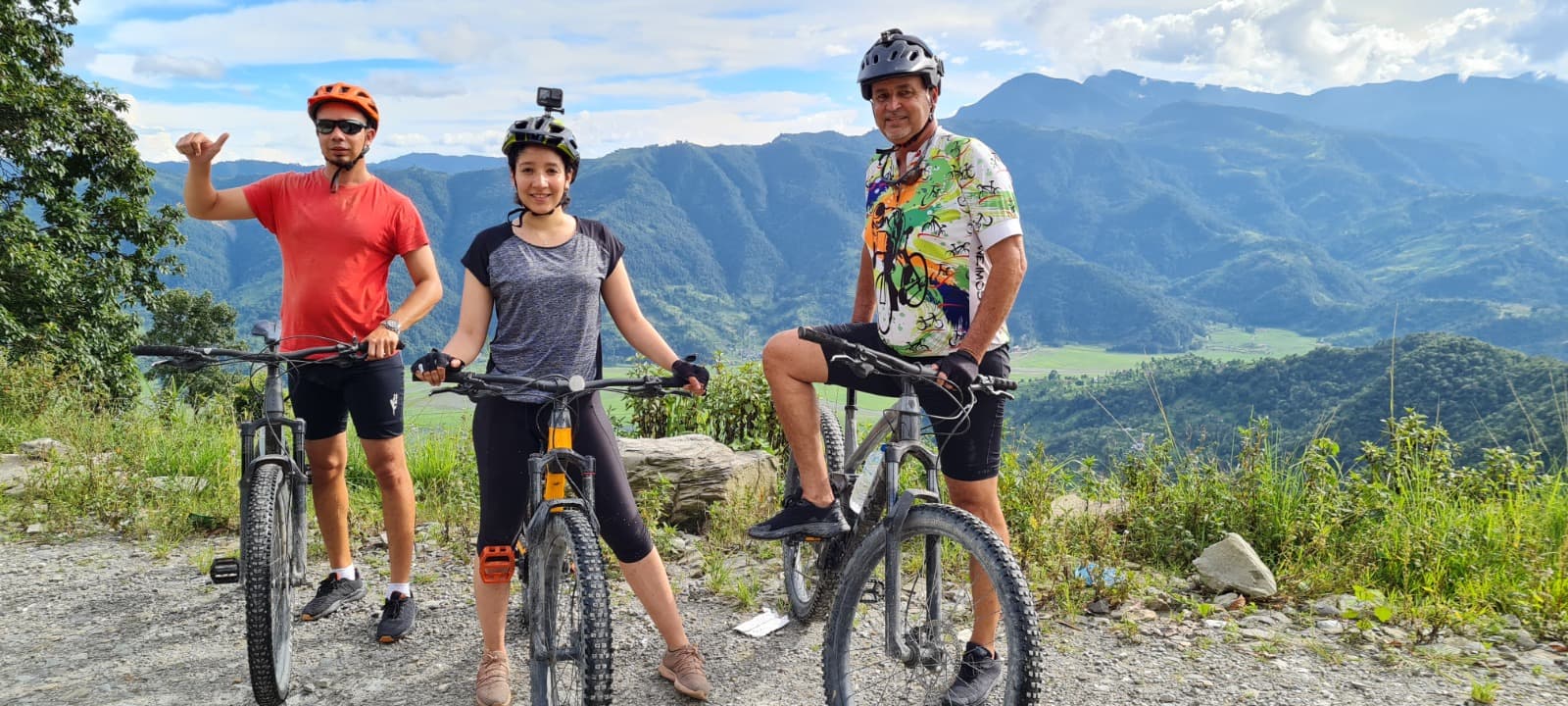
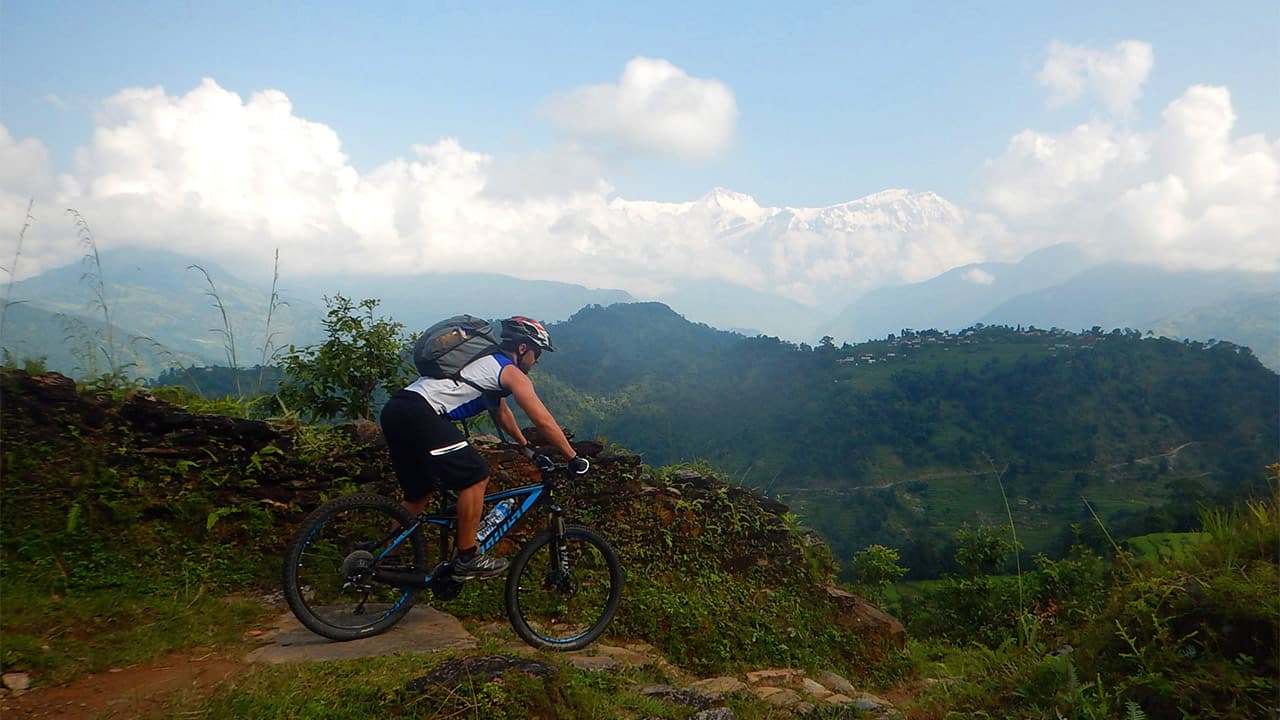
  • Methlang viewpoint with views of Annapurna, Machhapuchhre, Phewa Lake and Pame Valley
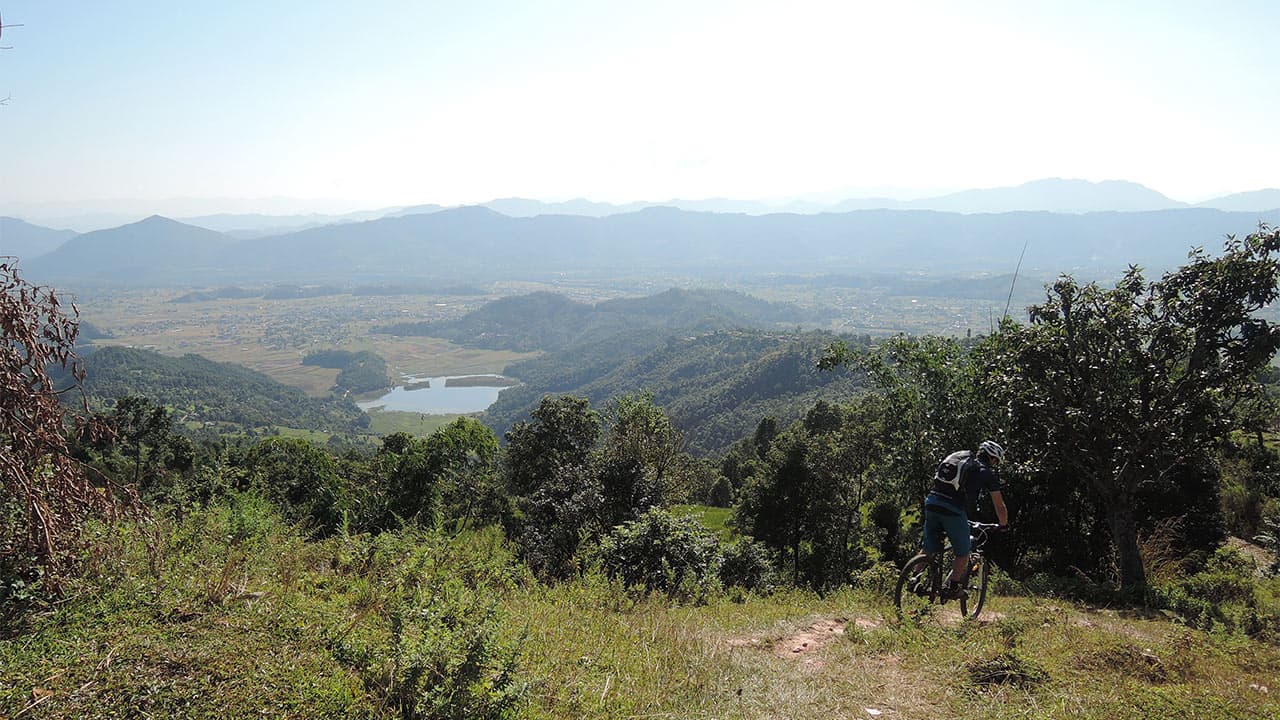
  • Forest singletrack below Gyarjati, with loose shale, roots and technical sections
  • Coffee stop at Gyarjati Coffee Farm between the two major climbs
  • World Peace Pagoda, the white stupa at around 1,100 m on Anadu Hill
  • Cultural finish past Chhorepatan, Davis Fall and Gupteshwor Mahadev Cave
  • Bike, helmet, and full-finger gloves included and fully checked before riding

The Route, Stage by Stage

1

Stage 1:

Lakeside to Methlang Ridge and Gyarjati

You roll out of Lakeside on quiet roads while the legs are still waking up. It does not last. The climb toward Methlang steepens quickly into concrete switchbacks winding up past rural homes, and this is the hardest sustained pitch of the morning.

Distance

Elevation Gain

Terrain / Road

About 11 km

+520 m

Quiet roads, steep concrete switchbacks, gravel jeep track

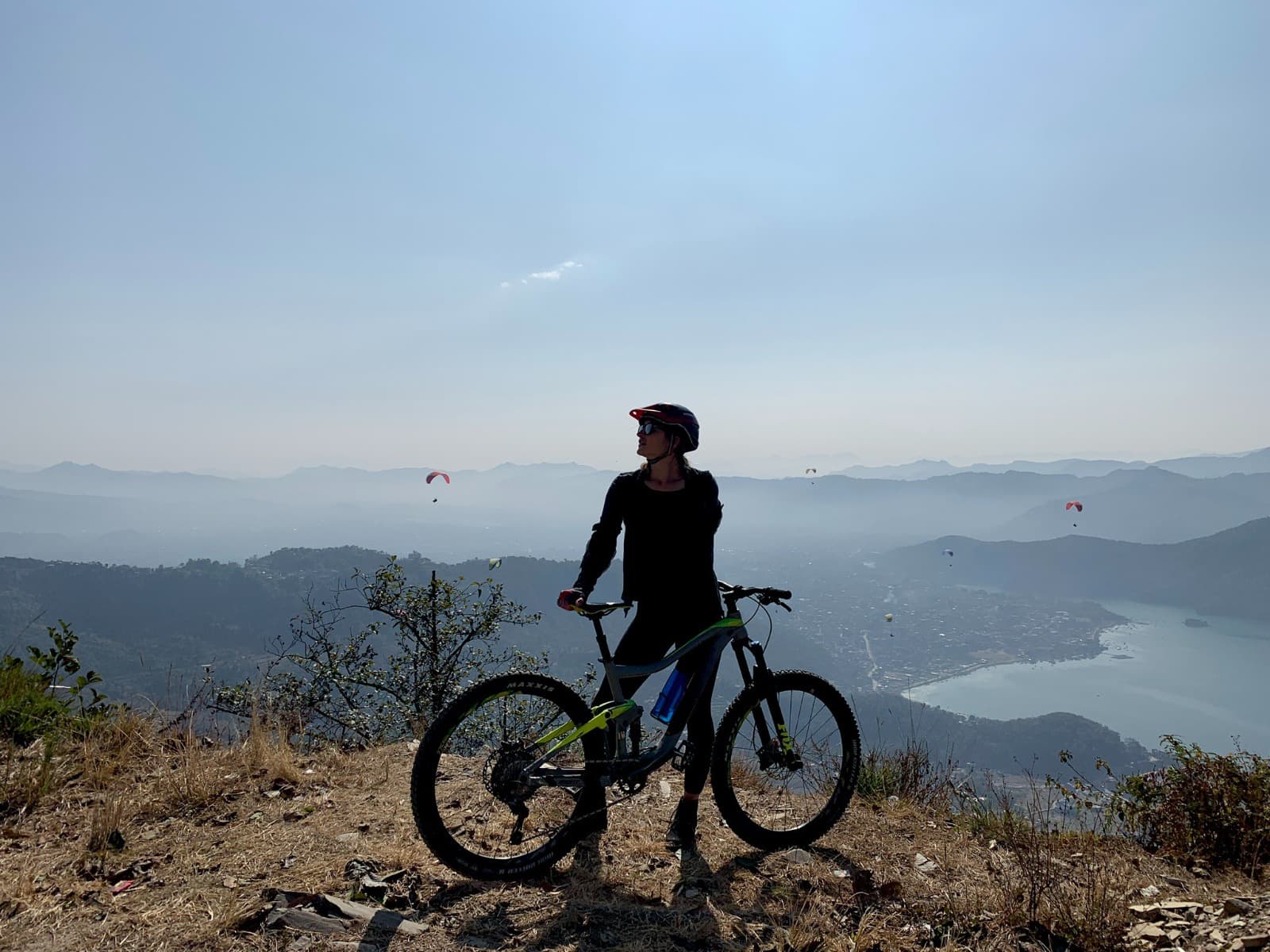
Methlang is a forested hill immediately above Lakeside, close enough that you are climbing within minutes of leaving your hotel, but rural enough at the top that the traffic noise disappears completely. From the viewpoint comes the payoff: the Annapurna range, Machhapuchhre (Fishtail), Phewa Lake laid out below, the Pame valley running west, and the Methlang village ridge.

From there the route contours through terraced countryside, an easier stretch where you can eat, drink and recover, before dropping off-road toward Gyarjati.

Rider tips

  • Shift into your climbing gear before the steep pitches, not during them. Under load on a steep concrete ramp, a shift can drop your chain or stall you.

  • Stay seated when traction is limited. Standing shifts weight forward and the rear tire spins.

  • Pace this deliberately. There is a second 430 m climb later, and riders who race the first one pay for it on the second.

  • Drink on the flatter contouring section, not just at the top.

2

Stage 2

Gyarjati Singletrack Descent to the Pame Basin

The coffee stop comes first. Gyarjati sits between the two big climbs, which makes it the natural break in the day. Coffee is a real crop in the hills around Pokhara, and Nepali arabica grows at exactly this kind of mid-hill elevation, so a coffee here is a local product rather than an import. It is also the last comfortable stop before the technical part of the day, so eat something. (The stop depends on the farm or cafe being open.)

Distance

Elevation Loss

Terrain / Road

About 12 km

-480 m

Forest singletrack, loose shale, exposed roots, drainage features, jeep track

Then you leave on a narrow dirt singletrack through the forest, and this is the most technical riding of the tour. Expect loose shale that moves under the tire, exposed roots that stay slick even when they look dry, and drainage bars cut across the trail. The trail opens into rougher jeep track down toward the Pame valley, then an easy paved section carries you to the foot of Anadu Hill.

Rider tips

  • Look far ahead. On loose shale, decisions made late are decisions made badly.

  • Brake before the corner, not in it, and use both brakes progressively.

  • Drop your saddle or dropper post before the singletrack starts, not halfway down it.

  • Cross roots and drainage bars as square as you can. Hitting them at an angle is how front wheels go sideways.

  • These are shared trails. Expect walkers, farm workers, livestock, and blind corners.

3

Stage 3

Anadu Climb and the Peace Pagoda Ridge

The second climb starts from the valley floor and heads up Anadu Hill through steep dirt, uneven stone and cobblestone ramps, and quiet roads. It is shorter than the morning climb but harder in practice, because you ride it with 25 km behind you and the day at its warmest.

Distance

Elevation

Terrain / Road

About 8 km

+430 m / -250 m

Dirt singletrack, stone and cobblestone ramps, rocky sections

The reward at the top is the World Peace Pagoda, the white stupa standing at around 1,100 m on Anadu Hill above Phewa Lake's southern shore. It was completed in 1996 by Japanese Buddhist monks working with the local community, and it is one of the most recognisable landmarks in Pokhara. From up here, you are looking back across the lake at the Methlang ridge you climbed this morning, with the Annapurna skyline behind it.

Then the route drops toward Chhorepatan on the most technical descent of the second half.

Rider tips

  • Settle into a rhythm early on this climb and hold it. Do not chase anyone.

  • Wet or dusty stone and cobble ramps change grip suddenly. Keep your weight balanced and your speed low.

  • The Peace Pagoda is a place of worship and a busy walking destination. Ride in slowly, dismount where the signs ask, and expect people on the path.

4

Stage 4

The Cultural Valley Finish

You leave the trail system on rocky, uneven ground and drop into Chhorepatan, the neighbourhood on Pokhara's south side that is home to the Tashi Ling Tibetan settlement, established here in the 1960s.

Distance

Elevation Loss

Terrain / Road

About 5 km

-200 m

Rocky, uneven trail, then urban asphalt

A few hundred metres on are Davis Fall, where the Pardi Khola drops into an underground channel, and Gupteshwor Mahadev Cave directly across the road, a limestone cave holding a Shiva shrine, where you can walk down toward the waterfall from underneath. 

After the stops, it is a paved road back to Lakeside.

Rider tips

  • This last section is urban riding with real traffic. Stay tight to the group and stay alert.

  • Both sites are working religious sites. Dress and behave accordingly and follow the on-site rules.

  • Your legs will be done by now. Most crashes on any ride happen in the last hour. Concentrate.

What's Included and Excluded

Included

  • Professional local MTB guide with mechanical and first-aid support
  • Selected standard hardtail mountain bike, 1×12 drivetrain, air fork, hydraulic disc brakes
  • Helmet and full-finger trail gloves
  • Pre-ride bike check, fitting and trailside mechanical support
  • Coffee stop at Gyarjati, subject to the farm or cafe being open
  • Hydration refills, energy snacks and seasonal fruit

Excluded

  • Lunch for Standard Package guests
  • Entrance fees at the cultural sites, paid locally
  • Personal cycling apparel, padded shorts and cycling shoes
  • Travel and adventure-sports insurance covering mountain biking
  • Personal expenses
  • E-MTB add-on (USD 85)
  • Tips. Tipping your guide and support staff is not mandatory. It is customary and appreciated.

Why riders love this

No reviews on this page yet.

Frequently asked questions

Challenging. The difficulty is physical rather than technical: 36 km with around 950 m of climbing in two sustained blocks, at low elevation where the air is warm. The trail surface reads at roughly S1 to S2 in dry conditions, which most regular trail riders handle comfortably. The climbing is what decides whether you enjoy the day.

Subscribe to our newsletter

Get trail updates, riding tips, and exclusive tour offers straight to your inbox