The Tiji Festival E-MTB Expedition is a 16-day, high-altitude e-MTB journey through the walled Kingdom of Lo (Upper Mustang), built around the 2027 Tiji Festival in Lo Manthang, three days of sacred masked dances held June 1–3, timed to the Tibetan lunar calendar and rarely witnessed by outside travelers. You'll be inside the walled city for all three days: the opening Tsa Chham dance, the dramatic Nga Chham battle between the deity Dorje Jono and the demon Man Tam Ru, and the closing procession that marks the demon's banishment.
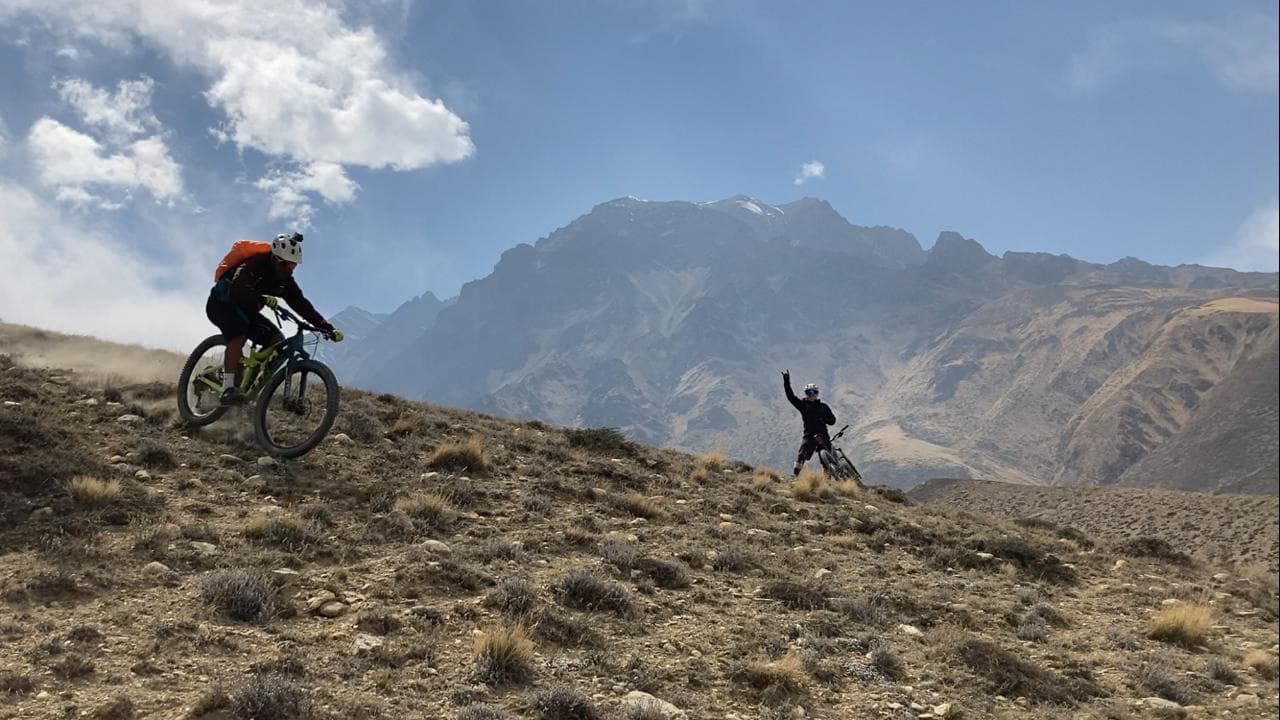
This is where the e-MTB makes the difference. On a standard mountain bike, the climbs to Nyi La (4,010m) and Mui La (4,170m) mean long stretches of hike-a-bike; on an e-MTB, that same ground is rideable, so you arrive in Lo Manthang with legs to spare for the festival rather than needing to recover from the approach.
Beyond the festival days, the route threads ancient salt-trading routes, medieval cave monasteries, and the blood-red cliffs of Dhakmar, a full Upper Mustang crossing built around the one event that defines this region's cultural calendar.
Quick Facts
Why Ride Upper Mustang on an E-MTB
Upper Mustang is one of the most challenging mountain biking destinations in the Himalayas; that's exactly why we built this e-MTB package: to make the route and the Tiji Festival accessible to riders of all fitness levels and age groups.
The motor takes on the hardest climbs, so passes like Nyi La (4,010m) and Mui La (4,170m) stay within reach even if you're not an elite-level rider.
Older riders and those with moderate fitness can complete the same route as strong riders, at a pace that still feels comfortable.
You spend less energy fighting the climbs and more energy enjoying the descents, the landscape, and the festival itself.
Our guides adjust the day's pace and motor settings to match your group's fitness, so nobody is pushed beyond what's safe.
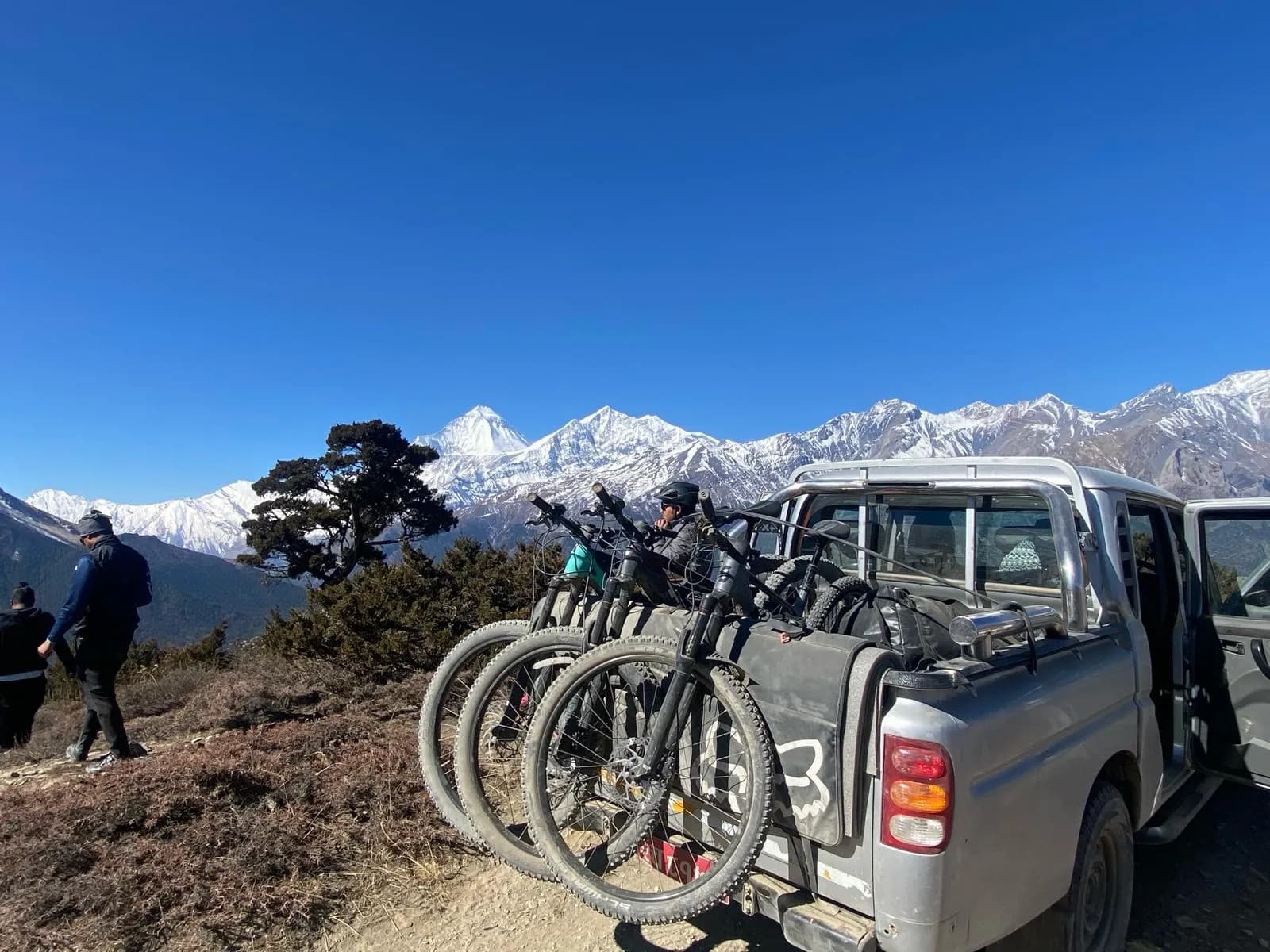
A 4WD sweep vehicle is always nearby, so if altitude or fatigue catches up with anyone, there's a safe way to skip a tough stretch without ending the trip.
The result is a genuinely challenging Himalayan region made reachable, without needing to be a hardcore mountain biker to get there.
The Landscape, Culture and Wildlife
The Landscape
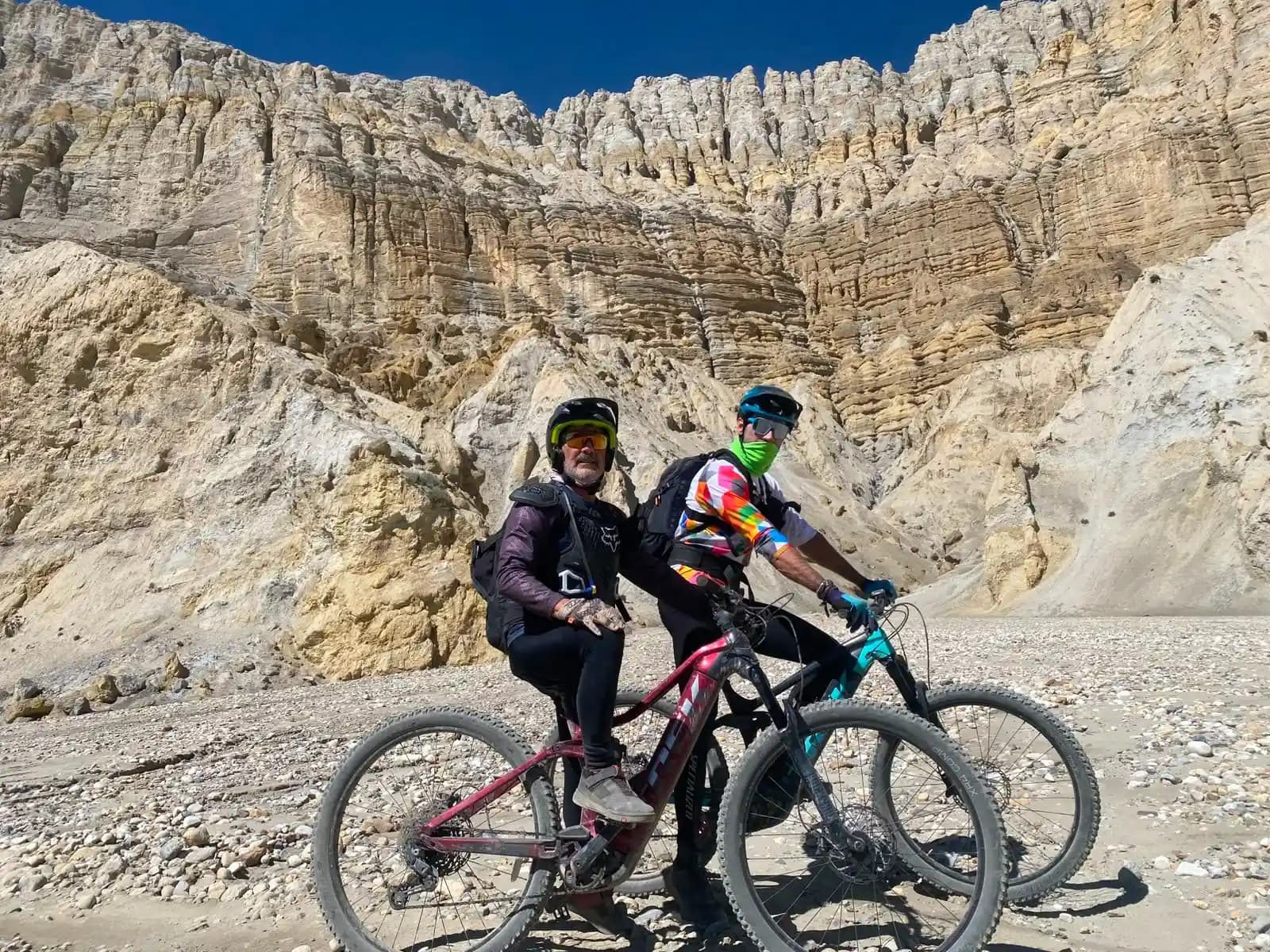
A high-altitude desert sitting in the rain shadow of the Annapurna and Dhaulagiri massifs. The terrain is a dramatic sweep of wind-sculpted ochre and red clay cliffs, deep river gorges, and broad rolling plateaus framed by snow-capped peaks. In early June, the valley floors transform into vibrant oasis-like patches of green barley and buckwheat fields.
The Culture
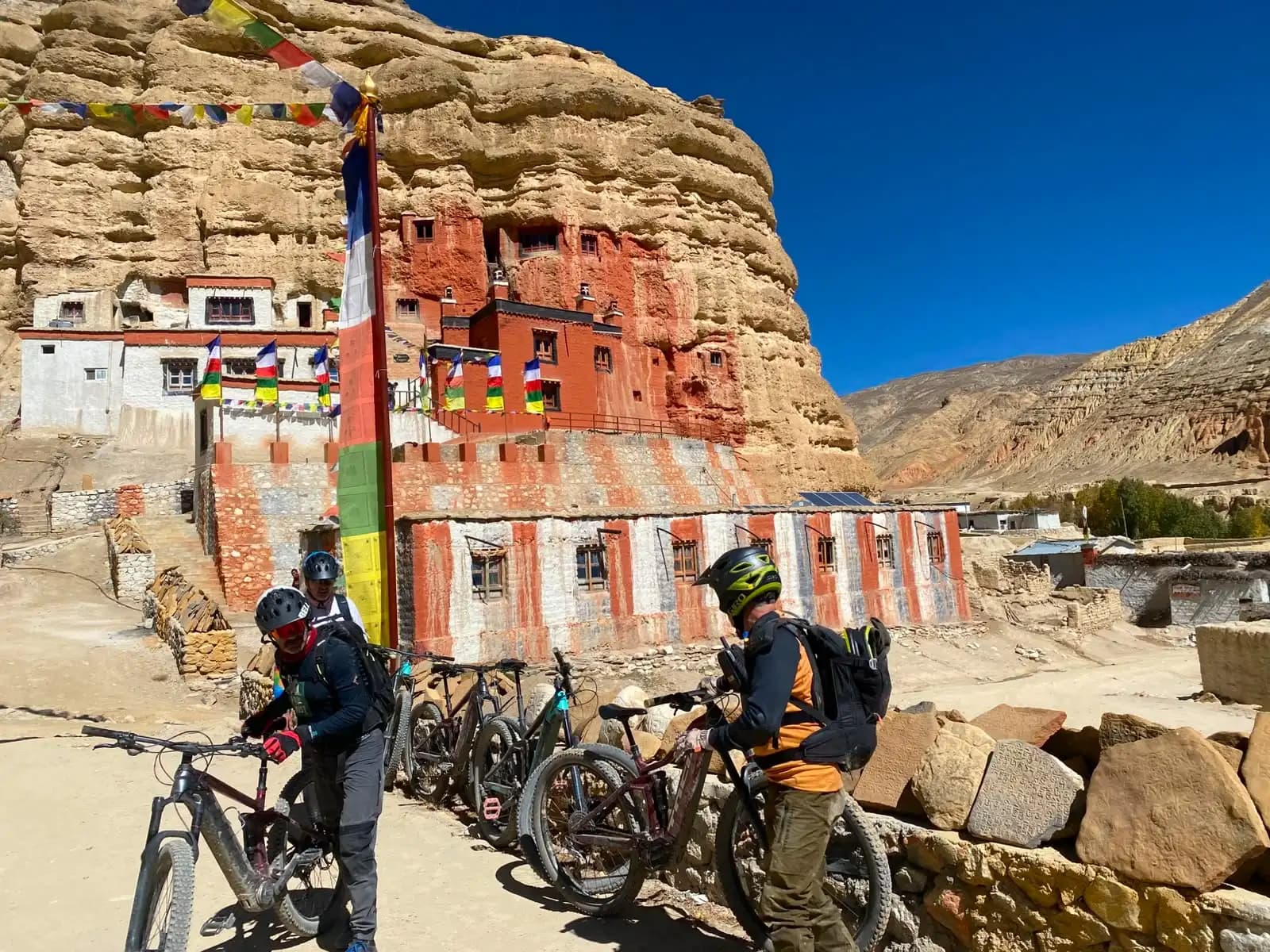
Heavily influenced by Tibetan Buddhism and ancient Bon traditions. You ride past centuries-old Mani walls, chortens, and ancient monasteries (gompas) unchanged for half a millennium. Lo Manthang was founded in 1380, and its wall, palace, and three main monasteries are all still standing. The communities along the route are Lhopa people, and their daily life, language and faith are closer to Tibet than to lowland Nepal.
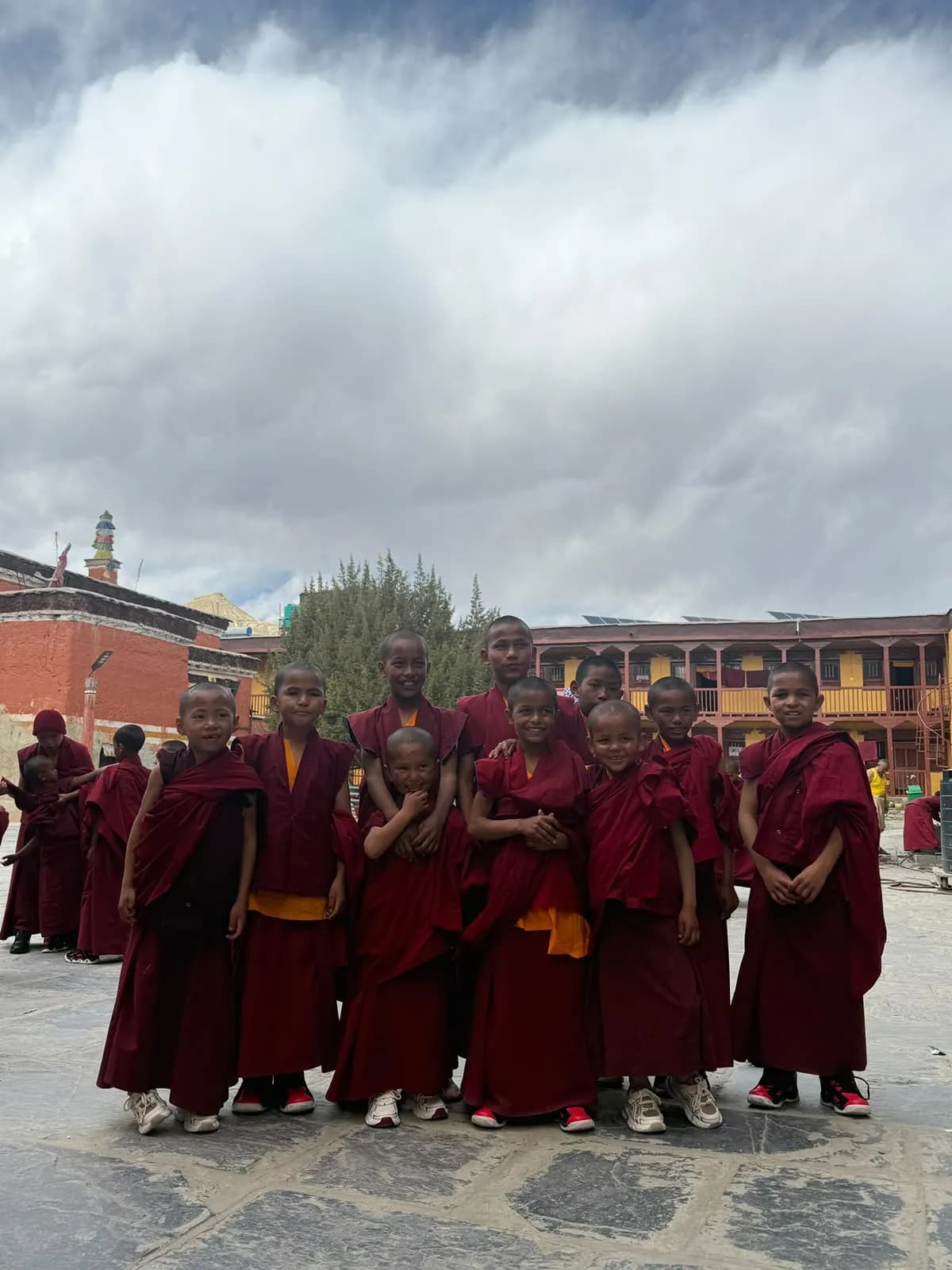
The Tiji Festival is the cultural centrepiece of the trip. It is a three-day monastic festival held annually in the courtyard of the royal palace in Lo Manthang, celebrating the victory of the deity Dorje Jono over a demon that threatened the kingdom with drought and ruin. Each day has its own character:
Day 1 (Tsa Chham): The opening ceremonies, the unfurling of the giant three-storey Thangka and the initial masked monastic dances depicting the awakening of ancient deities.
Day 2 (Nga Chham): The dramatic climax, with furious rhythmic dances depicting the struggle between Dorje Jono and the demon.
Day 3 (Rha Chham): A grand procession outside the city walls, the ceremonial destruction of the demon's effigy amidst traditional matchlock gunfire and tsampa offerings.
The Wildlife: Keep an eye on the cliffs and skies. The region is home to rare Himalayan wildlife, including the elusive snow leopard, blue sheep (Bharal), Tibetan wolves, and Himalayan marmots. Massive Himalayan Griffons and Golden Eagles ride the thermal winds above the dry canyons.
Want the full story behind the festival, its rituals, and how to plan around it? Read our complete Tiji Festival mountain biking guide.
Why Ride Upper Mustang With Nepal MTB Adventures
E-MTB logistics that actually work at altitude
This itinerary runs on a 1:4 guide-to-rider ratio, a dedicated mechanic on every departure, and a 4WD sweep vehicle carrying spare batteries, tools, and a medical kit, every riding day, not just the hard ones.
Permits handled before you arrive
Restricted-area permits, ACAP permits, and TIMS cards are processed before you arrive. The restricted-area permit alone requires a registered local operator, a minimum group size, and advance, we handle all of it.
Charging infrastructure confirmed in advance
Every teahouse on this route has been checked for reliable overnight charging, the single biggest logistics detail on an e-MTB expedition. Our Premium package adds priority access to teahouse power with heavy-duty power strips, guaranteeing a full charge for every bike.
Local guides who know this route
Our guides are 1st-batch Nepal Government-certified, IMBA and WFR-trained, with multiple past Tiji Festival departures on this exact route. A dedicated e-MTB mechanic and experienced drivers travel with every group. Looking for a shorter or non-festival trip? See our standard Upper Mustang E-MTB tour.
Altitude, Safety and Acclimatization
The itinerary moves progressively from the lower Kali Gandaki valley into Upper Mustang and includes several nights above 3,500 m. The highest scheduled riding point is 4,170 m at Mui La Pass. The highest place you sleep is Lo Manthang at 3,840 m.
The profile is built to give your body time. You spend the first two days below 2,800 m, then gain height through Kagbeni, Samar, and Ghami before arriving at Lo Manthang with three rest-and-ride days for the festival. That festival pause does real acclimatization work before the return leg.
What riders should do:
Hold a conservative pace, especially on the first two days above 3,500 m. Riding at your normal home effort at altitude is the fastest way to get into trouble.
Eat and drink regularly. The air is dry, the wind is constant, and you dehydrate without noticing.
Protect yourself from sun and wind. UV at 4,000 m is intense and the wind strips heat fast.
Report symptoms to the guide early. Unusual headache, dizziness, nausea, marked fatigue, shortness of breath at rest, or loss of coordination all need to be said out loud, not pushed through.
No rider should be expected to keep climbing once significant altitude symptoms appear. The guide team may shorten, modify, reverse, or abandon a planned stage and arrange descent or other support. The group carries a medical kit and an emergency oxygen cylinder.
E-MTB Battery Management at Altitude
Battery management on a multi-day E-MTB expedition at altitude is a real planning concern, and it is one of the main reasons a specialist operator matters here.
Cold-weather performance: Lithium-ion batteries lose capacity in cold conditions. At altitude, overnight temperatures can drop below freezing. Store your battery inside your room at night, not on the bike.
Charging: The support vehicle carries spare batteries. Every overnight stop has been confirmed for charging access. The Premium package adds heavy-duty power strips and priority access at every teahouse.
Riding modes: Our guides brief every rider on motor modes and battery strategy before the first climb. The general rule is to use Eco and Tour modes on the long approach climbs and save Turbo for the steep technical sections above 3,800 m where you need it most.
Range: With a 625 to 750 Wh battery and smart mode management, riders can expect 40 to 70 km per day with 800 to 1,200 m of climbing. Every stage on this itinerary is within a comfortable range.
Flight and Weather Contingency
Nepal's mountain flights, and the Pokhara to Jomsom leg in particular, operate in a mountain environment and are affected by wind and visibility. Jomsom flights usually go early in the morning, before the valley wind builds, and cancellations do happen.
If the scheduled Jomsom flight is cancelled, we activate the agreed ground-support contingency using private vehicles and available road options, subject to weather and road conditions. The road to Jomsom exists and is driveable in normal conditions, so a cancelled flight usually costs time rather than the trip.
Any additional hotel nights or transport that fall outside the booked package, and that are caused by circumstances outside our control, are payable by the traveller unless agreed otherwise in writing. This is standard across Himalayan operators, and it is worth having travel insurance that covers trip delay.
Meet Your Guides
Every departure is led by a licensed local E-MTB guide at a 1:4 guide-to-rider ratio, supported by a dedicated mountain bike mechanic and our 4WD logistics crew.
Senior guide team: Mr. Laxan Sunar, Suman BK, Anil BK, and Mr. Santaram (mechanic and guide). Our senior guides are Nepal Government-registered certified mountain bike guides with WFR (Wilderness First Responder), MBC-UK, IMBA and local certifications, with years of first-hand experience on the Upper Mustang route specifically, including multiple past Tiji Festival departures.
Please note: This itinerary is an outline of the planned expedition. It can be fully customised to suit the specific fitness levels, technical skills, or preferences of a private group. Additionally, factors such as mountain weather conditions, trail blockages, high-altitude safety requirements, or flight schedule changes may necessitate modifications to the route during the trip to ensure the safety and enjoyment of all riders.
Our Packages:
Standard Package:
From USD 4,650 per person for groups of 7–8+ riders.
Standard package prices are per person and are based on the stated group size. Contact us for larger groups or private departures.
The Standard Package is designed for riders who want a fully supported expedition, having in the City premium boutique hotels with selected mountain-lodge accommodation, an included Electric mountain bike, and professional mechanical support.
Premium Package:
From USD 5300 per person for groups of 5–6 riders.
This premium package price is per person and is based on the stated group size. Contact us for larger groups or private departures.
The Premium Package is intended for private groups seeking upgraded 5-star luxury city hotels, premium Himalayan lodge accommodation, a premium full-suspension E-MTB, enhanced support, and baggage-portage arrangements on sections inaccessible to vehicles.
Note:
Bike options: If you like to bring your own bike, you will get a USD 300 reduction.
Flying with an Electric Mountain Bike (E-MTB) is heavily restricted and usually prohibited, primarily due to international aviation safety regulations regarding large high-capacity lithium-ion batteries.
We highly recommend using the bikes from our rental fleet here in Nepal.