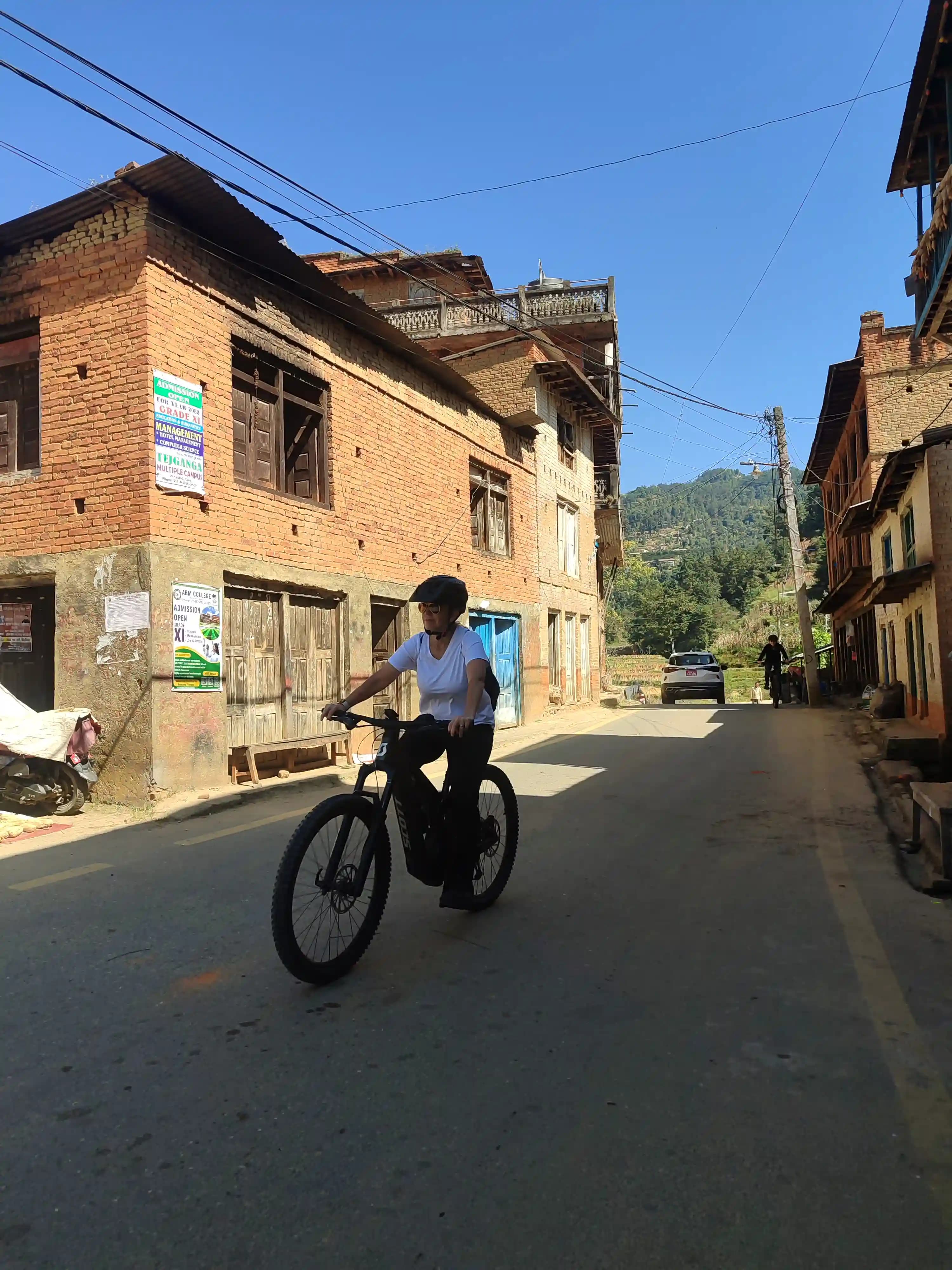
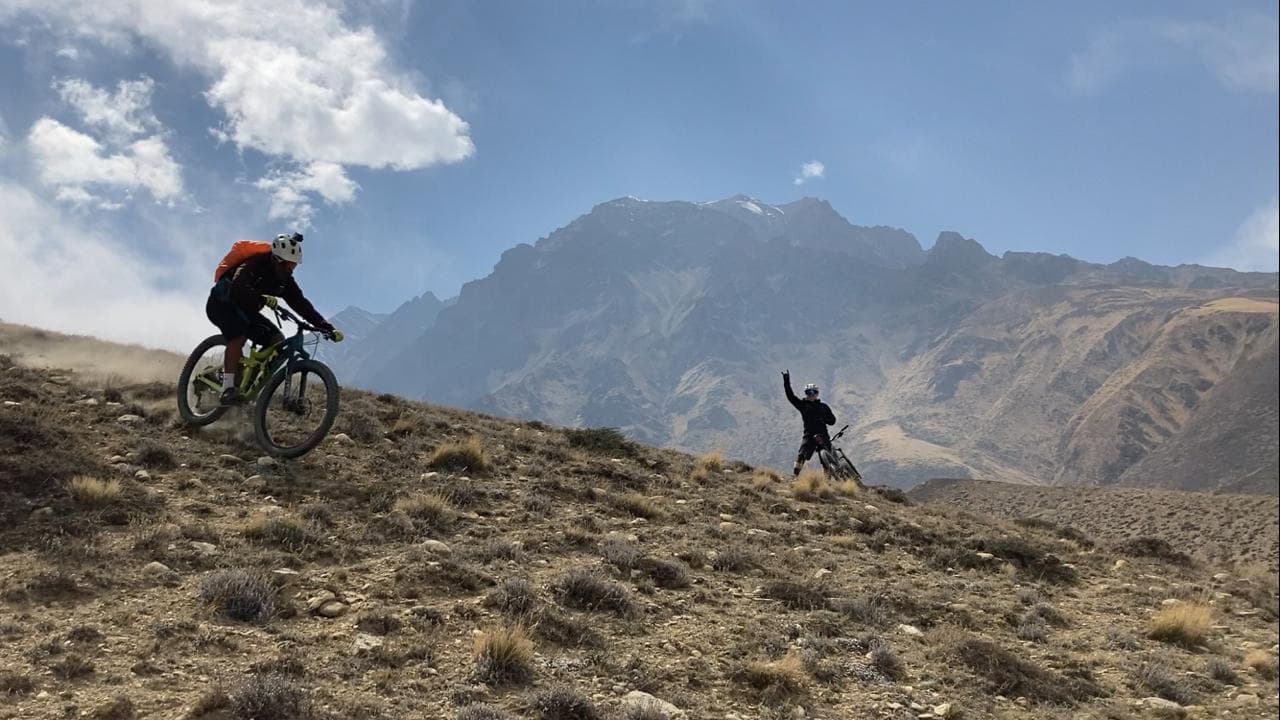
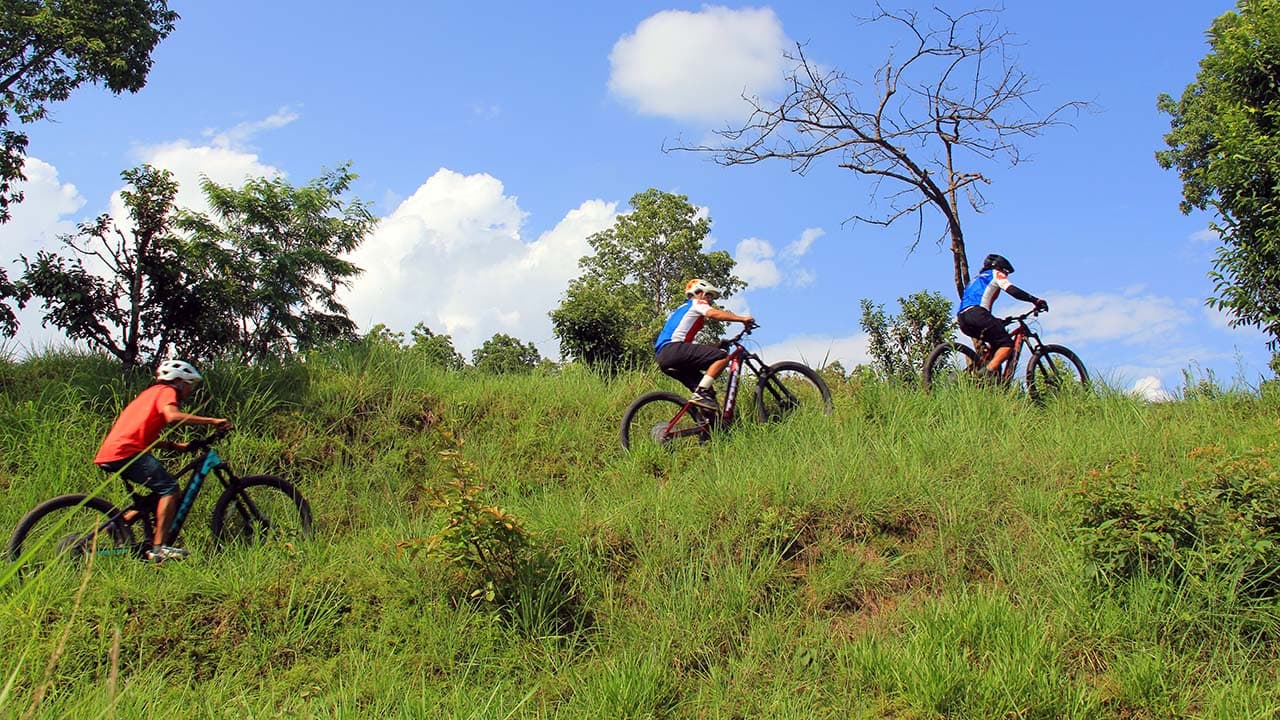
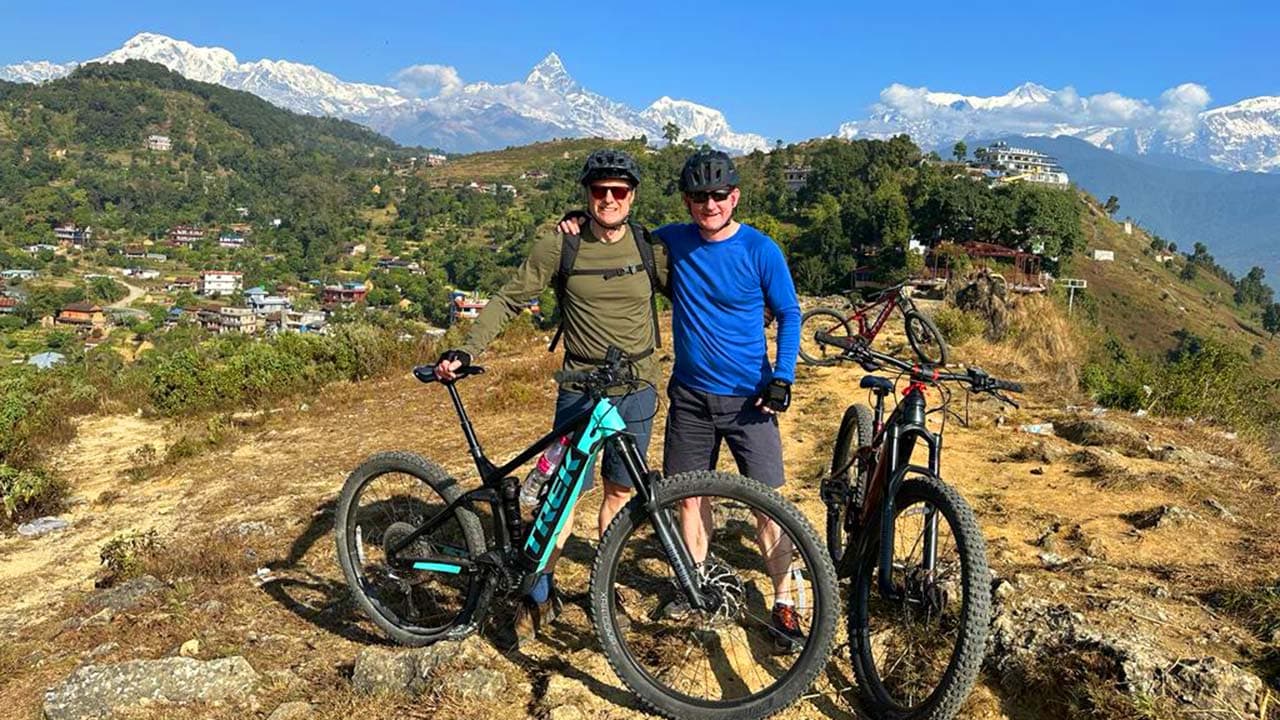
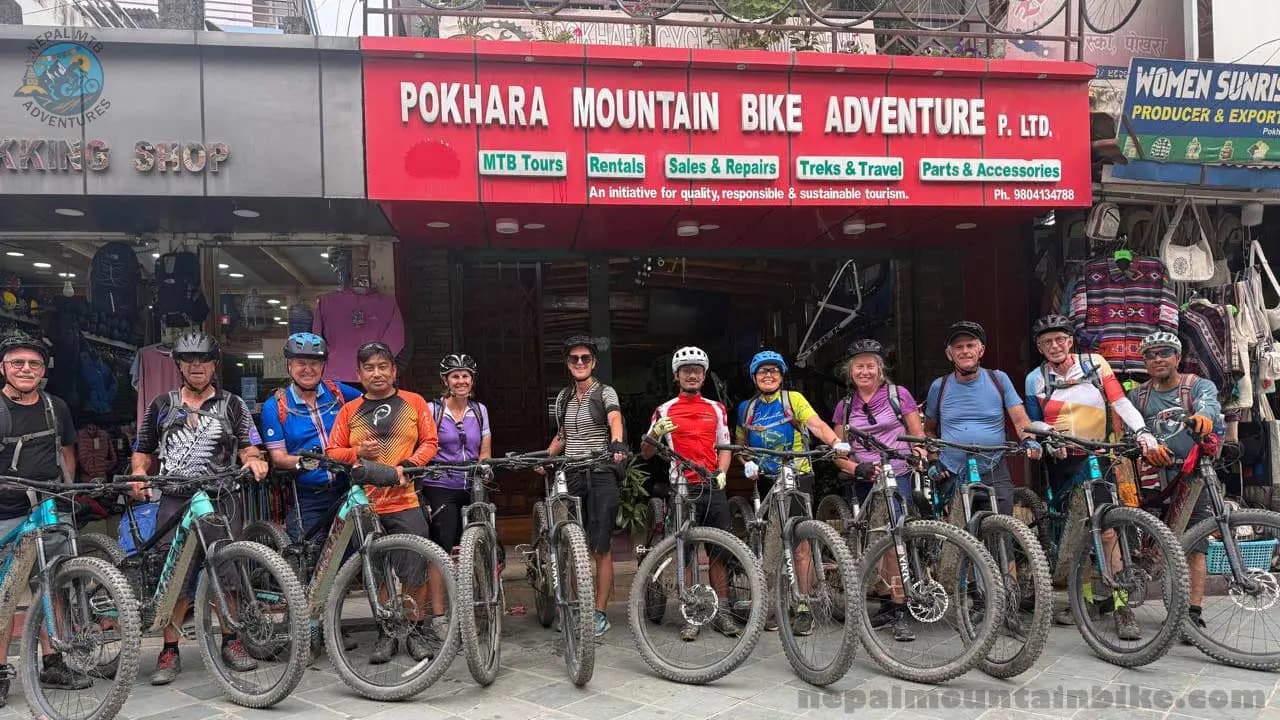
The Kathmandu Valley is ringed by forest tracks, natural singletrack, ridge trails, terraced farmland, village paths and rocky jeep roads. For a mountain biker that is an unusually varied riding environment sitting within easy reach of the capital, and most visitors never see it.
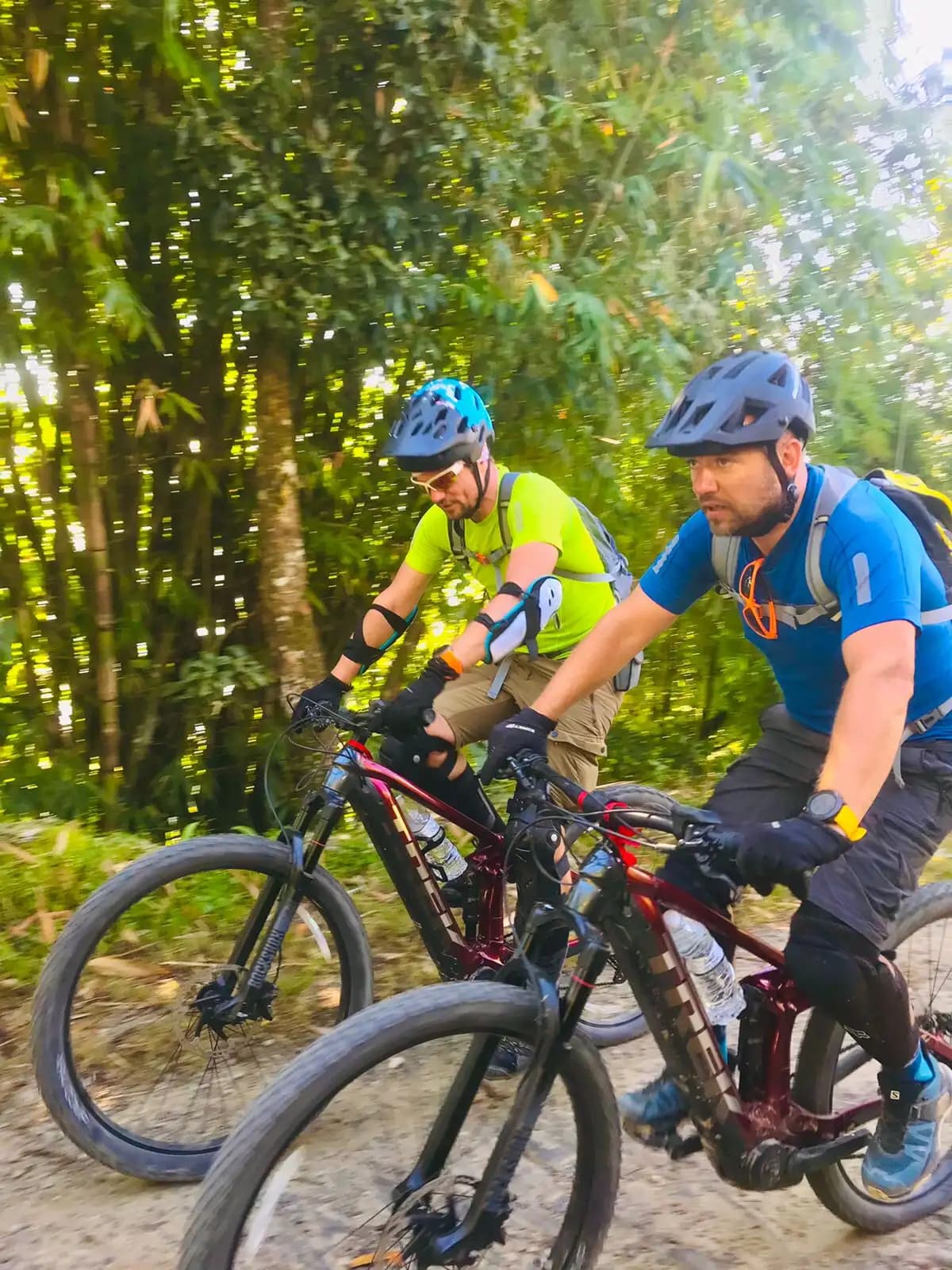
Nepal MTB Adventures built this seven-day Kathmandu Valley Rim E-MTB Tour around that variety. Six riding days, approximately 211 km and approximately 4,750 m of climbing, running from Kakani on the northern rim across to Nagarkot and Dhulikhel in the east, then down to Lakuri Bhanjyang and Godavari in the south. You ride full-suspension electric mountain bikes, with a 4x4 support vehicle and mechanical support alongside you every riding day.
Nepal Tourism Board identifies the Kathmandu Valley rim, including Kakani, Shivapuri, Nagarkot, Dhulikhel, Lakuri Bhanjyang and Godavari, as important mountain-biking areas. This expedition uses those established riding areas as its foundation.
Kathmandu Valley Rim E-MTB Tour at a Glance
Who We Built This Package For
If you are in Kathmandu and you want a real adventure activity rather than another day of temples, squares, and traffic, this trip was built for you. Most visitors only see the valley floor. You spend six days on the ridges, forests, and villages that surround the city.
You do not need to be a fit rider. Climbing is what normally shuts visitors out of the valley rim, and the motor removes that barrier. You still steer, brake, corner, and descend under your own control; you just are not grinding up every hill with nothing left for the good part.
This package is for you if
You are visiting Kathmandu and want a real adventure activity instead of a standard sightseeing itinerary
You want to see the valley from its hills, forests and villages rather than from the ring road
You ride a bike, but you are not a fit climber, and you want the motor to handle the ascents
You are an experienced technical rider who wants raw natural singletrack and long descents
You are travelling as a couple, a family or a group of friends with different fitness and skill levels
You want a private trip where the route is decided around you rather than around a fixed departure
You want a support vehicle, a mechanic, and a guide with you every riding day
You have about a week in Nepal and do not have time for a longer
Kathmandu to Pokhara e-MTB journey or a high-altitude Himalayan expedition
This package is probably not for you if
You have never ridden a bike off a paved road, in which case talk to us first about an easier version
You want lift-access downhill or a bike park, because every descent here is earned
You are looking for a one-day activity, in which case our
Kathmandu mountain bike day tour is the better fit
Choose Your Riding Style: Technical, Intermediate, or Recreational
Not every rider comes to Kathmandu looking for the same trail. Some riders want to push their bike-handling skills, find natural technical sections, and spend the day descending singletrack. Others want a scenic mountain-bike holiday where the priority is mountain views, forests, villages, terraces, cultural landscapes and enjoyable riding without excessive technical difficulty.
That is why we do not believe every rider should be forced onto exactly the same trail.
If you are a technical rider
Tell us that technical riding is your priority. Where it suits your ability and the trail conditions on the day, your guide can build the ride around:
Natural raw singletrack
Technical forest trails
Rocky descents
Root sections
Rock gardens
Tight switchbacks
Off-camber trail
Steeper climbing
Technical climbing lines
Loose and uneven surfaces
Ridge singletrack
Narrow village trails
Rough jeep tracks
Natural trail features
Longer technical descents
Less-travelled backcountry connections
The Kathmandu Valley has a surprisingly broad range of terrain, from easier dirt roads to technically demanding forest descents. Our role is to identify the trails that best match your skills rather than simply adding kilometres.
If you are an intermediate rider
We can create a balanced day that runs climb, then singletrack, then a technical section, then a scenic ridge, then a village trail, then a descent, then a cultural stop.
You may ride the challenging sections where they suit your ability, while having easier alternatives available when you want them.
If you prefer easy or recreational riding
Tell us that too. We can reduce the technical component and emphasize on:
Your E-MTB holiday should match your skills and fitness, not somebody else's idea of difficulty.
Why This Is Not a Fixed Sightseeing Route
Our Kathmandu riding is not limited to a set loop between monuments.
The valley's mountain-bike network runs across the surrounding hills and connects forest, farmland, villages, ridge lines and remote settlements. Nepal Tourism Board specifically identifies longer valley-rim routes toward Nagarjun, Kakani, Shivapuri, Nagarkot, Dhulikhel, Lakuri Bhanjyang, Phulchowki and other areas. Nepal MTB Adventures uses that existing trail network to address different riding objectives.
For technical riders, we look for terrain that rewards line choice, body position, braking control, traction management and confident bike handling.
For recreational riders, we prioritise scenery, local life, gentle off-road terrain and enjoyable exploration.
For mixed-ability groups, the route can be adjusted so stronger riders receive more technical options while the group still shares the major viewpoints, villages, meals and cultural experiences.
This is one of the practical advantages of booking a private guided MTB or E-MTB experience rather than joining a rigid mass-market cycling itinerary. On a fixed departure, the route is set before anyone knows who is riding it. On this trip, the route is set after we know.
What Kind of Trails Can You Expect?
The Kathmandu Valley is not one type of mountain-bike destination. It is a collection of different riding environments, and the seven-day route moves between them deliberately.
Raw natural singletrack
For experienced riders, natural singletrack is often the most rewarding part of riding Kathmandu.
When we say raw singletrack, we mean natural, minimally developed narrow trail rather than a smooth, machine-built bike-park track. These trails twist through forest, contour hillsides and descend through uneven terrain, and they were built by use rather than by a machine. Expect changing surfaces rather than perfectly groomed bike-park trails. Depending on the route and conditions, you may encounter:
Roots
Rocks
Natural steps
Loose soil
Tight corners
Switchbacks
Off-camber sections
Short steep pitches
Rock gardens
Technical line choices
The challenge here is often not speed. It is finding the right line and maintaining traction and control.
Forest trails
Kakani, Shivapuri, and other northern valley areas provide access to forested mountain terrain.
Shivapuri-Nagarjun National Park occupies a substantial section of the northern Kathmandu Valley rim.
Forest riding on this route ranges from relatively smooth dirt track to narrower, technical singletrack, and the guide chooses between them based on the group.
Village trails
Some of the most memorable riding on this trip happens away from the main roads.
Village trails connect small settlements, farms and ridges, giving riders a closer view of everyday life in the Kathmandu Valley than any vehicle can.
These are not purpose-built mountain-bike trails. Their character comes from their original use as local paths and agricultural connections, which is exactly why they ride the way they do.
Terraced farmland
You ride between terraces, small farms, and rural communities as the landscape changes from forest to cultivated hillsides.
This is one of the biggest differences between Kathmandu Valley mountain biking and a conventional urban
cycling tour. A city tour shows you the valley floor. This route shows you the hillsides that surround it.
Off-road and jeep tracks
Not every part of the expedition is singletrack.
Old jeep roads, dirt roads and rough off-road tracks provide important connections between trail systems, and they can deliver excellent climbs and descents in their own right.
For E-MTB riders, these sections are useful in a specific way. You can climb them efficiently and arrive at the technical riding with energy still in reserve.
Ridge riding
Ridge trails around Nagarkot, Kakani and Lakuri Bhanjyang combine open landscapes with changing views.
When visibility is good, the surrounding Himalayan ranges become part of the riding experience rather than a photo stop at the end of it. Nagarkot itself sits at approximately 2,175 m and is recognised by the Nepal
Tourism Board for its Himalayan panoramas and surrounding rural landscapes.
Technical MTB Language You Will Hear on the Trail
If you are an experienced mountain biker, you will recognise the language we use when discussing trail character. If you are newer to the sport, this is the vocabulary you will hear all week, so it is worth reading before you arrive.
Singletrack
A narrow trail generally ridden by one rider at a time. It may be smooth and flowing or highly technical, depending on the terrain.
Line choice
The line you select through rocks, roots, corners, and obstacles. Good line choice can be more important than simply riding faster.
Rock garden
A section containing multiple rocks that requires careful wheel placement, balance and traction management.
Off-camber
A trail surface that slopes away from the direction of travel, requiring careful body positioning and tyre loading.
Switchback
A tight change of direction used to gain or lose elevation. Steep switchbacks can require advanced cornering and braking technique.
Technical climb
A climb where gradient is only part of the challenge. Roots, rocks, loose surfaces, steps, and traction changes require controlled power and precise line choice.
Technical descent
A descent where rocks, roots, steep sections, tight corners, loose surfaces or other obstacles demand concentration and active bike control.
Flow
A section where the terrain allows the rider to maintain rhythm and momentum through linked corners, rollers and natural trail contours.
A-line and B-line
Where trail options exist, an A-line generally represents the more challenging line while a B-line provides an easier alternative.
Our guides do not expect every rider to take the hardest line. Walking a difficult feature is a legitimate mountain-bike decision, and nobody on this trip will think less of you for making it.
Is the Kathmandu Valley Rim E-MTB Tour Difficult?
The honest answer is that you set the difficulty, within limits. The route framework is fixed. The technical content inside it is not, and it is worth knowing how mountain bike trails are graded in Nepal before you tell us which version of the week you want.
Here is how the three rider profiles map onto this trip.
Beginner mountain bikers
Beginners can ride selected easier sections of the Kathmandu Valley, but this seven-day expedition is not designed as a first-ever cycling experience. Six consecutive riding days averaging around 790 m of climbing a day is a real physical commitment even with motor assistance.
If you are new to mountain biking but reasonably fit, speak to us before booking. We can often modify the itinerary toward easier terrain and shorter technical sections. What we will not do is put a complete beginner onto natural forest singletrack and hope it works out.
Intermediate riders
This is the ideal profile for the standard version of the expedition.
You should be comfortable with:
Several hours of riding
Gravel and dirt roads
Basic singletrack
Moderate climbs
Descents on uneven surfaces
Roots and rocks
Basic braking and cornering
Occasional technical sections
If that list describes you, the standard route will feel rewarding rather than intimidating, and you can step onto harder lines on the days you feel strong.
Advanced and pro riders
Experienced riders can request a more technical interpretation of the route.
Where conditions, access and local trail use allow, the guide can emphasise:
More singletrack
Steeper natural descents
Technical rock sections
Rooty forest terrain
Off-camber trail
Technical climbs
More challenging line choices
Longer descending sections
Less-travelled trail connections
Please tell us your actual riding level, not the level you hope to become during the trip. That allows us to choose trails that are challenging without becoming unnecessarily risky.
What each version of the week actually looks like
If you are travelling to Nepal specifically because you want to ride technical mountain-bike trails, tell us before your trip and we will design the riding around it. Here is the shape each version takes.
The same Kathmandu Valley can provide all three experiences. Our job is to put the right rider on the right trail.
Why an E-MTB Works So Well in the Kathmandu Valley
The Kathmandu Valley is characterised by repeated climbs and descents rather than one continuous mountain pass. Look at the daily profile: roughly 790 m of climbing on an average day, spread across several separate ascents rather than one long one.
That pattern is exactly where pedal assistance earns its place, and it is the same reason e-MTB tours work so well across Nepal.
If you are still weighing a traditional mountain bike against an E-MTB, this route is where the difference shows. On an analogue bike, a valley-rim day means arriving at every technical descent already tired from the climb that preceded it. On an E-MTB you manage the elevation more efficiently and arrive at the descent with something left.
For technical riders, that means more energy for:
Technical climbing
Descending
Line selection
Cornering
Rock gardens
Natural singletrack
For recreational riders, it means you can access more scenic viewpoints and rural trails without turning every climb into a fitness test.
The motor does not replace mountain-bike skills. It changes how you spend your energy.
The E-MTB Fleet and How We Set It Up
The bikes
The itinerary uses full-suspension E-MTBs equipped for demanding trail conditions.
Depending on the bike allocated to you, the fleet includes features such as:
Bosch Performance Line CX drive system
Large-capacity Bosch PowerTube battery
Shimano 1x12 drivetrain
Wide-range climbing cassette
Four-piston hydraulic brakes
Aggressive trail tyres
Full suspension
Remote dropper seatpost
Official Bergamont E-Trailster specifications confirm configurations using Bosch Performance Line CX systems, Shimano 1x12 drivetrains, four-piston hydraulic brakes and aggressive Schwalbe trail tyres, although exact specifications vary by model and model year. We will tell you which bike you are on rather than making a blanket claim about the whole fleet.
Technical bike setup before you ride
Your guide and mechanic set the E-MTB up according to your weight, riding style, and the terrain. This happens on Day 1, before any riding, and it is the single most underrated part of a good week on the bike.
Your expert guide handles the full setup, from frame size, saddle height and suspension sag through to rebound, tyre pressure, brake-lever and handlebar position, dropper-post height, pedals and your motor-assistance settings, so the bike fits you properly before the first climb.
A technical rider tip worth reading twice
For climbing, use an appropriate assistance level and maintain traction rather than simply selecting maximum power. On loose or rooty climbs, full power spins the rear wheel and costs you the climb.
Before a technical descent: drop the saddle, check your brakes, choose your line, and commit only when you are comfortable with the feature.
On technical terrain, control is more important than speed.
7-Day Kathmandu Valley Rim E-MTB Itinerary
The daily distances and elevation figures below are the planned figures for the standard interpretation of the route. If you book the technical version, expect similar distances with a higher proportion of singletrack. If you book the recreational version, expect similar distances on more forgiving surfaces.
Route Flexibility Is the Most Important Part of Your Booking
The itinerary above is a framework. It is not a promise that every rider must ride every technical section, and it is not a guarantee that every metre of trail will be exactly as described on the day you arrive.
Trail conditions change because of:
Your guide may therefore change a trail section when necessary. That is normal, and it is a sign of good guiding rather than a broken promise.
More importantly, your personal riding ability matters.
If you tell us "I want the most technical natural singletrack available," we know what to look for.
If you tell us "I want beautiful scenery and villages, but I do not want difficult technical descents," we can design around that preference.
If your group contains both strong technical riders and recreational riders, tell us before arrival so we can plan the riding appropriately. Mixed-ability groups work well on this trip, but only when we know in advance.
Fitness: An E-MTB Does Not Mean Effort-Free
An E-MTB reduces the physical demand of climbing. It does not eliminate the need for fitness, and riders who arrive expecting a motorised holiday are the ones who struggle.
You still need to:
Technical riding can be physically demanding even when climbing assistance is available. Descending in particular is an active, whole-body effort that no motor touches.
For six riding days, we recommend arriving able to comfortably ride for several consecutive days. That is the honest bar.
Safety on Technical Trails
Our philosophy is simple. Technical does not mean reckless.
A difficult section should be approached according to the rider's ability, the trail condition, and the consequences of a mistake. Those three things, in that order.
Our guides can help riders with:
Line selection
Braking points
Climbing technique
Descending position
Dropper-post use
E-MTB assistance
Rock and root technique
Cornering
Trail etiquette
If a feature does not feel right, walk it. There is no achievement in crashing because you felt pressured to ride something beyond your ability, and there is no bike shop waiting on the far side of a bad decision.
Guiding qualifications differ between the two packages. The Standard package includes a professional mountain-bike guide, with an appropriately first-aid-qualified guide where assigned. The Premium package includes a WFR and E-MTB certified professional mountain-bike guide. Both packages travel with a dedicated 4x4 support vehicle, trail-side tools, common spare parts and mechanical support.
Mountain Views, Villages and the Less-Explored Kathmandu
Technical riding is only one part of the experience.
Between the demanding sections, the route travels through landscapes that most visitors never experience from a vehicle. You ride through:
Nepal Tourism Board describes Kathmandu's mountain-bike trails as routes that reach remote settlements, terraced hillsides, hamlets, riverbanks, temples and other rural environments around the valley.
That is the real attraction of riding here. You are not simply cycling around Kathmandu.
You are riding through the landscape that surrounds Kathmandu.
Best Time to Ride the Kathmandu Valley
The Kathmandu Valley rides all year round. This is not a route with a closed season, which sets it apart from the tighter riding seasons elsewhere in Nepal. The rim sits low enough that nothing here freezes shut in winter and nothing here becomes unreachable in summer, and the support vehicle travels with you in every month of the year.
What changes with the season is not whether you ride. It is what you see, and how the trail feels under the tyres. The same ridge above Nagarkot gives you a spring hillside in April, a green monsoon valley in July, a clear Himalayan skyline in October and a cold bright horizon in January. Riders who come back a second time usually come back in a different season on purpose.
Tell us when you can travel, and we will tell you honestly what that month gives you. There is no month we turn riders away.
Accommodation and Recovery
The expedition combines demanding riding with comfortable accommodation, and the reason is practical rather than luxurious. After several hours of singletrack and climbing, riders need proper recovery before they do it again tomorrow. Six consecutive riding days punish bad sleep.
The package is built around selected premium hotels and hill lodges, subject to availability. On the Standard package, you stay in a premium boutique hotel in Kathmandu with mountain lodge accommodation along the route. On the Premium package, the Kathmandu hotel is a five-star property, with mountain lodge accommodation along the route.
Where a remote trail location does not have genuine luxury accommodation, we prefer to describe the property accurately rather than exaggerate its category. A lodge on a ridge is a lodge on a ridge, and we would rather you know that before you arrive than feel misled when you get there.
Food and Hydration
The tour operates on a full-board basis according to the confirmed package.
Breakfast provides the base for the riding day, and trail lunches keep riders moving. Carry adequate hydration throughout the ride, which for these distances means a 2 to 3 litre capacity.
For technical riders working at higher intensity, consider bringing your preferred:
Local meals are part of the experience, but riders with specific nutritional requirements should tell us before departure so we can plan for them rather than improvise on the trail.
What to Bring for Technical Riding
This is the short version for this route. Our full mountain biking checklist for Nepal covers packing for longer and higher trips.
Essential
Certified MTB helmet, provided by us. We supply a certified helmet in your size as part of both packages, so you do not need to pack one or travel with it. You are welcome to bring your own if you prefer your own fit, and many experienced riders do.
Strongly recommended for technical riders
Bike
Your E-MTB, charger and standard technical support are included according to the confirmed package.
Standard or Premium: What Actually Changes
The route, the distances, the trail choices, and the support vehicle are the same on both packages. Three things change.
If your priority is the riding, the Standard package puts you on the same trails with the same support. If your priority is recovery quality in Kathmandu and the highest guiding certification on the trail, the Premium package is the reason to spend the difference.
Custom Quotes and Private Bookings
This is a private guided expedition, which means the published rates are a starting point rather than a fixed shelf price.
The final price depends on:
Contact Nepal MTB Adventures with your dates, group size, and riding level so we can recommend the most appropriate route.
Your Technical Riding Brief
Before departure, tell us which description best represents you. This single answer shapes your whole week.
"I want technical." Prioritise natural singletrack, challenging descents, rocky and rooty sections, technical climbing and advanced trail riding where appropriate.
"I want a mixture." Combine technical trail with scenic riding, villages, forests and cultural experiences.
"I want scenic and recreational." Reduce difficult technical terrain and emphasise countryside trails, villages, terraces, forests, viewpoints and enjoyable riding.
"Our group has mixed abilities." We can discuss the group's experience and build a route that gives stronger riders appropriate challenges while keeping the overall experience enjoyable for everyone.
Your fitness and technical ability should influence the route. Ours is the only trip on the valley rim where that statement is the actual booking process rather than marketing language.
Why Ride With Nepal MTB Adventures?
We understand the difference between cycling and mountain biking.
Our objective is not simply to put you on an electric bicycle and move you from one hotel to another.
We work with the Kathmandu Valley's established MTB terrain, and we understand that riders arrive with different expectations. A technical rider may want to spend the day searching for the best natural singletrack. A recreational rider may remember the same day because they rode through a farming village with Himalayan peaks appearing above the terraces.
Both experiences are valid. Our role is to connect the right trails with the right rider.
Our strengths
Local trail knowledge. We know the Kathmandu Valley rim as riders, not as a list of viewpoints on a map, and that is what lets us find the trail that suits you on the day.
Routes planned by mountain bikers. Every day of this itinerary was built around riding quality rather than around what is convenient for a vehicle.
Experienced local guides. Your guide rides these trails all year and knows which sections hold up after rain and which do not.
Real E-MTB experience. We run electric mountain bikes as a fleet, so the briefing, the assistance settings, and the battery management are routine for us rather than an experiment.
Proper technical bike setup. Your bike is fitted to your weight, riding style, and the terrain before you ride, which is the difference between a good week and a sore one.
Mechanical support every riding day. Trail-side tools and common spares travel with the group, so a mechanical is a delay rather than the end of your day.
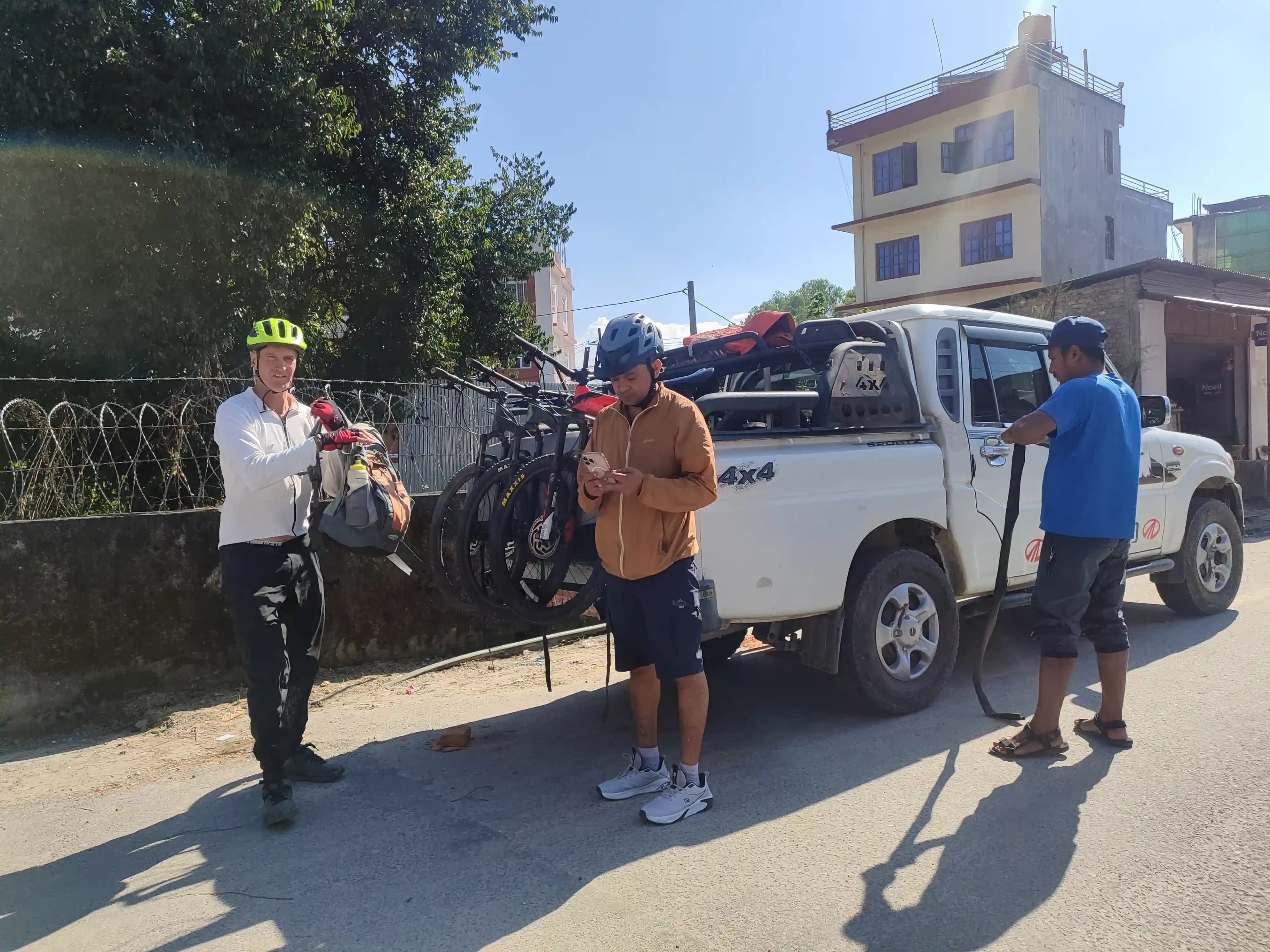
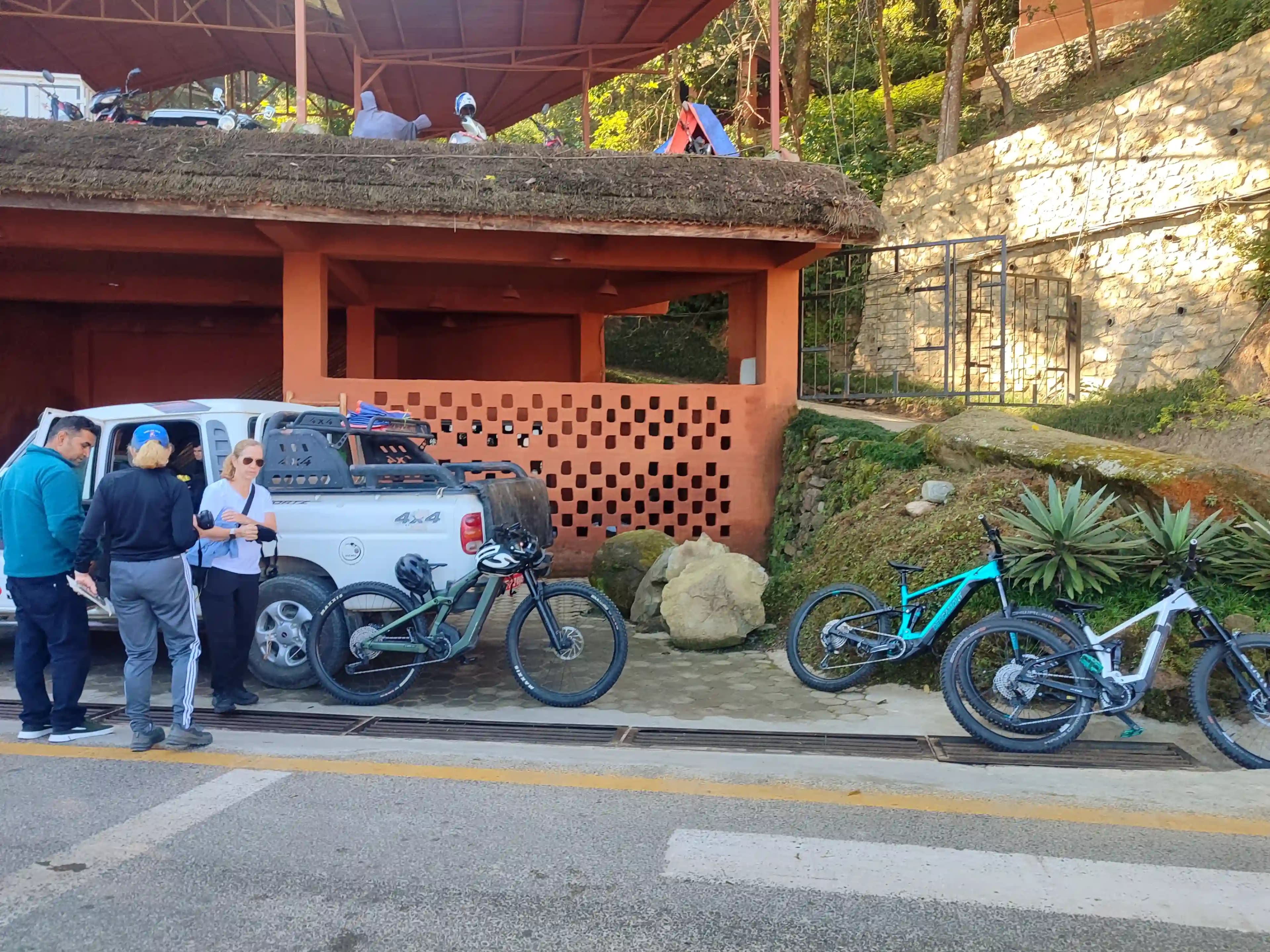
Support-vehicle logistics. A dedicated 4x4 with driver and bike rack shadows the route, carrying your gear and giving anyone the option to sit out a section.
Private departures. You ride with your own group and nobody else, so the pace and the trail choice belong to you.
Flexible route planning. The framework stays the same, but the trails inside it change to match the riders, the weather, and the conditions.
Knowledge of rural trails and communities. We ride through villages we have relationships with, which is why the access exists in the first place.
Riding intensity adjusted to your group. We build the week around the riders in front of us rather than around a brochure.
Ride the Kathmandu Valley Beyond the Tourist Roads
The Kathmandu Valley offers something that few mountain-bike destinations can match: technical trail and culture in the same ride.
One moment you can be riding a narrow forest singletrack, picking a line through roots and rocks. A few kilometres later you may be rolling through terraced farmland, passing a village, crossing an old rural track or looking across the valley toward the Himalayas.
For technical riders, Nepal MTB Adventures can help you find the natural singletrack, technical descents, forest trails, rocky terrain and less-travelled routes that make Kathmandu rewarding on an E-MTB.
For recreational riders, we can turn the same valley into a more relaxed journey through villages, terraces, forests, countryside and viewpoints.
Tell us what kind of mountain biker you are, and we will match the Kathmandu Valley to your riding.
Request your private Kathmandu Valley E-MTB tour
Send us your travel dates, group size, riding experience, and preferred riding style, and we will recommend the most suitable technical, balanced, or recreational version of the Kathmandu Valley Rim E-MTB experience.