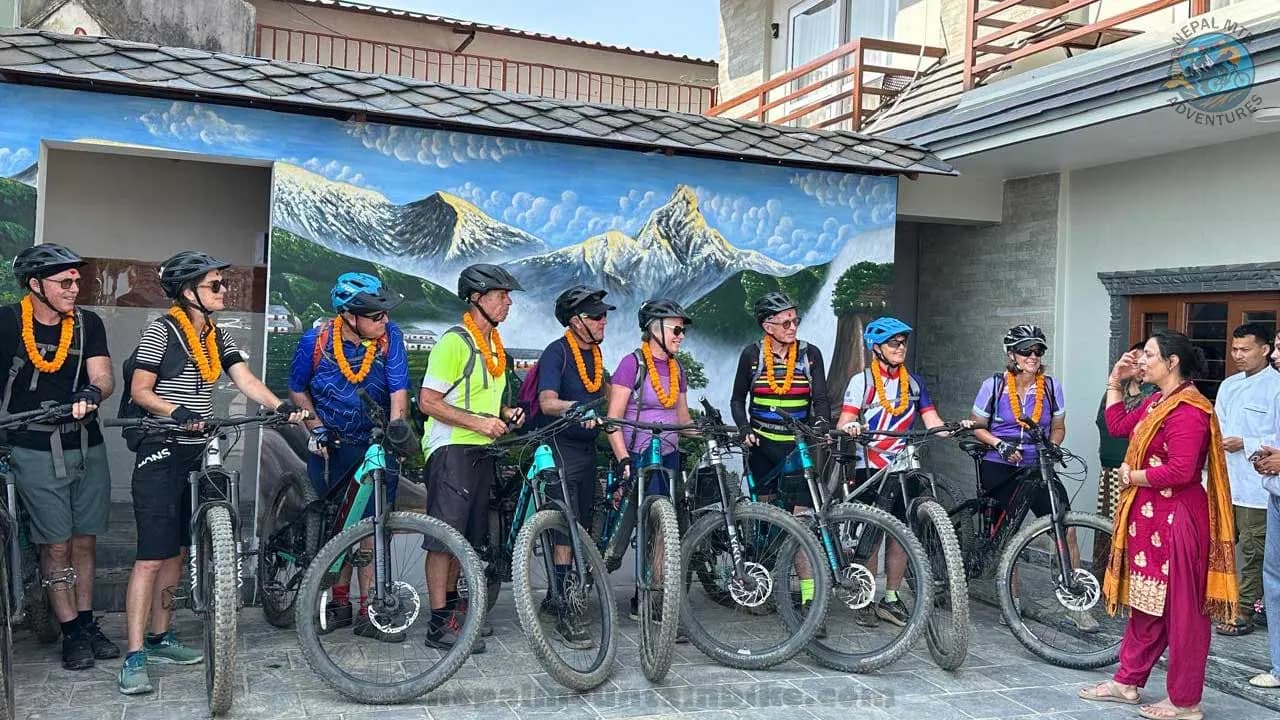


For mountain bike clubs that have ridden the best of their own country: how a club trip to Nepal works, from the Pokhara team that has guided riders since 2004.
Every club has a list. The trail centre everyone rides first, the bike park weekend, the big trip that took two years to organise. Then the list runs out, and someone at the end-of-season social asks where the club goes next. More clubs are answering with a word that used to sound out of reach: Nepal.
It's a bigger step than the Alps or a week in the desert, and a club has more to work out than a solo rider. Will it suit the fast riders and the steady ones? Who organises it, and how? What will members need to know before they fly? This guide answers those questions in order, using what we've learned from guiding groups and teams around Pokhara, Kathmandu, Annapurna and Mustang.
Club trips to Nepal in brief
Best seasons: October to November and March to April, just as many home seasons end or begin
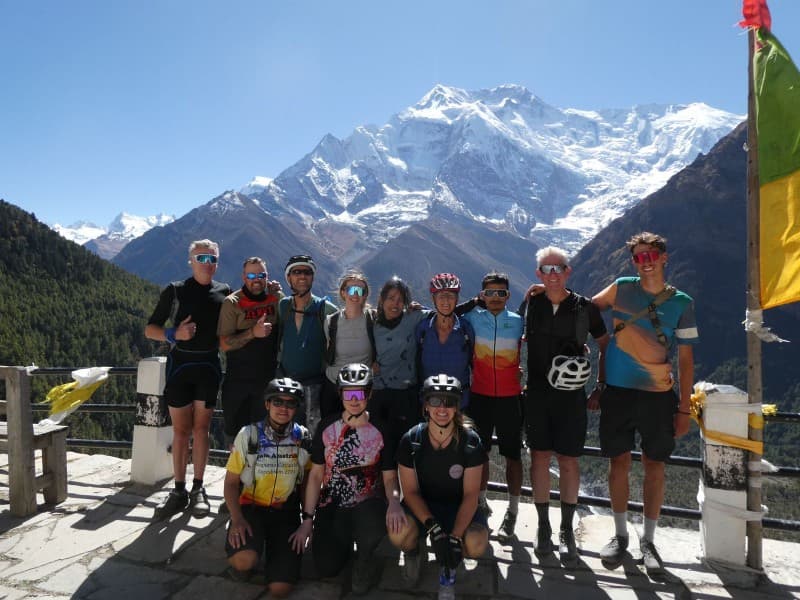
Who it suits: any club, from mixed-ability local clubs to gravity crews, e-MTB groups and expedition-minded riders
How it runs: a private trip on your club's dates, or members booking our tours with a club code
Getting there: fly to Tribhuvan International Airport in Kathmandu with one connection, and buy a visa on arrival
What we arrange: licensed guides, permits, bikes, mechanics, support vehicles, lodges and meals on riding days
What members arrange: flights, insurance that covers mountain biking at altitude, and their riding kit
What the club gets back: a member discount and a donation to club funds for every member who rides with us
You've ridden your country's best trails. What's next?
The next step after your country's best riding is height, scale, and culture, and Nepal has all three in one trip. Your club already has the skills. What changes is how high you ride, how long the descents last, and what you ride through.
Your club's home classics | What a Nepal trip adds |
UK: the 7stanes and Glentress, Coed y Brenin, BikePark Wales, Antur Stiniog, the Lake District fells | Natural trails nobody built for bikes, and passes over 5,000 m (16,400 ft) instead of fells under 1,000 m |
US: Moab, Sedona, Fruita, Pisgah, Downieville, Park City | High desert in Mustang that canyon riders love, and village trails no trail crew has touched |
Canada: Whistler, Squamish, the North Shore, Kamloops, Revelstoke | Long descents off high ridges, without a lift line in sight |
Australia: Derby, Maydena, Mt Buller, Thredbo, Bright | Multi-day riding between lodges, with the Himalaya filling the skyline every day |
New Zealand: Rotorua, Queenstown, Nelson, the Old Ghost Road | Backcountry days like the Old Ghost Road, but at three or four times the height |
Germany, Switzerland and Austria: Stoneman routes, Lenzerheide, Davos, Saalbach, Leogang | Hut-to-hut style riding at a far bigger scale, ridden after the Alps have closed |
Height you can't ride at home
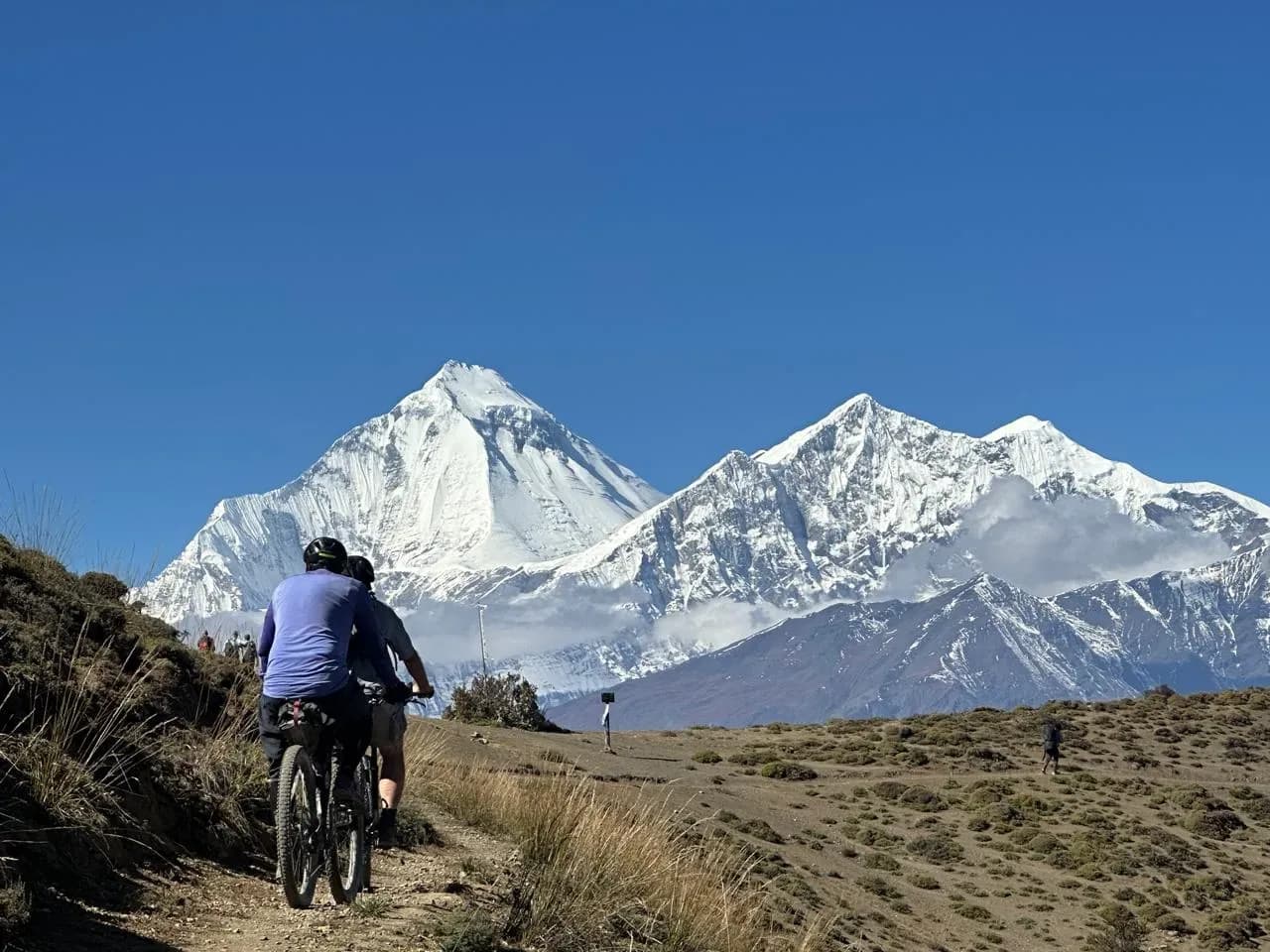
Thorong La, the high pass of the Annapurna Circuit, sits at 5,416 m (17,769 ft). That's more than four times the height of Ben Nevis, and 2,652 m (8,701 ft) higher than Col de l'Iseran, the highest paved pass in the Alps. For most club riders, it's the highest place they will ever take a bike.
Trails people built, not machines
Nearly every trail you ride in Nepal is an old footpath between villages. Nobody shaped the berms or graded the climbs. Stone steps, roots, loose rock and long flowing ridgelines can all turn up in one morning, and you share them with farmers, school children and mule trains. A club used to trail centres finds that it rides differently every day.
The culture is on the trail
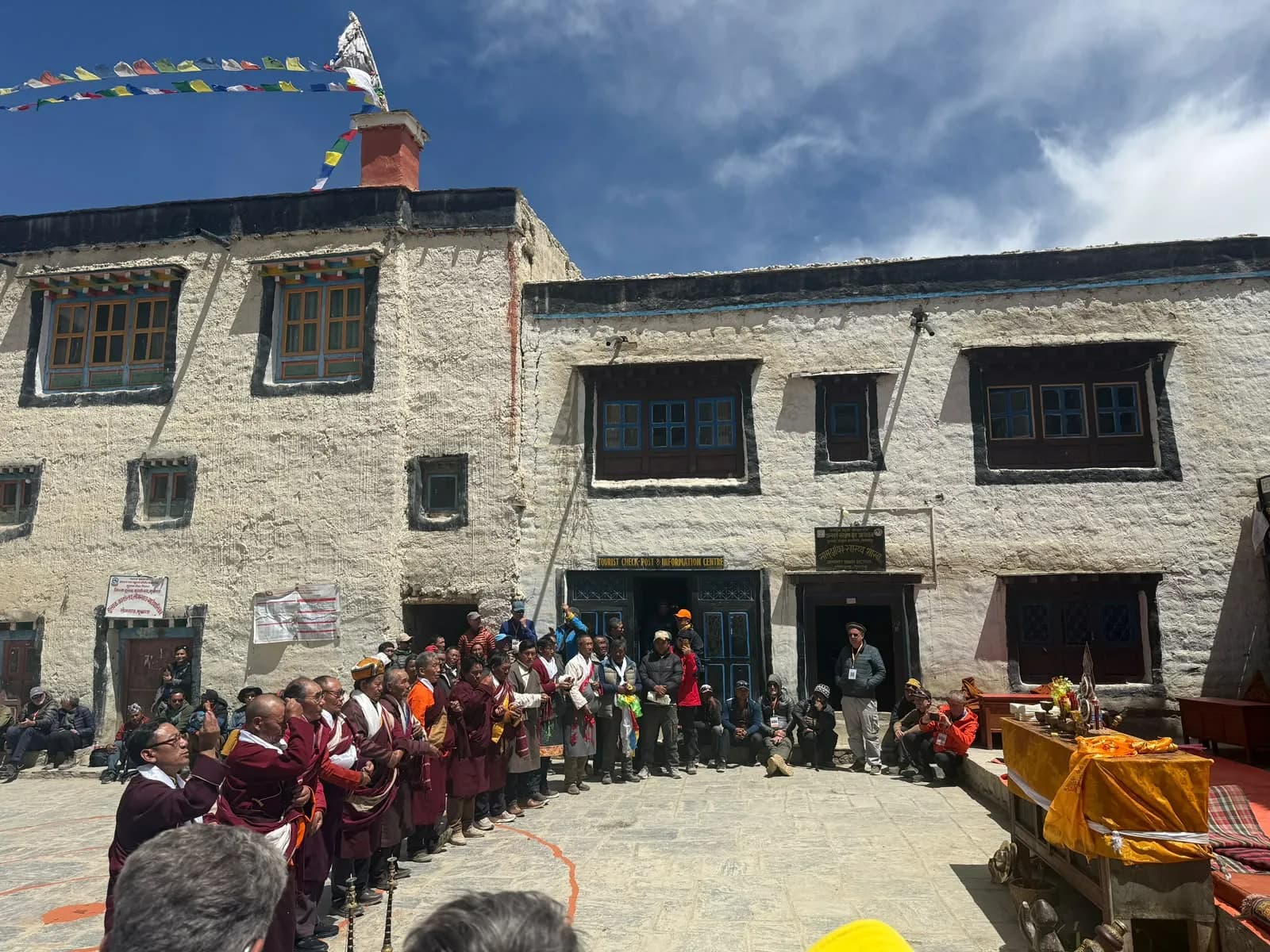
You ride past prayer walls and monasteries in Mustang, stop for tea in Gurung villages above Pokhara, and pass Hindu temples on the rim of the Kathmandu Valley. You sleep in family-run lodges called teahouses. For a club, the evenings are part of the trip: one long table, one stove, and a day's riding to talk over.
> Guide's tip: the pros have noticed too. Gee Atherton's Upper Mustang ridgeline film has been watched more than 1.5 million times. Show it at your club night when you pitch the trip.
Your season ends, ours begins
Nepal's best riding comes just as most northern seasons finish. That makes a Nepal trip the club's ride after the season ends, not a trip that competes with it.
Home riding | When it winds down | What Nepal offers then |
Whistler Mountain Bike Park | Closed 12 October 2026 | Peak season, October to November |
Saalbach and Leogang | Last lifts on 26 October and 8 November in 2026 | Peak season, with clear post-monsoon skies |
UK trail centres and fells | Autumn mud from October | Dry trails and clear Himalayan views |
Australia and New Zealand | Spring, with your season starting | Our October and November are your spring break |
The second season, March to April, suits clubs that want to open their year with a big trip. It brings warmer days and rhododendrons in flower on the hills above Pokhara.
Plan around Nepal's festivals
Nepal's two biggest festivals fall in the autumn riding season. They're a good time to be here, but they change how the country moves.
Festival | 2027 dates (expected) | What it means for a club trip |
Dashain | Starts 30 September; main Tika day about 9 to 10 October | Buses and flights fill up as people travel home. Book transport early, and expect quieter trails near Pokhara. |
Tihar | About 27 to 31 October | The festival of lights. Villages glow with oil lamps and marigolds, and riding runs as normal. |
Holi | March | The festival of colours. Cities get lively, and riding outside them is unaffected. |
The government publishes the official holiday dates each year, so we confirm them for your trip when the list comes out.
> Guide's tip: clubs in Germany, Switzerland and Austria often look at the second half of October. The bike parks are closing, autumn school holidays fall in many regions, and Nepal's trails are at their best.
Where clubs ride in Nepal
Most club trips are built from four riding areas. Each one suits a different kind of club, and the longer trips link two of them.
Pokhara: the base for mixed clubs
Pokhara sits by Phewa Lake under the Annapurna range, at about 800 m (2,600 ft), so altitude isn't a factor. From town, you can ride Sarangkot and its descents, loop around Fewa Lake, or ride to Begnas Lake by e-MTB. It's the easiest base for a club with a wide mix of riders, because every day can be shaped to the group.
Kathmandu Valley: riding with temples and history
The hills around Kathmandu hold forest singletrack and old villages, with temple towns such as Bhaktapur and Changu Narayan on the way. The Kathmandu Valley Rim e-MTB tour is a full week, and day rides suit clubs with a day or two before or after a longer trip.
Annapurna: the big expedition
The Annapurna Circuit climbs through Manang to Thorong La and drops into the Kali Gandaki valley, one of the deepest on earth. It's the trip for a club's strongest riders, or for a club that trains for it together.
Mustang: high desert behind the Himalaya
Lower Mustang takes in Jomsom, Kagbeni and the temple at Muktinath. Upper Mustang, the walled city of Lo Manthang and its canyons, is a restricted area with its own permit. Both sit in the rain shadow of the Himalaya and ride very differently from the green hills further south.
> Guide's tip: members can preview the riding before they commit. About 30 trails around Pokhara are mapped on Trailforks, and Komoot has Nepal MTB routes too.
Will your club cope? Grades, fitness and mixed abilities
If your members ride the red or intermediate trails at home comfortably, your club has the skills for most of our tours. The bigger questions are fitness for long days and how you keep a mixed group together.
Reading our grades in yours
We grade every tour Green, Blue, Red or Black, plus an altitude band. Our trail grading guide translates each grade into UK trail centre colours, IMBA, AusCycling, New Zealand grades and the Singletrail-Skala, so members can see the level in the system they already know.
Fitness for long days
Club rides at home are often two or three hours. A Nepal trip strings riding days together, and on the expeditions many of them are at altitude. Members who ride twice a week and add a long ride at the weekend in the three months before the trip arrive ready.
Altitude affects everyone differently
Fitness doesn't protect you from altitude sickness, so the strongest rider in the club can feel it first. On the high routes we plan the climbing days so the whole group acclimatises, and our guides watch every rider. Our guide to guided and self-guided riding sets out the acclimatisation rules we follow.
Keeping fast and steady riders together
We regularly host mixed-ability groups, and three things keep everyone on the same trip:
A second guide. One guide leads, and one rides sweep, and the group can split on the hardest climbs and descents and meet again for lunch or at the lodge.
E-MTBs for those who want them. When a club mixes e-MTBs and regular bikes, we set the pace to the riders without a motor.
Shuttles where there's a road. Long road climbs can go in the support vehicle, so the climbing days don't decide who comes.
Five ways clubs run a trip abroad
Clubs organise overseas trips in a handful of ways, and each one works with us. Pick the one that fits how your club already runs.
A trip leader books for the club. One volunteer plans the trip, members sign up, and the leader works with us on the details. This is how many club trips start, from a local club to an IMBA chapter or a DIMB group.
A private trip for the whole club. Any of our tours can run privately on your dates, for your riders only. It suits clubs that want to ride the whole trip together.
A club partnership. The club becomes one of our partner clubs. Members book any tour on their own dates with the club code, and the club earns a donation for every booking. Part 8 explains how it works.
A group of friends from the club. Four to six members who ride together book a private trip of their own. It's often how a club's first Nepal trip begins.
A university club expedition. Many universities fund student expeditions. In 2025, Imperial College's Exploration Board helped fund two students to ride the Annapurna Circuit self-supported (Imperial College). Student clubs can put the same kind of grant towards a guided trip, with bikes and permits arranged by us.
What the trip leader looks after
Whichever model you choose, one member usually becomes the club's contact with us. Their jobs are simple to list:
• [ ] Agree the trip, dates and budget with the club
• [ ] Collect names and early deposits, so "I'm keen" becomes "I'm coming"
• [ ] Share our trip summary and this guide with members
• [ ] Gather passport details for the permits, and bike sizes for anyone renting
• [ ] Keep a group chat for flight times and last-minute questions
Everything in Nepal, from permits and guides to lodges and bikes, is our job.
A trip with a purpose
A club trip to Nepal can do more than tick off a ride. Clubs often build in one of these.
Ride for a charity
Many clubs fund a cause through a big ride. A Himalayan trip gives supporters a story worth backing: a pass at 5,416 m (17,769 ft), or a week on village trails. Tell us your goal and dates, and we'll shape a route around it.
Give back to the trails
Clubs spend their weekends building and fixing their own trails, and some carry that to Nepal. In 2024 the Himalayan Trust ran a riding trip that included trail-building with the Phaplu MTB Club in Solukhumbu (Himalayan Trust). Ask us about adding a trail day with local riders to your club's trip.
Ride with Nepal's own riders
Nepal has a young, fast-growing riding scene. The Pokhara Enduro race runs from 10 to 12 December 2026 over six stages, with around 100 riders, and we're its race mechanical support. A gravity club timed around the race can watch, or enter, and ride the same trails as Nepal's best. Our enduro tours are built on the same hills.
Celebrate a milestone
A club anniversary, a member's big birthday, or the end of a racing season all make good reasons for a trip. We can plan a celebration night at the lodge, or a ride that finishes somewhere worth remembering.
Life on a club trip in Nepal
Members will ask what the days and nights are like. This is what to tell them.
Rooms and lodges
In Kathmandu and Pokhara we stay in hotels. On the trail we stay in teahouses, family-run lodges with simple twin rooms, thick blankets and a warm dining room. Most clubs share rooms, and single rooms are limited on the busiest routes in peak season, so tell us early if members need them.
Food on the trail
Teahouse food is fresh and cooked to order. The staple is dal bhat: lentil soup, rice, greens and curried vegetables, with refills until you say stop. Menus also offer eggs, porridge, pasta and potatoes. Vegetarian riders eat very well here, and we pass dietary needs on to each lodge in advance.
Money, SIM cards and signal
Nepal's currency is the rupee. Cash machines are easy to find in Kathmandu and Pokhara, but members should carry cash in the mountains. A local SIM from Ncell or Nepal Telecom works in the towns and on much of the trail, with long gaps near the high passes.
Trail manners
Mule and yak trains: stop and step to the uphill side of the trail until they pass.
Villages: ride slowly through them, and walk the bike where children are playing.
Prayer walls and stupas: pass them with the wall on your right, the same way locals walk.
People: a "namaste" goes a long way, and ask before taking a photo of someone.
Drones
Club trips love a drone shot, but drones need approval in Nepal before you fly, and the national parks and conservation areas need their own permission on top. Tell us early if anyone plans to bring one, because approval takes time.
Thanking your guides
Tipping guides and support crew is customary in Nepal. Most groups pool a tip and hand it over on the last evening, and many sources suggest around USD 10 to 15 per guide per day as a group. We'll give your trip leader a clear guide before you travel.
Our club partner programme
Any mountain bike club can become a partner club: a local club, an IMBA chapter, a Cycling UK group, a DIMB group, a university club, a women's riding group or a club touring section. This is what partner clubs get.
A member discount. Your members get 5% off any of our tours with your club's own code.
A donation to your club for every booking. For every member who rides a tour with us, we give USD 50 to your club for your trail fund, trail days or club funds.
Private club trips. Any tour can run privately on your club's dates, built around your mix of riders.
Material for your club. A short trip write-up and photos for your newsletter, website or club night.
One contact. One person on our team looks after your club from the first message to the last ride.
Members book their own places with the code, so the club never handles anyone's money. To join, send us your club's name, where you ride and roughly how many members you have.
Planning a club trip, month by month
Start 12 months out for a big club trip, and 9 months out at the latest. This is the timeline we suggest.
When | What to do |
12 months before | Agree on the season and the kind of trip at a club meeting. Ask us for two or three trip options to share. |
9 months before | Choose the trip and dates. Take a deposit from everyone who's in, and we hold the guides, bikes, and lodges. |
6 months before | Members book flights to Kathmandu and travel insurance, and decide whether to bring a bike or rent one of ours. |
3 months before | Members check their passport has at least six months left, see a travel clinic, and start building riding fitness. |
1 month before | We confirm permits, final numbers, bike sizes, and the plan for each day. |
Arrival | Fly in a day early if you can. We meet the group, fit the bikes, and brief everyone. |
Flights and the visa
There's no non-stop flight to Kathmandu from Europe, North America or Australia. Most riders connect in Doha, Dubai, Istanbul or Delhi, and riders from Australia and New Zealand often connect in Singapore, Kuala Lumpur or Bangkok. UK, US, Canadian, Australian and most European passport holders can buy a tourist visa on arrival at Kathmandu airport, paid in US dollars cash: USD 30 for 15 days, USD 50 for 30 days and USD 125 for 90 days. Our cycling holidays guide covers flights and the visa in more detail.
Bikes for the whole club
Members can fly with their own bike or ride one of ours. Our rental fleet runs from Trek and Scott hardtails to full-suspension trail bikes and e-MTBs, and we'll need numbers and sizes early to hold enough bikes. E-MTB riders should rent here: passenger flights don't carry lithium batteries over 160 watt-hours, and an e-MTB battery is far bigger. Riders bringing a bike should read our guide to flying with a mountain bike to Nepal.
Checklist to send your members
[ ] Travel insurance that covers mountain biking, medical costs and helicopter evacuation to the trip's highest point, plus cancellation. Our guide to mountain bike travel insurance for Nepal explains what to check.
[ ] A passport with at least six months left, and passport details sent to the trip leader for the permits.
[ ] US dollars in cash for the visa on arrival.
[ ] A travel clinic visit six to eight weeks before departure.
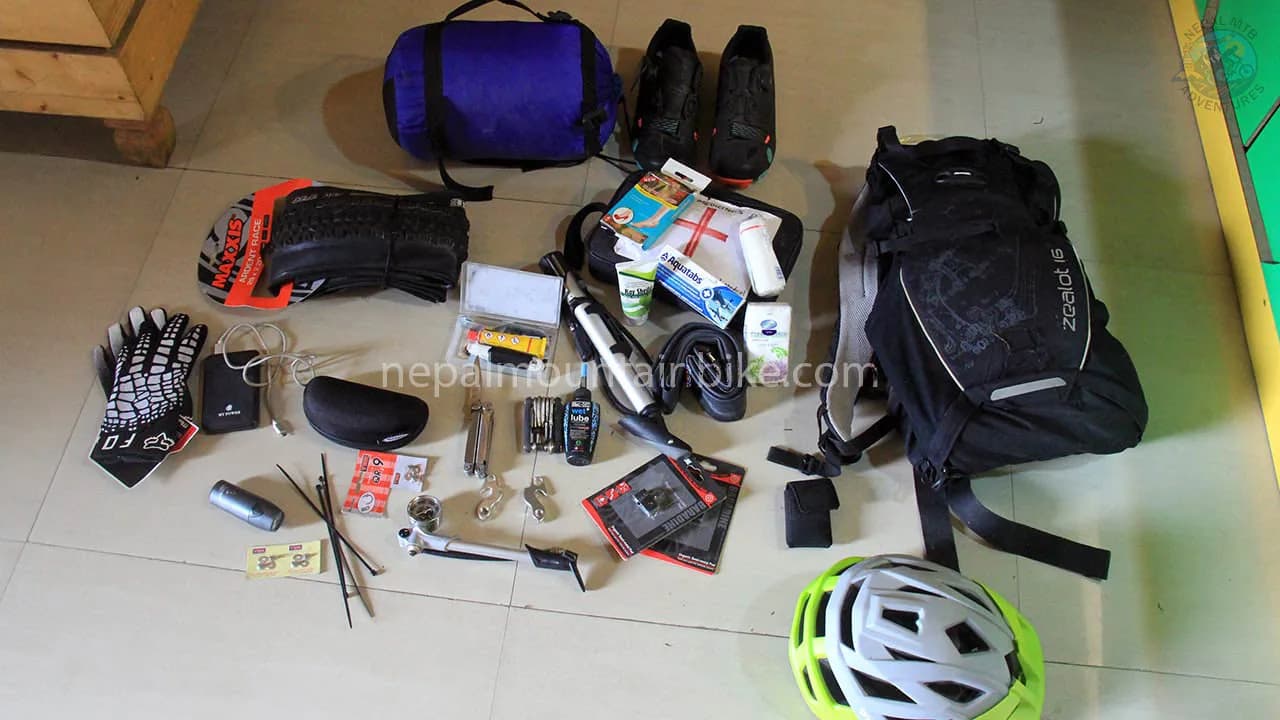
[ ] Kit for warm valleys and cold passes, from our mountain biking checklist for Nepal.
[ ] An honest look at the trip's grade and the riding fitness it asks for.
> Guide's tip: in the national parks, conservation areas and restricted areas, every group rides with licensed guides, cyclists included. It helps to tell members early why the trip is guided, so nobody is surprised at the first checkpoint.
Frequently asked questions
Which trips work best for a club?
It depends on the club. Mixed clubs do well on a Pokhara week or the Kathmandu Valley Rim e-MTB tour. Gravity clubs head for our enduro tours. Clubs after one big expedition look at the Annapurna Circuit or Mustang. Part 3 covers each area.
How big can a club group be?
Tell us your numbers early. Larger clubs ride with more guides, and in the restricted areas, such as Upper Mustang, the rules allow up to seven riders per guide.
Does the partner donation go to our club or to a national body?
To your club. We pay it into the club account, for the committee to spend on trails or members as it decides.
Has a club or team ridden with you before?
Yes. We ran a 15-day Tilicho Lake expedition privately for a team from Australia, and we're the Nepal ground team for overseas operators, including BikeFlow Adventures from Australia. You can meet our guides before your club decides.
Can non-riding partners come?
Yes. We can mix riding days with other activities around Pokhara, so partners and friends join for part of the trip.
Can a women's riding group book a club trip?
Yes. Women's clubs and riding groups book private trips with us like any other club, on their own dates and at their own pace.