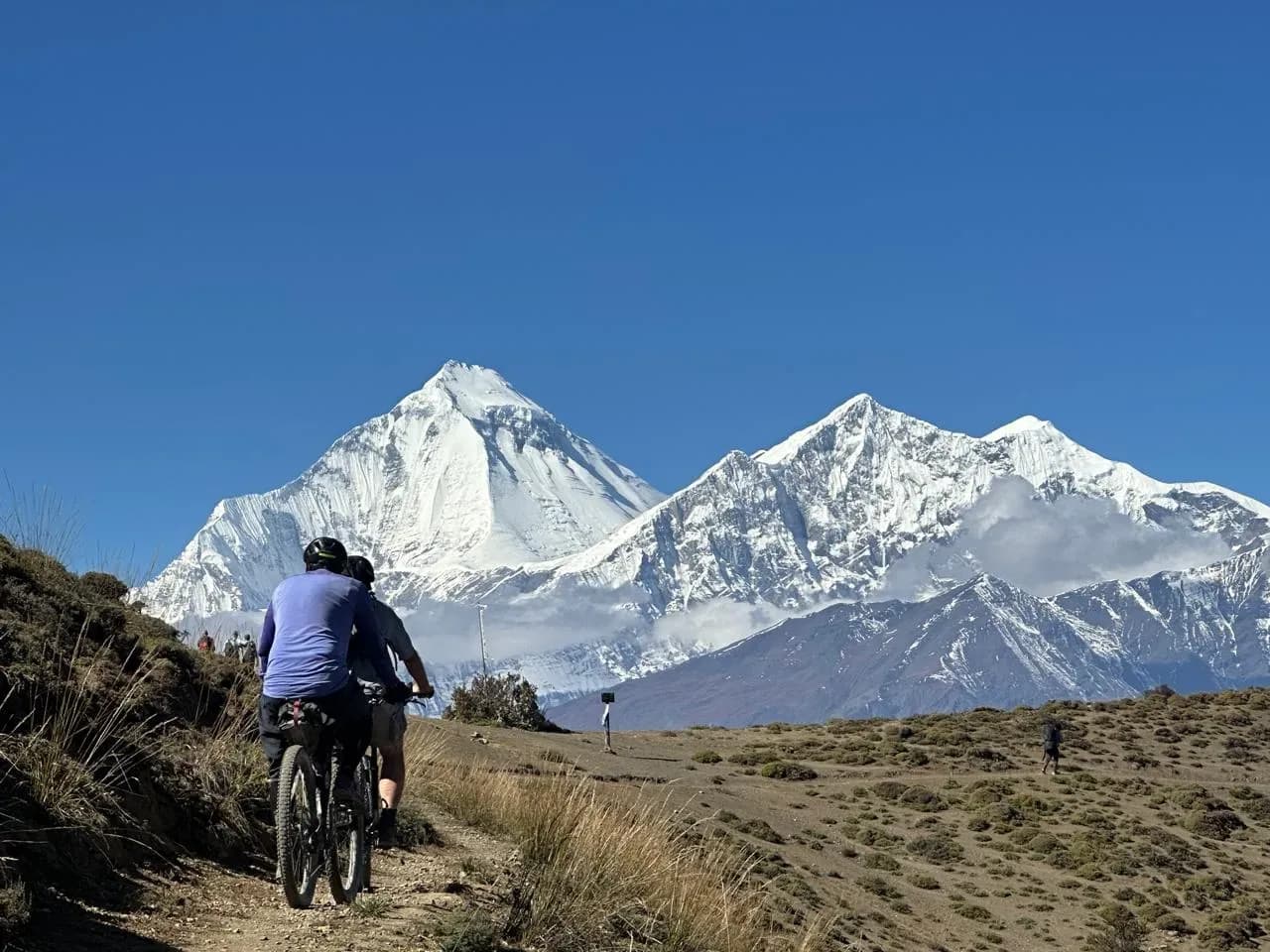



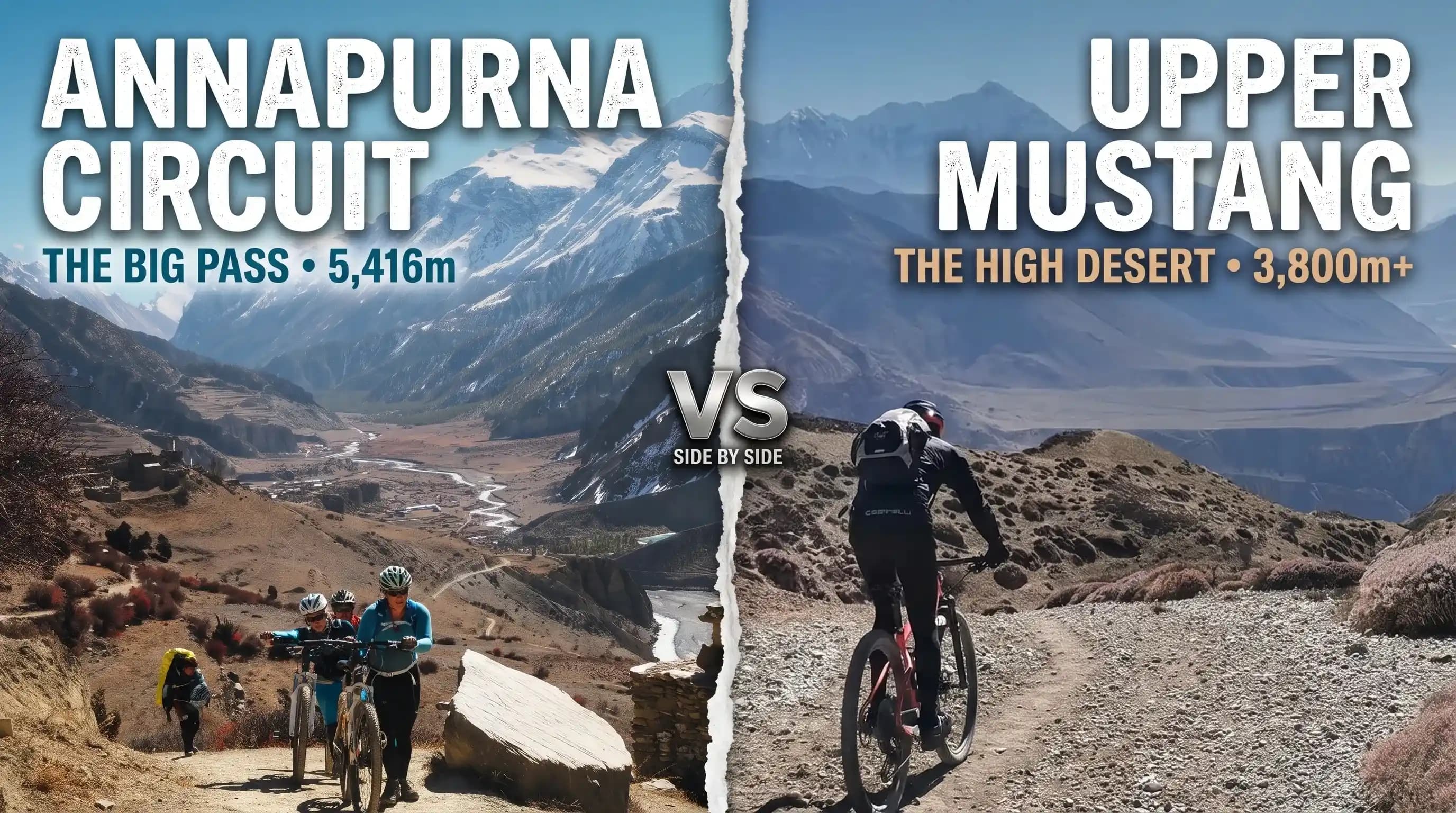
Two of the biggest bike trips in the Himalaya, side by side, from the Pokhara guides who ride both every season.
- Laxman Sunar, senior MTB guide, Nepal MTB Adventures
You have two weeks, one big trip in you this year, and two names on the shortlist. One is the Annapurna Circuit, the loop over Thorong La that riders talk about for years afterwards. The other is Upper Mustang, the old Kingdom of Lo, a desert behind the Himalaya that was closed to outsiders until 1992.
Both are hard, both are beautiful, and they almost touch. The Circuit comes down from the pass to Muktinath, and a short ride below it is Kagbeni, the gate to Lo Manthang. But they ride very differently. One asks you to go higher than you have ever been, once. The other keeps you high for longer and makes you work for every pass. This guide puts the two side by side, in the order riders usually decide, so you can pick the one that fits you.
Annapurna Circuit or Upper Mustang, in brief
Choose the Annapurna Circuit for one big pass at 5,416 m (17,769 ft), a classic loop around an 8,000-metre mountain, and busier, livelier trails
Choose Upper Mustang for desert singletrack, Tibetan Buddhist villages, empty trails and a long run of passes at about 3,800 to 4,200 m (12,500 to 13,800 ft)
Harder on altitude: the Annapurna Circuit.
Harder on total work: Upper Mustang, with more riding days and more climbing
Riding in summer: only Upper Mustang rides well from June to August
Permits: both need a licensed guide. Upper Mustang adds a restricted-area permit of USD 50 per person per day
Can't choose? Ride both in one trip of about three weeks
The two rides at a glance
The Annapurna Circuit is a loop around a mountain range with one very high pass in the middle. Upper Mustang is a journey north into a high desert, with a pass most days and a walled city at the end. This table sets them side by side, using our two main trips.
Annapurna Circuit | Upper Mustang | |
|---|---|---|
The shape | A loop: up the green Marsyangdi valley, over Thorong La, down the Kali Gandaki | North from Kagbeni to Lo Manthang, home by the remote east side, out down the Kali Gandaki |
Highest point | Thorong La, 5,416 m (17,769 ft) | Paha Pass, about 4,210 m (13,812 ft) |
Highest night | Thorong Phedi, 4,450 m (14,600 ft), or High Camp, 4,850 m (15,912 ft) | Lo Manthang, 3,840 m (12,598 ft) |
Riding days | About 10, plus a rest day at Manang | 13 |
Climbing on the bike | About 5,000 m (16,400 ft) in total | About 7,850 m (25,750 ft) in total |
Hours in the saddle | 4 to 6 a day on average | 4 to 8 a day |
Where you push | Mostly in one block: the climb to Thorong La | Spread out: short carries near several passes, and two rough days on the east side |
Landscape | Five climate zones, from rice terraces to high desert | High desert almost all the way: canyons, red cliffs, village oases |
Culture | Gurung, Manangi and Thakali villages, and the temple at Muktinath | The Loba people, Tibetan Buddhist monasteries, the walled city of Lo Manthang, sky caves |
Company on the trail | Busy in October and November | Quiet all year; the permit keeps numbers low |
Permits | Conservation area permit, TIMS card, licensed guide | Restricted-area permit, conservation area permit, TIMS card, licensed guide, registered agency |
Best months | October to November; March to May | March to May; September to November; summer is rideable too |
Trip length with us | 15 days from Kathmandu | 15 or 16 days from Kathmandu |
Where the two meet
The two routes meet at Muktinath, in Lower Mustang. Coming down from Thorong La, the Circuit stops for the night at Muktinath. A short ride below it is Kagbeni, the gate of Upper Mustang, where permits are checked, and the restricted area begins. Our Upper Mustang expedition also comes back out through Muktinath. That's why the two trips link so well (see Part 10), and why both finish the same way: through the Lubra valley to Marpha, then down the Kali Gandaki, between Dhaulagiri and Annapurna I, to the hot springs at Tatopani.
Altitude: one big spike or a long high plateau
The Annapurna Circuit takes you much higher, but only for a short time. Upper Mustang never goes near 5,000 metres, but it keeps you above 3,500 metres (11,483 ft) for most of a week. That one difference shapes everything else about the two trips.
The Annapurna Circuit: up, over and down
The Circuit is a slow climb to one summit. You ride up the Marsyangdi valley for a week, take a rest day at Manang, 3,540 m (11,614 ft), and then move up in short stages to Thorong Phedi. On pass day you climb about 966 m (3,169 ft) on foot to 5,416 m (17,769 ft) and ride straight down 1,616 m (5,302 ft) to Muktinath. You spend about five nights above 3,500 metres, the last of them at Muktinath, 3,800 m (12,467 ft). The next night you're down at Marpha, 2,670 m (8,760 ft).
To put Thorong La in perspective: it's more than 1,100 m (3,600 ft) higher than the summit of Pikes Peak in Colorado, and higher than any summit in the Alps. For most riders, it's the highest place they will ever take a bike.
Upper Mustang: a week on the plateau
Upper Mustang works the other way. From Kagbeni, 2,800 m (9,186 ft), you climb onto the high desert in a day or two and stay there. On our 16-day route you sleep at Samar, Ghami, Tsarang, Lo Manthang (two nights), Yara and Muktinath, all between 3,500 and 3,840 m (11,483 and 12,598 ft). Lo Manthang alone sits a little higher than the Grossglockner, Austria's highest mountain. In between, you cross pass after pass: Nyi La at 4,010 m (13,156 ft), Lo La at about 3,950 m (12,959 ft), Paha at about 4,210 m (13,812 ft) and Gyu La at about 4,070 m (13,353 ft), plus a string of smaller ones.
Annapurna Circuit | Upper Mustang | |
|---|---|---|
Nights above 3,500 m (11,483 ft) | About 5 | About 7 |
Highest night | 4,450 to 4,850 m (14,600 to 15,912 ft) | 3,840 m (12,598 ft) |
Highest point on the bike | 5,416 m (17,769 ft) | About 4,210 m (13,812 ft) |
What altitude feels like | A few very hard days around the pass | A steady, week-long tax on every climb |
Insurance must cover at least | 5,500 m (18,045 ft) | 4,500 m (14,764 ft) |
What this means for you
If you've struggled with altitude before, Upper Mustang is the gentler choice. You still need to go up slowly, but you never face a night at 4,450 metres or a pass above 5,000.
If you want the big number, only the Circuit gives it to you. Thorong La is the benchmark ride of high altitude mountain biking, and nothing in Upper Mustang comes close in height.
Fitness doesn't protect you from altitude sickness on either trip. The rider who feels strongest often climbs too fast. On both routes, we plan the ascent so the group acclimatises, and our guides watch every rider closely.
> Guide's tip: check your travel insurance before you choose. Many policies stop at 4,000 metres. Upper Mustang needs cover past 4,000 m, and the Circuit needs a policy that goes to 5,500 m or more. Our mountain bike travel insurance guide explains what to look for.
The riding: trail, pushing and descents
Both trips are a mix of jeep track and real singletrack, and both have pushing. The difference is where the pushing comes and what the trail feels like under your tyres.
The Annapurna Circuit: varied trail, one long carry
On our 15-day route, roughly a third of the riding is rough jeep track and a third is high singletrack, with the rest on dirt trail and short stretches of paved road. The road runs up both valleys now, so the art is in leaving it. The high trail from Ghyaru to Ngawal, the stretch from Manang over the pass to Muktinath, and the Lubra valley on the far side are where the Circuit rides best.
Almost all the pushing happens in one go. On pass day you walk your bike up from Thorong Phedi to the top, before dawn and at very high altitude, and our porters carry the frames over the steepest part. In good conditions, you can ride nearly everything else.
Upper Mustang: desert trail, little and often
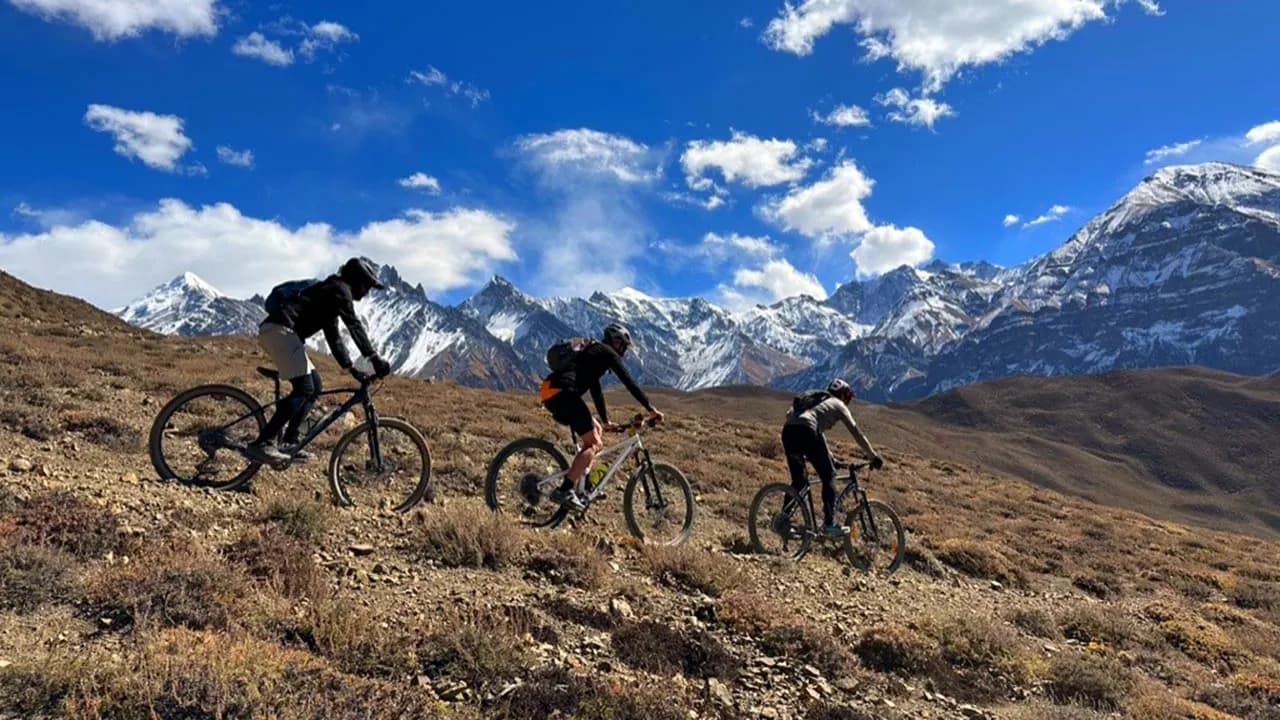
Upper Mustang rides like a high desert. The ground is dry and firm for most of the year, with no mud or roots, and the challenge is loose rock, shale, and sand. The main route north to Lo Manthang follows the old salt-trade trail and the jeep road, with singletrack lines off it. Once you turn east from Lo Manthang, through Dhi, Yara and Tangge, the share of singletrack rises to about half of each day, and you can ride for hours without meeting anyone.
The pushing comes in short doses rather than one block. Expect brief carries on loose shale near several passes, and two days on the east side, Yara to Tangge and the crossing of Paha Pass, with real hike-a-bike. If those two days look like too much, there's a support route back down the main valley by jeep track, which rejoins the group at Chhusang.
The descents
Each trip has its own big descent, and then both finish the same way.
Descent | Annapurna Circuit | Upper Mustang |
|---|---|---|
The big one | Thorong La to Muktinath: 1,616 m (5,302 ft) in one go, rocky and steep at the top | Paha Pass to Chhusang: more than 1,200 m (3,937 ft), loose and exposed in places |
Shared by both | The Lubra valley below Muktinath: natural switchback singletrack down to a Bon village (one of two lines you can choose that day) | The same |
The finale | Marpha to Tatopani: about 1,500 m (4,900 ft) lower in a day, through the pine forest singletrack at Lete | The same |
> Guide's tip: the Kali Gandaki wind is the same on both trips. From late morning it blows hard up the valley, straight into your face as you ride south. On both routes, we start early and aim to finish the exposed sections by early afternoon.
Which one is harder?
The Annapurna Circuit is harder on your lungs, and Upper Mustang is harder on your legs. The Circuit's hardest day is pass day; Upper Mustang's is the crossing of Paha Pass. Over the whole trip, Upper Mustang asks for more work.
Why the Circuit feels hard
Thorong La. Walking a bike uphill from 4,450 m to 5,416 m, starting at about 4 am, is a different kind of hard from anything you'll ride at home.
The highest nights. Sleep is poor at Thorong Phedi or High Camp, and you climb the pass the next morning.
No easy way out. Between Manang and Muktinath there's no road, so once you're committed, you're committed.
Why Upper Mustang feels hard
More riding days. Thirteen, against about ten on the Circuit.
More climbing. About 7,850 m (25,750 ft) on the bike, against about 5,000 m (16,400 ft) on the Circuit.
The remote east side. Rough trail, hike-a-bike and long days far from a road.
The wind and the sun. Wide-open passes with little shelter, every day.
How we grade them
We grade the Annapurna Circuit Guided Tour Black, mainly for the altitude and the pass. The 16-day Upper Mustang expedition is graded Red, with two harder days on the east side that you can swap for the support route. Our trail grading guide shows what each grade means in the system you know from home.
You'll probably find the Annapurna Circuit harder if
[ ] You've felt altitude before, even on a ski trip
[ ] You're happy riding all day but hate walking with a bike
[ ] You sleep badly in the cold
You'll probably find Upper Mustang harder if
[ ] Your rides at home are two or three hours, not back-to-back long days
[ ] Loose, rocky climbing is your weak point
[ ] You need a social trail and a busy village at the end of the day to keep going
> Guide's tip: on either trip, the riders who do best aren't the fastest. They're the ones who ride steadily at altitude and are happy to walk a section they don't like the look of.
Landscape, culture and people on the trail
The Annapurna Circuit changes every day. Upper Mustang stays in one extraordinary place and takes you deeper into it.
The Annapurna Circuit: five worlds in two weeks
You start among banana trees and rice terraces, climb through pine forest and yak pasture, cross the pass into high desert and finish in subtropical forest again. The people change with the land: Gurung villages in the lower Marsyangdi, the Tibetan-influenced villages of Manang, and the Thakali villages of the Kali Gandaki, who built many of the inns that became today's lodges. Muktinath, just below the pass, is sacred to Hindus and Buddhists alike.
It's a busy route in October and November. Lodges are full of walkers and riders from all over the world, and evenings around the stove are lively. Some riders love that. Others find it takes the edge off the wildness.
Upper Mustang: the Kingdom of Lo
Upper Mustang is one landscape, seen in depth: red and ochre cliffs, wind-cut sandstone towers, caves stacked high in the cliff faces, and green oases of barley and poplars wherever a stream reaches a village. The people are the Loba, who speak a Tibetan language and follow Tibetan Buddhism. You ride past long prayer walls at Ghami, under the red cliffs of Dhakmar, and into Lo Manthang, a walled town founded around 1380 that still has its palace and three old monasteries. On the rest day, you can climb into the sky caves at Chhoser. On the east side, Luri Gompa, a cave monastery with old wall paintings, sees very few visitors.
Because every visitor needs a restricted-area permit, the trails stay quiet. A lodge may have only your group that night.
If you want | Choose |
|---|---|
A landscape that changes every day | Annapurna Circuit |
One landscape you'll never see anywhere else | Upper Mustang |
Busy lodges and other riders and walkers to swap stories with | Annapurna Circuit |
Quiet trails and villages that see few visitors | Upper Mustang |
A trip with a festival in it | Upper Mustang, timed for Tiji in late May or early June |
> Guide's tip: in Upper Mustang, walk your bike through village centres and monastery grounds, and pass prayer walls and chortens with them on your right. Our Upper Mustang rider's guide has more on riding there respectfully.
Permits and rules
Both trips need a licensed guide, so you can't ride either one alone. Upper Mustang adds a restricted-area permit that costs more and can only be filed through a registered agency.
Annapurna Circuit | Upper Mustang | |
|---|---|---|
Main permit | Annapurna Conservation Area permit, NPR 3,000 for foreign nationals | Upper Mustang Restricted Area Permit, USD 50 per person per day inside the area |
Also needed | TIMS card, NPR 2,000 | Annapurna Conservation Area permit, NPR 3,000, and a TIMS card, NPR 2,000 |
Licensed guide | Required on the Annapurna Circuit since spring 2023, for cyclists as well as trekkers | Required in the restricted area |
How you get it | The conservation area permit online or at a permit counter; the TIMS card through a registered agency | Only through a registered Nepali agency, before you travel |
Solo riders | Allowed, with a guide | Allowed since 22 March 2026, with a guide |
Checked at | Checkpoints in both valleys | Kagbeni, as you enter the restricted area |
What the Upper Mustang permit adds
You pay for each day you spend inside the restricted area. Our Upper Mustang trips spend eight or nine days there, so the permit comes to about USD 400 to 450 per rider. It was USD 500 for the first ten days until a Cabinet decision in November 2025 changed it to a daily fee with no minimum stay. The Nepal Tourism Board also lists Upper Mustang under its guide and TIMS card rule, so we arrange a TIMS card with your permits.
On every trip we run, we file all the permits for you, so there's nothing to queue for. Our guide to guided and self-guided riding in Nepal explains the guide rule in more detail.
When to go
Months | Annapurna Circuit | Upper Mustang |
|---|---|---|
March to May | Good. Warmer days, rhododendrons on the lower slopes, some haze by late May | Best. Warming days, long light, windy afternoons |
Late May to early June | Showers start on the east side | Tiji festival in Lo Manthang |
June to August | Monsoon rain, mud and landslide risk on the east side | Rideable. The rain shadow keeps it much drier, but flights to Jomsom often stop and the road can be blocked, so allow spare days |
September to November | Best. Clear skies and firm trails, but busy lodges | Best. Clear air, cold nights |
December to February | Possible, but snow can close Thorong La for days | Not recommended. Very cold, and many lodges close |
How you get there
The Circuit starts from Pokhara. On our trip, we ride out of town on old trails past Begnas Lake and on to the Marsyangdi valley. Upper Mustang usually starts with the early-morning flight from Pokhara to Jomsom, which is often delayed by wind and cloud. When it's cancelled, we drive instead, so a cancelled flight usually costs time rather than the trip.
Month-by-month detail is in our guide to the best time to mountain bike in Nepal.
> Guide's tip: if your only free time is July or August, don't force the Circuit. Of the two, Upper Mustang is the one that summer suits.
Bikes, e-MTBs and support
The same bike suits both trips: a trail or enduro full-suspension bike with about 140 to 160 mm of travel, low gearing and tubeless tyres. A strong hardtail works too, and it's lighter to carry. Where the two trips differ is how much support a vehicle can give, and that matters most if you're thinking about an e-MTB.
Support on the trail
Annapurna Circuit: our support vehicle runs up to Manang and meets the group again at Muktinath. Between the two there's no road, so porters carry the luggage, and the frames over the steepest part of the pass.
Upper Mustang: a jeep road runs from Jomsom to Lo Manthang, so our support vehicle can follow much of the main route north. The east side is more remote, with porters where the vehicle can't go.
Which suits an e-MTB?
Upper Mustang suits an e-MTB better. Spare batteries travel with the group, the vehicle can follow much of the route, and the long climbs on jeep track and old caravan trail are exactly where electric assist helps. The one cost is weight: an e-MTB is much heavier to push and carry on the steep pass approaches. That's why we run a dedicated 15-day E-MTB Upper Mustang trip and a Tiji festival e-MTB expedition.
On the Circuit, e-MTBs are available on request. The vehicle carries spare batteries up to Manang and again from Muktinath, and our porters carry the heavier frames over the steepest part of the pass. It works, but the pass day is no easier on an e-bike. Our e-MTB guide covers riding with a motor in Nepal.
Bring your own or ride ours
On both trips, you can bring your own bike or ride one from our Pokhara workshop: Trek, Scott and Giant hardtails, full-suspension bikes and e-MTBs. E-MTB riders should rent here: passenger flights don't carry lithium batteries over 160 watt-hours, and an e-MTB battery is far bigger. For the Circuit, our best bike for the Annapurna Circuit guide goes into more detail.
Choose in five questions
Answer these in order. Most riders have their answer by question three.
1. Do you want to ride over 5,000 metres?
Yes: the Annapurna Circuit. Thorong La is the reason to go.
Not really: go to question 2.
2. Have you had trouble with altitude before?
Yes: Upper Mustang. You stay high for longer, but you never sleep above 3,840 m.
No: go to question 3.
3. When can you travel?
June to August: Upper Mustang. The Circuit is wet and muddy in the monsoon.
Late May or early June: Upper Mustang, for the Tiji festival.
Any other time: go to question 4.
4. What do you want to remember?
One huge day and a loop around a mountain: the Annapurna Circuit.
Lo Manthang, cave monasteries and empty desert trail: Upper Mustang.
A landscape that changes every day: the Annapurna Circuit.
5. How do you like to ride?
Long days on a bike, happy to walk for one big push: the Annapurna Circuit.
Day after day of climbing, loose desert trail, and plenty of time in the saddle: Upper Mustang.
With electric assist: Upper Mustang.
Still split down the middle? Read on.
Can't choose? Ride both
You can ride both in one trip, and the order works in your favour. Our 22-day Annapurna Circuit and Upper Mustang tour rides the full Circuit over Thorong La, then turns north at Kagbeni instead of heading home. From there you ride to Lo Manthang and the sky caves, come back by the east side through Yara and Tangge, cross the Pa Pass at about 4,200 m (13,780 ft), and finish down the Kali Gandaki to Tatopani.
Because you reach Mustang after crossing Thorong La, you arrive already acclimatised to more height than Upper Mustang asks of you. It needs about three weeks plus travel, and it's for experienced riders with real time to spare.
Our trips for each choice
Trip | Days | Choose this if |
|---|---|---|
15 | You've chosen the Circuit and want the full loop with full support | |
17 | You want the pass, but your group is mixed: walk up, ride down | |
11 | You want the high Manang side in less than two weeks | |
16 | You've chosen Mustang and want all of it, including the remote east side | |
15 | You want Lo Manthang by the main route north and back, without the remote east side | |
15 | You want Mustang with electric assist, or your group mixes strong and steady riders | |
22 | You want both, in one journey | |
11 | You want the Kali Gandaki descents and Muktinath without either big commitment |
Both the Circuit and the Upper Mustang expedition run as scheduled group departures, and every trip can run privately on your own dates. Not sure yet? Tell us how you ride, when you can travel, and what you want from the trip, and we'll tell you honestly which one fits.
Read next
About the author
Laxman Sunar is a senior MTB guide at Nepal MTB Adventures, with more than 15 years of guiding riders on the Annapurna Circuit and in Upper Mustang. Meet the team.
Frequently asked questions
What's the difference between Upper Mustang and Lower Mustang?
Lower Mustang is the Kali Gandaki valley around Jomsom, Marpha, Kagbeni, and Muktinath. It's on the Annapurna Circuit and needs no restricted-area permit. Upper Mustang is the restricted region north of Kagbeni, higher, drier, and quieter, with Lo Manthang at its end. Our Lower Mustang and Upper Mustang pages describe each one.
Can I ride Upper Mustang first and then the Annapurna Circuit?
You can, but we don't recommend it. That way round, you cross Thorong La from Muktinath, which means climbing about 1,616 m (5,302 ft) on foot in a single day to the pass, and you lose the big descent. Riding the Circuit first and turning north at Kagbeni is easier on your body and keeps the best descents downhill.
What happens if Thorong La is closed by snow?
The usual plan is to wait a day at Manang or Thorong Phedi for the pass to clear, which is why we suggest a spare day or two in your flights. If it stays closed, the only other way to the Mustang side is back down the Marsyangdi valley and round by road, which costs days. Upper Mustang's passes are lower, but winter snow can close them too.
Can I get a GPX file for either route?
Ask us when you book. We share the GPX file for our Upper Mustang route on request, and the route details for the Circuit, so you can see each day's line before you arrive. Our guides still choose the final line on the day, depending on the weather, the trail, and how the group is riding.
Can I bikepack either route without a tour?
The Annapurna Circuit, yes. You can carry your own kit and choose your own lodges, but the guide rule still applies, so a licensed guide rides with you. Rent a bike from us, and we'll arrange the guide and the TIMS card. Upper Mustang, no. The restricted-area permit is only issued for a trip organised by a registered agency, so it has to be a guided trip.
I've already trekked the Annapurna Circuit. Is it worth riding?
It's a different trip on a bike: you cover more ground each day, ride the long descents you walked down, and find singletrack away from the road. If you want somewhere new instead, Upper Mustang begins at Kagbeni, just below Muktinath, and it needs its own permit, so few Circuit trekkers ever go north of it.