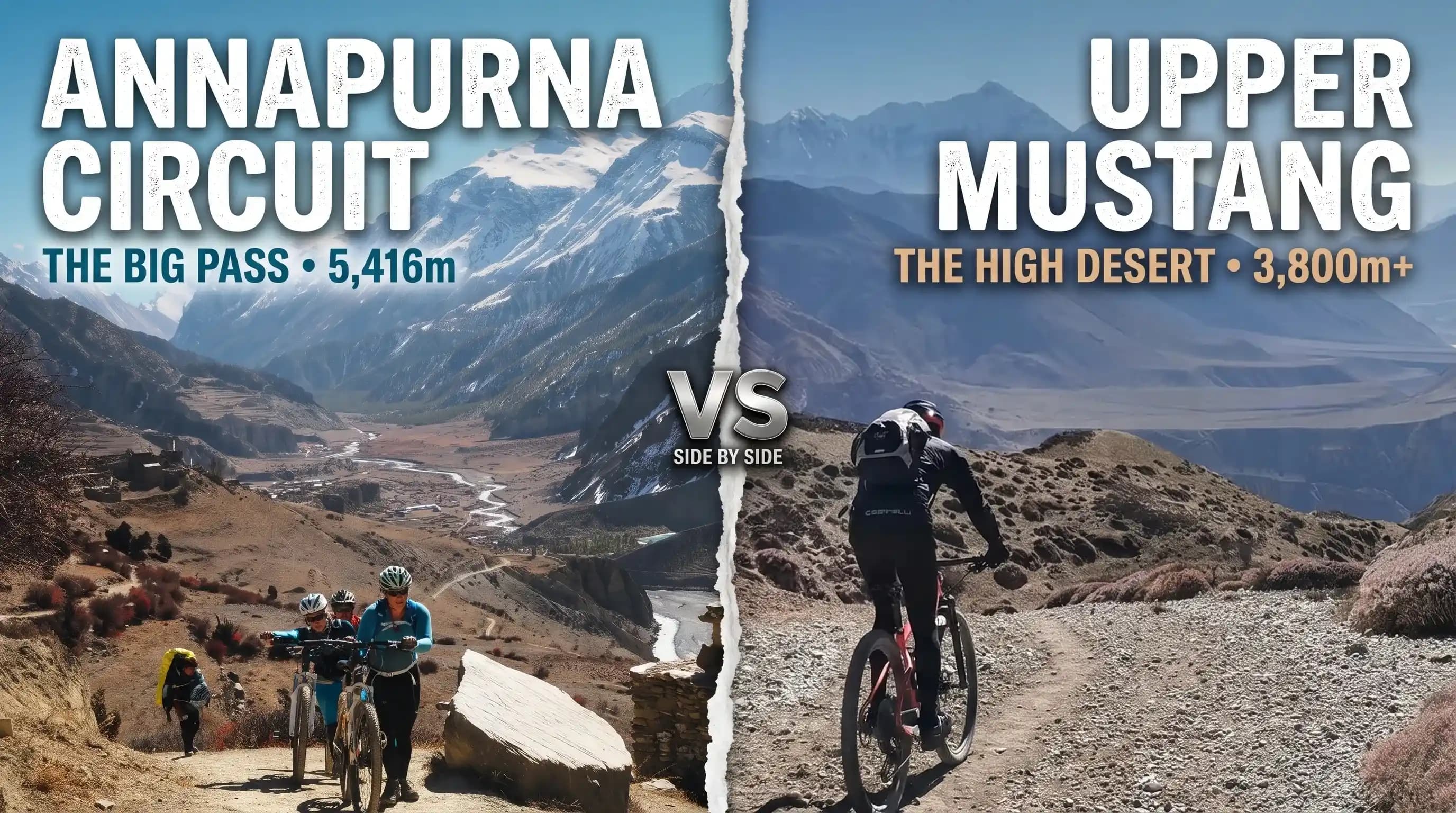




Thorong La is the benchmark ride of high altitude mountain biking. This is our guide to the pass: what pass day is like, how riding changes up high, a self-test to show whether you're ready, and an 8-week plan to close the gap.
Nepal MTB Adventures guiding team, Pokhara · October 2026
Riders rarely come unstuck on the descent from Thorong La. They come unstuck in the days before it. There's the 1,800-metre climbing day in the Marsyangdi gorge, the short stages above 4,000 metres that take all morning, and a 4 am walk uphill with your bike in the thinnest air of the trip. All of that comes before the 1,616-metre drop to Muktinath that you came for.
This page covers all of it. It starts with the pass itself and how we get you over it. Then it covers what thin air does to you and your bike. After that, you test yourself against rides you already know, and follow an 8-week plan to fix whatever falls short. High altitude mountain biking is mostly preparation you can do before you fly. The rest is acclimatisation, and that's our job on the trail.
Thorong La in brief
Where: the high pass of the Annapurna Circuit in central Nepal, between the Manang valley and Mustang
Height: 5,416 m (17,769 ft)
Pass day: a 4 am start, about 966 m (3,169 ft) of pushing and carrying from Thorong Phedi, then 1,616 m (5,302 ft) of descent to Muktinath
Best months: October and November, then March to May
What you can train: your engine, your skills, and walking uphill with a bike
What you can't train at home: your body's response to altitude. Fitness doesn't protect you from altitude sickness.
The test: 13 yes-or-no statements, about ten minutes.
The plan: 8 weeks if you already ride three times a week.
Why Thorong La is the benchmark for high altitude mountain biking
Every kind of mountain biking has a ride that riders measure themselves against. Downhill racers have the Megavalanche. For high altitude mountain biking, we think it's Thorong La. A few motor roads in the Indian Himalaya climb higher. Few rides anywhere pack as much into one trip: ten days from rice terraces to high desert, a pass higher than any summit in the Alps, and a descent that goes on for days.
How high is 5,416 metres
Reference point | Height | Thorong La is |
Ben Nevis, the UK's highest mountain | 1,345 m (4,413 ft) | about four times as high |
Mount Kosciuszko, Australia's highest mountain | 2,228 m (7,310 ft) | more than twice as high |
Col de l'Iseran, the highest paved pass in the Alps | 2,764 m (9,068 ft) | 2,652 m (8,701 ft) higher |
Mount Blue Sky Road, North America's highest paved road | 4,310 m (14,140 ft) | 1,106 m (3,629 ft) higher |
Mont Blanc, the highest summit in the Alps | 4,807 m (15,771 ft) | 609 m (1,998 ft) higher |
How far down it goes
The way down is just as big. From the pass you ride down to Muktinath in one morning. Then you keep going, down the Kali Gandaki, by some measures one of the deepest gorges on earth, to the hot springs at Tatopani. From the top of the pass to Tatopani, that's more than 4,000 metres (13,100 ft) of descent over two to three riding days. The Megavalanche, the Alpine race famous for its drop, descends about 2,600 m (8,500 ft). This is more than one and a half times that.
And you sleep in a bed every night
You ride all of it from lodges. Family-run teahouses line the route, even at Thorong Phedi, 4,450 m (14,600 ft), so there's no tent and no loaded bike. That's a big part of why a ride this high is within reach of a fit, prepared rider.
Part 1: Thorong La at a glance
Thorong La is the highest point of the Annapurna Circuit, crossed on foot with your bike and ridden down the far side. Everything about the day, from the direction you ride to the month you come, is planned around getting you over it safely.
Where | Central Nepal, on the Annapurna Circuit. It links the Manang valley in the east to Muktinath and Mustang in the west, inside the Annapurna Conservation Area. |
Height | 5,416 m (17,769 ft) |
Last night before the pass | Thorong Phedi, 4,450 m (14,600 ft), or High Camp, 4,850 m (15,912 ft) |
The climb | About 966 m (3,169 ft) from Thorong Phedi, pushed and carried |
The descent | 1,616 m (5,302 ft) to Muktinath, 3,800 m (12,467 ft) |
Best months | October and November, then March to May |
Not recommended | December to February. Snow closes the pass and the high lodges shut. |
Permit | Annapurna Conservation Area permit, NPR 3,000 for foreign nationals in 2026. We arrange it on our trips. |
Where you sleep | Family-run lodges every night, including at Thorong Phedi and High Camp |
Why we cross it anticlockwise
We ride the Circuit anticlockwise, east to west, so you reach the pass from the Manang side. That gives you a week of gradual climbing and a rest day at Manang, 3,540 m (11,614 ft), before pass day. From Thorong Phedi you then climb about 966 metres. Go the other way, and you'd face more than 1,600 metres of climbing from Muktinath in one push, with far less time to acclimatise. Anticlockwise also puts the long descent where you want it: after the pass, not before.
Our trips that cross Thorong La
Trip | Days | How you cross the pass |
15 | On foot with your bike. Our porters carry the frames over the steepest sections. | |
14 | On foot with your bike, with our summit porters | |
22 | Over the pass, then on into Upper Mustang to Lo Manthang | |
17 | On foot, without your bike. It goes ahead by jeep and meets you at Muktinath. | |
13 | An optional Thorong La day, if the weather, the trail and your acclimatisation allow |
The day-by-day route for each option is in our Annapurna Circuit bike itinerary.
Part 2: Pass day, hour by hour
Pass day is the one you'll remember, and the one we plan most carefully. It takes about 6 to 7 hours, starts in the dark, and splits into two halves: a long walk up with your bike, then the descent you came for.
The day before
You sleep at Thorong Phedi or High Camp. High Camp makes the morning shorter, but the night is colder and higher. We decide on the day, using the weather forecast, your oxygen readings, and how you slept, not the plan.
We check your bike together: brake pads, tyre pressure, anything loose.
Pack your bag the night before, eat a big dinner, drink plenty, and go to bed early.
The climb
We wake you at about 3:30 am and set off at about 4 am, by head torch. It will usually be well below freezing. The early start gets you over the top before the strong winds that build by late morning.
There's no riding on the way up. You push on the easier grades and shoulder the bike on the steep switchbacks. Our porters carry the frames over the steepest sections, so you reach the top with legs left for the descent.
Go slowly enough to hold a conversation. At this height a steady pace gets you to the top. A fast one gets you a headache.
At the top
Prayer flags, a view across to Mustang, and a hot drink if the teahouse is open. Take your photos, then we go. The cold at 5,416 metres drains your energy fast.
The descent
Drop your saddle, put on dry gloves, and add a layer before you start.
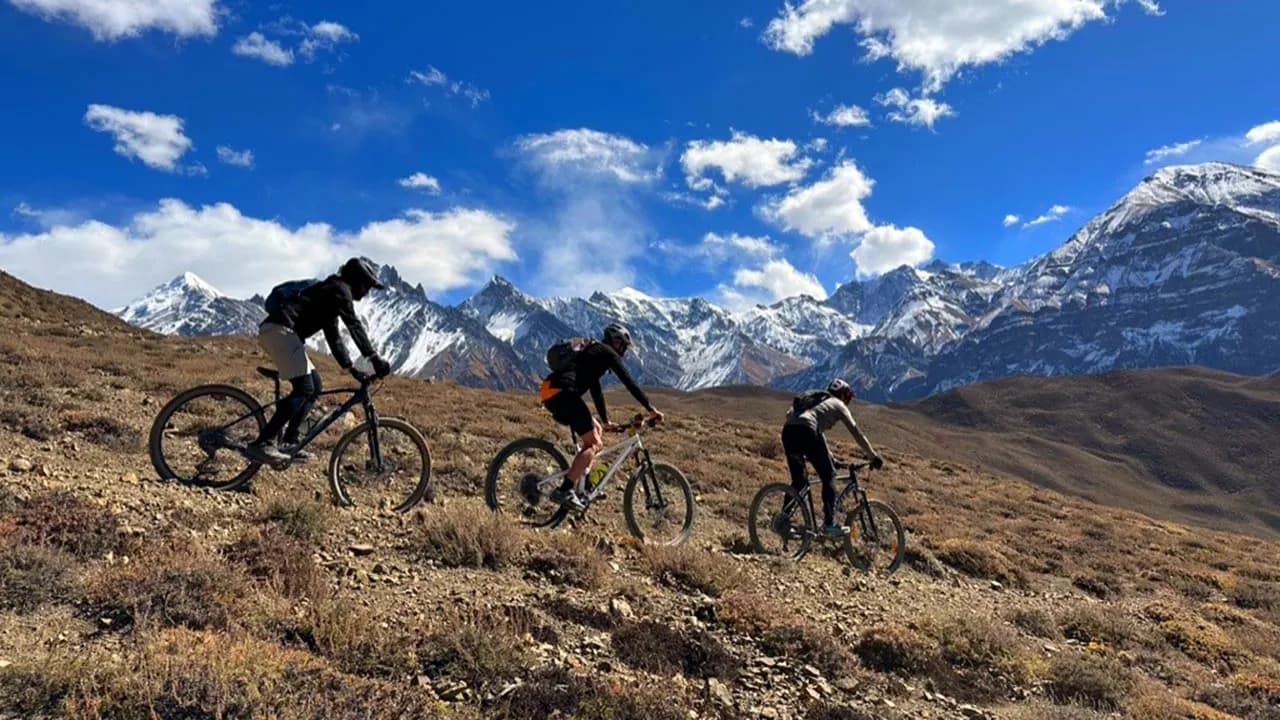
The top is loose shale and moraine with tight switchbacks, and in early and late season, snow. Ride what you're happy on and walk the rest. Lower down it opens into fast, flowing high-desert singletrack.
Stop now and then to rest your hands and let your brakes cool. Give walkers plenty of room. They've had a long morning too.
By early afternoon you roll into Muktinath, 3,800 m (12,467 ft), among stone houses and apple trees.
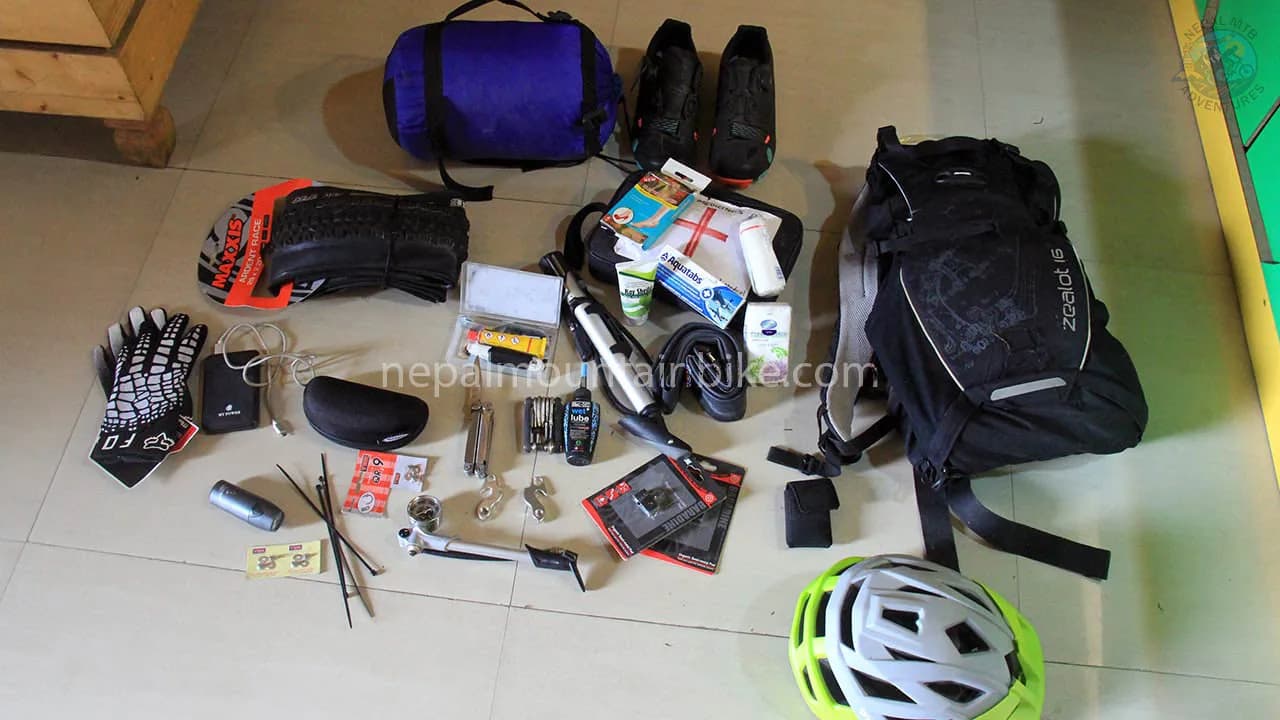
What to carry on pass day
Insulated jacket and a windproof shell
Warm gloves with liners, and a spare dry pair for the descent
A warm hat that fits under your helmet
Head torch with fresh batteries
Two litres of water, carried inside your jacket so it doesn't freeze
High-energy snacks you'll still want to eat when you've lost your appetite
Sunglasses, sunscreen and lip balm
Some cash for the teahouse at the top
When the pass says no
Snow can lie on the upper switchbacks in any season, and then the top of the descent becomes a careful walk. In bad weather, the pass closes, sometimes for days. That's why every trip has a spare day. If you're unwell, or the weather turns, we wait or turn back. Your guide makes the call, and the pass will still be there tomorrow.
Guide's tip. Put your descent gloves in an inside pocket at Thorong Phedi. After four hours of climbing, the pair you're wearing will be damp. Dry, warm hands are what make the top of the descent safe.
Part 3: Riding at high altitude: what changes
Up high, you have less power, you need more water and food, the weather is harsher, and your bike works harder on the way down. None of it is a reason not to go. All of it changes how you ride.
Your engine
Your engine shrinks as you climb. In tests on trained endurance athletes, maximal aerobic capacity fell by about 6% for every 1,000 m (3,300 ft) of height, and those tests only went up to 2,800 m (9,200 ft). Above that, it keeps falling. By the top of Thorong La, the air pressure, and with it the oxygen you take in with each breath, is roughly half what it is at sea level.
You feel it most on stages that look easy on paper. On our 15-day tour, Manang to Yak Kharka is a short stage that takes four to five hours. The trail isn't hard, and the gradient isn't steep. You simply have less energy to spend.
Pacing and breathing
Climb at conversation pace. If you can't speak in sentences, slow down.
Shift early and spin a low gear rather than pushing a big one.
Take short rests often, before you need them, not long rests when you're spent.
Let the guide set the rhythm. Chasing the rider in front is the quickest way to a headache.
Food and water
The dry, thin air dries you out, and altitude dulls your appetite just when you need the most fuel. Drink three to four litres of water a day. Eat plenty of carbohydrate even when you don't feel hungry: dal bhat, potatoes, porridge, noodles and garlic soup are on every lodge menu. Little and often works best on the bike.
Cold, wind and sun
Cold. Pass-day mornings are well below freezing. Layer up for the start and strip off as the sun hits you.
Wind. On the Mustang side, strong wind builds from late morning, especially in the Kali Gandaki. That's why we start early on the western side.
Sun. UV gets stronger as you climb, by about 10% for every 1,000 metres, according to the World Health Organization. Wear wraparound sunglasses, high-SPF sunscreen and UV lip balm, even when it's cold.
Your bike up high
Brakes. The descent from the pass, followed by the Kali Gandaki days, can wear out a set of brake pads. Bring two pairs that match your brakes, and ride 180 mm rotors where your frame allows.
Tyres. We drop pressures for the loose ground beyond Manang. Tubeless tyres with tough sidewalls save a lot of roadside repairs.
Spares. There's no bike shop beyond Besisahar that will stock parts for your bike. Bring two spare derailleur hangers for your frame.
Shoes. Sticky flats or clipless shoes you can walk in. You'll hike in them on frozen ground.
Bags. A frame bag or hip pack. A big backpack is miserable on the carry.
More on choosing a bike for the pass is in our best bike for the Annapurna Circuit guide.
Part 4: What Thorong La asks of your body
Thorong La asks for four things: an engine that recovers overnight, legs and lungs that can walk uphill for hours at extreme altitude, the skill to ride loose ground when you're tired, and a body that adapts to thin air. The first three you can train. The fourth you can only manage.
The days that decide it
These are the hardest days on our 15-day Annapurna Circuit tour. They're the days the self-test is built around.
Day | What happens | What it tests |
Day 3 | 6 to 7 hours in the saddle, about 857 m (2,800 ft) of climbing, on a low, rolling trail | Time on the bike |
Day 5 | About 1,800 m (5,900 ft) of climbing in 5 to 6 hours, with almost no descent to recover on | Sustained climbing |
Day 7 | Tight switchbacks out of Pisang, then narrow, exposed high trail to Manang | Technical skill in thin air |
Day 9 | The short stage to Yak Kharka, 4,110 m (13,484 ft), in 4 to 5 hours | Pacing at altitude |
Day 10 | A loose scree traverse, then a steep climb to Thorong Phedi | Focus when tired |
Day 11 | Pass day | Everything at once |
Look at the pattern. No single day is beyond a strong club rider at home. What makes the trip hard is that the days stack up, the air thins as they do, and the hardest one comes last.
Guide's tip. The riders who struggle on pass day are rarely the weakest. They're the ones who raced the stages after Manang to stay with the front. Ride Day 9 and Day 10 slower than feels necessary, and you'll have plenty left for the top.
Part 5: The self-test
Answer each statement honestly about how you ride now, not how you rode two years ago. Score one point for every yes. Base your answers on a ride you've actually done, not one you think you could do.
A. Your engine
I ride at least three times a week, and I have for the last three months.
I can ride 4 to 5 hours off-road with about 1,200 m (3,900 ft) of climbing.
I can repeat that ride the next day, and the day after, without my legs giving out.
I can climb 600 m (2,000 ft) in one go without stopping, at a pace where I could still talk in short sentences.
I can walk uphill for an hour pushing or carrying my bike, or with a 10 kg (22 lb) pack.
B. Your skills
I ride loose, rocky trails graded red or black in the UK, blue square or black diamond in North America and Australia, S2 to S3 on the Singletrail-Skala, or grade 4 in New Zealand. I walk no more than the odd feature.
I can ride tight, loose switchbacks downhill, and walk the ones I can't ride without getting flustered.
I can ride 30 minutes of continuous rough descent without stopping because my hands or arms give out.
I ride technical trail at the end of a long day, not only when I'm fresh.
A narrow trail with a long drop on one side doesn't stop me in my tracks.
C. You in the mountains
I've slept above 2,500 m (8,200 ft) and felt fine, or I've been above 3,500 m (11,500 ft) without serious altitude sickness.
I've ridden or hiked in sub-zero temperatures and know which layers keep me warm.
My doctor knows I'm going to 5,416 m (17,769 ft) and is happy for me to go.
Three must-haves
Whatever your total, these three need a yes before Thorong La:
Statement 3, back-to-back days. The Circuit is ten riding days, not one big one.
Statement 6, trail grade. You can build fitness in eight weeks. Confidence on loose, exposed trail takes longer.
Statement 13, your doctor. Book the appointment before you book the flight.
Talk to your doctor before you book if you have a heart or lung condition, sickle cell disease, high blood pressure that isn't well controlled, are pregnant, or if you've ever had high-altitude pulmonary oedema (HAPE) or cerebral oedema (HACE). It doesn't automatically rule you out. It does need a proper conversation first.
What your score means
Score | Where you are | What to do |
11 to 13, with all three must-haves | Ready now | Use the 8-week plan to sharpen up and rehearse pass day. |
8 to 10, with statement 1 a yes | Ready in 8 weeks | Follow the plan in Part 7. Retest in week 7. |
5 to 7, or statement 1 is a no | Ready in about 16 weeks | Use the 16-week outline in our Annapurna Circuit guide, or plan for next season. |
0 to 4 | Not this season | Build up first. See Part 9 for trips that get you there. |
If you scored well on A and poorly on B, your fitness is fine, and your skills are the gap. Put your training hours into technical riding, ideally with a coach, and see Part 9.
If you scored well on B and poorly on A, the 8-week plan was written for you.
If statement 11 is a no, that's normal, not a fail. Most riders arrive with no altitude history. Our itinerary is paced for exactly that. It does mean being extra honest with your guide about how you feel from Manang onwards.
Part 6: Your home benchmark
The simplest test is a ride you already know. If you can ride your country's benchmark in good shape, then get up and ride hard again the next morning, you have the engine for Thorong La. Only the Whole Enchilada, which starts above 3,400 m (11,200 ft), gives you any taste of altitude. The rest test your legs, not your lungs.
Where you ride | Benchmark | The ride | Ready for Thorong La if |
UK | The Beast, Coed y Brenin, Wales | 35 km (22 miles) with 1,100 m (3,600 ft) of climbing. Graded black (severe), 3 to 6 hours. | You ride it in one go, then ride a red loop hard the next morning |
US | The Whole Enchilada, Moab, Utah | 43 km (26.5 miles) from Burro Pass at 11,200 ft (3,414 m) to the Colorado River at 4,000 ft (1,219 m). More than 7,000 ft (2,130 m) of descent. | You ride it top to bottom with control left for the rough lower sections, then ride the next day again |
Germany, Switzerland, Austria | Stoneman Miriquidi (DE/CZ) or Stoneman Glaciara (CH) | Miriquidi: 162 km with 4,400 m of climbing. Glaciara: 127 km with 4,700 m. | You finish in three days for bronze. Silver, in two days, means you have plenty in reserve. |
Australia | Australian Alpine Epic, Mt Buller | 46 km (29 miles) with about 1,000 m (3,300 ft) of climbing. Graded black (advanced), around 6 to 8 hours. | You ride it in a day, then ride hard again the next morning |
New Zealand | Old Ghost Road, West Coast | 85 km (53 miles), grade 4 (advanced), with short grade 5 sections. Most fit riders take 2 to 4 days. | You ride it in two days, or in three with energy to spare each morning |
Riding in Canada? Use the IMBA grades in self-test statement 6, and a big alpine day of 1,200 m (3,900 ft) of climbing as your benchmark.
Two things the benchmarks don't show. First, Thorong La gives you ten days of this, not two or three. Second, at 4,000 m and above, the same effort moves you far more slowly. That's why statement 3 in the self-test matters more than any single ride.
Our trail grading guide explains how the trails on the Circuit compare with the grades you ride at home.
Part 7: The 8-week plan
This plan takes a rider who already rides three times a week to Thorong La fitness in eight weeks. It builds for three weeks, recovers for one, builds for three more, then tapers. Hours are total training time for the week, strength included.
The plan, week by week
Week | Focus | Key sessions | Hours |
1 | Build | Long ride 3 hours with 800 m (2,600 ft) of climbing. Two strength sessions. 20 minutes of hike-a-bike on a steep hill. | 6 to 7 |
2 | Build | Long ride: 3.5 hours with 1,000 m (3,300 ft). A climbing session: 3 × 15 minutes of steady climbing. Two strength sessions. | 7 to 8 |
3 | Build | First back-to-back weekend: 3.5 hours, then 3 hours. 30 minutes of hike-a-bike. Ride a technical section at the end of your long ride. | 8 to 9 |
4 | Recover | Cut your volume by about a third. One relaxed skills session on switchbacks and loose descents. One strength session. | 5 |
5 | Build | Long ride 4 hours with 1,200 m (3,900 ft). A climbing session: 4 × 15 minutes. 40 minutes carrying the bike on your shoulder. | 9 |
6 | Three-day block | Three long days in a row: 4 hours, 4 hours, 3 hours. These are self-test statements 2 and 3 in real life. | 10 to 11 |
7 | Peak | Long ride: 5 hours with 1,500 m (4,900 ft). 60 minutes of hike-a-bike up steep ground. One pre-dawn cold start. Retake the self-test. | 10 to 12 |
8 | Taper | Halve your volume. Keep two short rides with a few hard efforts. Service the bike. Sleep. | 4 to 5 |
A normal week in the plan
Day | Session |
Monday | Rest |
Tuesday | Climbing session, 60 to 90 minutes |
Wednesday | Strength, 30 to 40 minutes |
Thursday | Easy ride or skills session, 60 to 90 minutes |
Friday | Rest, or strength |
Saturday | Long ride, with hike-a-bike at the end |
Sunday | Second ride, shorter. From week 3, a long one. |
How hard to go
Long rides and back-to-backs: at conversation pace. This is the pace you'll climb at above Manang, so learn what it feels like now.
Climbing sessions: comfortably hard. You could say a few words, not a sentence. Recover fully between efforts.
Hike-a-bike: steady and unhurried. The aim is time on your feet uphill, not speed.
Strength, twice a week
Thirty to forty minutes, in weeks 1 to 6. Once in week 7, none in week 8.
Step-ups onto a knee-high box, with a pack: 3 × 12 each leg
Split squats: 3 × 10 each leg
Romanian deadlifts: 3 × 10
Single-leg hip bridges: 3 × 12 each leg
Push-ups: 3 × 10 to 15 (they help on the bike carry and on long descents)
Plank and side plank: 3 × 45 seconds each
Farmer's carry with heavy bags or dumbbells: 3 × 40 metres
No big hills where you live?
Stairs or a stadium with a 10 kg (22 lb) pack stand in for hike-a-bike. Walk up, take the lift or walk down gently, repeat.
A treadmill at 10 to 15% incline with a pack works for long, steady uphill walking.
A turbo trainer with long virtual climbs covers the climbing sessions. Ride outside for the long rides, though. Skills and comfort don't come from a trainer.
Step-ups in the strength session do more for pass day than almost anything else.
Rehearse pass day at home
Each piece of pass day can be practised. Tick these off in weeks 5 to 7.
Walk uphill for an hour in your riding shoes.
Shoulder your bike. Practise lifting it onto your shoulder with the top tube resting there. Then carry it up a steep path for 10 minutes at a time.
Start before dawn, in the cold. Once, set off with lights on a cold morning and ride for an hour before you've properly woken up.
Eat and drink while working hard. Practise getting food in every 45 minutes while you climb, in full-finger gloves.
Ride a long, rough descent with cold hands. Learn how your brakes feel in winter gloves, and how to rest your hands without stopping.
Ride in your pass-day layers. Find out what you'll strip off and when.
Carry your pass-day bag on your long rides from week 5.
Our mountain biking checklist for Nepal has the full kit list.
Guide's tip. Do your technical practice at the end of a long ride, not at the start. On the Circuit you'll meet the hardest descents tired, cold and short of breath. Practise them that way at home.
Part 8: Altitude sickness: what training can't do
Training gets your legs and lungs ready. It doesn't change how your body reacts to thin air. Training and fitness don't affect your risk of acute mountain sickness (AMS). The best guide to how you'll cope is how you've coped at altitude before. Fit riders do carry one extra risk: they can climb faster than their bodies can adapt.
What helps and what doesn't
| Does it help? |
Arriving fit | Yes. Not against AMS, but every day uses a smaller share of your engine, so you recover better. |
A slow ascent with rest days | Yes. This is the main protection. Above 3,000 m (9,800 ft), we raise your sleeping height by about 500 m (1,640 ft) a night at most, and we spend a full rest day at Manang. |
Acetazolamide (Diamox) | It can help prevent AMS. It's prescription-only, so talk to your doctor before you travel. Doctors often suggest a short trial at home first, because tingling fingers and fizzy drinks tasting flat are common side effects. |
Altitude training masks | No. They make breathing harder, but they don't reduce the oxygen in the air. See the FAQ. |
Hypoxic tents at home | No. Current medical guidelines advise against them for preventing altitude sickness. See the FAQ. |
Time high before the trip | Yes, if you can. Two or more nights above 2,750 m (9,000 ft) in the two weeks before you travel helps, in the Alps or the Rockies, for example. It isn't required. |
Alcohol in the first days: high | Skip it for the first 48 hours at altitude, and never use it as a sleep aid up high. |
The signs to know
Acute mountain sickness (AMS) feels like a hangover. It's a headache plus at least one of these: nausea or loss of appetite, dizziness, tiredness, or poor sleep. It usually starts 2 to 12 hours after reaching a new height. It's common, and nothing to hide. We don't go higher until it clears.
High-altitude cerebral oedema (HACE) shows as confusion, stumbling or loss of balance, and unusual drowsiness.
High-altitude pulmonary oedema (HAPE) shows as breathlessness out of proportion to the effort, then breathlessness at rest, and a cough that turns wet or brings up blood-stained phlegm.
HACE and HAPE are rare with good acclimatisation, and both are emergencies. The treatment is to go down straight away. Even 300 to 1,000 metres lower makes a real difference, and on a bike you can lose height quickly.
What we do on the trail
On our Annapurna Circuit trips, from Day 5 we check every rider's heart rate and blood oxygen morning and evening. The trend over several days tells us how you're adapting. We carry medical oxygen, every guide has the authority to turn a rider around, and our Pokhara office coordinates helicopter rescue if it's ever needed. Your policy needs to cover that rescue; see our mountain bike travel insurance guide.
Your part is simple. Tell your guide about a headache the day it starts, not the day it gets bad.
Part 9: Not ready yet? Your options
Not ready this season isn't a no. It's a later date, or a different way to reach the pass.
Give it a season. If you score 5 to 7 now, a spring or autumn date six months away is realistic. See the best time to mountain bike in Nepal.
Walk the pass, ride the rest. On our Annapurna hike and bike, you trek over Thorong La and pick up your bike at Muktinath for the descent.
Ride an e-MTB. It takes much of the work out of the climbing days. See the FAQ.
Ride the western side first. Lower Mustang tops out at about 3,800 m (12,470 ft). That's high enough to learn how you handle altitude, with no 5,000-metre pass. It also runs as an e-MTB expedition.
Start with Pokhara. A few day rides around Pokhara show you what Nepali trails feel like and where your skills stand.
Still deciding between riding and walking the Circuit? Read our bike it or trek it comparison.
Frequently asked questions
How hard is Thorong La by bike?
It's one of the hardest days you can ride anywhere, but it isn't a technical-riding test on the way up. The climb is a walk of several hours with your bike, and the top of the descent is steep and loose. The hard part is doing it on day eleven, at 5,416 m, after ten days on the bike.
Is Thorong La the highest bike ride in the world?
No, and we won't tell you it is. Motor roads in Ladakh, in the Indian Himalaya, climb higher: Umling La reaches 5,799 m (19,026 ft), and Mig La about 5,900 m (19,400 ft). Thorong La is higher than any summit in the Alps and any paved road in North America, and it's one of the highest points crossed on a classic guided mountain bike tour. What makes it the benchmark isn't the height alone. It's the whole ride: the climb through the Marsyangdi valley, the pass, and the long descent down the Kali Gandaki.
Do I need a guide to ride Thorong La?
Yes. Since 1 April 2023, Nepal Tourism Board rules have required foreign trekkers and cyclists in national parks and conservation areas to travel with a licensed guide and carry a TIMS card (NPR 2,000). Thorong La is inside the Annapurna Conservation Area, so the rule applies. On our trips your guide is licensed and we arrange the TIMS card and the conservation area permit.
Is the Annapurna Circuit harder by bike than on foot?
It's harder on your legs, and easier to get wrong on altitude. Walkers climb slowly whether they like it or not. Riders can gain height quickly, which is why we keep the stages above 4,000 m short. On pass day, walkers carry a day pack while riders also get a bike over the top.
Is Thorong La dangerous?
The real risks are altitude, cold, and weather, not the riding. Weather can turn fast up there: in October 2014 a sudden blizzard killed about 40 people around Thorong La. That's why we watch the forecast, start early, carry the right layers, and turn back when the mountain says so.
Do altitude training masks work?
No. A training mask restricts how easily you breathe in, but the air you breathe still holds sea-level oxygen. Real altitude lowers the oxygen pressure in the air itself. A mask may train your breathing muscles, but it won't acclimatise you. Spend the time on long rides and hike-a-bike instead.
Will an altitude tent help before my trip?
Probably not. The Wilderness Medical Society's 2024 guidelines recommend against hypoxic tents for preventing altitude sickness, because two placebo-controlled studies found they didn't significantly reduce it. Real-time high is what helps: two or more nights above 2,750 m (9,000 ft) in the fortnight before you travel. If you can't manage that, the slow ascent and the Manang rest day on our itinerary do the job.
Am I too old for Thorong La?
Age isn't the test. Your self-test score and your doctor's view are. Book a check-up, be honest about any heart, lung, or blood-pressure issues, and train for the back-to-back days.
Can I hire a pony if I'm struggling?
Yes. Pony hire is available along the route if you need help on the climb, on top of the porters who already carry the bike frames over the steepest sections. Tell your guide early. It's an easy call to make at Thorong Phedi, and a hard one halfway up.
Can I ride an e-bike over Thorong La?
Yes, on request on our 15-day tour. The support vehicle carries charging and spare batteries up to Manang and again from Muktinath, and our porters carry the heavier e-bike frames over the steepest part of the climb. An e-MTB makes the climbing days easier. It doesn't make the altitude or the descents easier.
Should I bring my own bike or rent one?
Either works. On our tours, you can ride one of our hardtails or full-suspension bikes, set up for you in Pokhara before you start. Bring your own if fit matters a lot to you. If you fly with it, our flying-with-a-bike guide covers packing and airline rules, and our workshop checks it over before the tour.