


An honest guide to the risks of riding in Nepal, risk by risk, from the Pokhara team that has guided mountain bikers here since 2004.
Somewhere between booking the flight and boxing the bike, the doubts arrive. A video shows a bus overtaking on a cliff road. A friend of a friend spent three days of their trip in bed. The news runs footage of a landslide. And a simple question starts to nag: is this actually safe?
It's a fair question, and it deserves a straight answer rather than "it's perfectly safe" or a list of horror stories. Mountain biking in Nepal is safe for most riders on a well-run trip. The risks are real, but they're specific. Most of them depend on where you ride, which month you ride, and how you get there, so most of them can be planned around. This guide goes through each one: what it is, how likely it is, what we do about it on our tours, and what you can do yourself.
Mountain biking safety in Nepal in brief
The overall answer: safe for most riders on a guided, well-timed trip. The risks are predictable by place and season.
Most common problem: an upset stomach. Usually mild, and twice as likely in spring as in autumn.
Main medical risk on high routes: altitude sickness. Fitness doesn't prevent it. A slow ascent does.
Biggest danger in numbers: the roads, not the trails. Nepal's roads kill about seven people a day.
Seasonal risk: landslides and floods from June to September, plus storms that can run into October.
Easy to overlook: rabies in dogs and monkeys. Rare for riders, but every bite needs treatment the same day.
Getting help: it exists, but it's slower than at home, and a rescue helicopter only flies once someone has guaranteed payment.
Your three must-dos: insurance that covers mountain biking and helicopter evacuation, a travel clinic visit, and riding in October to November or March to April.
What goes wrong on most Nepal bike trips is small: a stomach bug, a bruised hip, a headache at altitude. Serious problems are rare, and they cluster in a few places: the highways, the high passes, and the monsoon months.
The risks at a glance
This is how we rate each risk, based on more than twenty years of guiding riders here and the official sources quoted in each part below.
Risk | How likely | How serious | Where and when |
Upset stomach | Common | Usually mild, one to three days | Anywhere. Higher from March to May |
Falls and crashes | Occasional | Mostly scrapes and bruises. Collarbones and wrists when it's worse | Stone steps, loose descents, tired legs late in the day |
Altitude sickness | Mild symptoms are common above 3,000 m (9,800 ft) | Serious forms are rare with a slow ascent, but they're emergencies | Annapurna Circuit, Upper and Lower Mustang |
Road accidents | Rare on any one trip | Can be severe | Highways, night buses, city traffic |
Landslides and floods | Seasonal | Mostly they block roads. Sometimes deadly | June to September, plus storms into October |
Snowstorms on high passes | Rare | Severe if you're caught out | Thorong La and other high passes, after storms in any season |
Crime | Low for serious crime | Mostly lost property | Cities, buses, kit left unattended |
Where the risk sits, trip by trip
The kind of ride you choose changes the list more than anything else. Our guide to cycling holidays in Nepal compares where to ride and how to plan around each region.
Kind of trip | Highest point | The risks that matter most |
Day rides around Pokhara | Below 1,600 m (5,250 ft) | Traffic in town, heat, stomach, and falls on steep trails |
Kathmandu Valley rides | Rim ridges up to about 2,700 m (8,860 ft) | City traffic, air quality in spring and winter, dogs |
Enduro days around Pokhara | Ridges above town | Crashes on steep, technical descents and arm pump. Altitude isn't a factor |
About 3,800 m (12,470 ft) at Muktinath | Altitude, jeep traffic and dust, afternoon wind, remoteness | |
Passes around 4,000 m (13,100 ft) and above | Altitude, remoteness, cold, a long way to a hospital | |
Thorong La, 5,416 m (17,769 ft) | Altitude, cold and storms on the pass, long descents, jeep traffic |
What isn't the problem
Serious crime against visitors is rare. The UK government's travel advice calls Nepal's rate of serious crime low, and warns mainly about pickpockets and bag snatchers in airports and on buses (FCDO). On the trail, people are welcoming and curious. A rider is far more likely to be offered tea than to be bothered.
> Guide's tip: most of what goes wrong on a bike trip here starts the same way, with someone pushing on when they should have said something. Tell your guide about the headache, the twinge, or the dodgy brake the moment you notice it. Every problem is smaller on the day it starts.
Is Nepal safe to visit right now?
Yes. As of 1 November 2026, none of the main governments advise against travel to Nepal as a whole. They ask visitors to take extra care and to avoid one flood-damaged area north of Kathmandu, well away from Pokhara, Annapurna and Mustang.
What the travel advisories say
Government | Current level for Nepal | What it singles out |
United States | Level 2: Exercise increased caution. Lowered from Level 3 on 31 March 2026 | Level 4, do not travel, for the Rasuwagadhi, Timure and Syafrubesi area of Rasuwa and the China border crossing, after the August 2026 flood |
United Kingdom | No advice against travel | Flood and landslide damage in Rasuwa, Nuwakot, Dhading and Gorkha |
Canada | Exercise a high degree of caution | Avoid non-essential travel to Rasuwa and Nuwakot districts |
Australia | Exercise a high degree of caution, because of natural disasters and road accidents | Reconsider your need to travel to the flood-hit areas along the Bhote Koshi and Trishuli rivers in Rasuwa and Nuwakot |
Advisories change, so read the current page before you travel: US State Department, UK FCDO, Canada and Australia's Smartraveller. Your insurer reads them too, and some policies don't cover travel to an area your government advises against.
The politics, briefly
In September 2025, protests led by young Nepalis turned violent in Kathmandu and other cities. At least 76 people died, and the government fell. An interim government took over, Nepal held elections on 5 March 2026, and a new government was sworn in on 27 March. When the US lowered its advisory the following week, it said the nationwide protests had ended, and the security situation was stable, while warning that protests can still start with little warning (Kathmandu Post).
For a rider, that means two practical things. Keep away from demonstrations in the cities. And expect the odd bandh, a general strike that can stop road traffic for a day. When one is called, we move transfers around it. Our Nepal travel update covers how the country has run since the protests.
Petty crime and scams
The usual city care applies. Keep your phone and wallet zipped away on buses and in crowds, and use a hotel safe. The scam worth knowing about is the one riders and trekkers most often fall into: a trip that's far cheaper than everyone else's. If you're weighing an overseas company or a local operator, check exactly what's included on the ground. The UK and Canadian governments both warn about cheap trekking deals, and about guides who rush clients uphill to trigger a helicopter evacuation billed to their insurer. Our mountain bike travel insurance guide explains the 2026 rescue-fraud case and how to protect your claim.
Altitude: the risk fitness can't fix
Altitude is the main medical risk on our high routes. It's predictable and manageable with a slow ascent, but no amount of training protects you from it. The fittest rider in the group can feel it first.
How high our rides go
Place | Height | What it means |
Pokhara | About 800 m (2,600 ft) | No altitude effect |
Kathmandu | About 1,400 m (4,600 ft) | No altitude effect for almost everyone |
Jomsom | 2,720 m (8,920 ft) | Some riders notice it on the first climbs and the first night |
Manang | 3,540 m (11,610 ft) | Higher than any town in the Alps. We spend a full rest day here on the Annapurna Circuit |
Muktinath | About 3,800 m (12,470 ft) | The top of Lower Mustang |
Thorong La | 5,416 m (17,769 ft) | More than four times the height of Ben Nevis, and more than 1,000 m (3,300 ft) above the highest summits in Colorado |
Why riders are at more risk than trekkers
Walkers climb slowly whether they like it or not. On a bike, you can gain height in a morning that would take a trekker two days. The climbing days on our high routes are set by how fast a body adapts, not by how fast a rider can pedal. That's why some of our days above 3,000 m look short on paper.
The bike also gives you an advantage. The treatment for serious altitude illness is to go down, and on a bike you can lose height quickly.
The rules we ride by
These follow the CDC's guidance on high-altitude travel (CDC Yellow Book).
Above 3,000 m (9,800 ft), raise your sleeping height by no more than about 500 m (1,640 ft) a night.
Build in a rest day for every 1,000 m (3,280 ft) or so of height gained.
Never go higher with symptoms. Rest until they clear, or go down.
Go down straight away with any sign of the serious forms: confusion, stumbling, or breathlessness at rest.
Skip alcohol for the first 48 hours at a new height.
Talk to your doctor about acetazolamide (Diamox) before you travel. It's prescription-only.
What we do on high routes
On the Annapurna Circuit, our guides check every rider's heart rate and blood oxygen morning and evening from Day 5. We carry emergency oxygen on high routes. Every lead guide has the authority to turn any rider around, and the support vehicle runs up to Manang and picks up again at Muktinath. Our Annapurna Circuit guide explains how the itinerary handles the climb to the pass.
> Guide's tip: acute mountain sickness feels like a hangover: a headache, plus nausea, poor sleep, dizziness or no appetite. It's common and nothing to be embarrassed about. The only dangerous version is the one you hide.
On the trail: crashes, descents and sharing the path
Most riding injuries in Nepal are the same as at home: scrapes, bruises and the odd sprain. What's different is the terrain, the length of the descents, and the fact that you share every trail with people and animals.
Trails built for feet, not bikes
Almost every trail you ride here is an old footpath between villages. Nobody shaped the berms or graded the steps. One descent can bring stone staircases, loose rock, roots, a narrow ledge with a drop, and a smooth flowing ridge, all in an hour. Our trail grading guide shows how each tour compares with the grades you ride at home, so you can pick a level you'll enjoy rather than survive.
Walking a section is normal here. On the steepest stone steps, local riders walk too.
Long descents and tired arms
Nepal's descents are long. Coming off a high pass, a single descent can run for well over 1,000 m (3,300 ft) of height. Our 10 best Himalayan mountain biking trails show where the longest ones are. That brings its own risks:
Fatigue. Crashes tend to happen late in the day, when hands, arms, and concentration are tired. That's why our shuttle-assisted enduro day around Pokhara spends your legs on descending, not climbing. Stop and shake out your arms often on long descents.
Cold hands. Hands that are numb from the cold can't brake properly. Wear full-finger gloves and carry a warmer pair for the high passes.
Brakes. Long descents and fine dust wear pads fast. One rider on the Annapurna Circuit reported that "both my brake pads and my riding partner's glazed, meaning we both lost all of our brake power" (Adventure Cycling). Carry spare pads, and if you bring your own bike, have the brakes serviced before you fly. On our Annapurna trips, a bike mechanic is part of the crew, and the support vehicle carries spares.
Mule trains, jeeps and villages
You share the trails with farmers, school children, porters, and trains of mules and donkeys carrying loads up the valleys. A few rules keep everyone safe:
Mule and donkey trains: stop and wait on the uphill side of the trail, away from the drop, until the whole train has passed. A loaded animal can knock a rider off the edge.
Jeeps on the trail roads: on the Annapurna and Mustang roads, pull in on the mountain side, not the drop side, and let them pass.
Villages: ride slowly. Children run out, chickens cross, and someone is always carrying something round the next corner.
Blind corners: ride as if someone is coming up, because often someone is.
Afternoon wind in the Kali Gandaki
In Lower Mustang, a strong wind blows up the Kali Gandaki valley from around midday, often enough to push a rider sideways on exposed sections. Our Mustang riding days start early so the exposed sections are behind us before it builds.
Protective kit
Kit | Why it matters here |
Helmet | Non-negotiable on every ride. We provide premium helmets on our tours |
Full-finger gloves | Grip, protection in a fall, and warmth on cold descents |
Knee pads | Lightweight trail pads for stone steps and rocky descents |
Eye protection | Dust, grit, and strong sun at altitude |
Buff or dust mask | Jeep roads and dry trails get very dusty |
Bright layer | Helps drivers see you on road sections |
Overnight at lodges
Riders on teahouse trips sometimes lose small things left on the bike overnight. Two bikepackers on the Annapurna Circuit wrote: "We made the mistake of leaving some tools, bib shorts and other clothing in the frame bag. The next day our stuff was gone" (bikepacking.com). Take everything off the bike each evening.
Roads, traffic and flights
By the numbers, Nepal's roads are the most dangerous part of any trip here, far more than the trails. The answer is simple: travel by day, ride trails rather than highways, and leave buffer days around any mountain flight.
What the numbers say
Nepal Police recorded 29,988 road accidents and 2,707 deaths through mid-July 2026. That's about 82 accidents and seven deaths every day, and motorcycles were involved in most of them (Republica). The UK government calls road accidents a major cause of death and disability in Nepal.
The road riders worry about most is the Prithvi Highway between Kathmandu and Pokhara. Shortly after midnight on 23 February 2026, a crowded Pokhara to Kathmandu night bus left the highway near Benighat and fell towards the Trishuli River. Nineteen people died, including a young British traveller (AP]).
How we and you reduce the road risk
Don't ride the main highways. Where a route includes road riding, we choose quiet mid-hill roads and village tracks over the busy highways wherever we can, as on our 13-day Kathmandu to Pokhara e-MTB tour
Travel by day. The UK and Canadian governments both advise against night buses and travel after dark. Whatever you book, make every road journey a daytime one.
Choose daytime tourist buses or private transport over crowded local buses.
Don't ride the main highways. Where a route includes road riding, we choose quiet mid-hill roads and village tracks over the busy highways wherever we can.
Allow extra time. Roadworks and landslide repairs can turn a journey of a few hours into a full day. Never plan an international flight for the day you drive back to Kathmandu.
Riding on Nepal's roads
Some road riding is unavoidable, usually through towns and on the approach to a trailhead. It helps to know how traffic works here:
The horn means "I'm here", not anger. Expect a toot before every overtake and every blind corner.
Vehicles overtake on bends. Hold a steady line, ride single file, and leave yourself room on the inside.
Buses and trucks own the road. If one comes up behind you on a narrow section, pull over and let it go.
Cities are the worst part. Kathmandu's own riders agree. "It's very scary to ride on the road," a member of the Nepal Cycling Association told the Kathmandu Post in April 2026. Our Kathmandu Valley rides are built around the trails of the valley rim, not the city streets. Our Kathmandu Valley rides are built around the trails of the valley rim, not the city streets.
The jeep roads to Manang and Jomsom
Roads now climb most of the way up the Annapurna Circuit, on both sides of Thorong La. They're unpaved, steep in places and dusty, and they carry jeeps, motorbikes and buses. They're also fragile. Landslides blocked the Besisahar to Chame road in April, August and September 2026, and it reopened on 3 October after repairs at 35 places, with officials warning that risks remained on the new, unpaved sections (Ekantipur). A storm in late September 2026 also closed the Beni to Jomsom road for about two weeks.
Where there's a choice, our routes leave the road for the old trails and side paths. Where there isn't, our support vehicle follows the group, and we check road conditions every day.
Are domestic flights in Nepal safe?
Nepal's domestic flights have a weaker safety record than you're used to at home. The EU has kept all Nepali airlines off its airspace since December 2013, and the UK's list includes them too. In January 2023, a Yeti Airlines flight crashed on approach to Pokhara and all 72 people on board died.
Flights to mountain airstrips such as Jomsom only run in the morning, because the afternoon wind is too strong. They're often delayed or cancelled by cloud, and some airlines suspend the route for weeks at a time. When a flight is part of a trip, we build in a spare day and keep the road as the back-up if the planes don't fly.
> Guide's tip: the safest day of a Nepal bike trip is often a riding day. The riskiest is a long road transfer on the wrong bus at the wrong time. Spend your planning effort on how you get to the trailhead.
Landslides, monsoon, snow and earthquakes: the risk calendar
Most of Nepal's natural hazards follow the calendar. Ride from October to November or March to April, and you avoid most of them. Storms can still arrive outside the monsoon, which is why we plan every high route with a way out.
Month by month
Months | Main hazards | What it means for riding |
October to November | Late monsoon storms in early October. Snow on high passes after any storm. Cold nights up high | The best riding season. In 2026, the monsoon left Nepal on 15 October, 12 days later than normal |
December to February | Cold, snow on the high passes, and Kathmandu's worst air of the year | Good riding at low altitude around Pokhara. High passes can be snowbound |
March to May | Smoke and haze from forest fires, afternoon thunderstorms, more stomach bugs | The second riding season. Views are hazier than in autumn |
June to September | Monsoon rain, landslides, floods, road closures, leeches and dengue in the lowlands | Low season on most routes. Mustang sits in the rain shadow, but the roads and flights into it are often cut |
Our best time to mountain bike in Nepal guide covers each month's riding in detail.
Landslides and floods
Landslides are Nepal's deadliest natural hazard in most years, and they peak in July, with many more in August and September. For a rider, the main effect is a road that's closed for days. The real danger is being on a slope when it moves, which is why the monsoon is low season for us.
In 2026, the monsoon was especially destructive. On 26 August, an ice and rock avalanche off Langtang Lirung turned into a flood that swept down the Bhote Koshi and Trishuli valleys north of Kathmandu. More than 1,400 people died in Nepal's worst disaster since the 2015 earthquake (ExplorersWeb). That valley is far from our riding areas around Pokhara, Annapurna, and Mustang. It did cut the Prithvi Highway at Krishnabhir for 18 days, which shows how far the effects of a disaster can reach.
Crossing a landslide zone
Even in the dry season, you'll cross old landslide scars on the Annapurna and Mustang roads. These are the rules our guides follow:
Look up before you cross. Fresh debris, small stones bouncing down, or a muddy trickle across the track all mean wait.
Cross one at a time, without stopping, and regroup well beyond the slide.
Never stop, rest or take photos under a fresh scar or a loose cliff.
Listen. Rockfall often announces itself with a clatter before you see it.
Cross early. Slopes are more stable in the cool of the morning than in afternoon rain.
Snow on the high passes
Thorong La can close after a storm in any month. In October 2014, the remains of Cyclone Hudhud brought a sudden blizzard to the pass and at least 43 people died, many of them trekkers caught high in the storm. In late September 2026, more than 150 trekkers turned back from the pass because of heavy snow, and the trail was cleared and reopened by mid-October.
We watch the forecast closely before pass day, start early, carry the right layers, and turn back when the mountain says so. A pass can't be guaranteed, so every high itinerary has a plan B. On the Annapurna Circuit, that can mean waiting a day, or taking a different route round to the Mustang side.
Earthquakes
Nepal sits on an active fault line, and small tremors are common. The big one most people remember is the 2015 Gorkha earthquake, magnitude 7.8, which killed close to 9,000 people. On 8 September 2026, a magnitude 5.3 quake struck near Lo Manthang in Upper Mustang, as measured by Nepal's monitoring centre. Hundreds of houses were cracked, and nobody died.
Earthquakes can't be predicted, so know what to do if one strikes:
Indoors: drop, take cover under a sturdy table, and hold on until the shaking stops. Then go outside to open ground.
On the trail: move away from cliffs, steep slopes, and buildings, and stay in the open.
Afterwards: expect aftershocks and landslides. Follow your guide's lead before moving on, and let family know you're safe.
Food and water on a riding day
An upset stomach is the most common illness on any Nepal trip. It usually passes in a day or two, but on a riding trip a lost day hurts. Hot, freshly cooked food and treated water prevent most of it.
How common stomach bugs are
The CDC puts the risk of travellers' diarrhoea in spring, from March to May, at double the risk in the autumn season from October to November. About a third of the patients seen at CIWEC Hospital, Kathmandu's main travel clinic, come in with diarrhoea. Most cases are caused by bacteria, and a CIWEC study found that the most common one, Campylobacter, was resistant to ciprofloxacin in 97% of cases.
That matters for your medical kit. See a travel clinic before you go and ask about an antibiotic to carry. The CDC names azithromycin as the drug of choice for self-treatment in Nepal (CDC Yellow Book). Carry oral rehydration salts too, one packet to a litre of treated water.
What to eat
Eat it hot and freshly cooked. Teahouse food is cooked to order, which is a big help.
Dal bhat is your friend. Lentil soup, rice, vegetables, and greens, with refills until you say stop. It's hot, safe, and exactly the fuel a riding day needs.
Peel your own fruit. Skip raw salads unless you know the kitchen disinfects them.
Be careful with dairy and meat in remote villages, where it may have travelled a long way without a fridge.
Wash your hands, or use sanitiser, before every meal and snack. Riders' hands are covered in trail dust.
New Zealand riders who crossed the Annapurna Circuit in 2026 kept it simple: "To reduce the risk of food poisoning they made sure they only drank hot tea and that all food they ate was cooked" (Otago Daily Times).
Fuel for long riding days
Teahouse menus are filling, but riders burn far more than trekkers, and village shops up high sell mostly biscuits, noodles and chocolate. Bring the snacks you know work for you: energy bars, gels and electrolyte tablets. They're light, and they can be hard to find above the road head.
Can you drink the tap water in Nepal?
No. The CDC says tap water in Nepal isn't safe to drink, and CIWEC advises treating all tap and ground water as contaminated. You have four good options:
Method | How it works in Nepal |
Boiling | Kills everything. Above 1,980 m (6,500 ft), the CDC advises a rolling boil for three minutes |
Filter plus chemical | A filter of 0.3 microns or finer removes bacteria and parasites but not viruses, so add chlorine dioxide or another treatment |
UV pen | Works well on clear water. Filter cloudy water first |
Refill stations | Some larger villages on the Annapurna Circuit sell treated water by the litre. Not every village has one |
Two cautions. Chlorine and iodine tablets don't work well against parasites, and CIWEC notes that they don't kill Cyclospora, a parasite that circulates from late May to August (CIWEC). And bottled water is available almost everywhere, but plastic bottles are a real litter problem in the mountains. A filter or UV pen is the better habit.
How much to drink
There's no single official figure, but altitude medicine guidance advises several litres of safe fluid a day, and riders need more than walkers. Dry air at altitude dries you out faster than you notice. Drink at every stop, and if your urine turns dark, drink more.
Dogs, monkeys, rabies and the rest of your health
Rabies is present in Nepal's dogs and monkeys. Bites are uncommon for riders, but every bite or scratch needs washing and a doctor the same day. A travel clinic visit six to eight weeks before you fly covers this and the vaccines you need.
Dogs on the trail
Nepal's dogs are mostly sleepy, village dogs that ignore riders. But some will chase a bike, especially near farms and on the edge of town. Rabies is a real concern: Nepal's health department estimates around 100 rabies deaths a year, and of the 223,510 animal bites treated in the year to mid-July 2025, 96% were from dogs (Kathmandu Post).
If a dog chases you:
Slow down. Sprinting away triggers the chase.
Get off and keep the bike between you and the dog.
Speak firmly and loudly. Most dogs give up once you leave their patch.
Walk on calmly. Don't kick out or swing the bike at it.
Monkeys in Kathmandu
Riders are often surprised to learn that monkeys, not dogs, cause the largest share of rabies exposures among tourists. A CIWEC study found that monkey bites and scratches made up 43% of tourist exposures, mostly at Swayambhunath and around Pashupatinath (CIWEC). Monkeys will jump on someone's pack if they smell food. Keep snacks out of sight, and don't feed them.
If you're bitten or scratched
Wash the wound with soap and running water for 15 minutes, then apply antiseptic.
See a doctor the same day. Don't wait to see whether the animal looks ill.
Unvaccinated riders need rabies immune globulin and a course of vaccine. CIWEC's hospitals in Kathmandu and Pokhara stock both. Remote health posts usually don't, so from the high routes this means heading down.
Tell your guide and your insurer, and keep every record.
Do you need a rabies vaccine for Nepal?
It's worth a serious conversation with your travel clinic. The CDC lists pre-exposure rabies vaccine as one to discuss with your provider. The UK's TravelHealthPro advises it for people doing higher-risk activities or travelling where treatment is far away. CIWEC goes further and recommends it for most travellers to Nepal. For riders on remote routes like Mustang and the Annapurna Circuit, it has one big advantage: if you're bitten, you no longer need immune globulin, which can be hard to find, and you need fewer follow-up shots.
Vaccines and health precautions
Vaccine or precaution | Who it's for |
Routine vaccines, including tetanus | Everyone. Check boosters are up to date |
Hepatitis A | Recommended for almost all travellers |
Typhoid | Recommended for most travellers. The CDC rates Nepal's typhoid risk among the highest in the world |
Hepatitis B | Recommended by the CDC for unvaccinated adults under 60 |
Rabies | Discuss with your clinic, especially for remote routes |
Japanese encephalitis | Usually only for long stays or extended rural travel, not a standard bike tour |
Flu | The CDC recommends it for trekkers, since high teahouses get crowded |
Malaria tablets | Not needed for Kathmandu, Pokhara, or the mountain routes. Risk is low and limited to the southern lowlands |
Sources: CDC traveller page for Nepal and TravelHealthPro. Your clinic will tailor this to you.
Dengue around Pokhara
Dengue, spread by mosquitoes that bite in the daytime, has become a real issue in Nepal's lowland cities. In 2024, Kaski district, which includes Pokhara, had more cases than any other district: 7,161. The risk usually lasts until mid-November. Use insect repellent during the day as well as in the evening on early-autumn trips, and wear long sleeves at dusk.
Air quality
Kathmandu's air can be poor, and the season matters. Forest fires and haze peak from March to May. On 3 April 2025, Kathmandu was ranked the world's most polluted city, and in April 2024 smoke in Pokhara was so thick that most flights were grounded. Winter, from December to January, has the worst air of the year in the valley, and July to September the cleanest (IQAir).
On bad days, cut back hard efforts in the city and ride higher, where the air is usually cleaner. Riders with asthma or heart conditions should talk to their doctor before a spring trip and carry their medication on the bike.
Sun and cold
UV radiation rises by roughly 10% for every 1,000 m (3,280 ft) you climb, according to the WHO, and snow reflects it up at you. At Thorong La, that's around half as much again as at sea level. Use high-factor sunscreen and lip balm, and wear sunglasses even on cloudy days. Then, within the same hour, a long descent in the shade can chill you to the bone. Carry a windproof jacket and warm gloves on every high day, whatever the morning looks like.
Getting help: medical care and rescue on our routes
Help exists on every route we ride, but it's slower than at home. There's no free mountain rescue service, and a helicopter only takes off once an insurer or the patient has guaranteed payment. That's why the planning happens before you fly.
Medical care along our routes
Place | Height | What's there |
Kathmandu | About 1,400 m (4,600 ft) | CIWEC Hospital, which has treated travellers since 1982, plus large private hospitals such as Norvic and Grande |
Pokhara | About 800 m (2,600 ft) | CIWEC Hospital in Lakeside, with a 24-hour emergency department, and several large hospitals |
Manang | 3,540 m (11,610 ft) | The Himalayan Rescue Association aid post, staffed by volunteer doctors in the spring and autumn seasons, with a daily talk on altitude (HRA) |
Thorong Phedi | About 4,500 m (14,800 ft) | The HRA clinic here is not operating. Manang is the last aid post before the pass |
Muktinath | About 3,800 m (12,470 ft) | A small health unit run by health assistants |
Jomsom | 2,720 m (8,920 ft) | Mustang's only hospital, with 25 beds |
Outside Kathmandu and Pokhara, healthcare is basic. Anything serious means getting to one of those two cities, by road or by helicopter.
How a rescue works on our trips
In the restricted areas, such as Upper Mustang, the permit rules decided on 22 March 2026 make the agency that holds your permit fully responsible for emergency rescue. For us, that's a responsibility we already carried
Your guide gives first aid and decides on the next step. With altitude illness, that means going down at once.
Your guide contacts our Pokhara office by phone where there's signal and by satellite communication on remote sections.
Our office calls your insurer's 24-hour emergency line with your policy details, location, and symptoms.
The insurer approves the evacuation and guarantees payment to the helicopter company.
The helicopter flies if the weather allows, usually in the morning, and takes you to Pokhara or Kathmandu.In the restricted areas, such as Upper Mustang, the permit rules decided on 22 March 2026 make the agency that holds your permit fully responsible for emergency rescue. For us, that's a responsibility we already carried. Our mountain bike travel insurance guide covers what your policy must include, and how a rescue claim works step by step.
Phone signal
Signal is better than most riders expect. Nepal Telecom brought 4G to Pisang, Ngawal, Manang and Khangsar in September 2025, and Mustang has had 4G in its main villages, including Jomsom, Kagbeni, Muktinath and Lo Manthang, for several years. Signal drops out in the gorges, on the high ground, and around Thorong Phedi and the pass. A Nepal Telecom SIM reaches more of the high villages than other networks.
If you ride on your own, carry a satellite messenger. Garmin doesn't list Nepal among the countries that restrict its devices, but India is on that list, so don't carry one through India on the way in or out.
Emergency numbers
Service | Number |
Police | 100 |
Tourist Police (English-speaking, free) | 1144 |
Tourist Police, Pokhara | 061-462761 |
Ambulance | 102 |
Fire | 101 |
Disaster helpline | 1234 |
Source: Nepal Police and the FCDO. The UK government notes there's no central public ambulance service, so calling the nearest hospital directly is often faster. On our trips, your guide and our office make these calls for you.
Who looks after you on our tours?
Licensed guides lead every trip, and our lead guides on multi-day trips hold Wilderness First Responder training.
Assistant guides are added as the group grows, so a sick or injured rider is never left alone.
We carry a wilderness first aid kit, emergency oxygen on high routes, and satellite communication on remote sections.
A support vehicle follows wherever there's a road, and doubles as the fastest way down.
Our Pokhara office coordinates any evacuation with your insurer.
You can meet our guides before you book.
Your safety checklist
Everything in this guide comes down to a few jobs, done at the right time. Get your bike serviced, brakes included, if you're bringing it. If you'd rather not fly with your own bike, you can rent a trail bike in Pokhara.
When you book
Choose a season that suits the route: October to November or March to April for the high routes.
Choose a grade you'll enjoy, using our trail grading guide.
Check what your trip includes on the ground: licensed guides, a support vehicle, first aid, and evacuation planning.
Buy travel insurance that names mountain biking, covers the trip's highest point, and includes helicopter evacuation.
Six to eight weeks before you fly
See a travel clinic for vaccines, rabies advice, an antibiotic for your kit, and altitude medication.
Get your bike serviced, brakes included, if you're bringing it.
Buy a water filter or UV pen.
Send us your insurer's name, policy number and 24-hour emergency number.
In your riding pack
Helmet, full-finger gloves, eye protection and a buff
Windproof jacket and warm gloves on every high day
Treated water, electrolytes and snacks
Sunscreen and lip balm
Hand sanitiser and oral rehydration salts
Your insurance details on paper, not only on your phone
The rest of your kit list is in our mountain biking checklist for Nepal.
On the trip
Travel by road only in daylight.
Tell your guide the day a symptom starts.
Wash any bite or scratch at once, and see a doctor the same day.
Wait on the uphill side for mule trains, and on the mountain side for jeeps.
Take everything off your bike at night.
Ask us anything before you book
Every rider's worries are different. Tell us which ride you're looking at, when you want to come and what concerns you, and we'll give you an honest answer, including when a different route or season would suit you better.
Frequently asked questions
Is the Annapurna Circuit dangerous by bike?
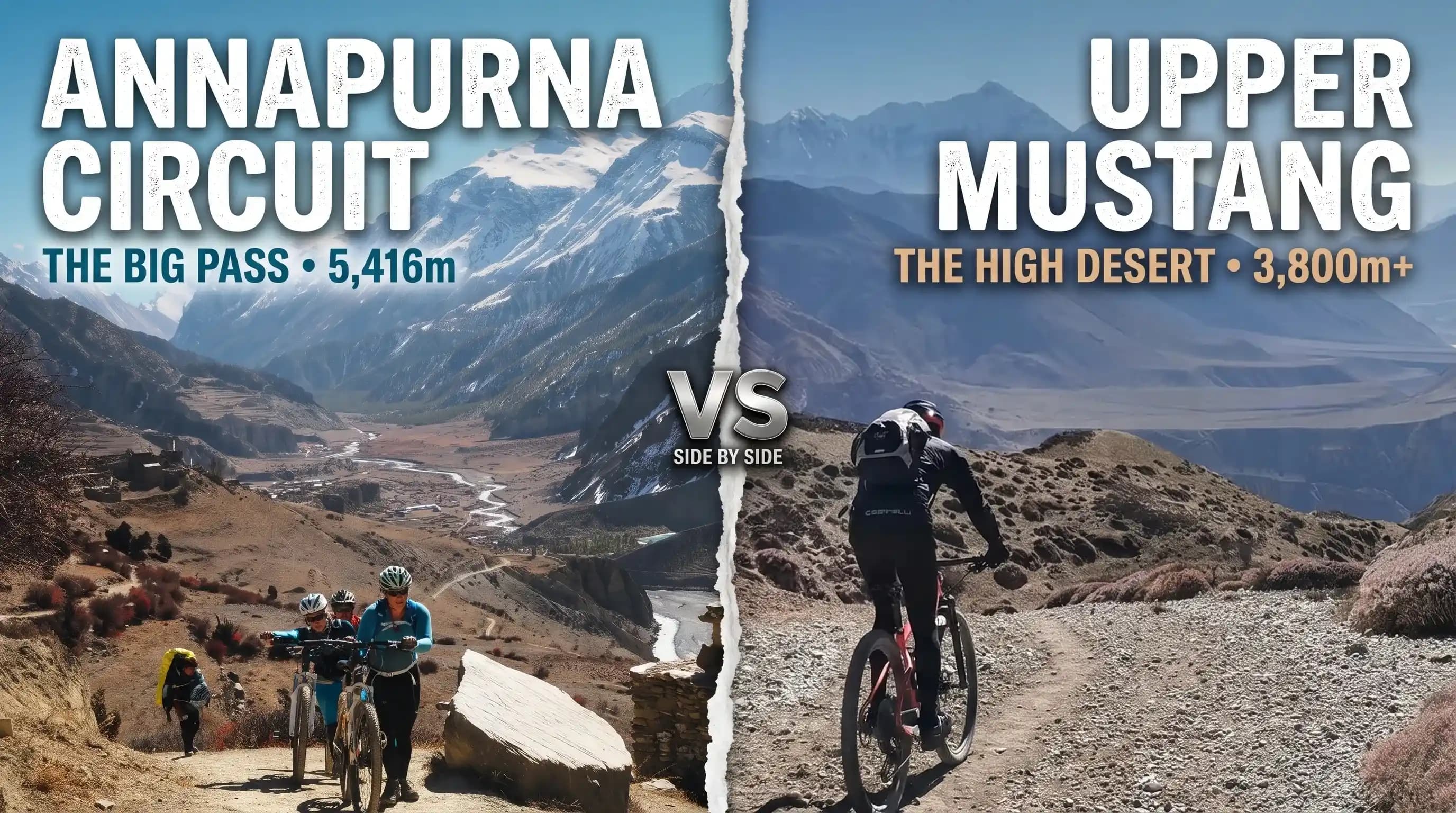
No more than many big mountain rides, if it's done with a slow ascent and in the right season. Its real dangers are altitude, cold, and storms on Thorong La, and jeep traffic on the road sections. The worst disaster on the route, the October 2014 blizzard, came from a cyclone that reached the pass. On a bike, the extra risks are gaining height too fast and long, tiring descents, which is why our itinerary keeps the high stages short and includes a rest day at Manang. If you're still choosing between the two high routes, our comparison of Annapurna Circuit vs Upper Mustang by mountain bike shows how the risks differ.
How many people die on the Annapurna Circuit each year?
There's no reliable annual count, so be wary of any figure you see quoted. The numbers that circulate online are often the death rate for climbing Annapurna I, an 8,000-metre peak, which has nothing to do with the Circuit. Deaths on the Circuit are rare, and most involve altitude illness, falls on foot trails, or being caught by severe weather high up.
Is mountain biking in Nepal OK for beginners?
Yes, if you start in the right place. Pokhara has easy, low-altitude rides that suit new riders, and our day tours are graded so you can pick a gentle one. An e-MTB takes much of the effort out of the climb, and our traditional vs e-MTB comparison helps you decide. Leave the high expeditions until you've done a few multi-day rides at home.
Do I need a guide to ride safely in Nepal?
In many places, it's the law. Since 1 April 2023, Nepal Tourism Board rules have required foreign trekkers and cyclists in national parks and conservation areas to have a licensed guide and a TIMS card. Restricted areas such as Upper Mustang need a permit arranged through an agency, with a licensed guide. Around Pokhara and the Kathmandu Valley, you can ride on your own. Our guide to guided and self-guided riding explains the rules route by route.
Is Pokhara safe?
Pokhara is a relaxed lake town at about 800 m (2,600 ft), with no altitude effect and good medical care, and it's our home base. Riders who want a step up from the beginner ride can try the village trails of our Kristi day tour.
Is Nepal safe for women and solo riders?
Yes. Serious crime against visitors is rare, and many of our riders are women. Any of our tours can run privately for a solo rider, on their own dates. Since March 2026, solo travellers can also get restricted-area permits, provided they travel with a licensed guide through an agency. The usual travel sense applies in the cities, especially at night.
What happens if I crash far from a road?
Your guide gives first aid, checks the injury, and decides how to move you. For minor injuries, that can mean walking or riding gently to the nearest village or road. For anything serious, our office arranges a jeep from the nearest road head or a helicopter through your insurer. The most common serious riding injury anywhere is a broken collarbone, and it usually ends the riding part of a trip, so make sure your policy covers an early flight home.
Does travel insurance cover mountain biking in Nepal?
Not automatically. Many standard policies exclude mountain biking, or cap altitude at 3,000 m or 4,000 m. Look for a policy that names mountain biking, covers the highest point of your route, and includes helicopter evacuation. Our mountain bike travel insurance guide shows what to check, with a ready-made email to send your insurer.