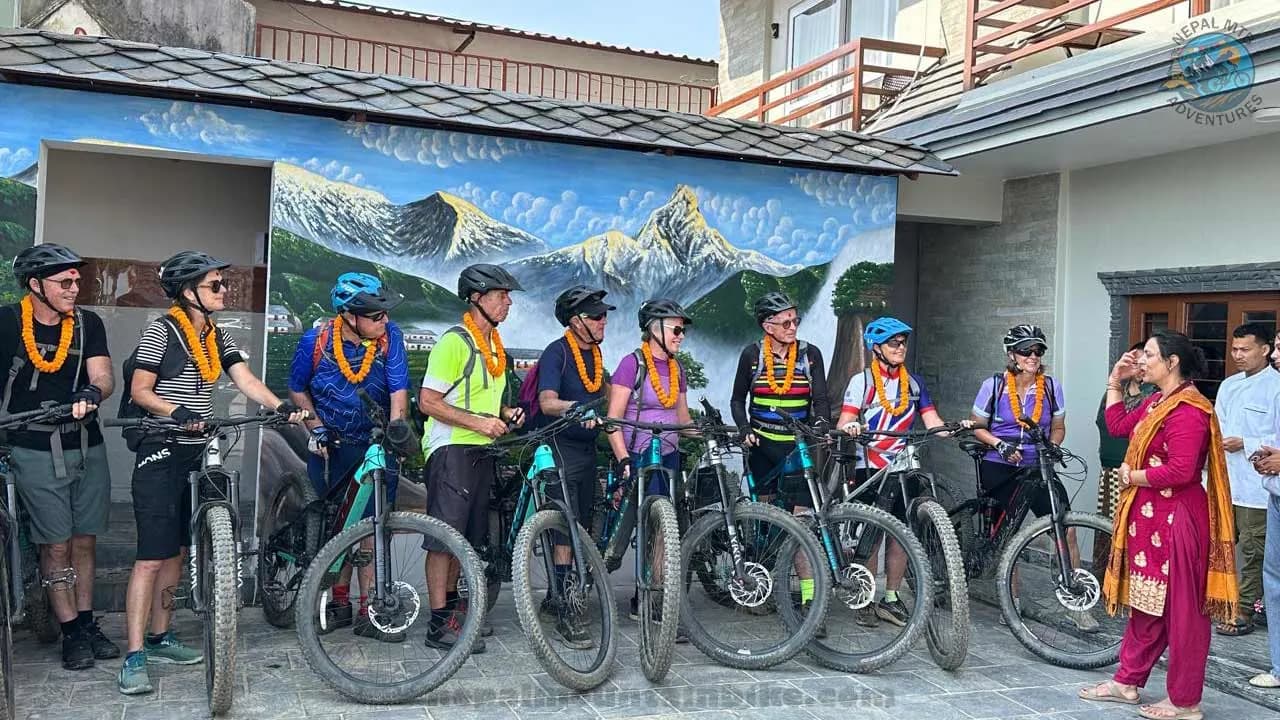



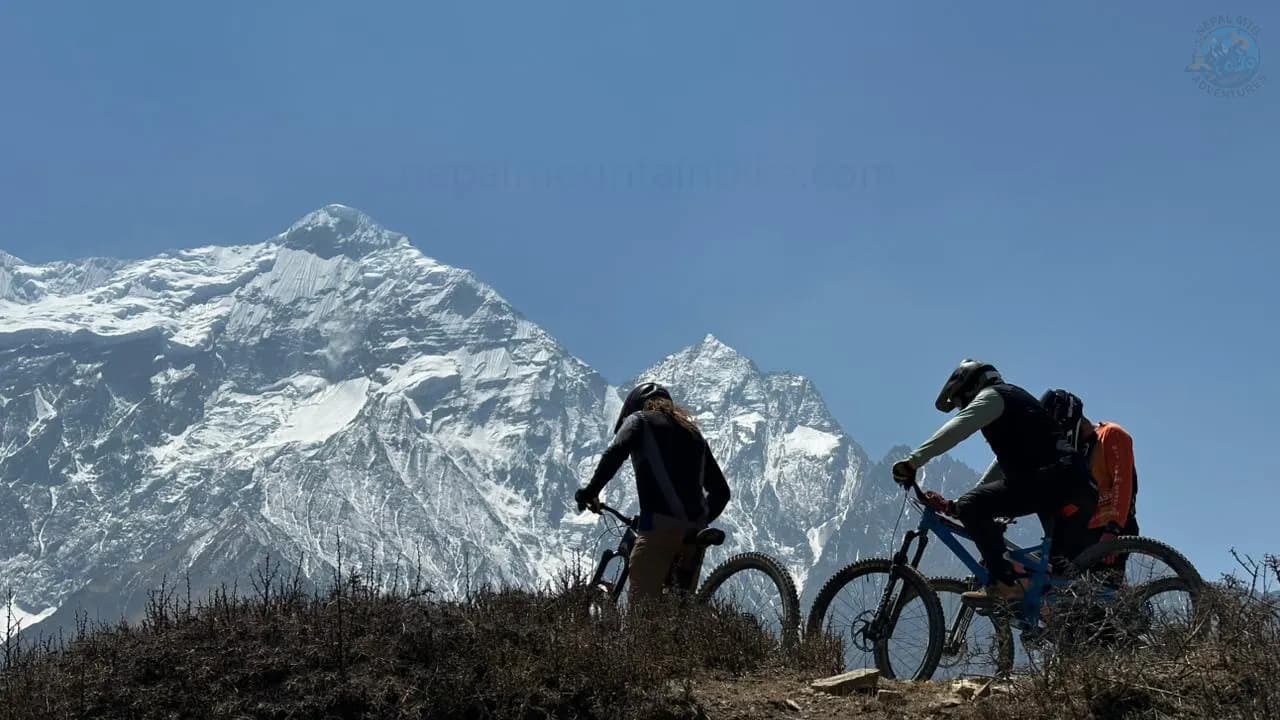
You've ridden Moab, or Bend, or Pisgah, and somebody told you the Himalayas are next. They were right.
The problem is that almost everything written about riding here is aimed at a general tourist and stops at breathtaking scenery. You want vertical, rideability, and surface, and you want it in feet. You want to know what fits in the vacation days you actually get, how thin the air is compared to Colorado, and whether your legs are ready.
That's what this is. Written by a Nepali company that's guided these routes since 2004.
Where you actually ride in the Himalayas
The Himalayas run about 1,500 miles, and Nepal sits in the middle of the range. Eight of the world's fourteen peaks over 26,000 ft are here, including Everest, Annapurna, and Dhaulagiri.
What matters more for you: this is where the riding is. Not a built trail, but a thousand-year-old network of trade routes and village paths, with teahouses along the way so you're not hauling camp, and a guiding industry built over decades.
You're not picking between mountains. You're picking between six different kinds of riding inside one country.
Region | Elevation | The riding | Days |
Annapurna Circuit | 2,600 to 17,769 ft | The big one. Forest to high desert, over Thorong La. Long alpine days and the descent everybody comes for. | 12 to 15 |
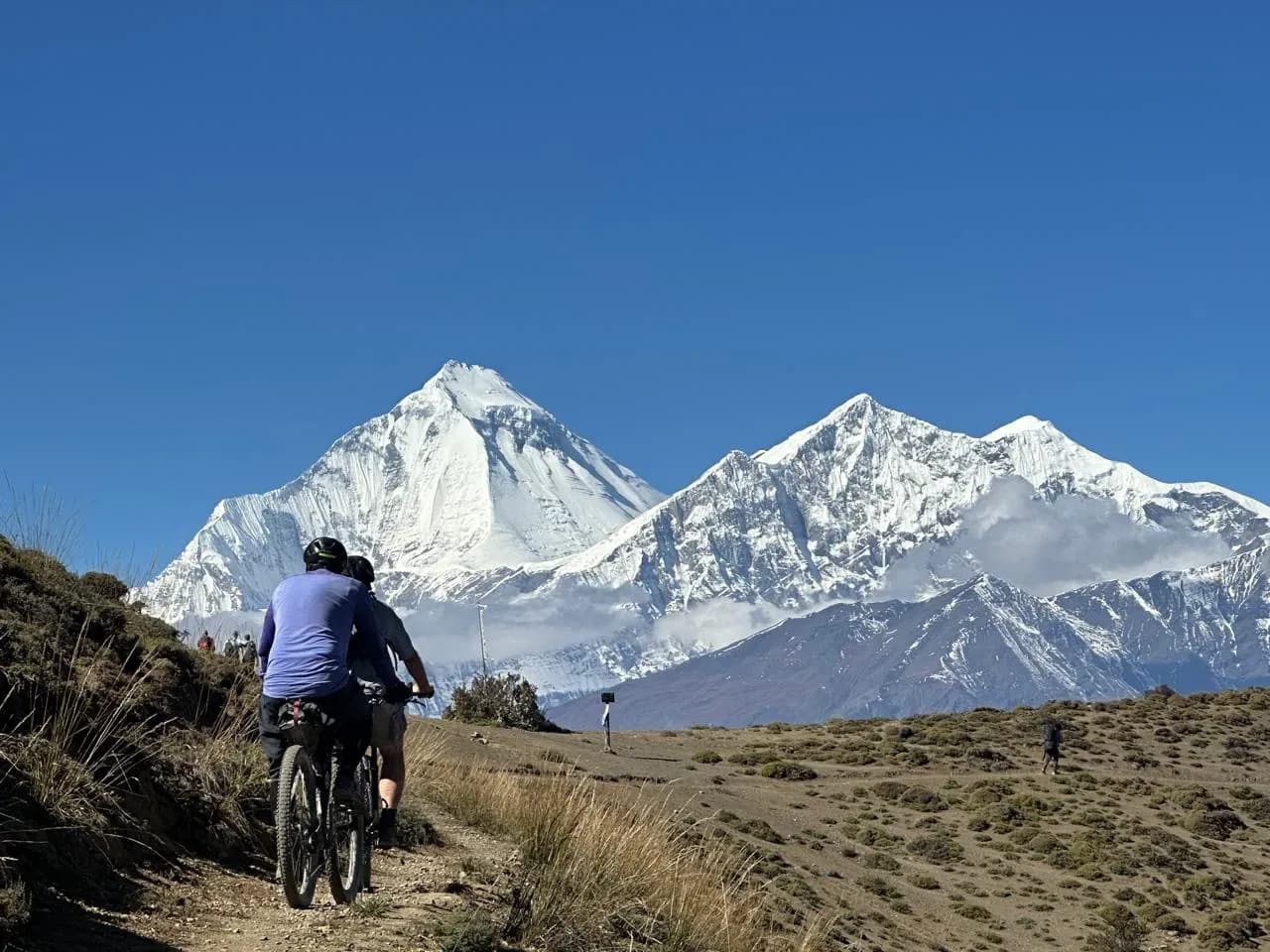
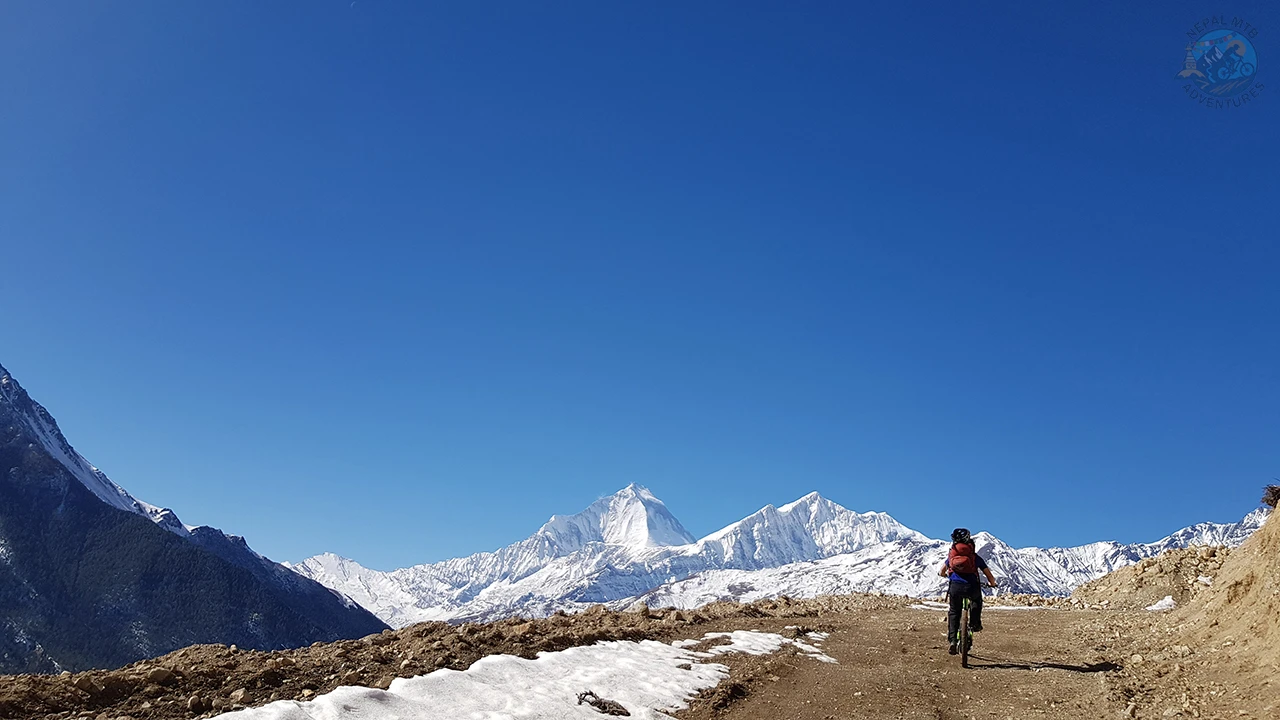
Lower Mustang | 8,000 to 12,500 ft | High desert in the Kali Gandaki. Muktinath, Marpha, Dhaulagiri, and Nilgiri overhead. No permit headaches. | 5 to 7 |
Upper Mustang | 9,000 to 14,000 ft | The restricted kingdom north of the Annapurnas. Red cliffs, cave monasteries, and Lo Manthang. Permit arranged ahead. | 12 to 14 |
Everest region, Pikey Peak | 6,500 to 13,300 ft | Sherpa villages, rhododendron forest, yak pasture and Everest views without the crowds. Bikes are banned inside Sagarmatha National Park, so Pikey sits outside it. | 7 to 9 |
The mid-hills | 2,000 to 8,000 ft | Kathmandu to Pokhara across farmland and ridge villages, with Himalayan views on the skyline. A real point-to-point ride. | 6 to 8 |
Pokhara valley | 2,600 to 5,200 ft | Day rides from Lakeside, from easy loops to demanding ridge rides and shuttled gravity. Where almost everybody starts. | 1 |
Two things separate these routes: altitude and how many days you can take off. For an American rider, the second one usually decides the first.
What actually fits in American vacation time
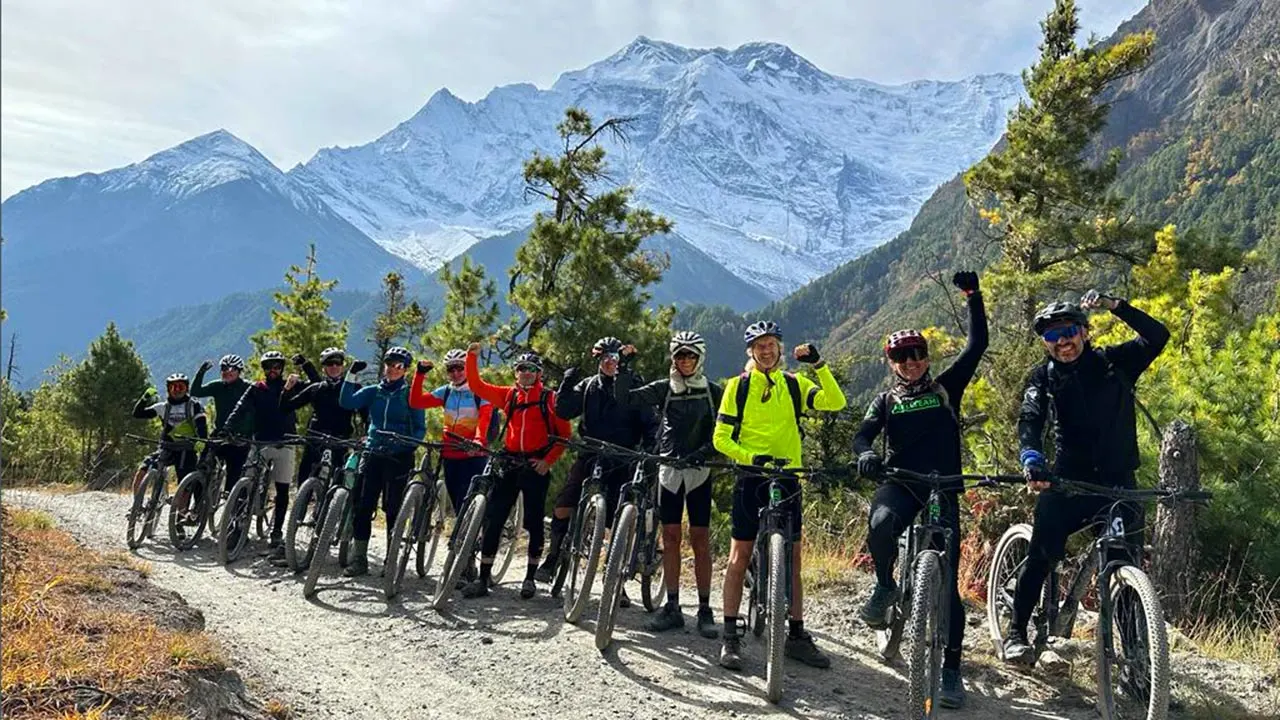
Almost every guide to Himalayan riding online is written for a European or an Australian with four to six weeks of statutory leave. Twenty-five OECD countries require at least twenty paid vacation days a year.
So the first question isn't "which trip is best." It's what fits for American riders.
Getting here and back eats about four days. No nonstop flights, a nine- to thirteen-hour time change depending on your coast, and you want a buffer day at each end so a delayed bag doesn't cost you a riding day.
Everything below is what's left after those four days.
Days off | Days riding | What's realistic |
7 to 8 | 3 to 4 | Pokhara day rides. Fly in, ride from Lakeside, and fly home. |
10 | 5 to 6 | Lower Mustang. The best short Himalayan trip there is. |
12 to 14 | 7 to 9 | Kathmandu to Pokhara, or Lower Mustang with extra Pokhara riding days. |
18 to 21 | 12 to 15 | The Annapurna Circuit or Upper Mustang. |
The altitude, in feet
This is what American riders consistently underestimate, and it lands better in units you already think in.
Location | Elevation |
Moab, typical riding | 4,000 to 8,000 ft |
Bend, Oregon | ~3,600 ft |
Colorado high alpine singletrack | 10,000 to 12,000 ft |
Trail Ridge Road, highest continuous paved road in the US | 12,183 ft |
Pikes Peak summit | 14,115 ft |
Mount Evans Road, highest paved road in North America | 14,130 ft |
Thorong La, Annapurna Circuit | 17,769 ft (5,416 m) |
Thorong La is about 3,600 ft higher than any paved road on the continent. If you've driven up Pikes Peak and felt the air go thin, the pass is another two-thirds of a mile above that. And you're riding and pushing a bike over it instead of sitting in a car.
Fitness doesn't protect you from altitude. Time does. Your body adapts by making more red blood cells. That starts within a day or two but takes a couple of weeks to amount to much. It's why our itineraries have rest days in them. They're not padding. They're the only thing that works.
The descents, against numbers you know
Americans measure a ride in vertical feet, so here's Nepal against your benchmarks.
Descent | Vertical | Distance | How you get up |
Whistler Bike Park, top to valley | ~5,000 ft | Lift served | Chairlift |
Downieville Downhill, classic route | 5,000 ft | 15 miles | Shuttle |
Whole Enchilada, Moab | 7,000+ ft | 26 miles | Shuttle |
Thorong La to Muktinath | 5,200 ft | 5.6 miles | You push it up |
Thorong La drops as much as the Downieville classic in a third of the distance. It's steeper, it's at 17,769 ft, and there's no shuttle.
You earn every foot
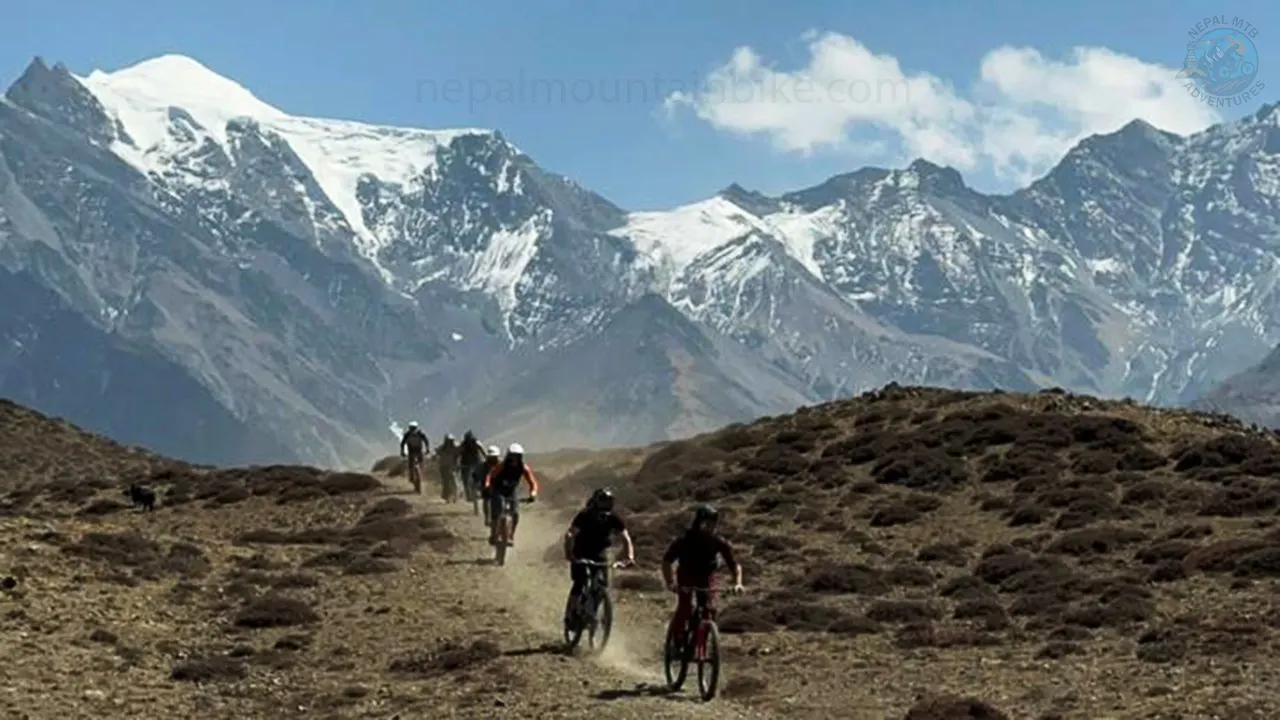
This is what separates the Himalayas from every big-descent trip in North America.
No lifts. Very little shuttling outside the Pokhara day rides. The climb to Thorong La includes about three miles of hike-a-bike that takes three to six hours, pushing and carrying at altitude, before you get the descent.
If your riding is lift-served or shuttle-served, that's the real adjustment. Not the technical difficulty. The fact that you pay for every descent with your legs and your lungs.
How much you actually ride
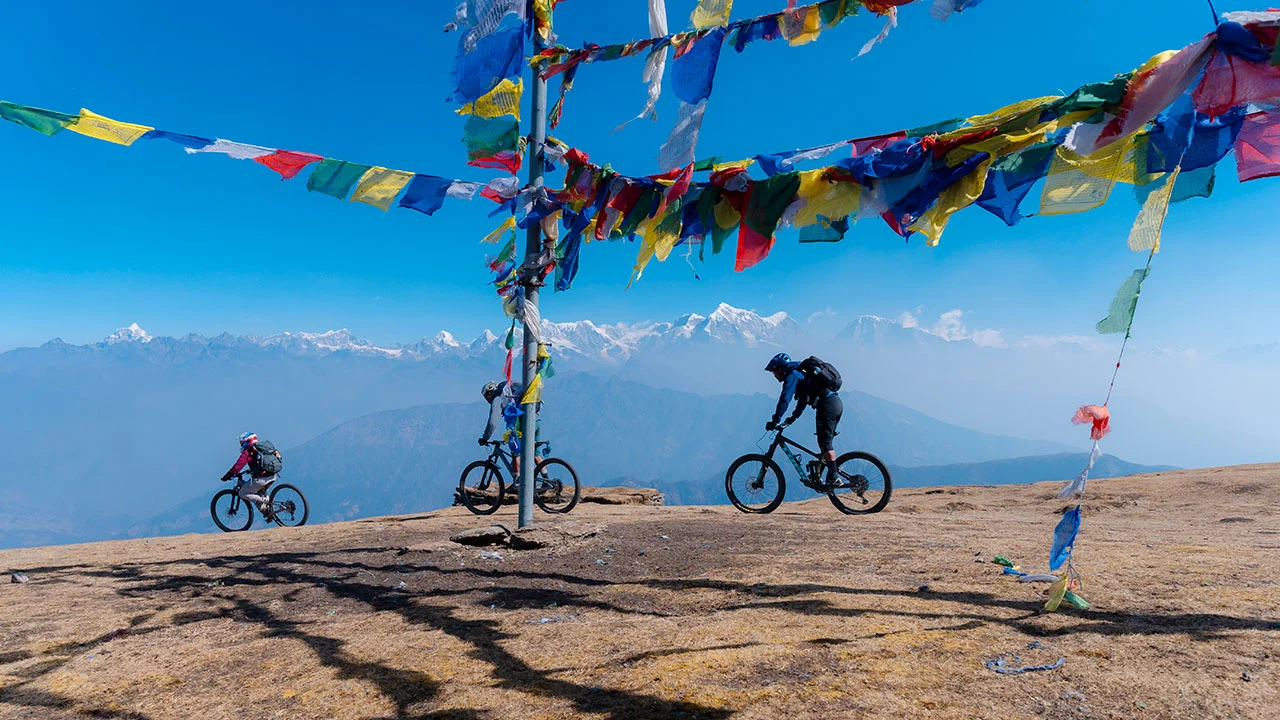
Straight numbers, because "adventure" often turns out to mean "you walked a lot."
Rideable | |
Annapurna Circuit overall | About 85% |
The climb to Thorong La | About 70% |
The descent off Thorong La | About 95% |
What the trails are actually like
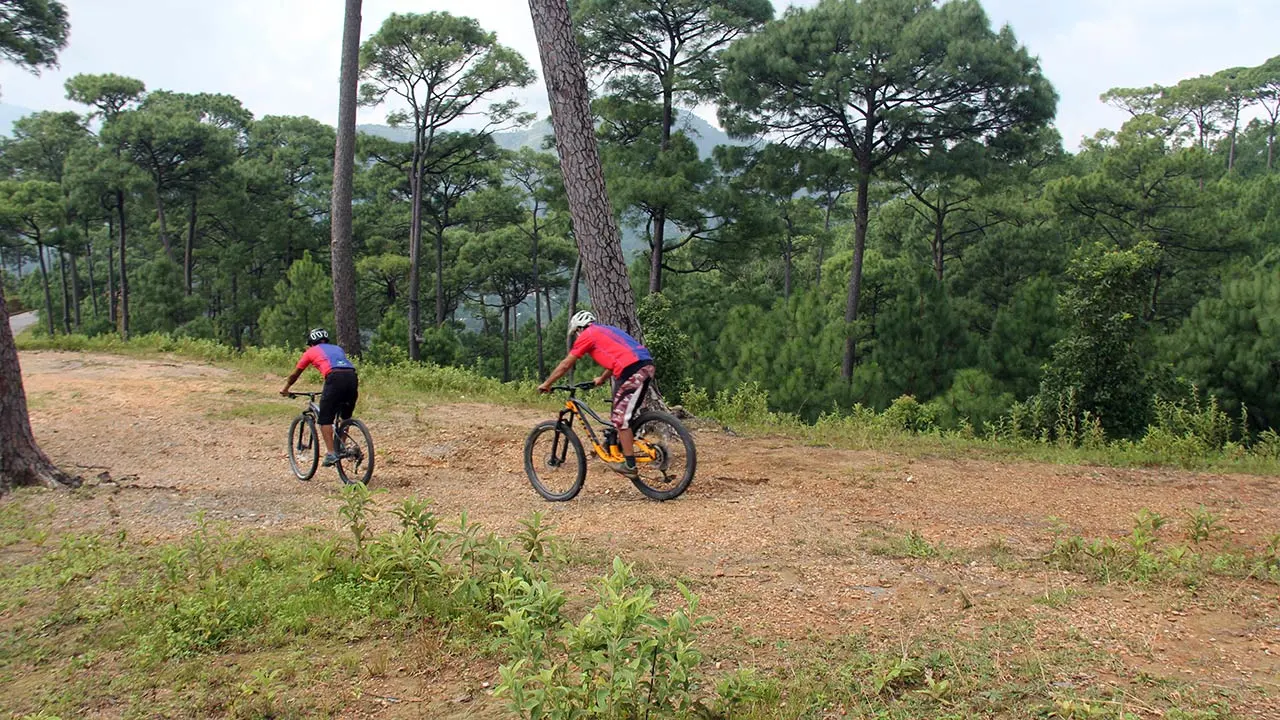
There's almost no purpose-built trail in Nepal. What's here instead is a thousand-year-old network of footpaths, trade routes, and village connections that people still walk every day.
That means loose surfaces, stone steps, off-camber traverses, and the occasional stretch that was clearly cut for a mule. It also means the trail goes somewhere real, and has for centuries.
Ride Moab? Upper and Lower Mustang will feel familiar. High desert, red rock, relentless wind, big open country. The difference is the village in the canyon that's been there six hundred years.
Ride Colorado or the Wasatch? The Annapurna Circuit is the natural step up. Long alpine days and thin air, only longer, higher, and rougher.
Ride Pisgah or anywhere in the Southeast? The forested descents around Pokhara will suit you. Roots, stone, steep, technical. The difference is it goes on for ninety minutes instead of fifteen.
Mostly ride bike parks? Reset your expectations now. Nothing here is graded, bermed, or sanctioned. Riders who show up expecting a flow trail are the ones who have a bad first day.
For how we grade what you'll be riding, see our guide to mountain bike trail grading in Nepal.
Why you won't find these trails on Trailforks
Your first instinct is to look the route up on Trailforks or MTB Project, check the grade, read the comments, and decide for yourself. That's the right instinct, and it's going to come up mostly empty here.
Why. Trailforks and MTB Project are crowd-built by riders in places with organized trail associations, trail days, and signage. Nepal has none of that, because these aren't mountain bike trails. They're footpaths that villages have used for centuries and still use to get to school. Nobody built them for bikes, so nobody mapped them for bikes. Pokhara has partial coverage, including the Peace Pagoda descent, but the high routes are largely unmapped.
So don't read thin coverage as a red flag. It's not a sign the riding is bad. It's a sign the riding is old.
What to do instead. Get the same information directly, and ask for it before you book. Any operator worth your money will hand it over:
Ask for the GPX. Load it into Strava, Gaia, or Ride with GPS and look at the elevation profile yourself. This is the single most useful thing you can ask for, and an operator who won't send it is telling you something.
Ask for POV footage of the descent you care about most. Video beats any paragraph on a website, including this one.
Ask for a day-by-day with numbers: miles, vertical, surface, and how many hours in the saddle. Not "a scenic ride through beautiful countryside."
Ask what happens on the hardest section, and whether people walk it. If the answer is "nobody ever walks," find another operator.
Read the reviews on the platforms you already trust, not the testimonials on the company's own page.
We'd rather you check. Every claim on this page is the kind of thing you can verify, and riders who arrive knowing exactly what they signed up for have better trips.
Bring your bike from the United States, or rent one here in Nepal
Most American riders rent. It's not a compromise. It's usually the better call.
Flying with your own
Airlines into Kathmandu handle bikes as oversized sports equipment, and there's a fee each way. Three things to know:
Pre-purchase the allowance online. Every major carrier prices a booked bike allowance well under what they'll charge at the counter.
Give advance notice. A growing number of airlines now require it, and showing up unannounced with a bike bag is how bikes get left behind.
Watch your connection. Your bike changes planes with you somewhere in the Gulf or Europe. A tight connection is the number one reason a bike shows up a day after its owner.
Then figure out what you're doing with an empty bike bag for two weeks while you're up in the mountains.
Renting from us
You get a full-suspension bike sized to you, serviced between rentals, with a mechanic on the trip carrying the spares that fit it. That last part matters a lot more at 14,000 ft than it does at your local trailhead. Our rental fleet is listed bike by bike with full specs, so you can see exactly what you'd be on before you commit.
What to bring either way
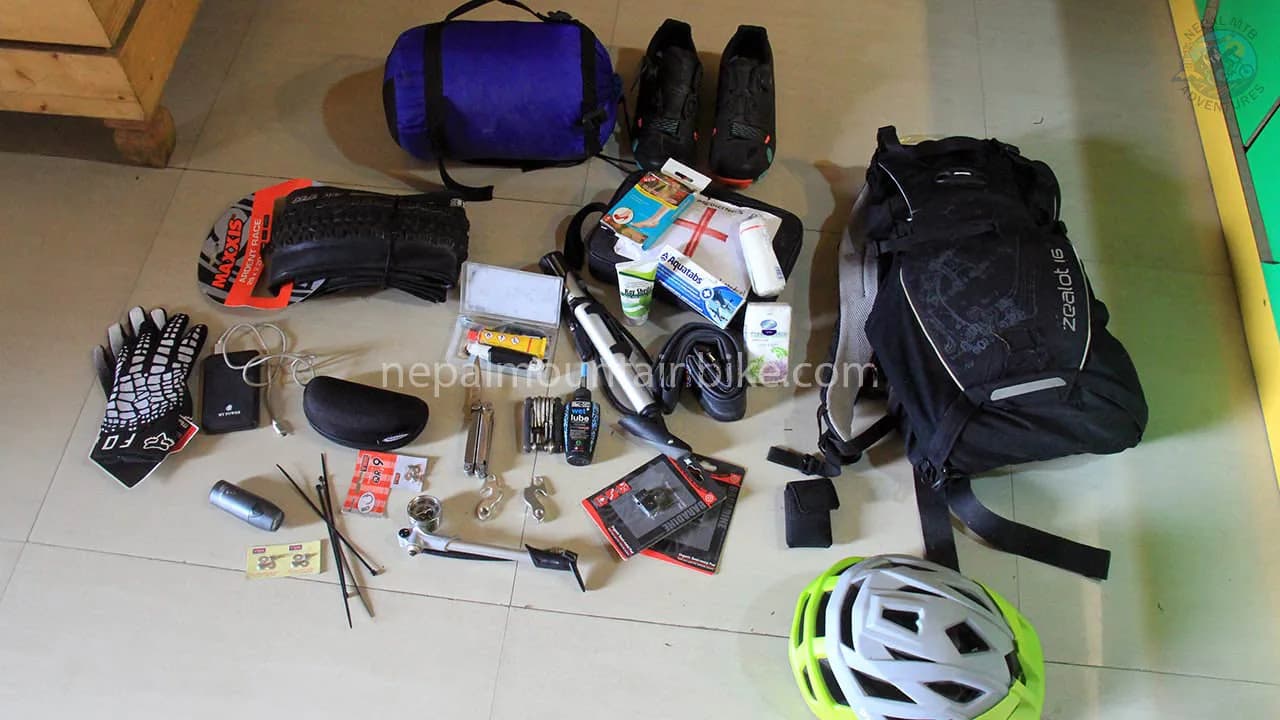
Bring your own pedals, shoes, shorts, chamois cream, and your helmet if you're particular about it. These are personal, they pack small, and the fit is what makes a long day tolerable. Bring the bike itself only if you genuinely can't ride anything else.
Also worth packing from home, because it's harder to find here: a spare derailleur hanger for your own bike, any prescription meds, and sunscreen at an SPF you actually trust. The sun at 14,000 ft is not the sun you're used to.
How to train for it
Most American riders train the wrong thing. They build fitness, which they mostly already have, and skip the two things that are going to hurt.
Know what altitude does to your numbers
If you ride with power, internalize this. Riders lose roughly 5 to 10 percent of power at 5,000 ft and 8 to 13 percent at 7,000 ft. Thorong La is 17,769 ft. You're way off the end of that curve, and no amount of training changes it. Only time at altitude does.
Train back-to-back days, not intervals
The Annapurna Circuit is five to seven hours in the saddle, twelve days running. Almost nobody trains for that.
A rider who can put down big numbers for two hours and then needs three days to recover is worse prepared than a slower rider who gets out every weekend. In the eight weeks before you come, prioritize back-to-back long days. Four hours Saturday plus four hours Sunday beats one brutal Tuesday.
Practice pushing a bike uphill
Nobody does this, and everybody wishes they had.
There's about three miles of hike-a-bike on the way to Thorong La, and it takes three to six hours. Pushing and shouldering a bike up a steep, loose slope uses muscles riding doesn't, and doing it for the first time at 17,000 ft is a bad plan.
Find a steep fire road or hiking trail near home and push your bike up it a few times. It's unglamorous, and it's the most route-specific thing you can do.
Go ride something unbuilt
If your local trails are machine-built flow, spend your last few weeks on the roughest, loosest, least maintained trail you can find. Recent time on that kind of ground is worth more than another interval block.
What can go wrong, and what we do about it
Altitude illness. The most likely thing to derail your trip, and it doesn't care how fit you are. This is why the acclimatization days exist and why guides watch how people are doing rather than just how fast they're riding. If somebody needs to go down, they go down. That decision gets made early, not heroically.
Weather can close a pass. Thorong La can be shut by snow, especially at the shoulders of the season. Any operator who guarantees you'll cross it is guessing. Routes get adjusted, and the good version of that is a guide who already knows what plan B looks like.
Mechanicals. You're a long way from a bike shop. This is the practical argument for renting: the mechanic on the trip carries the spares that fit the bike you're on. On your own bike, bring a spare derailleur hanger, because nobody in Nepal stocks one for your frame.
Crashes. These are village paths shared with people, livestock, and mule trains, and the surfaces are loose. Riding within yourself matters more here than it does at home, and walking a section is normal. Nobody rides everything.
Pick your trip by the days you have
3 to 4 riding days. Pokhara day rides out of Lakeside. Everything from easy lakeside loops to hard self-powered ridge days, plus shuttled gravity if you want descents without the climbing. Also where most riders warm up before a longer route.
5 to 7 riding days. Lower Mustang is the best short Himalayan option there is. Kali Gandaki Gorge, Muktinath, apple orchards at Marpha, Dhaulagiri and Nilgiri overhead, no permit complications, altitude kept sane. Two weeks off total? This is your trip.
6 to 8 riding days. Kathmandu to Pokhara crosses the mid-hills between the two cities, 125 to 155 miles of terraced farmland and ridge villages with the Himalaya on the skyline. Lower, warmer, and a genuine point-to-point.
7 to 9 riding days. Pikey Peak puts you in the Everest region without the Everest crowds, through Sherpa villages and yak pasture.
12 to 15 riding days. The Annapurna Circuit is the one you came for. About 150 miles over Thorong La at 17,769 ft, from subtropical forest to high desert in two weeks. Budget close to three weeks once travel is counted.
12 to 14 riding days. Upper Mustang, the restricted kingdom north of the Annapurnas. Red cliffs, cave monasteries, walled Lo Manthang. The restricted-area permit has to be arranged in advance through a licensed Nepali agency, so it's not a late decision.
Traveling with somebody who isn't riding every day. Pokhara to Chitwan drops out of the hills into the jungle and finishes with a safari in Chitwan National Park.
Don't want to grind up every climb? Most of these run on e-MTBs. It's also the cleanest way to bring a partner who rides less than you do and have both of you enjoy the trip.
When to come
Two good windows and one useful exception.
Fall, late September through November. Clearest and most popular. Book early, because October is peak month across the whole country and the good operators fill up.
Spring, March through May. Warmer, hazier, rhododendron across the hillsides. Less crowded than fall.
Summer, June through September, is monsoon almost everywhere, and the main trails are soaked. The exception is Mustang, which sits in the Himalayan rain shadow and stays dry and rideable straight through. If July and August are your only window, Mustang is the answer, and it's a good one rather than a consolation prize.
Winter, December through February. Cold on the high passes, and Thorong La can be closed by snow. But the lower valleys around Pokhara and Kathmandu ride well, and the mountain views are often the sharpest of the year.
Our season guide breaks it down region by region.
What American riders say
We would rather you checked than took our word for it. These are pulled from TripAdvisor and Trustpilot, and they are the ones that answer the questions this page raises.
"I have ridden all over the US, and it was one of my favorite places I've ever ridden."
→ "Did the enduro ride, it was so fun. Great guides and easy to work with owner. They hooked it up, trails were legit enduro tracks. I highly recommend it if you are a mtn biker."
Andrew E., enduro day ride, Pokhara. TripAdvisor, May 2026
On a hard Pokhara day ride, hike-a-bike included:
→ "I had just come off a two week medical volunteer trek, and am very fit, and wanted a challenging climb. I sure got it... My guide was patient and we had water and snack and hike-a-bike breaks whenever wanted or needed... As we neared the summit after about 3 and a half hours of climbing, it started to pour rain... Came back down, and we took off down through challenging exhilarating ziptrack, only got chased once by a spooked ox."
Till M., Peace Pagoda day ride, Pokhara. TripAdvisor, June 2019
On what a Pokhara day ride is actually like:
→ "It was challenging. There was a serious amount of climbing on loose rock, and some awesome downhill sections. We went through the forest at the end, through some sweet Nepalese single track. We didn't see any other mountain bikers the entire time."
emvee0919, Fewa Lake day ride. TripAdvisor, March 2016
Read the rest yourself. We have no control over what people write on these:
Tell us how many days you can actually take, including travel, and how much you ride at home. We'll tell you what fits. If the honest answer is that you should wait for a longer window instead of rushing a route that deserves better, we'll tell you that too.
Want the GPX and a look at the elevation profile before you commit? Ask. We'd rather you knew.
We've run these trails since 2004. The bikes are ours, the guides are on our staff, and we ride these routes ourselves.
Get in touch and tell us your dates.
Frequently asked questions
Where in the Himalayas should an American rider go first?
Depends entirely on how many days you have. With a week, ride Pokhara. With ten days, Lower Mustang gives you real high-desert riding in the Kali Gandaki without the extreme altitude or the permit complications. With two weeks, add the Kathmandu to Pokhara traverse. The Annapurna Circuit, the route most riders come for, needs closer to three weeks once travel is counted.
How does Nepal's altitude compare to Colorado?
Much higher. Colorado's high alpine singletrack sits around 10,000 to 12,000 ft, and Mount Evans Road, the highest paved road in North America, tops out at 14,130 ft. Thorong La is 17,769 ft, roughly 3,600 ft above that, and you ride and push a bike over it. Riding above 10,000 ft at home genuinely helps, but the acclimatization schedule matters more than fitness.
How much vertical do you actually descend?
The Thorong La descent alone is about 5,200 ft in 5.6 miles, comparable to the classic Downieville Downhill in a third of the distance. Over a full Annapurna Circuit, you stack several days like that, plus a 5,200 ft drop into the Kali Gandaki. The difference from a shuttle day at home is you climb and push for every foot of it.
Is there any lift or shuttle access in Nepal?
Essentially none outside the Pokhara day rides, where we use jeeps and, on one gravity tour, the Annapurna cable car. On the multi-day routes, you earn the descents. The climb to Thorong La includes about three miles of hike-a-bike, taking three to six hours at altitude.
How much of the Annapurna Circuit can you actually ride?
About 85 percent overall. The climb to the pass is roughly 70 percent rideable and the descent off it around 95 percent. The pushing is concentrated in one morning rather than spread across the trip.
Why can't I find these trails on Trailforks or MTB Project?
Because they aren't mountain bike trails. They're centuries-old village footpaths and trade routes, and crowd-sourced trail apps get built by riders in places with trail associations and signage. Pokhara has partial coverage. The high routes are largely unmapped. Ask your operator for the GPX file and POV footage instead, load the GPX into Strava or Ride with GPS, and check the elevation profile yourself.
Should I bring my own bike or rent in Nepal?
Most American riders rent, and it's usually the better call. Flying a bike means an oversize fee each way, advance notice on most carriers, real risk of it arriving a day late off a tight connection, and an empty bike bag to store for two weeks. Renting gets you a serviced full-suspension bike sized to you, with a mechanic on the trip carrying spares that fit it. Bring your own pedals, shoes, shorts, and helmet.
Is riding here harder than riding at home?
The terrain is comparable to rugged American backcountry riding. What's different is the altitude and the duration. Days are long, back-to-back, and far higher than anything in the lower 48. Surfaces are rougher than built trails, because these are working village paths rather than purpose-cut singletrack.
How fit do I need to be?
Fit enough to ride five to seven hours a day, several days running, on rough ground. That's the real bar, and it's about durability rather than peak power. If you get out most weekends and can back up a long Saturday with a long Sunday, you're in the range. The higher routes ask more. The Pokhara day rides and Lower Mustang are the forgiving end of the scale.
Do I need a guide?
For the high routes, yes, and on some of them it's a legal requirement rather than a preference. Past the rules: these are working village paths with no signage, no cell coverage over the passes, and no bike shop when something breaks at 14,000 ft. A local guide is also the difference between riding through a village and being welcome in it.
Does my travel insurance cover mountain biking in Nepal?
Often not, and this catches people out constantly. Mountain biking is commonly excluded from standard policies without an adventure sports upgrade, and even adventure cover frequently caps at an altitude below the passes you'd be crossing. Check three things before you buy: that mountain biking is named in the policy, that the altitude limit sits above the highest point on your route, and that helicopter evacuation and repatriation are both included. Most US health plans don't cover you overseas, and Medicare doesn't travel at all.
When should an American plan to go?
Fall, late September through November, is clearest and most popular. Spring, March through May, is second, warmer and hazier. Summer is monsoon everywhere except Mustang, which sits in the rain shadow and keeps riding. Winter is cold on the high passes with Thorong La sometimes closed, but the lower valleys ride well, and views are often the sharpest all year. To stretch your PTO, Thanksgiving falls at the tail of fall and Memorial Day at the end of spring.